
This guide is a running price reference for aquarium plants sold in India — one place to check whether a listing is priced fairly, broken down by species, format and typical range. It’s built from typical market rates across Indian aquarium plant sellers, not any single store’s price list, and we revisit it periodically to keep the numbers current.
Quick answer: In India the same-looking aquarium plant can be listed anywhere from ₹50 to several thousand rupees — price is driven by format (bunched, potted or tissue culture), rarity and variegation, imported versus domestic stock, and size at sale. As a benchmark, easy Anubias varieties typically run ₹90–₹300 by size; anubias.in grades five of its Anubias from S (starter cutting, up to 5 leaves) through XL (mother plants of 20+ leaves) at ₹90–₹250. Judge listings by format and maturity, not the photo.
Popular plants right now
Grown in Surat (pre-order plants imported to order) · live-arrival guarantee with a 4-hour unboxing video · ₹99 shipping, free from ₹999 · free plant gift from ₹600
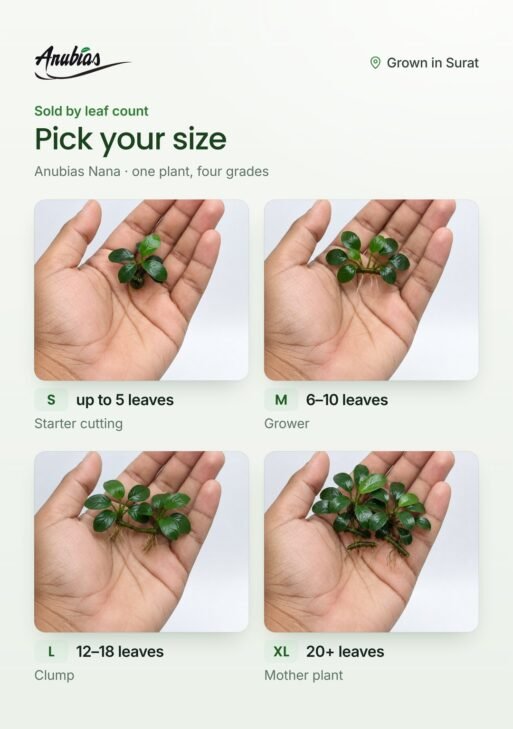
Price range: ₹90 through ₹250
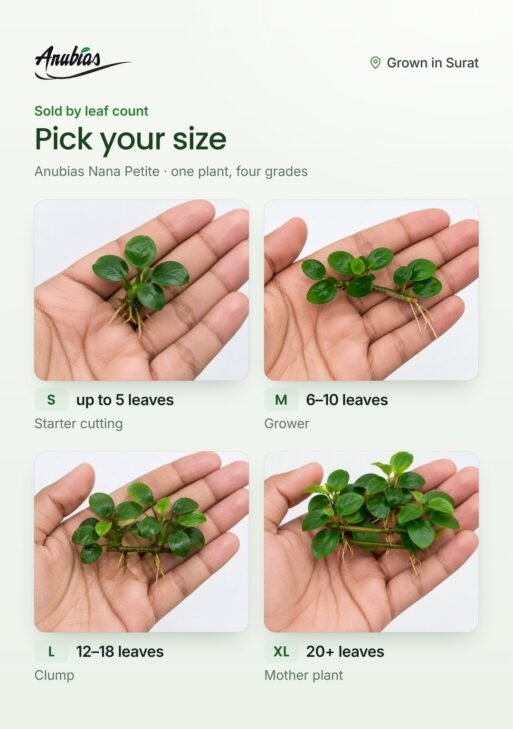
Price range: ₹90 through ₹250
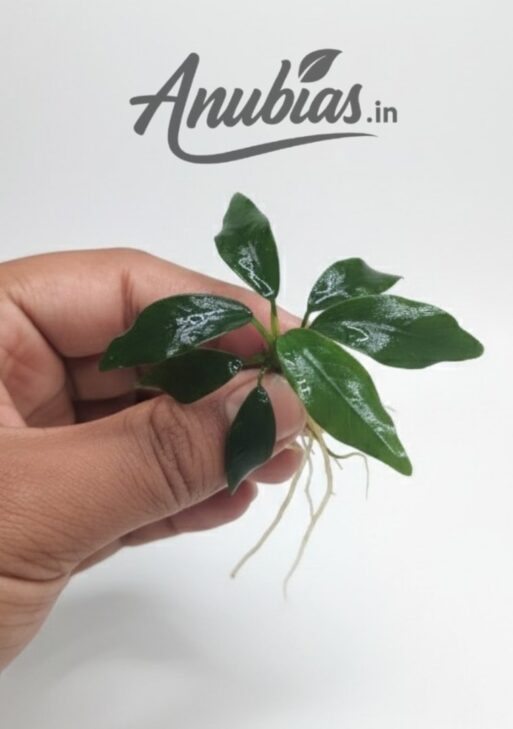
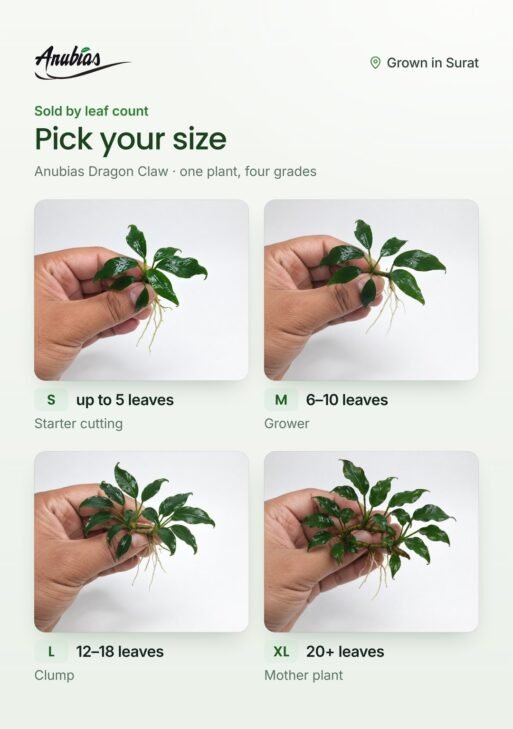
Price range: ₹90 through ₹190
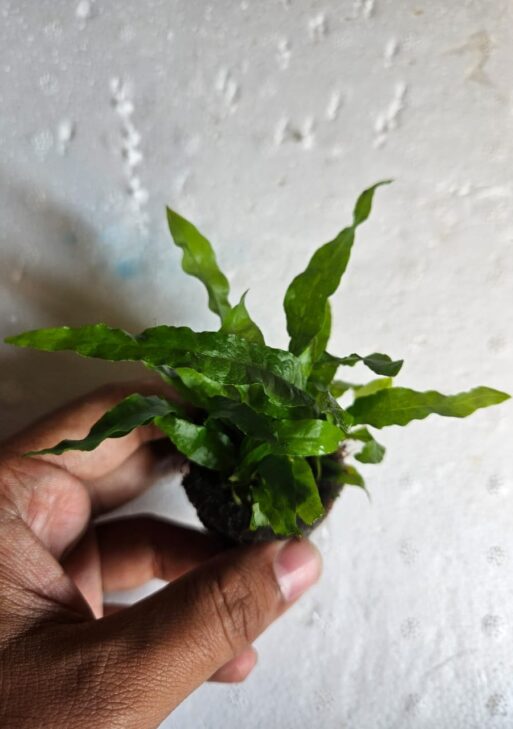
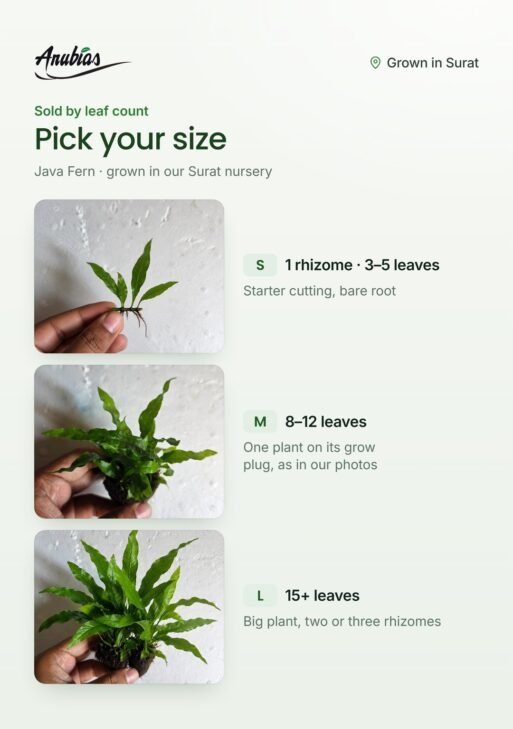
Price range: ₹90 through ₹250
Prices last checked against the Anubias.in store: 27 September 2026.
Why Aquarium Plant Prices Vary So Much
Search “aquarium plants price India” and you’ll find the same-looking plant listed anywhere from ₹50 to several thousand rupees. That spread isn’t random. Four things drive most of it: how the plant is grown and sold, how rare it is, whether it’s imported or domestic, and how big it was at the point of sale.
Format: Bunched, Potted or Tissue Culture
The same species reaches you in different physical forms, and format explains much of the price gap. Bunched stem plants — cuttings held with a lead strip or rubber band — are cheapest, since nurseries grow and cut them in volume with little handling per stem. Potted plants, the standard format for rhizome species like Anubias, Cryptocoryne and Java Fern, cost more since they’re grown to a more finished stage before sale. Tissue culture sits above both — plants cloned in a sterile lab cup rather than soil or pond water, meaning no snails, no algae, and true-to-name stock. We cover these three formats in more depth in a separate guide on this site; here, format is mainly a production-cost question, not a quality one.
Rarity and Variegation
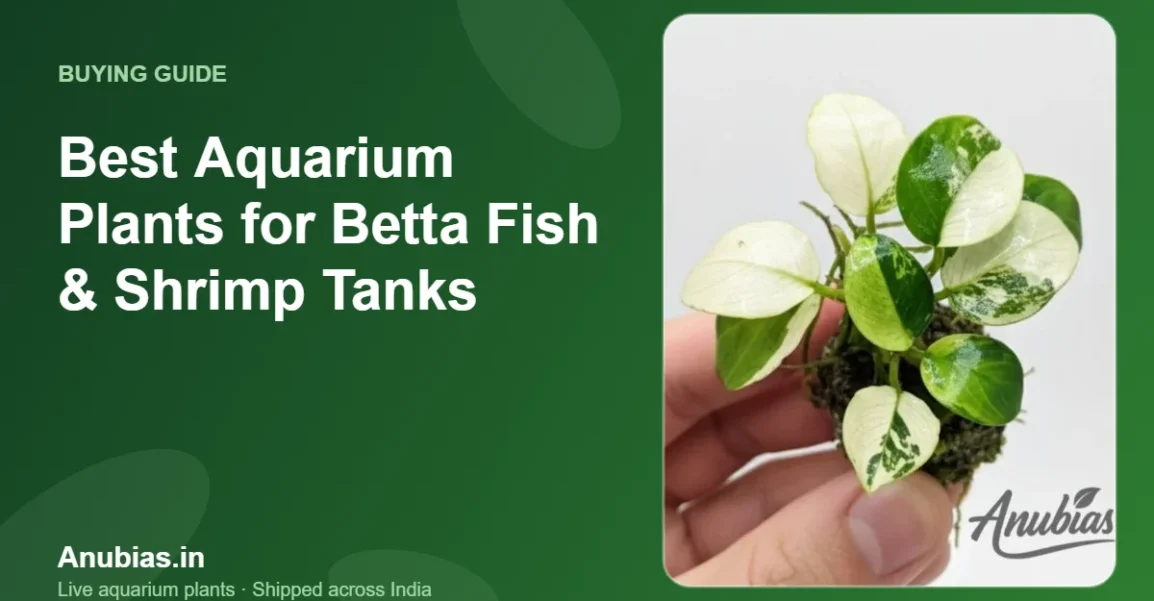
Species that grow fast and propagate easily stay cheap because supply keeps up with demand. Standard Anubias Nana, common wendtii-type Cryptocoryne and ordinary Java Fern fall into this bucket. Rare cultivars and variegated forms — plants with patches of white or pale tissue instead of solid green — are different: less chlorophyll means slower growth and a plant that’s genuinely harder to multiply. Supply stays thin no matter how popular the plant gets, and price follows.
Imported vs Domestically Grown
Many Bucephalandra cultivars and specialty Anubias forms sold in India were originally imported from Southeast Asian or European nurseries before Indian growers began propagating them locally. Freshly imported stock carries the cost of shipping, customs and in-transit losses, so it prices well above locally grown divisions of the same cultivar once domestic supply catches up — which is also why a cultivar can be pricey one year and noticeably cheaper the next.
Size and Maturity at Time of Sale
A single leaf on a tiny rhizome division and a mature clump with eight or ten leaves are technically the same plant, but not the same purchase. Bigger, established specimens spend more months on the nursery bench before they’re ready to sell, and that time is built into the price. Check whether a listing is a starter portion or a mature plant before assuming one seller is cheaper than another.
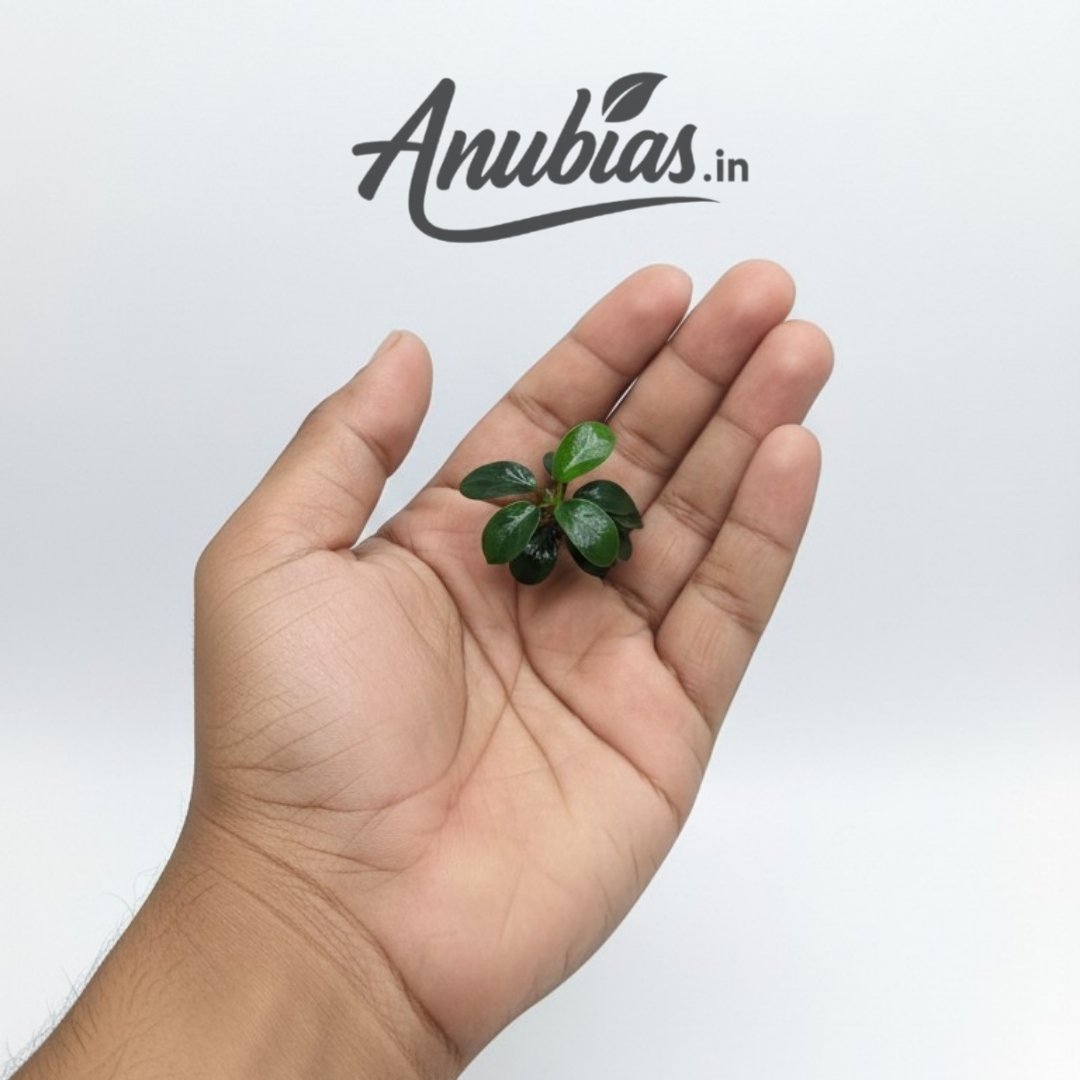
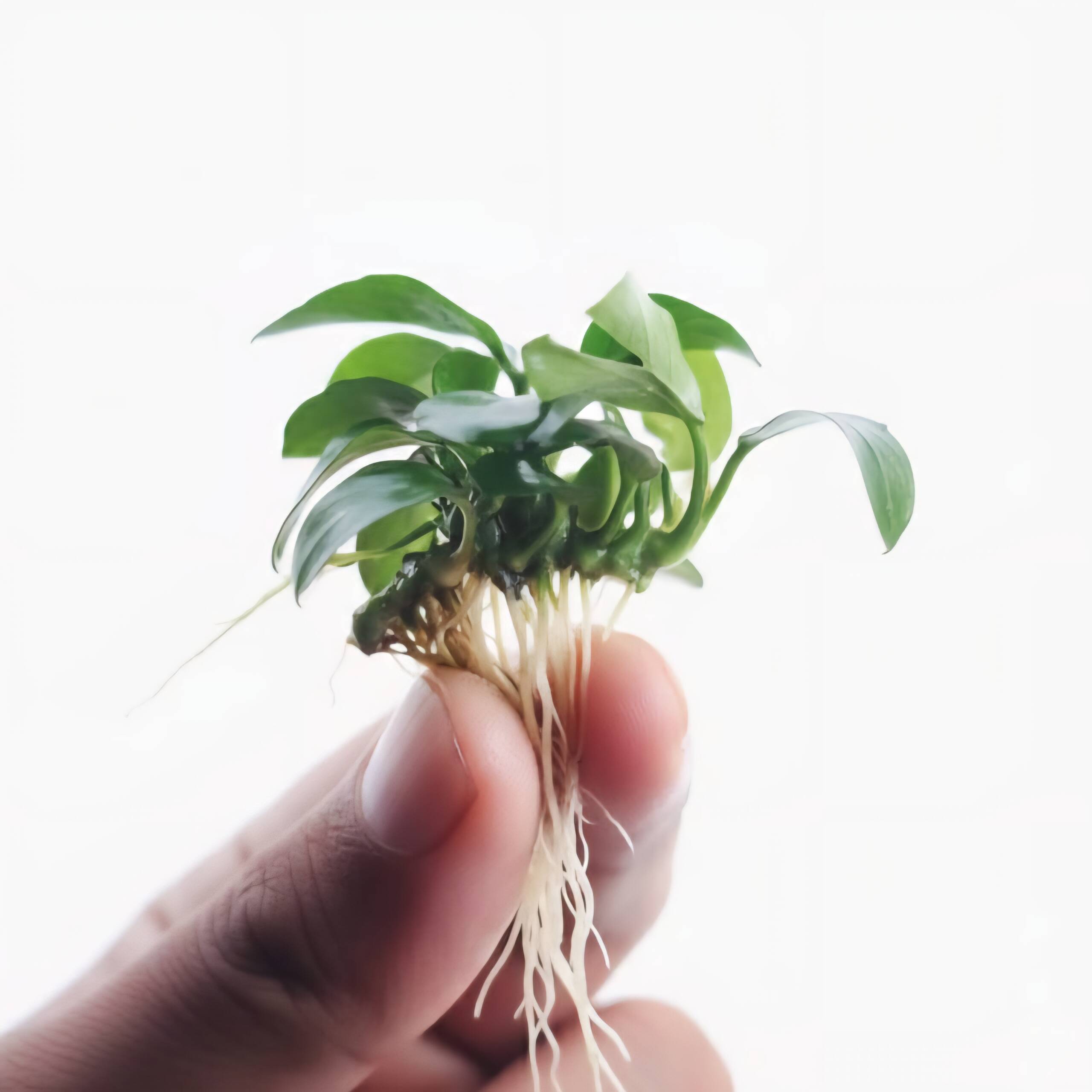
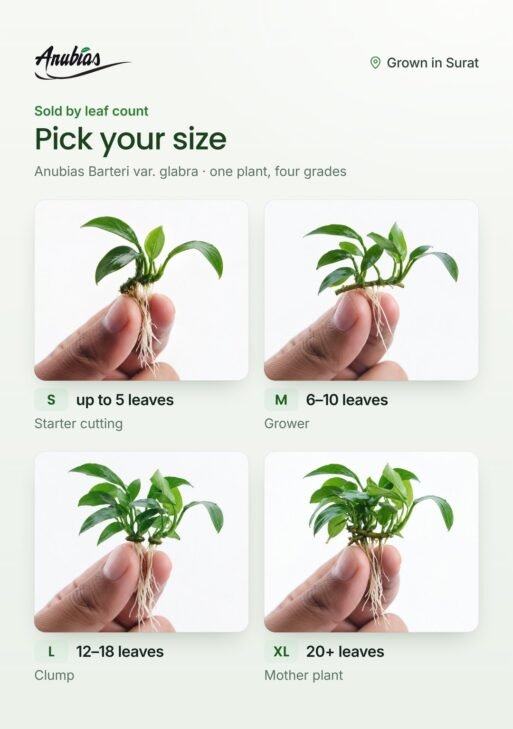
Some Indian sellers now grade this explicitly instead of leaving “small” or “large” to guesswork. anubias.in, for example, grades five of its Anubias (Nana, Nana Petite, Nana Gold, Dragon Claw and Barteri var. glabra) across four tiers — S (starter cutting, up to 5 leaves), M (grower, 6–10 leaves), L (clump, 12–18 leaves) and XL (mother plant, 20+ leaves) — priced from ₹90 to ₹250, with leaf count and rhizome maturity as the actual grading standard rather than a marketing label. Across the trade, mosses, Cryptocoryne, stem plants and floaters are often sold by portion, plantlet, stem or plant count; at anubias.in, every plant outside those five Anubias is sold at one price per unit, as described on each product page. See the full size guide for what each Anubias grade includes. Whether or not a seller uses formal grading, it’s worth asking which tier a listing represents before comparing two prices for “the same” plant. If you are comparing whole stores rather than single listings, here is how Anubias.in compares with Bunnycart on grading, pricing and shipping.
Aquarium Plant Price Guide: Species-by-Species (India)
The table below is the core of this guide — typical Indian market prices for 30 commonly sold aquarium plant species, spanning every major category. Ranges reflect what you’ll typically see across Indian aquarium plant sellers, not a single store’s price list. Where anubias.in stocks a species, its current price is listed alongside as one real, verifiable data point — a sanity check against the market range, not a recommendation to buy from any one place.
| Species | Category | Difficulty | Typical Price Range in India (INR) | anubias.in Price (INR) |
|---|---|---|---|---|
| Anubias Nana | Anubias | Easy | ₹90 – ₹300 (by size) | ₹90 – ₹250 |
| Anubias Nana Gold | Anubias | Easy | ₹90 – ₹300 (by size) | ₹90 – ₹250 |
| Anubias Nana Petite | Anubias | Easy | ₹120 – ₹350 (by size) | ₹90 – ₹250 |
| Anubias Barteri (incl. ‘Dragon Claw’, var. Glabra) | Anubias | Easy | ₹100 – ₹350 (by size) | ₹90 – ₹250 |
| Anubias Chili (dwarf compact) | Anubias | Easy | ₹200 – ₹450 | ₹310 (MRP ₹600) |
| Anubias Nana White / Pinto (variegated) | Anubias | Easy (slow-growing) | ₹400 – ₹1,200+ | ₹310 (MRP ₹600 Nana White, ₹550 Pinto) |
| Bucephalandra — common cultivars (Brownie, Kedagang types) | Bucephalandra | Easy | ₹300 – ₹900 per piece | ₹350 (Brownie Ghost) |
| Bucephalandra — rare/named cultivars | Bucephalandra | Easy (slow to propagate) | ₹1,000 – ₹3,000+ per piece | On pre-order: ₹549 (Godzilla), ₹649 (Skeleton King) |
| Cryptocoryne Wendtii (green/bronze/red forms) | Cryptocoryne | Easy | ₹100 – ₹300 | ₹150 (Wendtii Green) |
| Cryptocoryne Parva (dwarf) | Cryptocoryne | Moderate (slow) | ₹150 – ₹400 | Not currently stocked |
| Cryptocoryne Balansae / Spiralis (large types) | Cryptocoryne | Easy | ₹150 – ₹350 | Not currently stocked |
| Rotala Rotundifolia | Stem plant | Easy | ₹60 – ₹150 per bunch | ₹120 |
| Rotala Wallichii | Stem plant | Demanding (strong light + CO₂) | ₹80 – ₹200 per bunch | ₹90 |
| Ludwigia Repens | Stem plant | Easy | ₹80 – ₹180 per bunch | ₹140 |
| Bacopa Caroliniana | Stem plant | Easy | ₹60 – ₹150 per bunch | ₹120 |
| Water Wisteria (Hygrophila difformis) | Stem plant | Easy | ₹60 – ₹150 per bunch | ₹120 |
| Cabomba Caroliniana | Stem plant | Moderate (delicate) | ₹50 – ₹120 per bunch | ₹70 |
| Red Myrio (Myriophyllum tuberculatum) | Stem plant | Hard (needs high light and CO2) | ₹60 – ₹150 per bunch | ₹70 |
| Monte Carlo (Micranthemum tweediei) | Carpeting | Moderate | ₹120 – ₹350 | ₹150 |
| Dwarf Hairgrass (Eleocharis acicularis / sp.) | Carpeting | Moderate | ₹120 – ₹300 | ₹150 |
| Hydrocotyle Tripartita ‘Japan’ | Carpeting | Easy–Moderate | ₹120 – ₹300 | ₹170 |
| HC Cuba (Hemianthus callitrichoides) | Carpeting | Hard (demanding) | ₹200 – ₹500 | Not currently stocked |
| Staurogyne Repens | Carpeting / foreground | Easy | ₹120 – ₹300 | ₹180 |
| Duckweed (Lemna minor) | Floating | Easy (spreads fast) | ₹40 – ₹100 | ₹60 |
| Water Lettuce (Pistia stratiotes) | Floating | Easy | ₹60 – ₹150 | ₹90 |
| Amazon Frogbit (Limnobium laevigatum) | Floating | Easy | ₹60 – ₹150 | ₹90 |
| Water Mosaic (Ludwigia sedioides) | Floating | Moderate (needs bright light) | ₹60 – ₹150 | ₹70 |
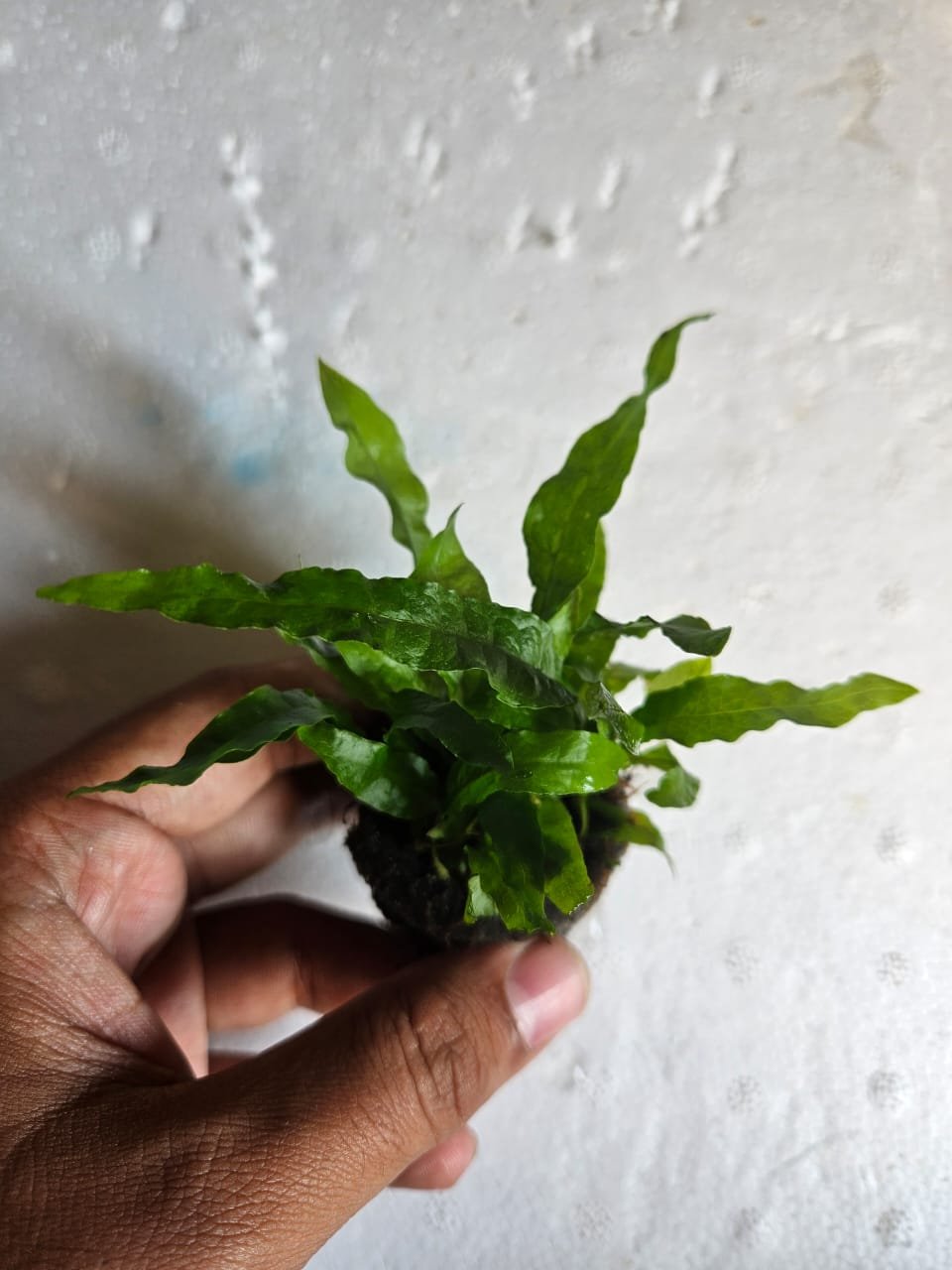
| Java Fern (standard, Microsorum pteropus) | Java Fern | Easy | ₹100 – ₹300 | ₹175 (MRP ₹320) |
| Java Fern specialty types (Philippine, Windelov, Dwarf ‘Mini’) | Java Fern | Easy | ₹150 – ₹350 | ₹175 (Philippine, Dwarf; MRP ₹320) |
| Java Moss (Taxiphyllum barbieri) | Moss | Easy | ₹80 – ₹200 | ₹120 |
| Christmas Moss (Vesicularia montagnei) | Moss | Easy | ₹100 – ₹250 | ₹150 |
Prices assume a single portion, pot or bunch at a small-to-medium size, not a bulk or wholesale order. A rare cultivar, an unusually large specimen, or fresh import stock can push any of these above its listed range — see the sections below for why.
Price Ranges by Plant Category (At a Glance)
The ranges below reflect typical market rates across the Indian aquarium plant trade, not prices from any single seller — a sanity check for budgeting, not a guarantee.
| Plant Category | Typical Format | Approximate Price Range (INR) |
|---|---|---|
| Common stem plants (Rotala, Hygrophila, Bacopa) | Bunched | ₹60 – ₹150 per bunch |
| Common Anubias / Cryptocoryne | Potted | ₹150 – ₹400 per pot |
| Bucephalandra — common/standard cultivars | Potted or loose rhizome | ₹300 – ₹900 per piece |
| Bucephalandra — rare/named cultivars | Potted or loose rhizome | ₹1,000 – ₹3,000+ per piece |
| Java Fern (standard types) | Potted or bare rhizome | ₹100 – ₹300 |
| Java Moss / Christmas Moss / Flame Moss | Portion | ₹80 – ₹200 |
| Carpeting plants (Monte Carlo, dwarf hairgrass, HC Cuba) | Bunched or potted | ₹120 – ₹350 |
| Tissue culture cups | Sealed cup | ₹150 – ₹350 common species, ₹500+ for rarer or newly imported species |
Treat the top of each range as the exception — a rarer cultivar or larger specimen, not an arbitrary markup.
What Drives the Higher End of Pricing
A handful of categories sit above everything else, and it helps to know why before assuming a seller is overcharging.
Variegated Anubias — Pinto and Snow White types especially — are the clearest example: patches of leaf tissue with little to no chlorophyll slow growth and make propagation at scale genuinely difficult. A modest division typically starts around ₹400–800, and larger specimens with clean, stable variegation climb well beyond that. You’re not paying extra for a fancier common plant — you’re paying for something slow and hard to produce.
Rare Bucephalandra cultivars follow the same logic. Borneo’s rivers have produced hundreds of named Buce forms, and only a fraction have reached wide cultivation, so a cultivar still uncommon in Indian nurseries prices well above a generic green Buce, even though both need identical care.
Import status adds another layer. Freshly landed stock — a new Buce cultivar, an unusual stem plant, anything not yet propagated domestically — carries a premium tied to shipping cost and early scarcity.
Tissue culture cups follow the same pattern within their own category: cups of staple species like Monte Carlo sit toward the bottom of the range, while newer or rarer species cost more, since lab space and propagation time scale less efficiently.
Is Cheap Always Bad?
No, and that deserves a straight answer. A ₹70 bunch of Rotala or a ₹180 pot of Anubias nana isn’t lower quality than a pricier listing of the same species elsewhere. The difference is almost always growing method and overhead, not health or genetics — bulk-grown stock from an outdoor nursery is naturally cheaper to produce than lab-grown tissue culture. That’s a supply-chain fact, not a quality signal, and plenty of budget plants arrive perfectly healthy.
Where it pays to be cautious is at the intersection of “rare” and “suspiciously cheap.” Spot a Pinto Anubias or a named Bucephalandra cultivar priced at a fraction of what it normally commands, and treat it as a warning sign, not a bargain. You’re far more likely looking at a mislabeled plant — a common green form sold under a premium name, or a young plant that hasn’t developed its variegation yet — than an actual deal. Rare cultivars are slow to produce everywhere in the trade; a price that ignores that usually means the listing isn’t accurate.
Hidden Costs: Budgeting Beyond the Plant Itself
The price tag on the plant is rarely the full cost of getting a planted tank running. A few line items are easy to forget, and together they’re the real cost of getting started:
Fertilizer. Most plants beyond the toughest Anubias and Java Fern need steady macro and micronutrients — liquid dosing, root tabs, or a nutrient-rich substrate. Treat it as an ongoing cost, not a one-time add-on.
Root tabs. Planting root-feeders like Cryptocoryne or carpeting species into inert substrate with no built-in nutrients makes root tabs close to mandatory, not optional.
Hardscape. Anubias, Bucephalandra and most mosses are epiphytes — in the wild they grow on wood and rock, not soil. You’ll need driftwood or lava rock to mount them on, and decent hardscape can cost as much as the plants going onto it.
A basic test kit. Not required to keep plants alive, but a simple pH/KH/GH kit removes a lot of guesswork when a plant is struggling for no obvious reason, especially early on.
None of this needs to blow up a budget, but pricing it in upfront beats being surprised by it later. If you are weighing live plants against plastic ones, live vs plastic aquarium plants compares the cost over a year.
A Note on Shipping Live Plants in India
Live plants ship differently from ordinary parcels — they have to survive the journey and still look worth keeping on arrival. Careful sellers pack them damp, wrapped in wet tissue or sphagnum moss and sealed to hold humidity, in packaging sturdy enough to survive being tossed around in transit. That extra handling is real cost, part of why shipping live plants tends to run higher than a similarly sized dry parcel.
Distance affects the outcome too. A shipment within the same state generally arrives in better shape than one crossing the country over several days, since less transit time means less stress on the plant. When comparing sellers, it’s worth asking how they pack for live arrival and roughly how long transit takes to your pin code. Our parcels leave from our base in Rander, Surat, so buyers in Gujarat and Maharashtra usually get the shortest transit.
Full aquarium plant price list (September 2026)
Every plant we currently list on Anubias.in, with live prices. Variable products show the range from the smallest to the largest size. Pre-order items are sourced to order.
Prices checked against the store on 27 September 2026. Shipping is ₹99 on orders under ₹999 and free from ₹999.
Frequently Asked Questions
Why do aquarium plant prices vary so much between sellers in India?
Mostly four factors: how the plant is sold (bunched, potted or tissue culture), how rare or slow-to-propagate the cultivar is, whether it’s freshly imported or grown domestically, and how mature the specimen is at the time of sale. Two listings of the exact same species can legitimately differ by three or four times once format and size are accounted for — it doesn’t automatically mean one seller is overcharging.
Is a more expensive aquarium plant always healthier or better quality?
No. Price differences are almost always about production method and scarcity, not plant health. A budget bunch of Rotala from an outdoor nursery can be just as healthy as a pricier tissue-cultured version of the same species. The one place to be cautious is the opposite case — a rare cultivar priced far below its usual range is more likely mislabeled or immature than an actual bargain.
What’s the cheapest way to build a planted tank without sacrificing plant health?
Start with easy, inexpensive species, and buy graded Anubias at the smallest size — an “S” or starter cutting rather than a mature clump — since most rhizome and stem plants reach full size within a few months regardless of their starting point. Pair budget staples like Java Fern, Java Moss, Anubias Nana and bunched stem plants with a basic fertiliser routine, and add rarer or larger specimens later once the tank is established.
Shop the plants in this guide: Browse the Anubias, Bucephalandra, Cryptocoryne and stem plant categories on anubias.in to compare current pricing and see what’s actually in stock before you plan your order.
Ready to buy? See our guide on where to buy aquarium plants online in India.
Grown in Surat (pre-order plants imported to order) · live-arrival guarantee with a 4-hour unboxing video · ₹99 shipping, free from ₹999