
Description
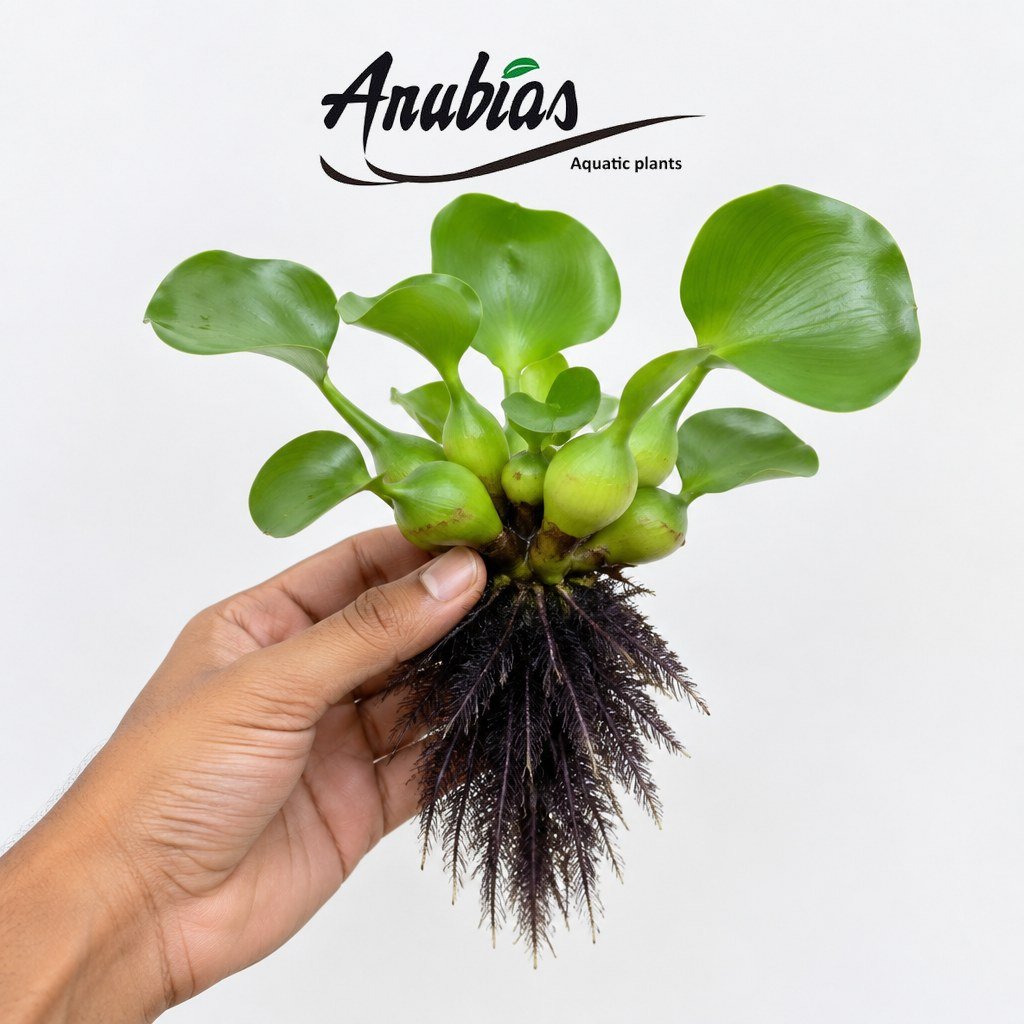
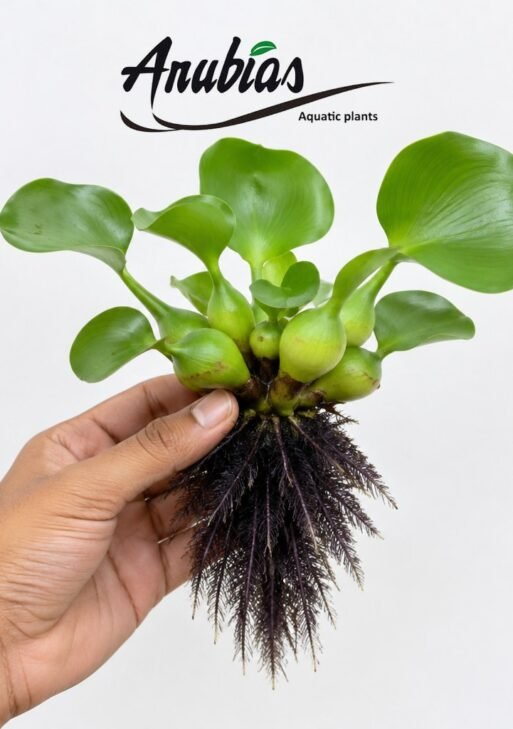
Water hyacinth (Eichhornia crassipes, now classified as Pontederia crassipes) is a fast-growing floating plant with rounded, glossy leaves on swollen, buoyant stalks, long feathery purple-black roots and, in strong sun, spikes of lavender-blue flowers. It comes from the Amazon basin and is now found across India, where it is also one of the most notorious invasive weeds in our lakes and canals. Kept responsibly, water hyacinth is a superb plant for ponds, tubs and bright open-top tanks: it shades the water, shelters fry and shrimp in its roots and strips excess nutrients that would otherwise feed algae. It is not a plant for a dim, covered indoor aquarium.
Water hyacinth at a glance
| Scientific name | Pontederia crassipes (synonym Eichhornia crassipes) |
|---|---|
| Family | Pontederiaceae |
| Origin | Amazon basin, South America; naturalised across India and the tropics |
| Difficulty | Easy outdoors; difficult under weak indoor light |
| Light | Bright, ideally direct sun or a strong light above the plant |
| CO2 | Not required; leaves are in the air and use atmospheric CO2 |
| Temperature | 20–30 °C; growth slows below about 18 °C; not frost-tolerant |
| pH | 6.0–8.0 |
| Growth rate | Very fast; can double in about two weeks in summer |
| Height/size | Rosettes 10–30 cm; roots trail 20–40 cm |
| Placement | Floating; ponds, tubs and open-top tanks |
| Propagation | Runners (stolons) producing daughter plants |
How to plant water hyacinth
There is no planting. Water hyacinth floats with its leaves in the air and its roots in the water.
- Rinse the plant and roots in a bucket of clean water and remove any damaged leaves.
- Float it on the surface. In a pond or tub, place it where it gets the most sun. In a tank, place it under the light.
- Keep the leaves dry. Spray bars, airstones and strong filter outflows that constantly wet the leaves cause rot; the plant likes a still surface.
- Leave at least 15–20 cm between the water surface and the light or lid so the rosette and flower stalks have headroom.
- Give it a week or two to adjust; the first new leaves tell you it has settled.
Water hyacinth care: light, CO2, fertiliser and water
Light. This is the deciding factor. Water hyacinth wants direct sun or a very strong light a short distance above the leaves. Outdoors in India it grows almost too well from March to October. Under a normal aquarium LED it survives for a while, grows slowly, and often declines over a few months as the leaves yellow. If your tank light is modest, treat it as a seasonal plant or keep it on a sunny balcony in a tub.
CO2. Not required. The leaves are emersed and take CO2 from the air, which is why it grows so much faster than submerged plants.
Fertiliser. In a pond or stocked tank the fish waste is usually enough. In a lightly stocked tub, dose a complete liquid fertiliser every week or two. Yellowing between the veins on new leaves means it has run out of iron or nitrogen.
Water. Unfussy about hardness and pH. It thrives at 20–30 °C and keeps growing through summer heat that stresses submerged plants. Growth slows below 18 °C, so in North Indian winters expect it to sit still until spring. Power cuts do not affect it; it needs no filter. Heavy monsoon rain can swamp the leaves, so tip excess water out of tubs after a downpour.
Growth, trimming and propagation
Water hyacinth grows explosively in summer. A single rosette sends out runners with daughter plants and can double in about two weeks, and a tub can be covered in a month. Keep it to about half the surface so light still reaches the water and oxygen can exchange at night; a fully covered pond can suffocate fish.
Thin it every week or two in summer by lifting out whole plants. Remove yellowing leaves as they appear, because they rot quickly and foul the water. Cut off spent flower spikes.
Propagation takes care of itself: snap daughter plants off the runners once they have a few leaves and roots. In a tank, trim roots to 15–20 cm so fish can move beneath them.
Where to use it in an aquascape or pond
Water hyacinth belongs in open, bright water. A 2–4 ft outdoor tub or cement tank (around 100–500 litres) with guppies, mollies or white cloud minnows is its ideal home, where it shades the water, keeps algae in check and shelters fry in its roots. In garden ponds it is classic cover for goldfish and koi, though both nibble the roots. In a bright, open-top indoor tank of 3 ft or more (120 litres plus) under a strong light it works as a nutrient sponge and fry refuge.
It is the wrong plant for nano tanks, covered tanks and tanks with lids. For an indoor floater choose a smaller floating plant such as frogbit or red root floater. Beneath water hyacinth in a tub, tough shade-tolerant plants do best: Anubias nana and Java fern on stones, Cryptocoryne in the substrate, and hardy stem plants around the edges.
It is safe with all fish and shrimp. Shrimp and fry graze the roots constantly, and bettas rest beneath the leaves.
Responsible keeping
Water hyacinth is listed as an invasive weed in India and chokes lakes, canals, rivers and reservoirs across the country. Please keep it contained. Never release surplus plants into drains, ponds, lakes, rivers or canals, and never tip tub water with roots or seedlings into a storm drain. Put excess plants in the household bin or compost them; dried out and composted, they are harmless and make good garden mulch. Keep tubs away from overflow points during the monsoon so plants cannot wash out.
Common problems and fixes
- Yellowing leaves indoors. Cause: not enough light. Fix: move it to a sunny spot or under a strong light close to the leaves; otherwise treat it as temporary.
- Leaves rotting at the base. Cause: leaves constantly wet from splashing or spray bars. Fix: move it away from flow and keep the surface calm.
- Roots eaten short. Cause: goldfish, koi or large cichlids. Fix: normal; the plant regrows roots.
- Pond fully covered, fish gasping at dawn. Cause: too much cover blocking oxygen exchange. Fix: thin to half the surface immediately and add an air pump.
- Pale new leaves. Iron deficiency. Fix: dose a liquid fertiliser with iron.
What you receive
One healthy water hyacinth plant of the size you select (Small or Standard), similar to the photo: a rosette with its trailing roots. Each plant is checked before packing, packed moist and shipped across India from Surat. ₹99 shipping, free on orders of ₹999 or more.
Live-arrival guarantee: record one continuous unboxing video within 4 hours of delivery and we will refund or replace a plant that arrived damaged.
FAQ
Can water hyacinth grow in an aquarium?
Only in a bright, open-top tank with a strong light close to the leaves. Under a normal LED in a covered tank it survives for a while, then declines. It is at its best in ponds and tubs.
Does water hyacinth need CO2?
No. Its leaves are in the air and use atmospheric CO2, which is why it grows so fast.
Is water hyacinth good for beginners?
Outdoors, yes: it is one of the easiest pond plants. Indoors it is one of the harder floaters because of its light demand.
How fast does water hyacinth grow?
Very fast. In Indian summer it can double in about two weeks, so thin it regularly and keep it to half the surface.
Why is my water hyacinth dying?
The usual causes are too little light (indoors or in a covered tank), very soft or nutrient-poor water that turns the leaves yellow, or sudden full sun after a shady spot, which scorches the leaves. Move it to bright light or a pond, give it a few days to adjust when changing spots, and add a little liquid fertiliser in plain tap water. Remove brown leaves; the plant regrows from the healthy crown and runners.
Why is water hyacinth considered invasive?
It spreads rapidly, blocks waterways and starves water of oxygen and light. That is why surplus plants must go in the bin or compost, never into drains, ponds, lakes or rivers.
Is water hyacinth safe for fish and shrimp?
Yes. Its roots shelter fry and shrimp. Goldfish and koi may eat the roots, which does not harm the fish.
Not sure what fits your tank? Plan it with our free AI tank planner.










There are no reviews yet.