
Water Hyacinth (Eichhornia crassipes) is one of the fastest-growing floating plants available to Indian aquarists — a rosette of rounded, waxy leaves sitting on inflated stalks, with long feathery roots trailing beneath. It’s a favourite for outdoor tubs, ponds and fry-raising setups, though it needs more light than a typical indoor aquarium provides to really thrive. This guide covers what it needs to grow well, how to use it responsibly, and why it’s not the same as a submerged aquarium plant.
Quick Overview
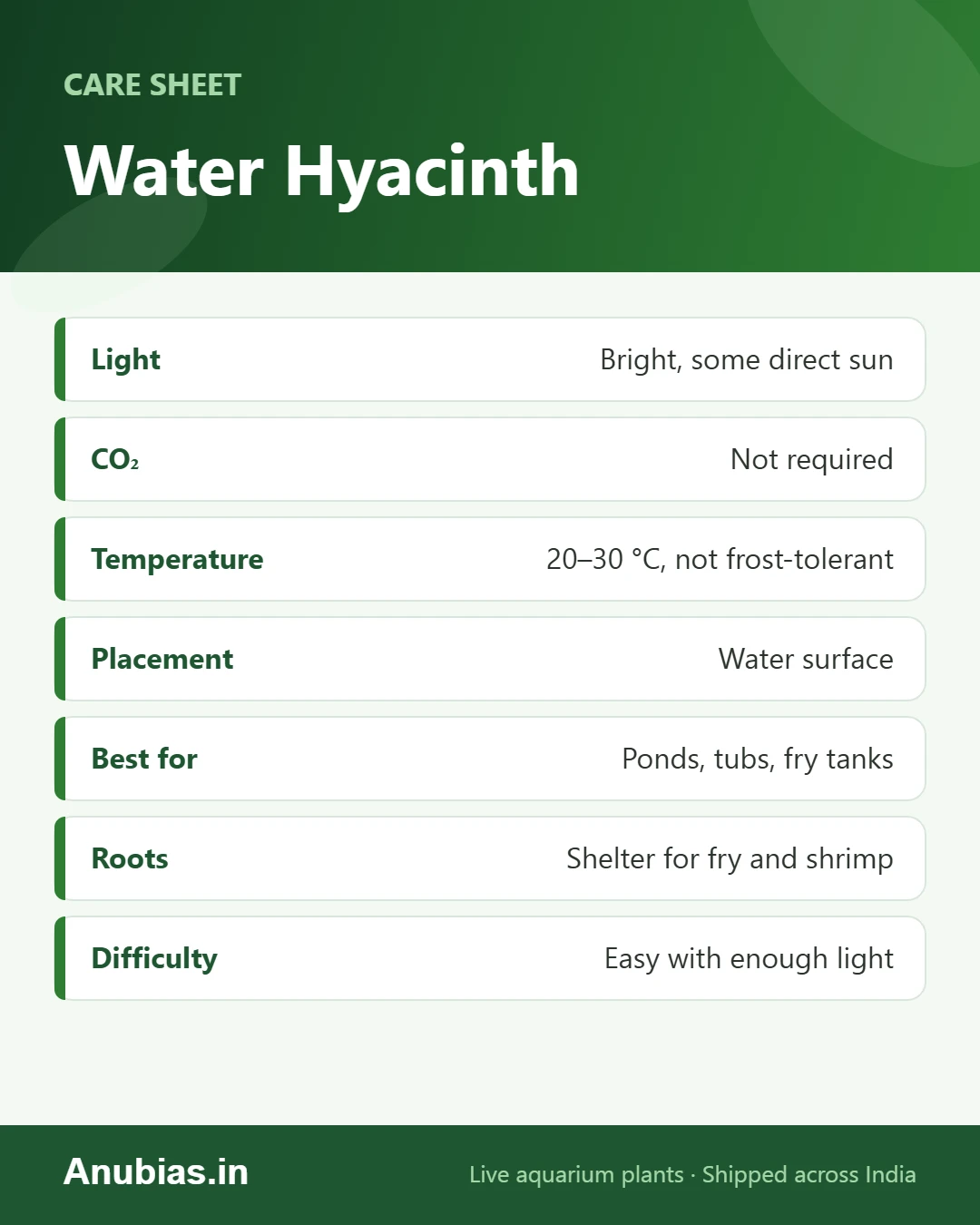
- Difficulty: Easy, given enough light
- Placement: Floating, on the water surface
- Light: Bright — ideally some direct sun or very strong artificial light
- CO2: Not required; the plant uses atmospheric CO2 through its emersed leaves
- Temperature: 20–30°C, not frost-tolerant
Why It Behaves Differently From Submerged Plants
Unlike Anubias, crypts or stem plants that grow fully underwater, Water Hyacinth grows emersed — its leaves and inflated leaf stalks sit above the surface while only the roots stay submerged. That means it photosynthesises using air, not dissolved CO2, so injected CO2 does nothing for it. What it does need is strong light hitting its leaves directly, the same as a houseplant, which is the single biggest reason it struggles in dim indoor tanks.
Light Requirements in Practice
Indoors, under a standard planted-tank LED, Water Hyacinth will usually survive but grow slowly and produce smaller leaves. Outdoors in a tub or pond with several hours of direct sun, the same plant can double in size within a couple of weeks and send up its characteristic pale lavender flower spike. If you’re keeping it indoors, place it as close to the light source as possible or supplement with a dedicated grow light.
A Natural Nutrient Sponge
Few plants absorb excess nitrate and phosphate as efficiently as Water Hyacinth, which is why it’s widely used in outdoor tubs and even in constructed wetlands for water treatment. A few plants covering part of an outdoor tub’s surface can noticeably reduce algae growth by out-competing algae for the same nutrients.
Breeding and Fry Safety
The dense curtain of roots hanging below each rosette is one of the best natural fry and shrimp shelters available. Livebearer fry, in particular, use the root mass to hide from adult fish, making Water Hyacinth a popular addition to outdoor breeding tubs alongside plants like Duckweed and Amazon Frogbit.
Keeping It Responsibly
Water Hyacinth is officially recognised as an invasive species across much of India, capable of forming thick mats that choke lakes, canals and irrigation channels — Loktak Lake and parts of the Deccan’s reservoirs are well-known examples of the ecological damage it can cause when it escapes cultivation. Keep it strictly to a contained tub, pond or aquarium, remove excess growth regularly, and never release surplus plants into any natural or public water body.
Winter and Indoor Considerations
The plant is not frost-tolerant and growth slows sharply below about 18°C. Gardeners and aquarists in cooler parts of India who keep it outdoors in summer often bring a few rosettes indoors to a bright, warm spot over winter to keep a stock alive for the following season.
More floating plant guides:
Frequently Asked Questions
Will Water Hyacinth grow under normal indoor aquarium lights?
It can survive under bright indoor lighting, but it flowers and grows most vigorously with direct sun or very strong light, which is why it performs best in an outdoor tub, pond, or a bright balcony setup rather than a dim indoor tank.
Is it safe to keep with fish, shrimp and fry?
Yes — the long trailing roots are a favourite hiding, grazing and spawning spot for shrimp and livebearer fry, and the plant itself is non-toxic to fish.
Can I release extra plants into a nearby pond, lake or canal?
No. Water Hyacinth is a declared invasive species in Indian waterways, capable of choking lakes and canals within a season. Please compost extra plants, share them with other hobbyists, or dispose of them in household waste — never release them into open water bodies.
When will my pre-order ship?
This plant is imported to order; typical arrival is around 15 days from purchase, and we’ll email dispatch and tracking details.
Setting up an outdoor tub or fry-raising pond? Water Hyacinth is available to pre-order here.
Planning a balcony tub or urli? See the best plants for outdoor tubs and balcony ponds in India.
Grown in Surat (pre-order plants imported to order) · live-arrival guarantee with a 4-hour unboxing video · ₹99 shipping, free from ₹999