

Few aquarium plants reward a beginner as quickly as Water Wisteria. Plant a few stems of Hygrophila difformis in half-decent light and within a couple of weeks you will have a taller, bushier, visibly growing plant — proof that the tank is working. It is fast, forgiving, and doubles as one of the best natural nutrient exporters you can add to a new setup. This guide covers what it needs, why its leaves keep changing shape, and how to deal with the melt it often shows right after you bring it home.
Quick answer: Water Wisteria (Hygrophila difformis) is one of the fastest, easiest stem plants: keep it at 22–27°C — it starts to struggle below about 20°C — with pH roughly 6.2–7.3 and hardness anywhere from 4 to 18 dGH. Plant stems a couple of centimetres deep, 3–5 cm apart, stripping the leaves that would sit buried, and expect visibly bushier growth within a couple of weeks.
What Is Water Wisteria?
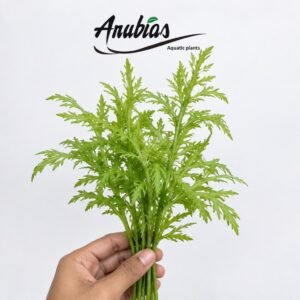
Water Wisteria is a fast-growing stem plant native to the flooded plains of South Asia, which makes it naturally well-suited to Indian water conditions. It grows upright on a central stem with deeply lobed, almost lacy leaves, and can reach the surface quickly in a normal-height tank if left untrimmed. Because it grows equally well fully submerged or with its top leaves emerged above the waterline, it is also a popular choice for paludariums and low-tech tanks with a lower water level.
Ideal Water Parameters
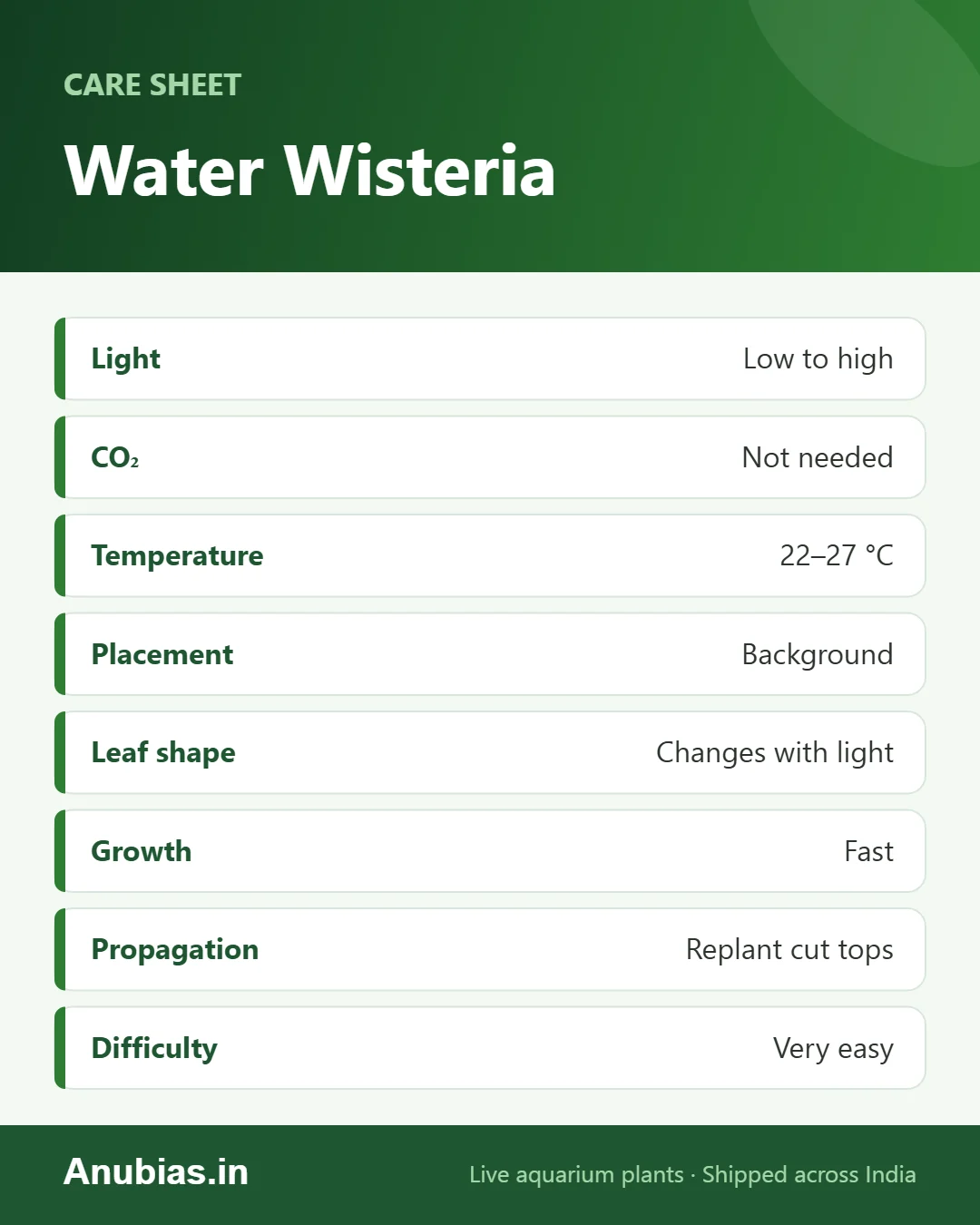
Water Wisteria does best at temperatures between 22 and 27°C; growth slows and the plant can start to struggle below about 20°C, so it is not a great match for unheated cold tanks. It tolerates a fairly wide pH range, roughly 6.2 to 7.3 for best results though it can handle anywhere from 5 to 8, and water hardness between about 4 and 18 dGH. This flexibility, combined with its tolerance for a range of Indian tap water profiles, is a big part of why it is considered such an easy beginner plant.
Light and the Leaf-Shape Effect
Water Wisteria is one of the few aquarium plants that visibly changes leaf shape depending on how much light and CO2 it gets, which makes it a genuinely interesting plant to watch rather than just a green filler. Under moderate to bright light with good CO2 and nutrients, new leaves grow narrow, finely divided and almost fern-like. Under lower light, leaves come in broader and less deeply cut. Roughly 50 to 80 micromoles of PAR at the leaf produces strong, well-defined growth, but the plant will still grow, just more slowly and with broader leaves, under more modest lighting. CO2 is not required but speeds up growth noticeably; see our DIY CO2 guide if you are on the fence about adding it.
Substrate and Planting
Water Wisteria is not a fussy rooter. Any standard planted substrate, or even plain gravel with root tabs or liquid fertiliser, will support it, since much of its feeding happens through the leaves and stem in the water column rather than the roots alone. Plant stems a couple of centimetres into the substrate, spaced 3 to 5cm apart to start, and trim the lower leaves that would otherwise sit buried before planting so they do not rot underground.
How to propagate Water Wisteria
To propagate Water Wisteria, cut a healthy top section 8–10 cm long, strip the leaves from the bottom 2 cm and push the cutting about 2 cm into the substrate. New roots usually form within seven to ten days. The stump usually branches into two or three new shoots, so each trim multiplies the plant.
It is worth comparing Water Wisteria against other beginner stem plants, which our guide to the best stem plants for beginners covers alongside Rotala and Bacopa.
Common Problems
The most common early issue is not really a health problem at all: Water Wisteria is frequently grown emersed (above water) in nurseries before sale, and the emersed-form leaves often melt away within one to two weeks of being fully submerged as the plant switches to producing new underwater-adapted leaves. As long as the stem itself stays firm, this is normal and resolves on its own; do not discard a stem just because its original leaves are dissolving. Because it grows quickly, the second most common issue is neglect: an untrimmed stem will reach the surface, flop over, and start shading everything beneath it, so plan to trim every couple of weeks once it is established. Pale new growth or holes in older leaves generally point to a nutrient shortfall, particularly nitrogen or iron, which regular liquid fertilising corrects.
More stem plant guides:
Frequently Asked Questions
Why did my Water Wisteria’s leaves dissolve after planting? This is almost always the emersed-to-submerged transition; the plant sheds leaves grown out of water and replaces them with new underwater leaves within one to two weeks, so keep the stem in place.
Does Water Wisteria need CO2? No, it grows without it, but CO2 injection noticeably speeds growth and produces the more finely divided, lacy leaf form.
How often should I trim Water Wisteria? Roughly every two to three weeks once established, or whenever stems approach the surface, to keep the plant bushy and stop it shading lower plants.
Does Water Wisteria need substrate? It grows best planted, but it is not fussy: plain gravel with root tabs or any plant soil is enough, because it also feeds through its leaves from the water. Stems left floating will put out roots and survive, but planted stems grow fuller and bushier.
Want to add a fast, forgiving stem plant to your tank? Our Water Wisteria (Hygrophila difformis) is available to order and ships across India. New to planted tanks generally? Our guide to the best aquarium plants for beginners in India is a good next stop.
Mixing up your Hygrophila? Compare Water wisteria vs Hygrophila pinnatifida.
Grown in Surat (pre-order plants imported to order) · live-arrival guarantee with a 4-hour unboxing video · ₹99 shipping, free from ₹999