
Rotala is one of the largest stem-plant genera in the hobby, and two of its members show up again and again on Indian aquascaping wishlists: Rotala Rotundifolia and Rotala Wallichii. Both turn red or pink under strong light, both get grouped as “red stem plants” in every catalogue, and both are available on anubias.in — but they are not interchangeable. One is a forgiving beginner plant; the other rewards a more dialled-in tank. Here is how to tell them apart and pick the right one.
Quick answer: Rotala rotundifolia is the forgiving one, with small rounded leaves and pink-to-orange tips even in modest setups; Rotala wallichii (₹90) has thread-thin whorled leaves that turn vivid pink-red but demands much more light and CO2 to show it. Pick rotundifolia for an easy first red stem plant, and wallichii only if your tank runs strong light with pressurised CO2.
The Rotala Genus in Brief
Rotala includes well over a dozen species commonly traded in the hobby, ranging from the nearly indestructible to the genuinely fussy. What they share is a tendency to blush red, pink or orange under bright light and a growth habit of upright stems that respond well to trimming and replanting. What varies enormously between species is leaf shape, how much light and CO2 they need to actually show that colour, and how forgiving they are if your tank is not running high-tech. Rotundifolia and Wallichii sit at opposite ends of that range, which is exactly why comparing them is useful before you buy either one.
Rotala Rotundifolia — the forgiving red starter plant
Rotala Rotundifolia is usually the first red plant anyone in this hobby is told to buy, and for good reason. Submersed leaves are small, rounded and closely spaced along the stem, and under bright light the growing tips blush pink to orange while lower, older growth often stays green — a natural gradient that looks good even before you have learned to aquascape. It is a fast, forgiving grower that will survive in a low-tech tank without CO2, just with less colour and a leggier habit than it shows under stronger light. At ₹120, it is the safer of the two to start with.
Rotala Wallichii — the fine-textured showpiece
Rotala Wallichii looks nothing like Rotundifolia up close. Instead of rounded leaves, it grows fine, needle-thin foliage in dense whorls around the stem, giving the whole plant a feathery, almost fern-like texture that reads as a completely different plant on the shelf. Colour potential is higher too — under strong light it turns a vivid pink-red from tip to base rather than just blushing at the growing point. That payoff comes with a catch: Wallichii wants more light and generally does best with CO2 and consistent dosing to stay compact and colourful, and it is more prone to getting leggy or melting back in a low-tech setup than Rotundifolia is. At ₹90, it is priced accessibly, but it asks more of your tank than the price suggests.
Leaf Shape Is the Fastest Way to Tell Them Apart
If you are ever unsure which plant you are looking at in a photo or in someone else’s tank, leaf shape settles it immediately. Rotundifolia has small, oval-to-round leaves in a fairly loose arrangement. Wallichii has thin, thread-like leaves packed into tight whorls, closer in texture to a soft green or red feather than to a typical broad-leaved stem plant. No other Rotala sold on anubias.in shares that needle-fine look, so if a tank photo shows feathery red whorls, it is Wallichii.
Comparison Table
| Rotala Rotundifolia | Rotala Wallichii | |
|---|---|---|
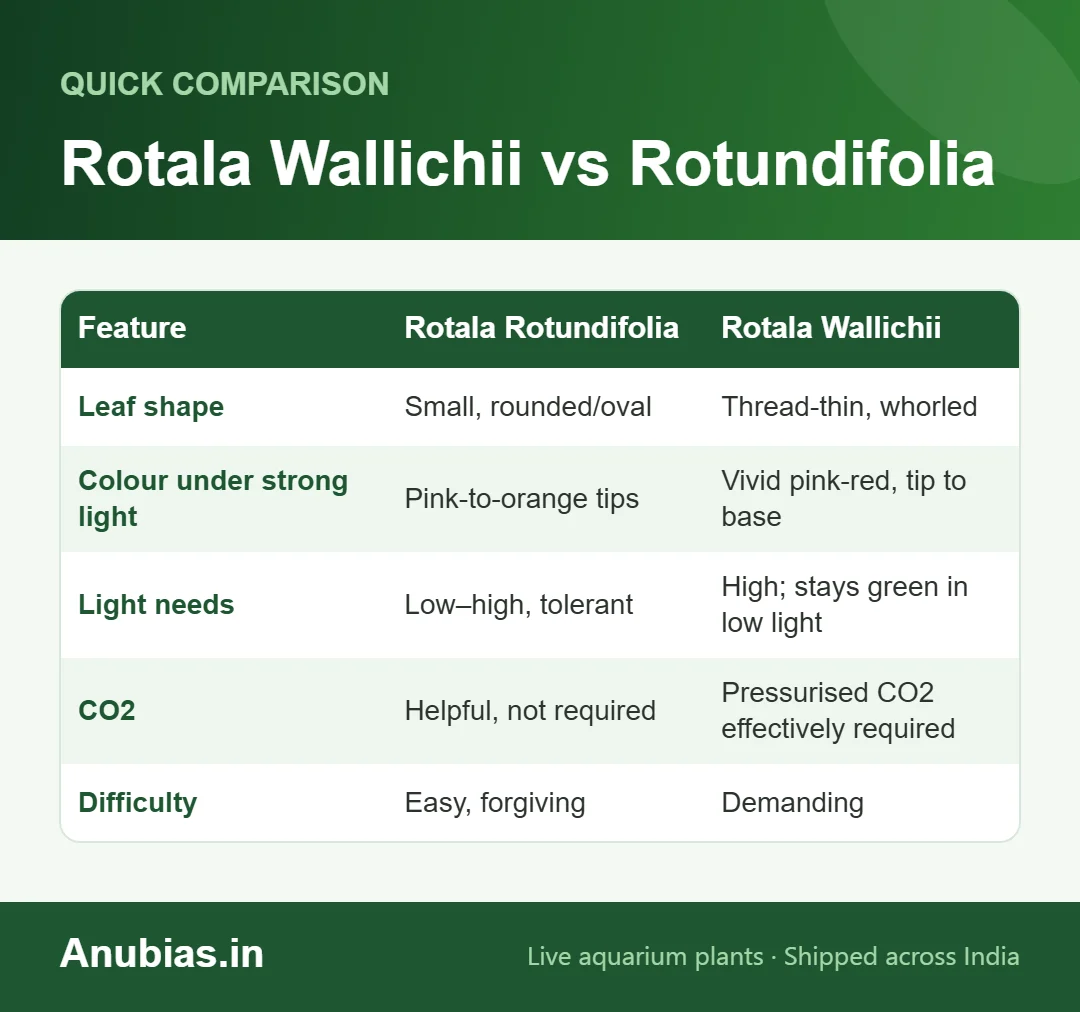
| Leaf shape | Small, rounded/oval | Thread-thin, whorled |
| Colour under strong light | Pink-to-orange tips | Vivid pink-red, tip to base |
| Light needs | Low–high, tolerant | High; stays green in low light |
| CO2 | Helpful, not required | Pressurised CO2 effectively required |
| Difficulty | Easy, forgiving | Demanding |
| Price | ₹120 | ₹90 |
Which One Should You Pick?
If you do not run CO2, or you want a red stem plant that will still look presentable after a missed trimming or two, start with Rotala Rotundifolia. It is the more forgiving of the two and still delivers real colour once your light is dialled in. If your tank already runs CO2 and moderate-to-high light and you want a textural contrast plant — something with a completely different silhouette to break up broader-leaved neighbours like Anubias or Cryptocoryne — Rotala Wallichii is worth the slightly fussier care for the look it adds. Many aquascapers eventually run both, using Rotundifolia as the reliable colour backbone of a stem-plant group and Wallichii as a fine-textured accent in front of or beside it. For the full planting, CO2 and colour-up details, see our Rotala Wallichii care guide. For more beginner-friendly stem plant options, see our guide to the best stem plants for beginners.
More stem plant guides:
Frequently Asked Questions
Can Rotala Wallichii grow without CO2? It can survive without CO2 but will usually grow leggier, paler and more prone to melting back than it does in a CO2-supplemented tank. If you are not running CO2, Rotala Rotundifolia is the more reliable choice of the two.
Why is my Rotala Rotundifolia green instead of pink? Colour intensity in Rotundifolia is driven mostly by light strength and duration. Under low-to-moderate light it often stays largely green with just a hint of colour at the tips; increasing light (and, where possible, adding CO2 and iron-rich fertiliser) is what pushes it toward pink and orange.
Are Rotala Wallichii and Rotala Rotundifolia planted the same way? Yes. Both are true stem plants: push a few centimetres of stem into the substrate, and both propagate the same way by cutting a healthy top and replanting it once the original stem grows tall enough to trim.
Growing Rotala? Read the Rotala rotundifolia care guide.
Grown in Surat (pre-order plants imported to order) · live-arrival guarantee with a 4-hour unboxing video · ₹99 shipping, free from ₹999