

Moss is one of the few aquarium plants that is genuinely hard to kill, which is exactly why Java Moss and Christmas Moss both stay permanent fixtures on anubias.in. They are used for similar jobs — covering hardscape, giving shrimp somewhere to graze, softening a bare tank — but they do not grow the same way, and the look you end up with depends heavily on which one you tie down. Here is how they actually differ and which one fits your project.
Quick answer: Java Moss grows fast in irregular, branching clumps, while Christmas Moss grows more slowly in flat, triangular, fir-tree-shaped fronds that look neater on driftwood. Christmas Moss is slightly fussier, preferring cooler water, and costs a little more at ₹150 against ₹120. For a first moss or quick shrimp cover, Java Moss is the safer pick.
Java moss vs Christmas moss: the main difference
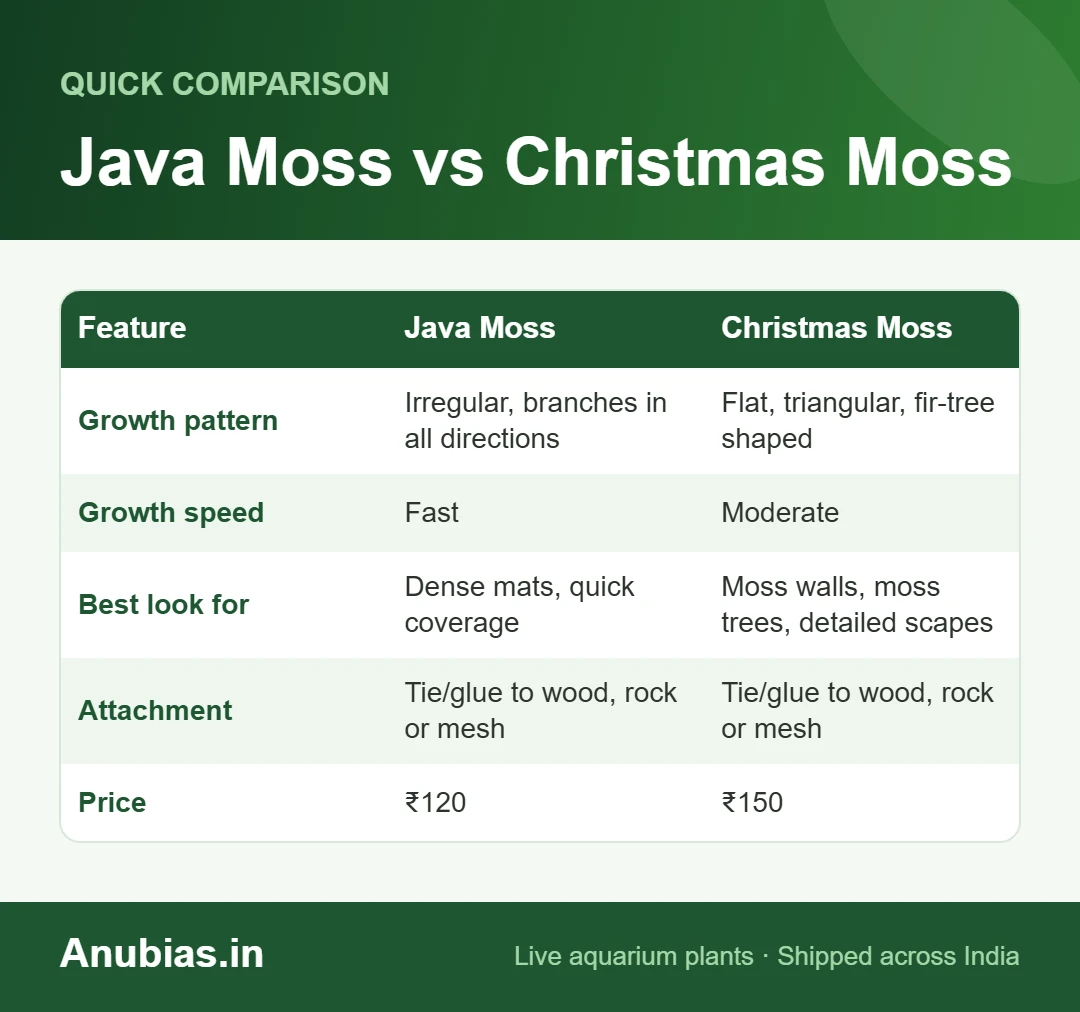
The main difference is growth pattern. Java moss branches in every direction and grows fast into a shaggy, irregular mat. Christmas moss grows more slowly in flat, triangular fronds shaped like tiny fir trees, so it looks neater on moss walls and trees. Care is almost the same: both attach with rhizoids and grow without CO2.
What Java Moss Looks Like and How It Grows
Java Moss (Taxiphyllum barbieri) has no leaves or roots in the usual plant sense — just a mass of thin, branching stems covered in tiny overlapping leaflets a couple of millimetres long, anchored by rhizoids rather than true roots. Growth is genuinely irregular: stems branch off in every direction with no consistent pattern, which gives it a wild, textured, “shaggy” look rather than a neat one. It is also the faster and cheaper of the two at ₹120, and it tolerates almost any water condition, light level and temperature you throw at it. If you have killed every stem plant you have tried, this is usually the one that survives.
What Christmas Moss Looks Like and How It Grows
Christmas Moss (Vesicularia montagnei) grows in a noticeably more structured pattern — fronds branch out in a flat, triangular shape that resembles a row of tiny fir or Christmas trees, which is exactly where the name comes from. That structured growth is why aquascapers reach for it over Java Moss when the moss itself needs to look deliberate rather than wild — moss trees tied to a manzanita branch, or a moss wall meant to read as a neat green backdrop rather than a shaggy mat. It is priced a little higher at ₹150 and is currently available to order on backorder, and it is slightly fussier than Java Moss, doing best with cooler water and an occasional trim to keep its triangular fronds crisp instead of overgrown.
Growth Pattern Is the Real Difference
Put the two side by side and the growth habit is what actually separates them, not the care level — both attach with rhizoids, need no substrate, and grow with or without CO2. Java Moss branches at random, filling gaps quickly but unevenly, which is perfect when you want fast, dense, no-fuss coverage and do not care about a neat silhouette. Christmas Moss branches in that flat, triangular pattern, which fills in more slowly but holds a deliberate shape far longer between trims — the difference between a plant you tie down and forget, and one you shape.
Best Use Cases
Carpet-style moss mats: tied across a mesh panel on the substrate, both mosses work as a soft, walkable alternative to true carpeting plants, but Java Moss is the more common choice here simply because it is faster and cheaper to fill a large mat.
Moss walls and moss trees: this is where Christmas Moss usually wins. Its triangular, layered fronds read as intentional structure from a normal viewing distance, which is exactly what a moss wall or a moss-covered branch needs to look finished rather than overgrown.
Shrimp and fry cover: both are excellent, since shrimp graze the biofilm that collects on moss and fry use the tangle to hide from adult fish. Java Moss’s denser, messier growth gives slightly more hiding volume for the same tank footprint, which is why it remains the default choice in dedicated shrimp and breeding tanks.
Comparison Table
| Java Moss | Christmas Moss | |
|---|---|---|
| Growth pattern | Irregular, branches in all directions | Flat, triangular, fir-tree shaped |
| Growth speed | Fast | Moderate |
| Best look for | Dense mats, quick coverage | Moss walls, moss trees, detailed scapes |
| Attachment | Rhizoids — tie/glue to wood, rock or mesh | Rhizoids — tie/glue to wood, rock or mesh |
| Price | ₹120 | ₹150 |
| Availability | Pre-order (imported to order, about 15 days) | Pre-order (imported to order, about 15 days) |
Java moss or Christmas moss: which should you choose?
Choose Java moss (₹120) for fast, dense, low-fuss cover in shrimp, breeding and beginner tanks. Choose Christmas moss (₹150) for moss walls, moss trees and display scapes where a neat, layered shape matters. Both are currently on pre-order, imported to order in about 15 days, and many tanks use both.
If your priority is fast, cheap, dense coverage — a breeding tank, a shrimp colony, or simply carpeting a mesh panel as quickly as possible — Java Moss is the more practical choice. If you are building a display aquascape and want the moss itself to look deliberate — a moss tree on a piece of spiderwood, or a neat moss wall as a backdrop — Christmas Moss‘s triangular growth pattern holds that structured look far longer between trims. Plenty of tanks use both: Java Moss out of sight doing the heavy lifting for shrimp cover, Christmas Moss front and centre where its shape actually gets seen. For general attachment and trimming technique that applies to either, see our Java Moss care guide.
More aquarium moss guides:
Frequently Asked Questions
Can Java Moss and Christmas Moss be planted in substrate? No. Neither has true roots — both anchor using rhizoids and should be tied or glued to driftwood, rock or mesh rather than buried, the same way Anubias and Java Fern are mounted rather than planted.
Which moss is better for a shrimp tank? Both work well, but Java Moss is the more common choice for dedicated shrimp and breeding tanks because its denser, messier growth provides more hiding volume and biofilm surface for the same footprint, and it is generally the cheaper, faster-growing option.
Why does my moss look patchy or grow unevenly? Uneven light across the moss mat is the usual cause — sections closer to the light grow in thicker while shaded sections lag behind. Rotating the hardscape or trimming back the thicker areas evens out growth over a few weeks.
Whichever side you land on, you can browse our moss range and grab a portion of each to test under your own light.
Grown in Surat (pre-order plants imported to order) · live-arrival guarantee with a 4-hour unboxing video · ₹99 shipping, free from ₹999