
Description
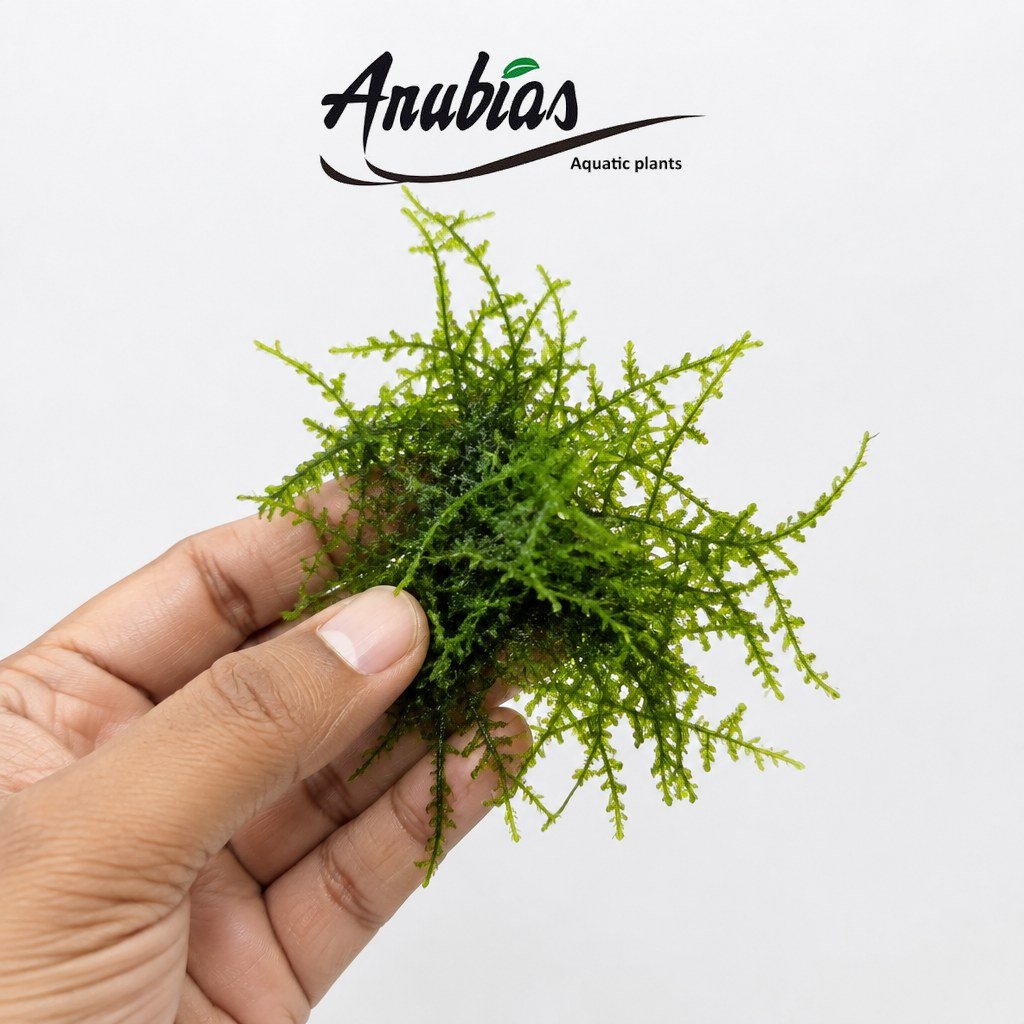
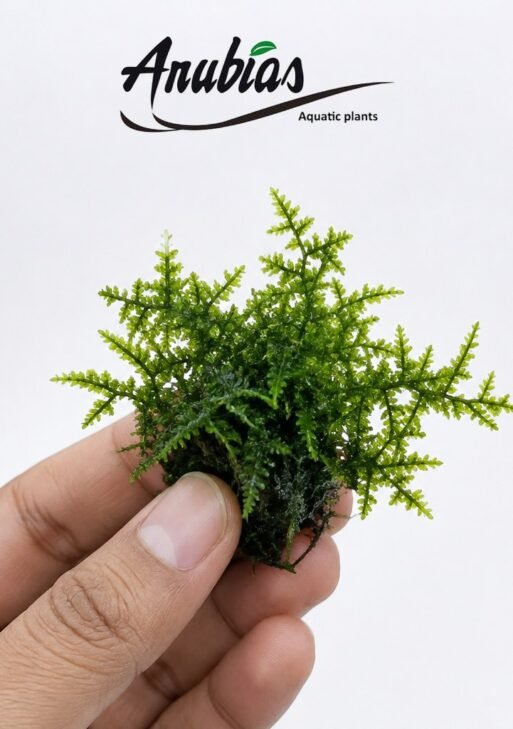
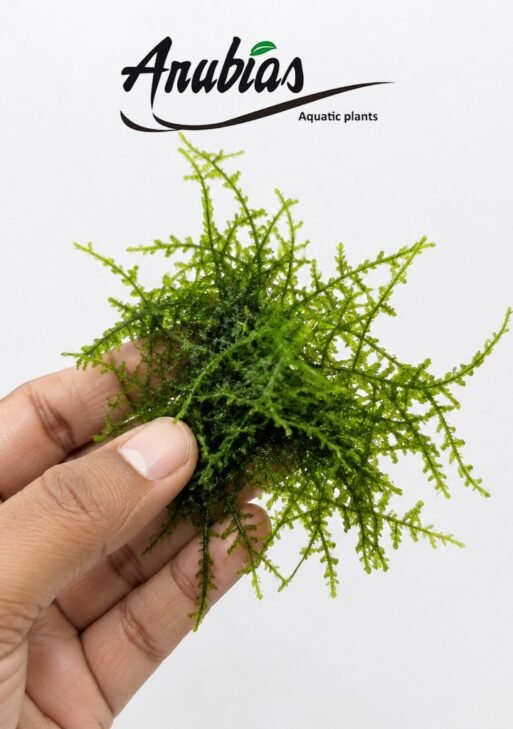
Java moss (Taxiphyllum barbieri) is the most widely kept aquarium moss in the world: a tangle of fine, branching green strands from Southeast Asia that attaches itself to wood, rock, mesh and almost any other surface. It has no roots, needs no substrate and no CO2, grows from low to high light and tolerates hard Indian tap water and warm summers. Java moss suits beginners who want something impossible to kill, shrimp and fish breeders who need a dense refuge for shrimplets and fry, and aquascapers building moss walls, moss trees and mossy driftwood.
Java moss at a glance
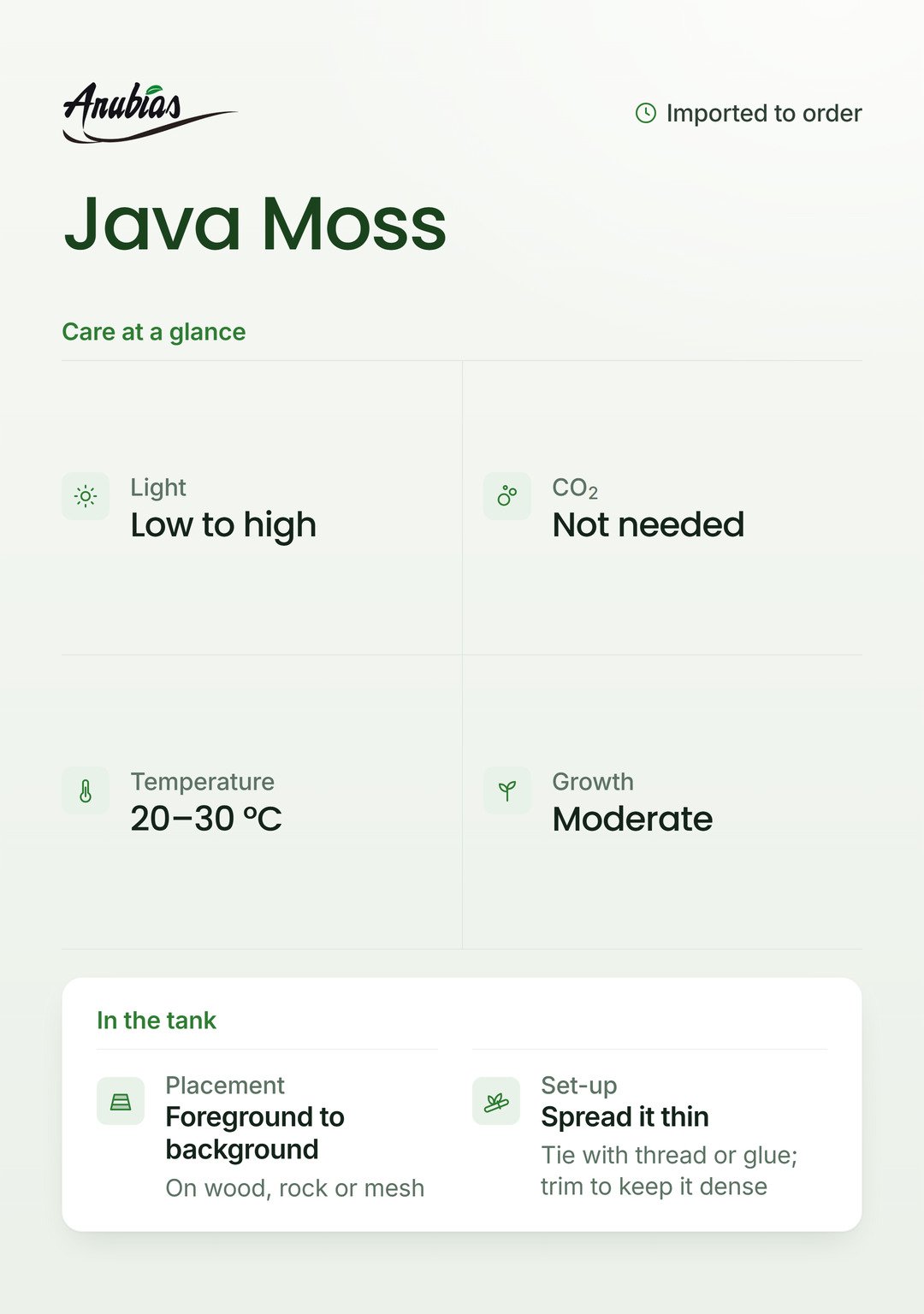
| Scientific name | Taxiphyllum barbieri (often mislabelled Vesicularia dubyana) |
|---|---|
| Family | Hypnaceae |
| Origin | Southeast Asia: Vietnam, Thailand, Malaysia, Indonesia and the Philippines, on wet rocks and tree roots along streams |
| Difficulty | Very easy |
| Light | Low to high |
| CO2 | Not required |
| Temperature | 20–30 °C |
| pH | 5.5–8.0 |
| Growth rate | Moderate; steady but not quick |
| Height/size | Spreading mat 3–10 cm thick, unlimited width |
| Placement | Foreground to background on wood, rock, mesh; can float |
| Propagation | Division; every fragment grows |
How to plant java moss
Moss has no roots, so it is attached rather than planted. Thin and spread is the rule: a thin layer grips and grows, a thick lump rots from the inside.
- Rinse the portion in a bowl of tank water and pull it apart into small, loose tufts.
- Spread a thin layer, no more than 5 mm thick, over the wood, rock or stainless steel mesh you want to cover.
- Tie it down with cotton thread or fishing line in a criss-cross pattern, or fix small pieces with aquarium-safe cyanoacrylate gel. For a moss wall or carpet, sandwich it between two sheets of mesh.
- If you choose the optional attach-to-lava-rock add-on, the moss arrives already tied to a small rock.
- Place it where gentle flow passes over it so debris does not settle. In two to four weeks new strands grip the surface, and after that the thread can be removed or left to rot away.
Java moss can also simply be left floating, where it becomes a drifting fry refuge, but it looks tidiest attached.
Java moss care: light, CO2, fertiliser and water
Light. Anything from low to high. In low light it grows slowly, dark green and stringy; in medium light it is denser and brighter. Very high light without CO2 invites hair algae to grow through it, so moderate light for 6–8 hours is the sweet spot.
CO2. Not required. Java moss grows well in low-tech tanks. With CO2 it grows faster and tighter, which matters mainly for competition-style scapes.
Fertiliser. It takes nutrients straight from the water column, so a weekly dose of a complete liquid fertiliser is enough. In a shrimp or fry tank with regular feeding it usually needs nothing extra. Avoid heavy copper-based medications, which harm moss and shrimp alike.
Water. Java moss tolerates pH 5.5–8 and hard borewell water as well as soft water. It is happiest at 20–28 °C and copes with Indian summers up to 30 °C; long spells above that turn it brown, so shade the tank or add a fan across the surface in May and June. It survives monsoon power cuts easily. Good flow is the one thing it really wants: moss in still water collects mulm and suffocates. Weekly 25–30% water changes and an occasional swish to shake out debris keep it clean.
Growth, trimming and propagation
Java moss grows steadily rather than fast. A thin layer tied to wood grips in two to four weeks and fills in over two to three months; a full moss wall can take longer in low light without CO2. Growth is in all directions, so the mat gets thicker as well as wider.
Trim every two to four weeks with sharp scissors, taking off the top third and keeping the layer thin enough for light to reach the strands beneath. Net out the trimmings before they settle and start new colonies where you do not want them. Rinse the mat under a gentle stream during water changes to flush out trapped debris. Propagation is automatic: every trimmed fragment is a new plant. Tie the trimmings onto a new rock, or drop them into a breeding tank as floating cover.
Where to use it in an aquascape
Java moss fits any tank. In a 1 ft nano of 15–20 litres, a mossy stone or a small moss-covered branch is the whole scape. In 2 ft tanks of 50–60 litres, cover driftwood branches with moss to make a moss tree, or build a moss wall on mesh against the back glass. In 3–4 ft tanks of 100–200 litres, use it to blur the line between hardscape and substrate so rocks look aged and natural.
Combine it with Anubias nana and Java fern on the same wood, with carpeting plants in front and stem plants behind. It is the standard plant for cherry and crystal shrimp tanks, where it holds biofilm and hides shrimplets, and for breeding egg-scattering fish such as tetras, danios and rainbowfish, whose eggs fall into the moss out of reach of the parents. Bettas and gouramis rest in it. Avoid goldfish and large cichlids, which tear it apart.
Common problems and fixes
- Browning in the middle of the clump. Cause: layer too thick, no light or flow reaching the centre. Fix: trim thin and spread the moss out.
- Hair or thread algae growing through it. Cause: too much light or nutrients. Fix: shorten the photoperiod, add Amano shrimp, pull out algae by hand with a toothbrush, and in bad cases remove the moss and start a fresh clean portion.
- Moss full of debris. Cause: poor flow. Fix: improve circulation and rinse the moss at each water change.
- Moss floats away. Cause: thread rotted before the moss gripped, or fish pulling at it. Fix: retie and give it more time.
- Turning brown in summer. Cause: water above 30 °C. Fix: cool the tank with a fan or ice packs in the water change.
- Growing stringy and sparse. Cause: very low light. Fix: increase light slightly and trim to encourage branching.
What you receive
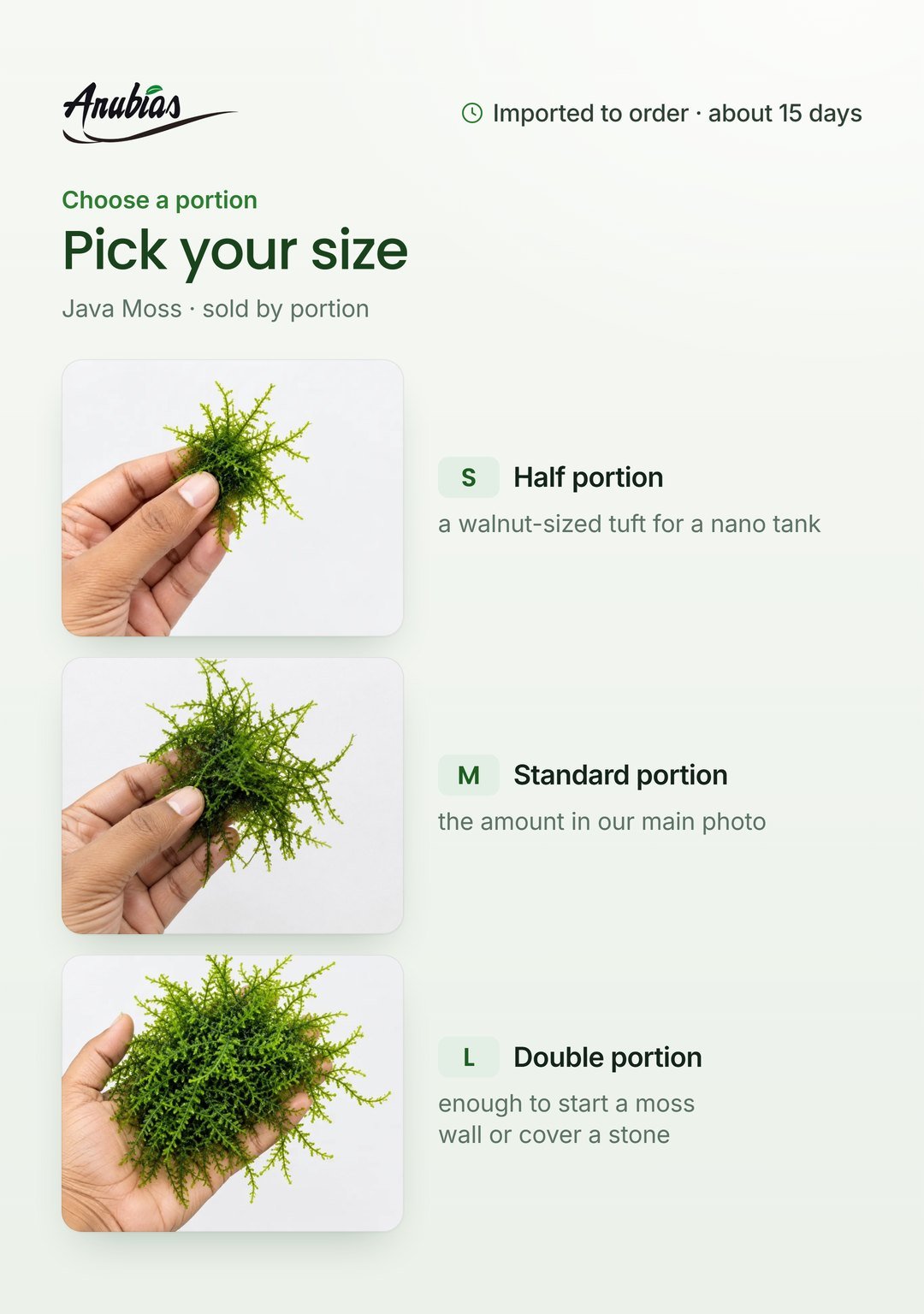
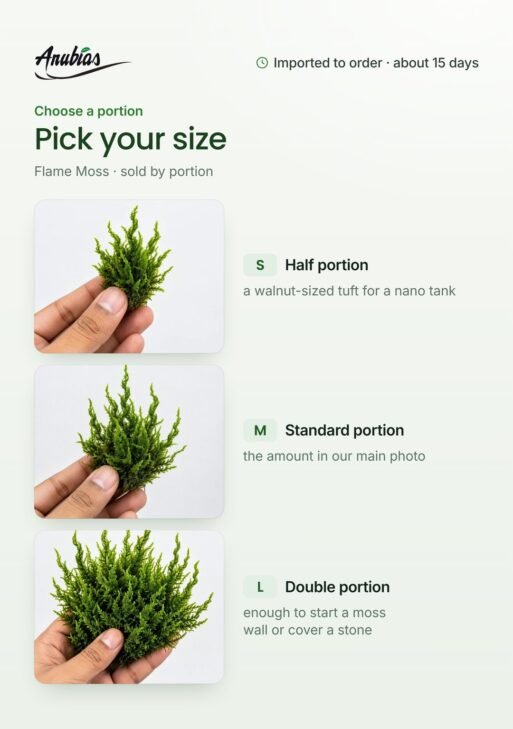
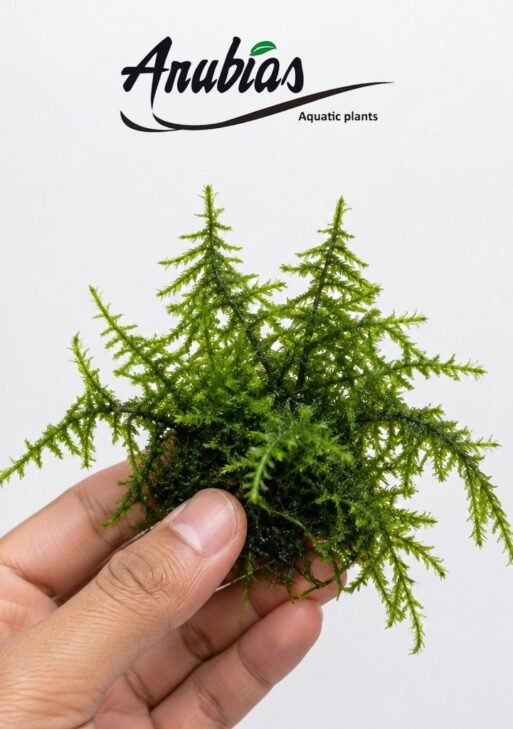
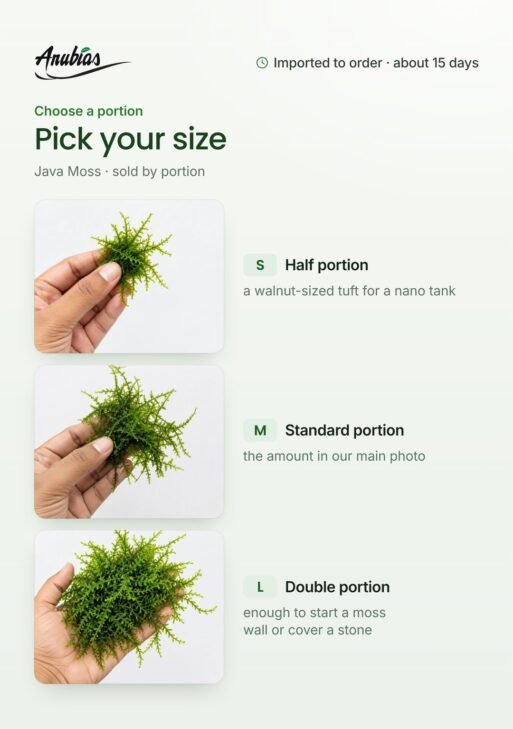
One healthy portion of java moss of the size you select (S, M or L), similar to the photo. Each portion is checked before packing, packed moist and shipped across India from Surat. ₹99 shipping, free on orders of ₹999 or more.
Live-arrival guarantee: record one continuous unboxing video within 4 hours of delivery and we will refund or replace a plant that arrived damaged.
FAQ
Does java moss need CO2?
No. It grows well without CO2 in a low-tech tank. CO2 only makes it faster and denser.
Is java moss good for beginners?
Yes. It tolerates low light, hard water and heat. Keep it thin and in flow and it grows for years.
How fast does java moss grow?
Steadily rather than fast. A thin layer grips in two to four weeks and fills in over two to three months.
Can java moss grow without substrate?
Yes. It has no roots and takes nothing from the substrate. Attach it to wood, rock or mesh, or let it float.
Java moss vs christmas moss: which is better?
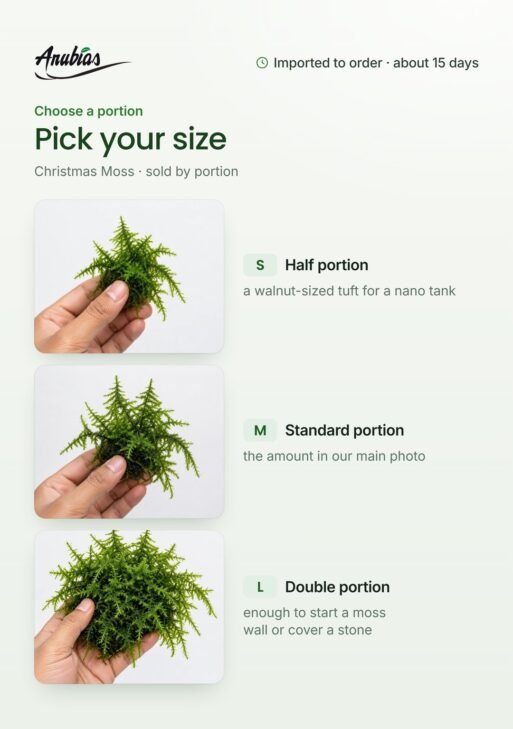
Java moss is tougher, cheaper and handles heat better; christmas moss grows in neater fir-tree fronds but prefers cooler water. For shrimp and breeding tanks choose java moss; for show scapes many prefer christmas moss.
Is java moss good for shrimp and fry?
It is the standard refuge plant. Shrimplets and fry hide in it and graze the biofilm, and egg-scattering fish spawn into it.
How do I attach java moss to driftwood?
Spread a thin layer and tie it with cotton thread or fishing line, or dab small tufts with cyanoacrylate gel. It grips in a few weeks.
Not sure what fits your tank? Plan it with our free AI tank planner.



There are no reviews yet.