
Description
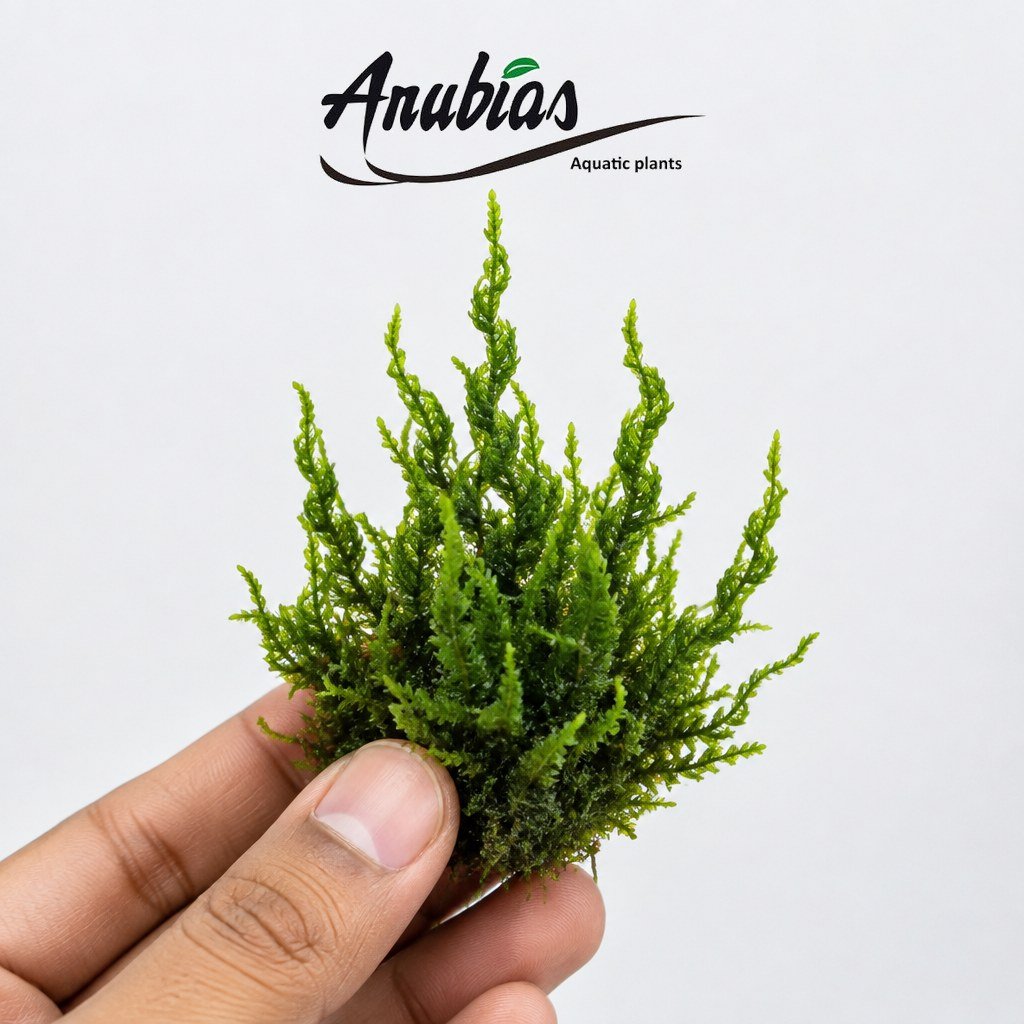
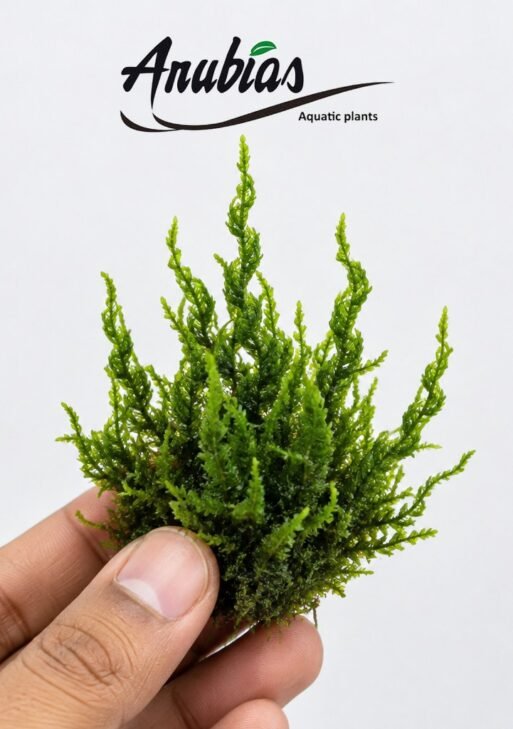
Flame moss (Taxiphyllum sp. ‘Flame’) is an aquarium moss that grows upward in twisting, spiralling tufts that look like small green flames, instead of spreading flat like Java moss. It is a hardy, low-light moss from South-East Asia that needs no CO2, attaches to wood and rock, and stays compact, which makes flame moss a favourite for nano tanks, shrimp tanks and detailed nature-style hardscape where a tidy, upright texture is wanted.
Flame moss at a glance
| Scientific name | Taxiphyllum sp. ‘Flame’ (trade name; a Taxiphyllum moss) |
|---|---|
| Family | Hypnaceae |
| Origin | South-East Asia (widely reported from Vietnam and surrounding regions) |
| Difficulty | Easy |
| Light | Low to medium |
| CO2 | Not required; gives denser, faster growth |
| Temperature | 18–28 °C, ideally 22–26 °C |
| pH | 5.5–7.5 |
| Growth rate | Slow to moderate (slower than Java moss) |
| Height/size | Tufts 5–10 cm tall, rarely more |
| Placement | Foreground to midground, attached to wood or rock |
| Propagation | Division; any fragment regrows |
How to plant flame moss
Flame moss has no true roots. It holds on with tiny rhizoids, so it must be fixed to a surface until it grips by itself.
- Rinse the portion in a bowl of tank water and pick out any debris or loose strands.
- Pull the clump into thin, flat pieces. A thin layer attaches faster and grows more evenly than a thick ball, whose centre gets no light.
- Lay the pieces on driftwood, lava rock or a small stone and wrap them with cotton thread or fine fishing line, spacing the wraps about 1 cm apart. Cotton rots away in a few weeks; by then the moss is anchored.
- For a vertical effect, attach it to upright branches or the face of a rock so the tufts grow straight up like a row of flames.
- Place it where gentle flow passes over it. Still water lets debris settle in the moss; strong jets flatten the tufts.
If you select the lava rock option, the moss arrives already tied to a natural lava rock and can be placed straight into the tank. Avoid planting flame moss loose on the substrate, where it collects mulm and smothers.
Flame moss care: light, CO2, fertiliser and water
Light. Low to medium light for 6–8 hours a day is enough. Flame moss grows more upright and compact under medium light; under very low light the tufts open up and grow loosely. More light than that mostly feeds algae on the moss, so resist the urge to turn it up.
CO2. Not needed. In a low-tech tank flame moss grows slowly and steadily. With CO2 injection the tufts come in thicker and taller and the colour deepens. Liquid carbon can brown it if overdosed, so start at half strength.
Fertiliser. A light weekly dose of a complete liquid fertiliser speeds growth slightly. Moss takes everything through its leaves, so root tabs do nothing for it. In a tank with fish, the waste alone is often enough.
Water. Clean, cool water is the main thing. Flame moss is happiest at 22–26 °C and tolerates ordinary Indian tap water, hard or soft, as long as it is stable. In summer, when tanks drift to 30 °C and above, moss can brown and thin out. A fan across the water surface, a shaded room or an air-conditioned space makes a real difference. During monsoon power cuts the moss is fine for a day or two without flow; just restart the filter promptly so debris does not settle. Weekly 25–30% water changes keep the tufts clean.
Growth, trimming and propagation
Flame moss is slower than Java moss. A small portion takes two to three months to thicken into a proper cushion, and tufts rarely exceed 10 cm in height. The upside is that it needs far less trimming and stays where you put it.
Trim with sharp scissors when the tufts grow too tall or stray strands wander onto the glass or neighbouring plants. Thin dense clumps now and then so the lower parts still receive light and flow; a clump that is too thick browns inside and can lift off its anchor. Net out the cuttings right away, because every fragment grows wherever it lands.
To propagate, cut or tear off a piece and tie it to a new surface; moss regrows from any healthy fragment.
Where to use it in an aquascape
The upright habit is what sets flame moss apart. Attach it to vertical driftwood branches so the “flames” rise in a line, tuck it into the crevices of dragon stone or seiryu in an Iwagumi layout, or cover a small mound of lava rock for a soft green hill in the foreground. It is a natural fit for nano tanks of 1 ft (around 15–25 litres), where a spreading moss would take over, and it works just as well in 2–3 ft tanks (60–120 litres) as a textural accent among larger plants.
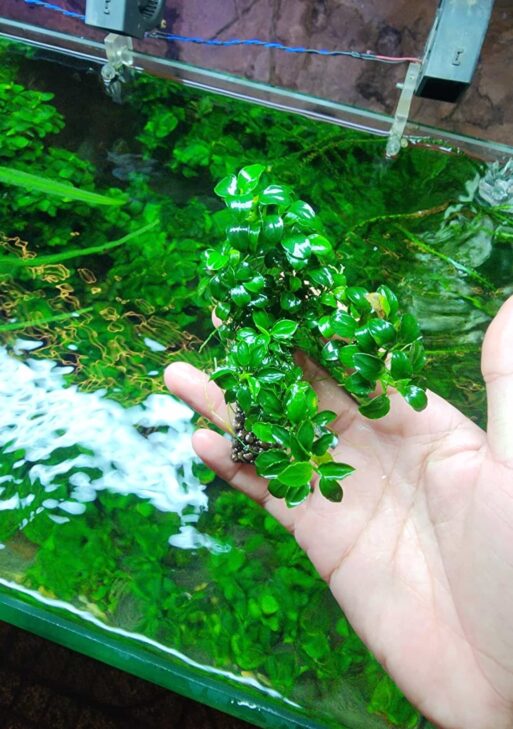
Pair it with Anubias nana and Java fern, which share its low-light, no-CO2 needs, and set it against a fine carpet from our carpeting plants for contrast in texture. Colourful stem plants behind it make the moss look greener.
Flame moss is ideal for shrimp tanks: cherry, crystal and Amano shrimp graze the biofilm on it all day, and shrimplets hide in the tufts. It is also safe with bettas, rasboras, tetras, otocinclus and small gouramis. Avoid goldfish and large cichlids, which uproot and eat it.
Common problems and fixes
- Browning after arrival. Some strands brown during transit and adjustment. Fix: trim the brown parts, keep the water cool and clean, and fresh green growth appears within a few weeks.
- Browning in summer. Water above 28–30 °C for weeks weakens the moss. Fix: cool the tank with a fan or frozen water bottles during peak heat and increase water changes.
- Hair algae tangled in the moss. Cause: too much light or excess nutrients. Fix: shorten the photoperiod, add Amano shrimp, and remove heavily infested tufts rather than treating the whole clump.
- Loose, stringy growth. Cause: too little light. Fix: raise the light slightly or move the moss higher in the tank.
- Debris and mulm stuck in the tufts. Cause: weak flow. Fix: squeeze the moss gently during water changes and point the filter outflow so a gentle current passes over it.
What you receive
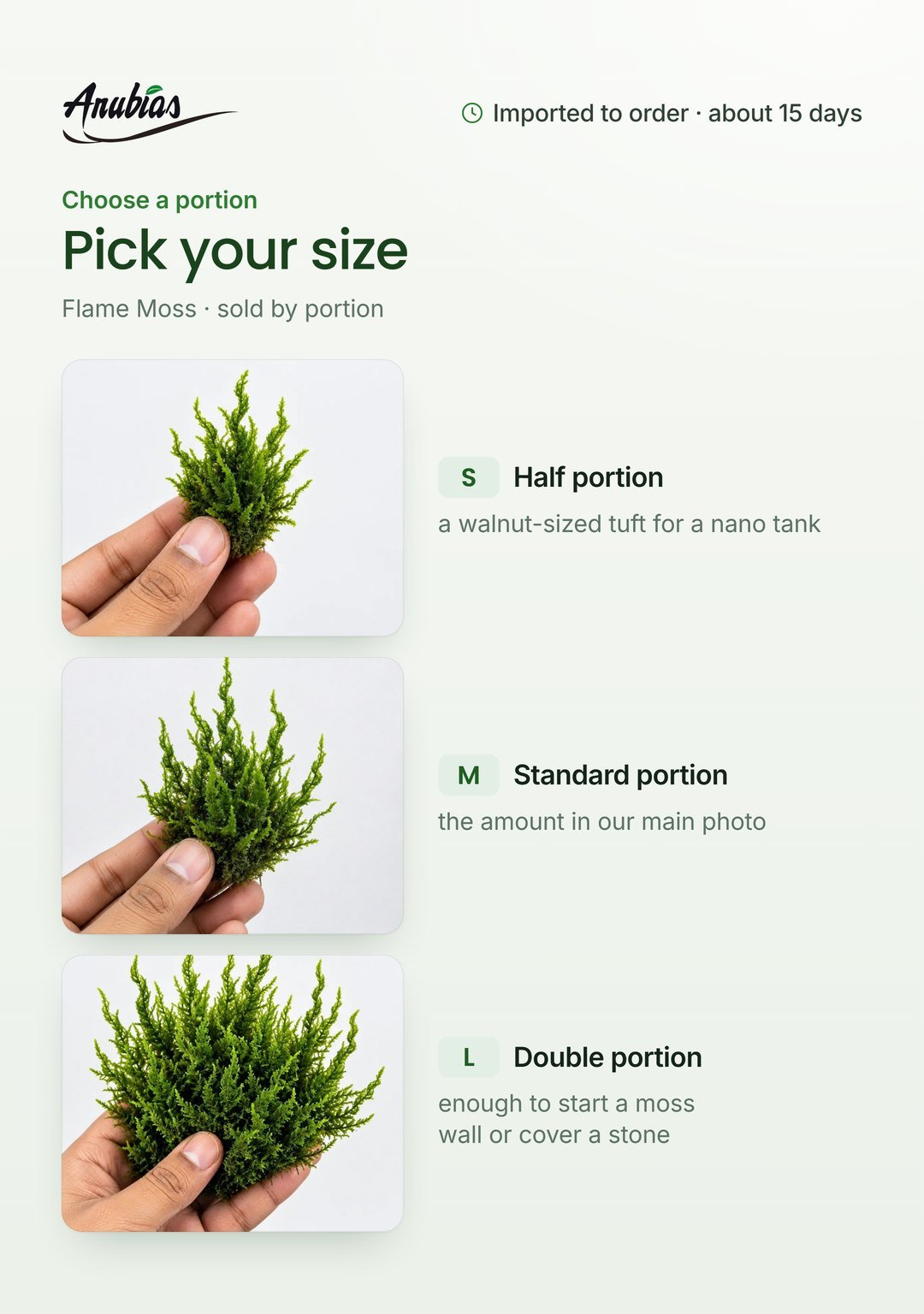
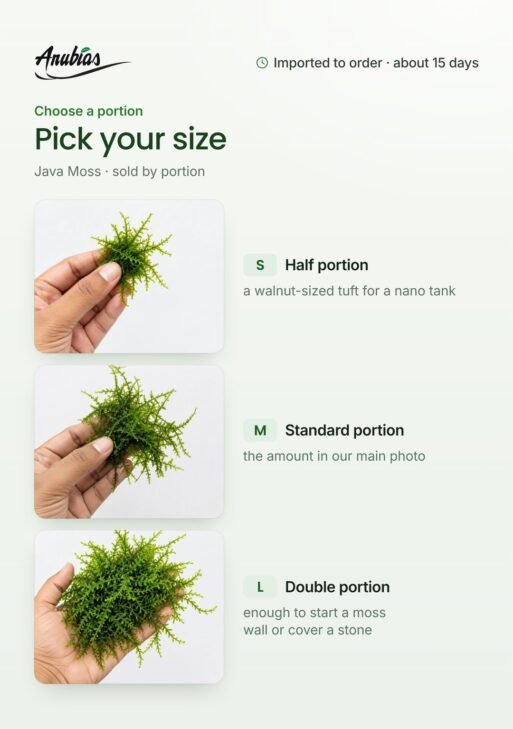
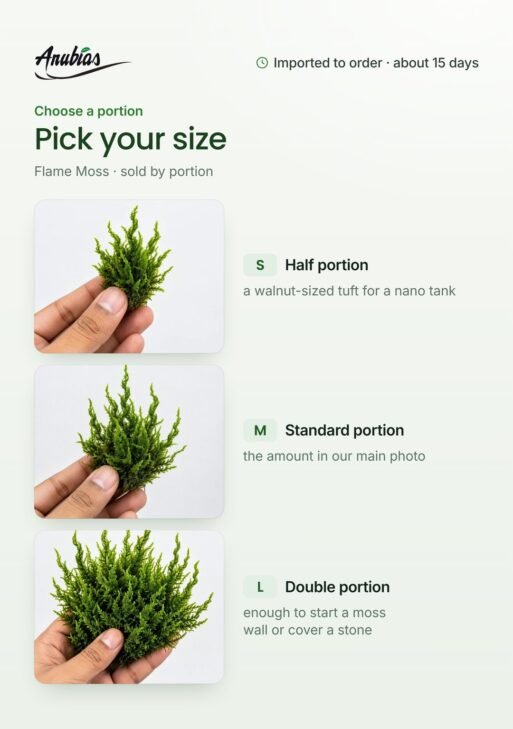
One healthy flame moss portion of the size you select (S, M or L), similar to the photo. Each portion is checked before packing, packed moist and shipped across India from Surat. ₹99 shipping, free on orders of ₹999 or more. Choose the lava rock option if you want it to arrive already attached.
Live-arrival guarantee: record one continuous unboxing video within 4 hours of delivery and we will refund or replace a plant that arrived damaged.
FAQ
Does flame moss need CO2?
No. Flame moss grows well in low-tech tanks without CO2. CO2 makes the tufts denser and taller, but it is optional.
Is flame moss good for beginners?
Yes. It tolerates low light, hard water and no fertiliser. Keep the water cool and clean, tie it on thinly, and it looks after itself.
How fast does flame moss grow?
Slowly compared with Java moss. Expect a small portion to thicken over two to three months; tufts stay under about 10 cm.
Flame moss vs Java moss: which is better?
Java moss grows faster and spreads in every direction, which is good for covering large areas. Flame moss grows upward in neat tufts and needs less trimming, which is better for small tanks and detailed hardscape.
Can flame moss grow on sand or gravel?
Not well. Loose moss on the substrate traps debris and rots. Attach it to wood, rock or a mesh pad instead.
Why is my flame moss turning brown?
Usually heat above 28–30 °C, old growth starved of light inside a thick clump, or a shock after transit. Trim the brown parts, thin the clump and keep the water cool.
Not sure what fits your tank? Plan it with our free AI tank planner.













There are no reviews yet.