
Java Moss care requirements
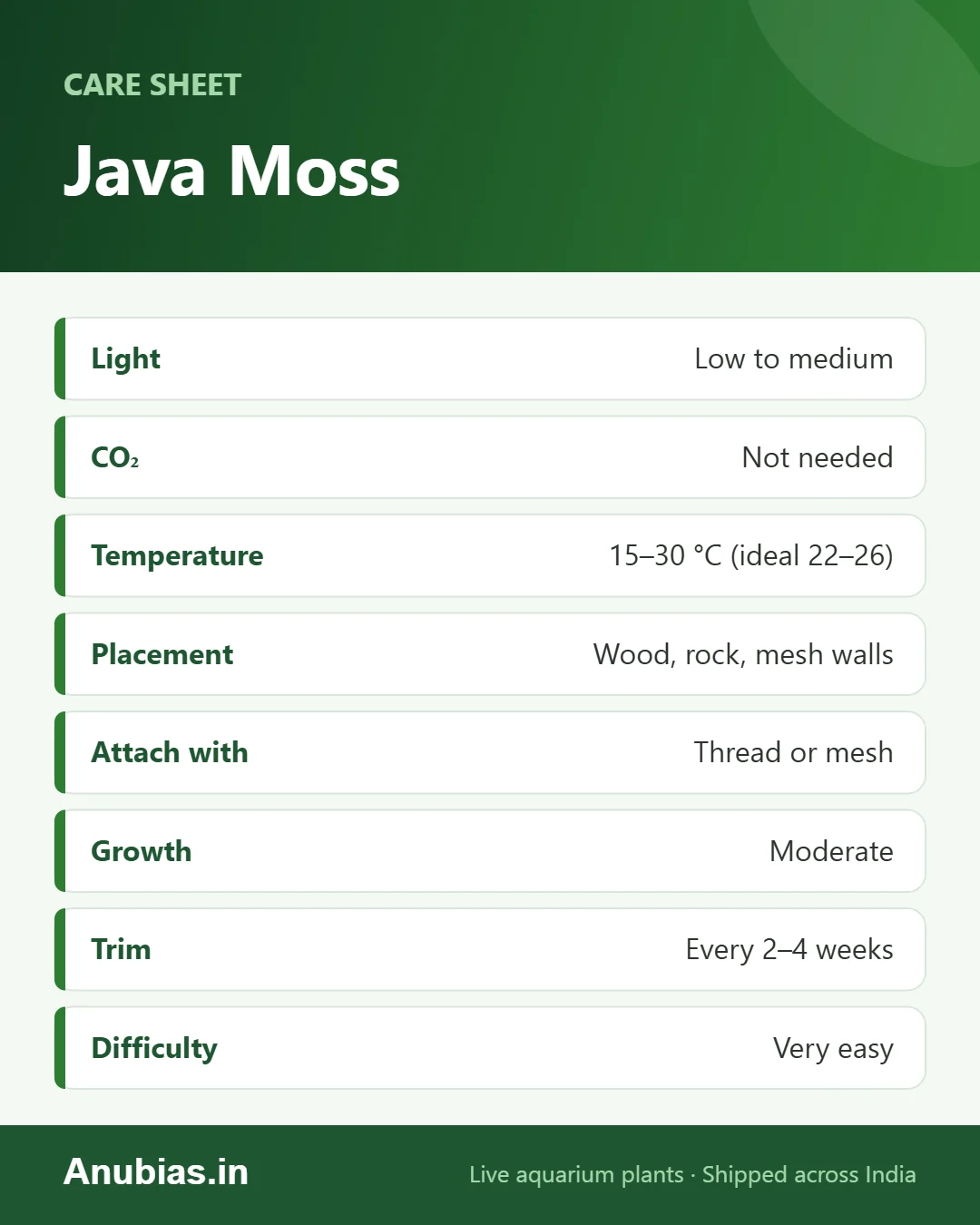
Quick answer: Java Moss needs very little: water at 15–30°C (ideally 22–26°C), pH 5.5–8.5, hardness of 2–20 dGH and any light from very low to high, with no CO2 or substrate. Tie it to rock or driftwood with cotton thread; its rhizoids grip on their own within 2–4 weeks. Trim every 2–4 weeks.
What Is Java Moss?
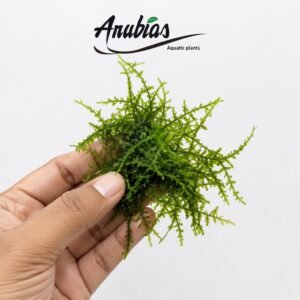
Java Moss (Taxiphyllum barbieri) is a freshwater moss native to Southeast Asia, growing on rocks, tree roots and riverbanks. It’s still sold under the older name Vesicularia dubyana in places, but Taxiphyllum barbieri is the correct ID.
Unlike Java Fern or Anubias, Java Moss has no leaves or rhizome in the usual sense — just a mass of thin, branching stems covered in tiny overlapping leaflets a couple of millimetres long, with no real root system. It anchors itself using rhizoids, fine thread-like structures that grip onto wood, rock and mesh.
That structure is why Java Moss is one of the most forgiving plants you can keep. It needs no substrate and no CO2, and shrugs off wide swings in light, temperature and hardness. Growth is slow in a dim tank and quick under bright light and CO2, but it grows either way. If you’ve killed every stem plant you’ve tried, this one is close to unkillable.
The Many Uses of Java Moss
This is where Java Moss earns its keep over most beginner plants — it isn’t just something you plant and leave, it’s a tool with several different jobs in the same tank.
Carpeting Rocks and Driftwood
Tied onto rock or wood, Java Moss spreads outward over several weeks into a thick green mat that follows the contour of whatever it’s attached to — the classic “aged rock” or mossy-log look in nature-style aquascapes, and one of the easiest carpet effects to pull off since it needs no substrate contact at all.
Background Walls
Sandwiched between two sheets of plastic mesh and mounted against the back glass or a frame, Java Moss fills into a solid green wall within a couple of months — a common way to hide equipment like heaters, filter intakes and wiring behind a living backdrop instead of a printed background.
Breeding and Fry Cover
Arguably its most practical job. A dense clump gives cherry shrimp somewhere to graze on biofilm and somewhere to hide while moulting, when they’re most vulnerable. For egg-scatterers like tetras, danios and killifish, moss near the bottom catches falling eggs and hides them from adults that would otherwise eat them, then shelters the fry and hosts the infusoria they feed on in their first days.
Moss Walls and Aquascaping Accents
Beyond flat backgrounds, Java Moss gets shaped into moss “trees,” draped over branch forks to mimic hanging vegetation, or packed into hardscape gaps to soften harsh lines. It’s cheap and fast-growing enough to experiment with shapes without wasting an expensive plant.
Layered With Anubias and Bucephalandra
On driftwood, Java Moss ties in well around the base of Anubias and Bucephalandra rhizomes, filling the gaps between them and softening the wood-to-plant transition. A piece that looked freshly planted a month ago starts looking established once the moss fills in around it.
Water Parameters and Light Requirements
Java Moss isn’t fussy, which is exactly why it fits into so many different setups.
| Parameter | Tolerated Range | Ideal Range |
|---|---|---|
| Temperature | 15–30°C | 22–26°C |
| pH | 5.5–8.5 | 6.5–7.5 |
| GH (hardness) | 2–20 dGH | 4–12 dGH |
| Light | Very low to high | Low to moderate |
| CO2 | Not required | Optional, speeds growth |
| Flow | Low to moderate | Gentle, not stagnant |
Higher light and CO2 push faster, denser growth, but also raise the risk of algae settling into the mat before the moss can outcompete it — more on that below. For most home tanks, low to moderate light with no CO2 gives the best balance of manageable growth and a clean mat.
How to Attach Java Moss
Java Moss has no rhizome and no single root point, so it doesn’t attach the way Anubias or Bucephalandra do.
Thread or fishing line is the standard method. Press a small clump against the wood or rock, then wind thin cotton thread or clear fishing line around it a few times and tie off. Cotton thread breaks down in the tank, by which point the rhizoids have usually gripped the surface on their own — typically 2 to 4 weeks. Fishing line lasts longer and can stay in place indefinitely.
Super glue (cyanoacrylate gel) is the go-to for Anubias and Bucephalandra, but it’s a poor fit for moss. Gluing suits a single rhizome with one clear contact point; Java Moss is a loose mass of dozens of thin stems, so glue bonds only the outer layer while the rest sits loose, and you’ll waste half the tube dabbing it on evenly. Thread or mesh gives a far more even, reliable hold.
Mesh works best on flat surfaces such as background walls or large rock faces: sandwich moss between two pieces of fine plastic mesh and pin or tie it in place.
You can also wedge moss into crevices or weigh it down loosely — it isn’t picky, and stray bits that break off will often latch onto nearby surfaces on their own.
Growth Habit and Trimming
Left alone, Java Moss doesn’t stay a tidy mat. It sends out longer, straggly strands in every direction, especially where it isn’t pressed against a hard surface. These loose wisps eventually detach, float around the tank, and get pulled into filter intakes.
Regular trimming is what keeps a mat looking like a mat instead of a green tumbleweed. Trim every 2 to 4 weeks as a rough guide — more often under strong light and CO2, less often in a low-tech tank. Use sharp, curved aquascaping scissors and treat it like a haircut: skim across the surface instead of snipping individual strands, keeping the cut close and even. This pushes the moss to branch sideways instead of growing tall and thin, giving you that dense, cushion-like carpet look over time.
Avoid pulling or ripping clumps out by hand — it tears the rhizoids holding the moss in place and can take chunks of the mat with it. Save the trimmings; small clumps tied onto new wood or rock will start additional mats elsewhere in the tank.
Common Problems
Turning brown or melting after arrival. Java Moss is usually grown emersed (out of water) by nurseries, and the switch to fully submerged conditions causes some of that growth to brown and die back. This is a normal transition, not a dead plant — new green growth typically shows up within one to two weeks. Trim away the obviously dead bits once fresh growth is established, rather than judging the plant on its first week.
Algae taking hold inside the mat. The same dense structure that traps detritus and biofilm also makes Java Moss a magnet for algae in tanks with too much light or nutrients relative to flow. Slow-moving water lets algae spores settle into the mat before the moss can outcompete them. If hair algae or a green film spreads through it, cut back light duration or intensity first, improve circulation, and pull out what you can reach by hand.
Detritus buildup inside the mat. The same trapping effect that makes moss useful for fry also collects fish waste, uneaten food and dead leaf litter over months, especially in a thick mat’s centre. Rinse the moss occasionally — lift it out and swish it in a bucket of tank water, or blast it with a turkey baster in place — to clear the buildup without disturbing the attachment.
Java Moss vs Other Mosses
Java Moss isn’t the only moss in the hobby, and it’s worth knowing the difference so you don’t end up with the wrong one. Christmas Moss (Vesicularia montagnei) branches more regularly, giving it a denser, triangular “fir tree” look compared to Java Moss’s looser growth. Flame Moss (Taxiphyllum sp.) grows upright in twisting spirals, better suited to vertical accents than flat mats. Weeping Moss (Vesicularia ferriei) sends out long strands that droop downward, closer to a willow than a carpet. All share Java Moss’s easy-going care — low light, no CO2 needed — but growth habit differs, so pick based on the shape you want.
Shop the plants in this guide: Browse our Java Fern & Moss category for ready-to-attach Java Moss portions, and pair it with Anubias or Bucephalandra if you’re building out a full driftwood layout that needs zero CO2 to thrive.
Java moss pairs naturally with Java fern on the same piece of wood — see our Java fern care guide for a classic low-tech combo.
Fancy comparing species before you commit? Browse all the aquarium moss we stock — every portion ships pest-checked across India.
Frequently asked questions
What water parameters does Java Moss need?
Java Moss tolerates 15–30°C, pH 5.5–8.5 and 2–20 dGH, with an ideal range of 22–26°C, pH 6.5–7.5 and 4–12 dGH. It grows in very low to high light and does not need CO2, though CO2 speeds up growth.
How do I attach Java Moss to driftwood or rock?
Press a small clump against the surface and wind cotton thread or clear fishing line around it a few times, then tie off. Cotton thread breaks down in the tank, by which point the rhizoids have usually gripped on their own, typically within 2 to 4 weeks.
How often should Java Moss be trimmed?
Trim every 2 to 4 weeks as a rough guide, more often under strong light and CO2 and less often in a low-tech tank. Use sharp curved scissors and skim across the surface like a haircut, which pushes the moss to branch sideways into a dense mat.
Why is my new Java Moss turning brown?
Nurseries usually grow Java Moss emersed, so the switch to fully submerged conditions causes some growth to brown and die back. This is a normal transition rather than a dead plant, and new green growth typically appears within one to two weeks.
Do shrimp eat Java Moss?
Not really. Shrimp graze the biofilm, algae and trapped food that collect inside Java Moss rather than the moss itself, which is why it is one of the best plants for a shrimp tank. Healthy moss is left alone; only strands that are already dying get picked apart.
How fast does Java Moss grow?
Java Moss is a slow-to-moderate grower. In a low-tech tank without CO2 it adds only a little growth each month, while brighter light, CO2 and fertiliser speed it up noticeably. Expect a thin layer tied onto wood to thicken into full cover over several weeks to a few months.
Can Java Moss grow floating?
Yes. Java Moss has no true roots and takes its nutrients from the water, so a free-floating clump keeps growing. Loose moss tends to drift into the filter and look untidy, so most keepers tie it to wood or rock, or let it settle as a loose mat for fry and shrimp.
Grown in Surat (pre-order plants imported to order) · live-arrival guarantee with a 4-hour unboxing video · ₹99 shipping, free from ₹999