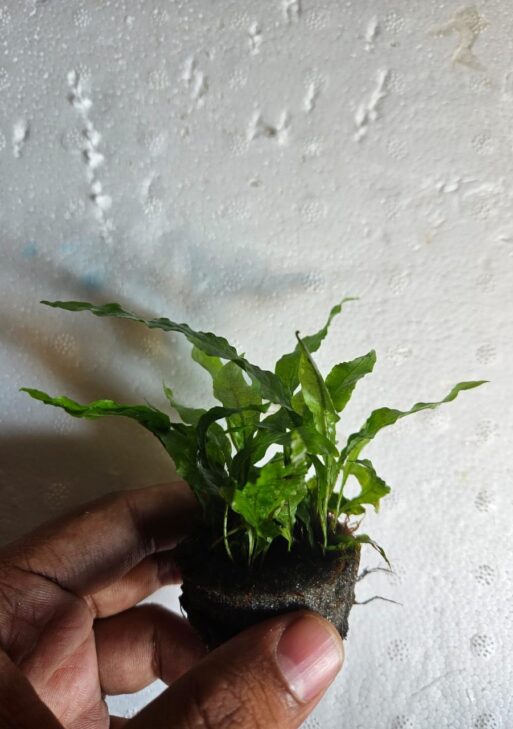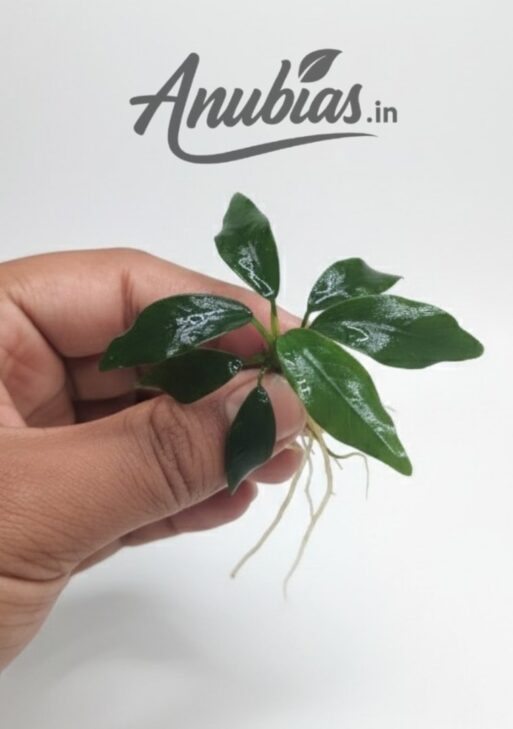


Christmas moss and Flame moss are both easy, decorative mosses, but they grow in opposite directions: one spreads flat and layered, the other grows upward. That makes the choice mostly about the look you want.
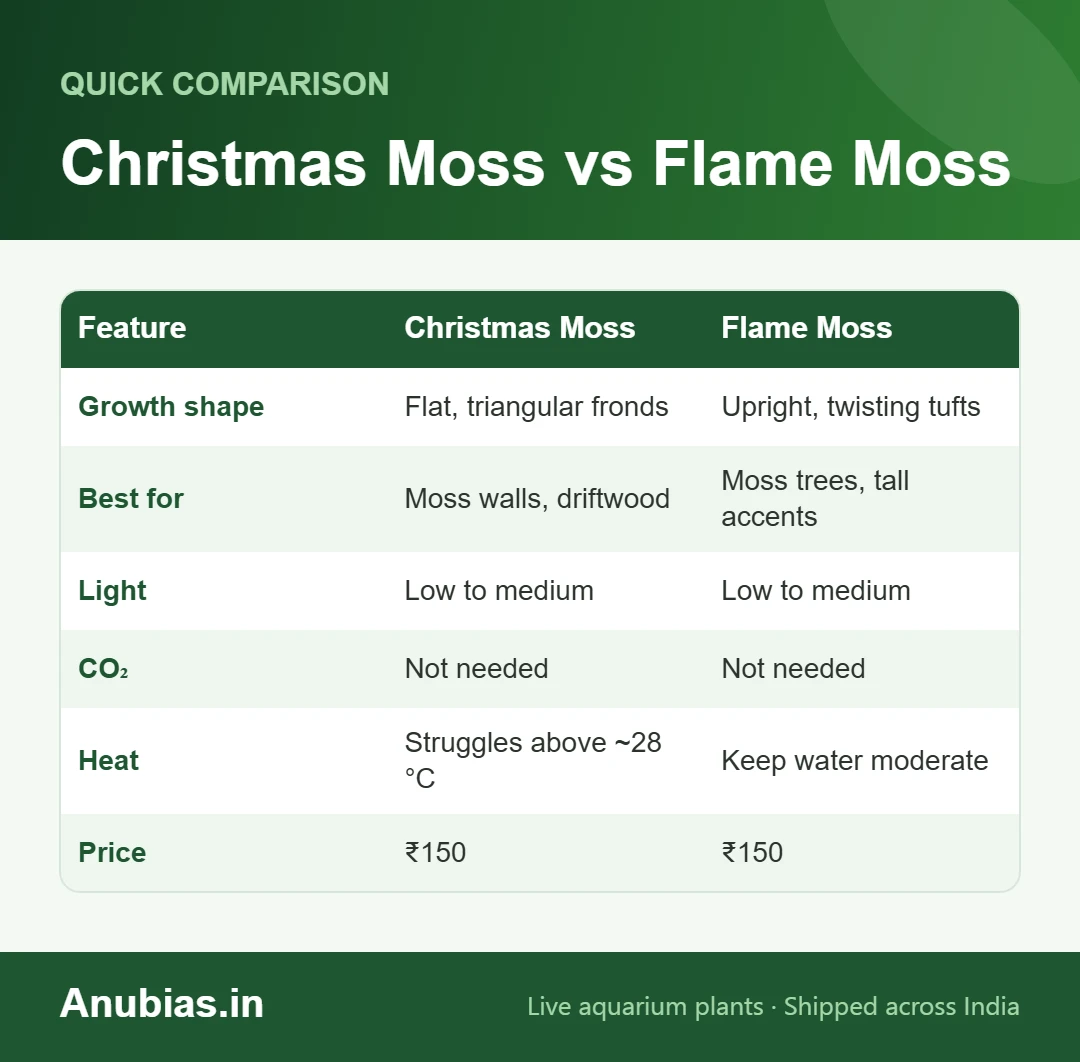
Quick answer: Christmas moss grows in flat, triangular fir-tree-shaped fronds that look neat on moss walls and driftwood, while Flame moss grows upright in twisting, flame-like tufts that suit moss trees and tall accents. Both need only low to medium light and no CO2, and both attach to wood or rock. Christmas moss prefers about 20–26°C and struggles in very warm tanks above about 28°C. Both cost ₹150 on Anubias.in.
Growth shape
Christmas moss builds layered, drooping fronds like tiny fir branches. Flame moss sends up dense vertical columns that twist like flames, so it adds height rather than spreading sideways.
Care
- Low to medium light, no CO2 needed.
- Gentle water flow and a trim every few weeks.
- Attach thin portions to wood, rock or mesh with thread. How to attach moss.
- In Indian summers keep tanks cool; Christmas moss struggles above about 28°C. Summer cooling tips.
Which to use where
- Moss wall or covering flat wood: Christmas moss.
- Moss tree or upright accent: Flame moss. Moss tree and wall guide.
- Hardiest and cheapest: Java moss, see Java moss vs Christmas moss.
More aquarium moss guides:
Tying moss so it actually attaches
Most moss failures happen in the first fortnight, before the moss has gripped anything. A thin, even layer attaches far better than a thick pad, because the lower strands in a thick clump get no light or flow and rot away, taking the attachment with them.
- Tear the portion into small pieces and shake out any brown or mushy strands before you start.
- Spread it over the wood or stone in a layer barely thicker than the moss itself, letting the surface show through in places.
- Wind cotton thread across it in loose criss-cross passes rather than tight bands, which crush the strands.
- Place the piece where gentle flow reaches it and leave it completely alone for three to four weeks.
- Give it the first light trim once new growth stands clear of the thread, which encourages branching and thickens the mat.
Cotton thread rots away by itself in a couple of months, which is convenient. Fishing line holds better on awkward shapes but has to be removed by hand later.
Getting moss through an Indian summer
Heat is the main reason mosses fail here, and it usually shows as browning from the inside of the clump outward while the tips still look fine. Once a tank sits above 29 or 30 degrees for weeks, the finer-leaved mosses struggle badly.
A few practical measures help. Drop the water level by an inch and run a small clip fan across the surface, which commonly buys two to three degrees through evaporation, though it means topping up more often. Keep the tank off exterior walls that bake in the afternoon. Increase flow slightly, because stagnant warm water around a dense moss mat is what starts the rot.
Trim harder going into the hot months than you would otherwise. A thinner mat survives heat much better than a dense pillow, and the trimmings will regrow once temperatures drop after the monsoon. If a clump does brown out in the middle, pull it apart, discard the dead core, and re-tie the healthy green strands as a fresh thin layer rather than trying to nurse the whole pad back.
Plants in this guide

Frequently asked questions
Which grows faster, Christmas moss or Flame moss?
Both are slower and tidier than Java moss; choose by shape rather than speed.
Can I mix Christmas moss and Flame moss?
Yes. Keep them on separate pieces of hardscape so the different textures stay distinct.
Do these mosses need CO2?
No. Both grow in low to medium light without CO2.
Shop Christmas moss and Flame moss on Anubias.in.
How often should moss be trimmed?
Roughly once a month once it is established, and more often in warm weather when growth is faster. Regular trimming is what keeps a mat dense, because cutting the tips makes the strands branch instead of growing long and stringy. It also stops the lower layer being shaded out and rotting.
Why is my moss brown at the base but green on top?
That pattern means the lower strands are not getting light or water flow, which is normal in a mat that has grown too thick. Trim the whole piece back hard, remove the dead brown material, and let the green growth spread again over a thinner layer. Improving circulation around the piece prevents it recurring.
Can moss grow without being attached to anything?
Yes, loose moss will keep growing as a floating or resting clump, and many keepers use it that way in breeding and shrimp tanks. It just will not form the shaped mat that makes a moss wall or moss tree look right, and it tends to collect detritus in the middle. Attach it if the appearance matters, leave it loose if the function does.