

Java moss and Christmas moss look best growing over driftwood and stones, but they will not stick on their own at first. Once attached, their rhizoids grip the surface within a few weeks. Here are three simple, aquarium-safe ways to attach moss.
Quick answer: Attach aquarium moss by spreading a thin layer over rock or driftwood and fixing it with cotton thread, small dots of aquarium-safe gel superglue, or by sandwiching it between two pieces of mesh. Keep the layer thin so the lower moss gets light and flow. The moss grips the surface with its rhizoids in about 2–4 weeks, after which thread can be left to dissolve or removed.
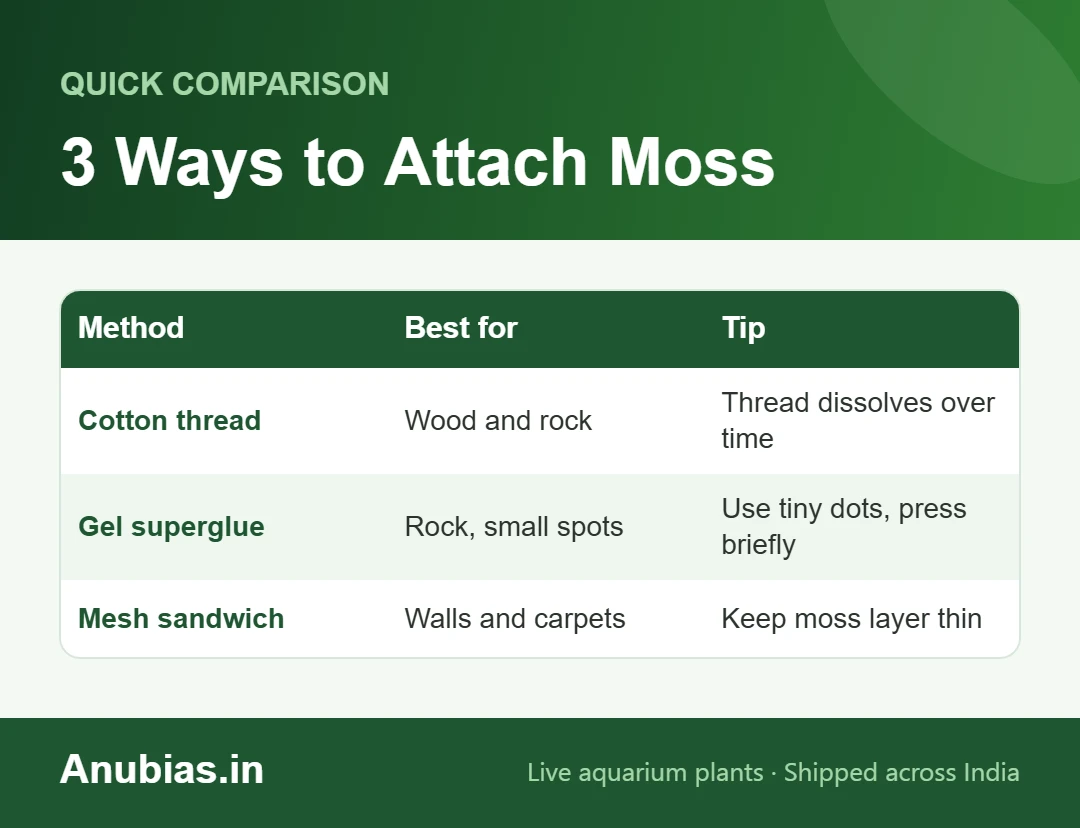
Method 1: Cotton thread
- Tease the moss into a thin, even layer.
- Lay it over the wood or rock.
- Wrap cotton thread around it several times and tie off.
- The thread breaks down as the moss attaches.
Method 2: Gel superglue
- Dry the spot on the hardscape with a paper towel.
- Add small dots of gel cyanoacrylate glue.
- Press small pieces of moss onto the glue for a few seconds.
- Return to water; the glue turns white but becomes inert.
Method 3: Mesh sandwich
- Spread a thin moss layer on stainless steel or plastic mesh.
- Place a second mesh sheet on top and tie the edges.
- Use it as a wall, carpet or wrap it around hardscape.
For projects, see our moss tree and moss wall guide.
Tips for success
- Use thin layers; thick clumps brown underneath. See why Java moss turns brown.
- Place moss in gentle flow to keep debris out.
- Trim every few weeks to keep it dense.
- Shrimp help keep attached moss clean.
More aquarium moss guides:
Preparing the moss and hardscape first
Ten minutes of preparation decides whether the moss grows evenly or browns off in patches. Do this before you pick up thread or glue.
- Rinse the moss in a bowl of dechlorinated water and swirl it gently. Debris, dead strands and any hitchhikers settle out.
- Pick out the brown and blackened strands with tweezers. Dead material never recovers and rots under whatever you tie over it.
- Trim the portion roughly with sharp scissors on a flat plate. Short, even pieces lie flatter and attach faster than long tangled strands.
- Scrub the rock or wood with a clean brush under a tap, with no soap, to remove loose dust and any existing algae film.
- Soak new driftwood until it sinks. Attaching moss to wood that still floats means redoing the job later.
- For the glue method, pat the hardscape dry with a cloth and work quickly, keeping the moss damp but not dripping.
Spread what you have over more surface than feels right. A thin scattering fills in; a thick pad browns from the inside out.
What goes wrong in the first month
Moss failures follow a small number of predictable patterns, and all are fixable if you catch them early.
- Brown centre, green edges. The layer was too thick and the middle is not getting light or flow. Lift it, thin it, and reattach.
- Moss lifting off in sheets. The rhizoids never gripped, usually because flow was too strong or the surface too smooth. Retie and choose rougher hardscape.
- Hair algae threading through it. The hardest problem, because you cannot pick algae out of moss cleanly. Reduce the photoperiod, add grazing shrimp, and trim the worst sections out rather than trying to save every strand.
- Fish or shrimp pulling it away. Common with barbs, goldfish and large cichlids. Use the mesh method rather than thread in those tanks.
- Melting after a hot week. Above roughly 30 degrees, moss slows and sheds older strands. Improve surface movement, keep the light short and wait it out.
A month of very little visible growth is not a failure. Moss establishes below the surface before it shows above it.
Plants in this guide

Frequently asked questions
Is superglue safe for aquarium moss?
Yes, gel cyanoacrylate glue is widely used and becomes inert once cured in water.
How long does moss take to attach?
Usually about 2–4 weeks for rhizoids to grip, depending on the moss and conditions.
Can I use fishing line instead of cotton?
Yes, fishing line lasts longer but should be removed once the moss has attached so it does not show.
Should I trim moss before I attach it or after?
Trim roughly before attaching and then again once it has gripped. Pre-trimming gives you short even pieces that lie flat and bond faster, while later trims control the shape once the rhizoids have taken hold. Cutting a freshly glued mat too soon can pull whole pieces away.
Why is the moss under my thread turning brown?
Almost always because it is packed too thickly and light cannot reach the layer underneath. Wrapping thread tightly compresses it further and traps debris against the surface. Lift the patch, thin it to a single loose layer, and wrap more loosely next time.
Does moss need to be attached at all?
No, moss grows perfectly well floating loose or resting in a corner. Attaching is about controlling where it sits and how it looks, not about keeping it alive. If you simply want a fry refuge or a shrimp grazing patch, a loose clump wedged behind a stone works just as well.