
Description
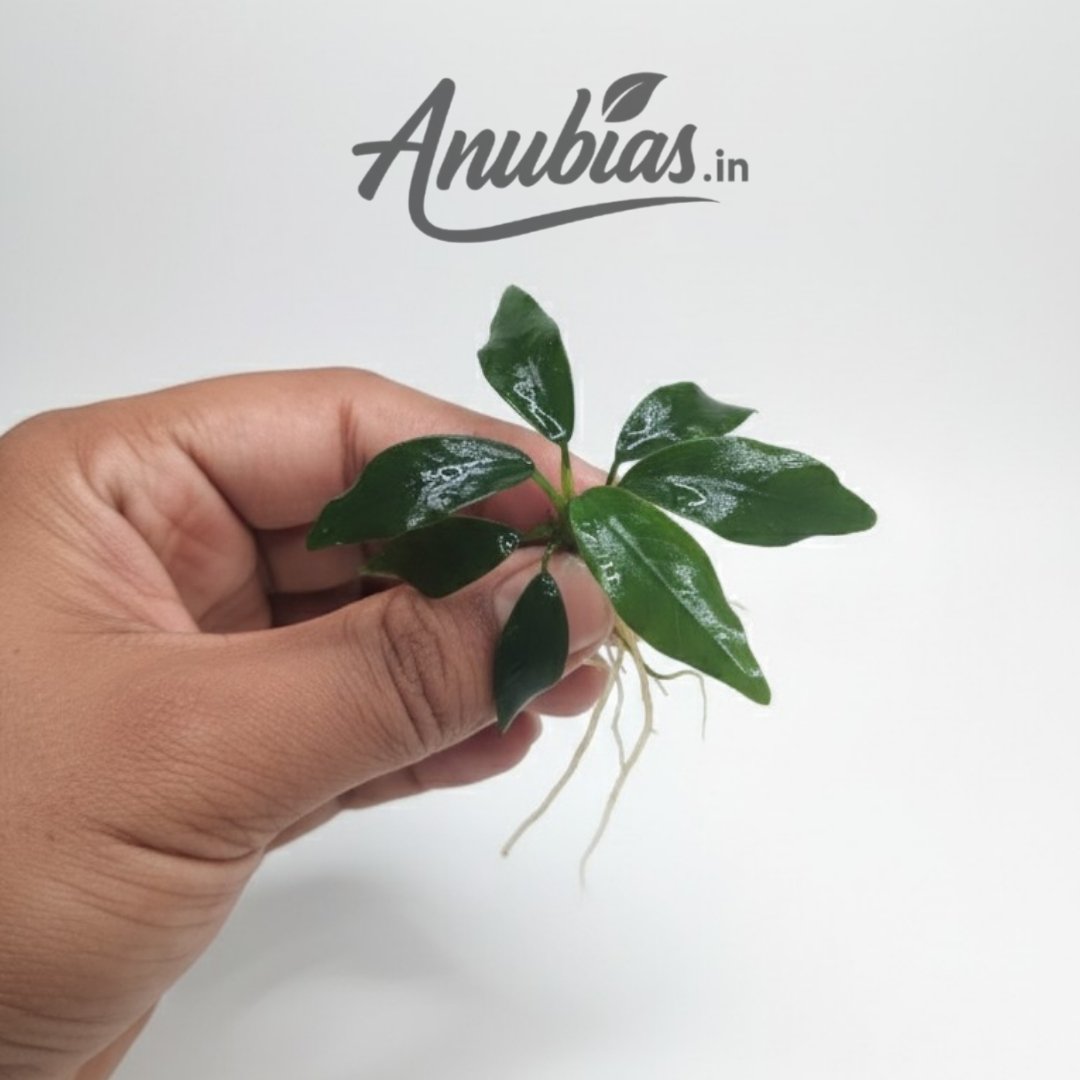
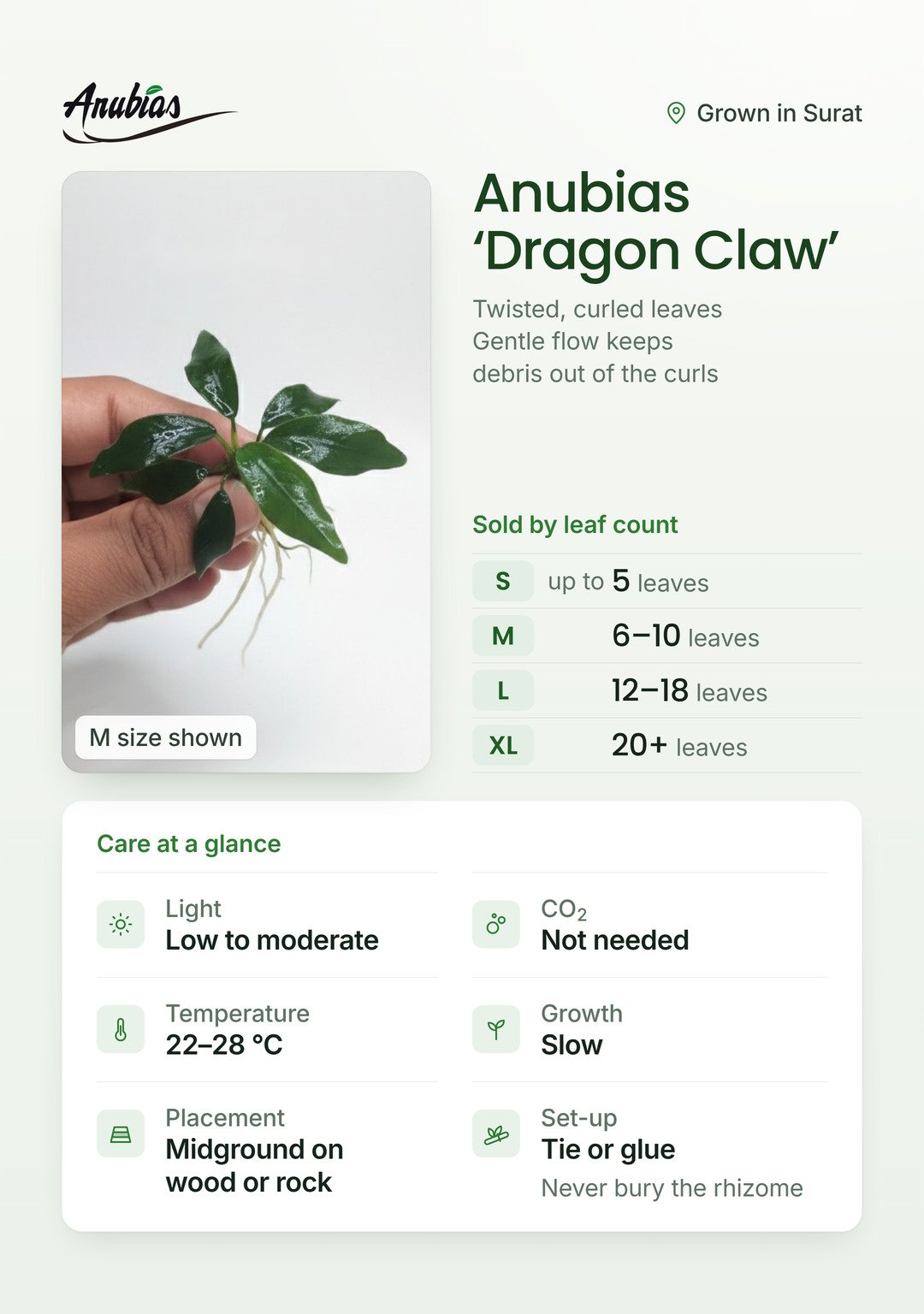
Anubias dragon claw (Anubias barteri ‘Dragon Claw’) is a cultivated anubias with twisted, curled leaves that fold back on themselves like a dragon’s talons, on a plant that usually grows 10–20 cm tall with leaves 5–8 cm long. The curl is the natural shape of this cultivar, not a sign of stress, and it gives the plant a texture no flat-leaved anubias has. Like every anubias it grows attached to driftwood or rock, needs no CO2, lives in low to moderate light and tolerates hard Indian tap water. Anubias dragon claw suits aquascapers who want a textured feature plant in the midground, and goldfish or cichlid keepers who need a plant those fish ignore.
Anubias dragon claw at a glance
| Scientific name | Anubias barteri ‘Dragon Claw’ (trade name; a cultivated form of Anubias barteri) |
|---|---|
| Family | Araceae |
| Origin | Cultivated form; the parent species comes from streams in West Africa |
| Difficulty | Easy |
| Light | Low to moderate |
| CO2 | Not required |
| Temperature | 22–28 °C |
| pH | 6.0–8.0 |
| Growth rate | Slow; roughly one new leaf every two to four weeks |
| Height/size | 10–20 cm tall; twisted leaves 5–8 cm long |
| Placement | Midground, epiphyte on wood or rock |
| Propagation | Rhizome division |
Which size should I buy?
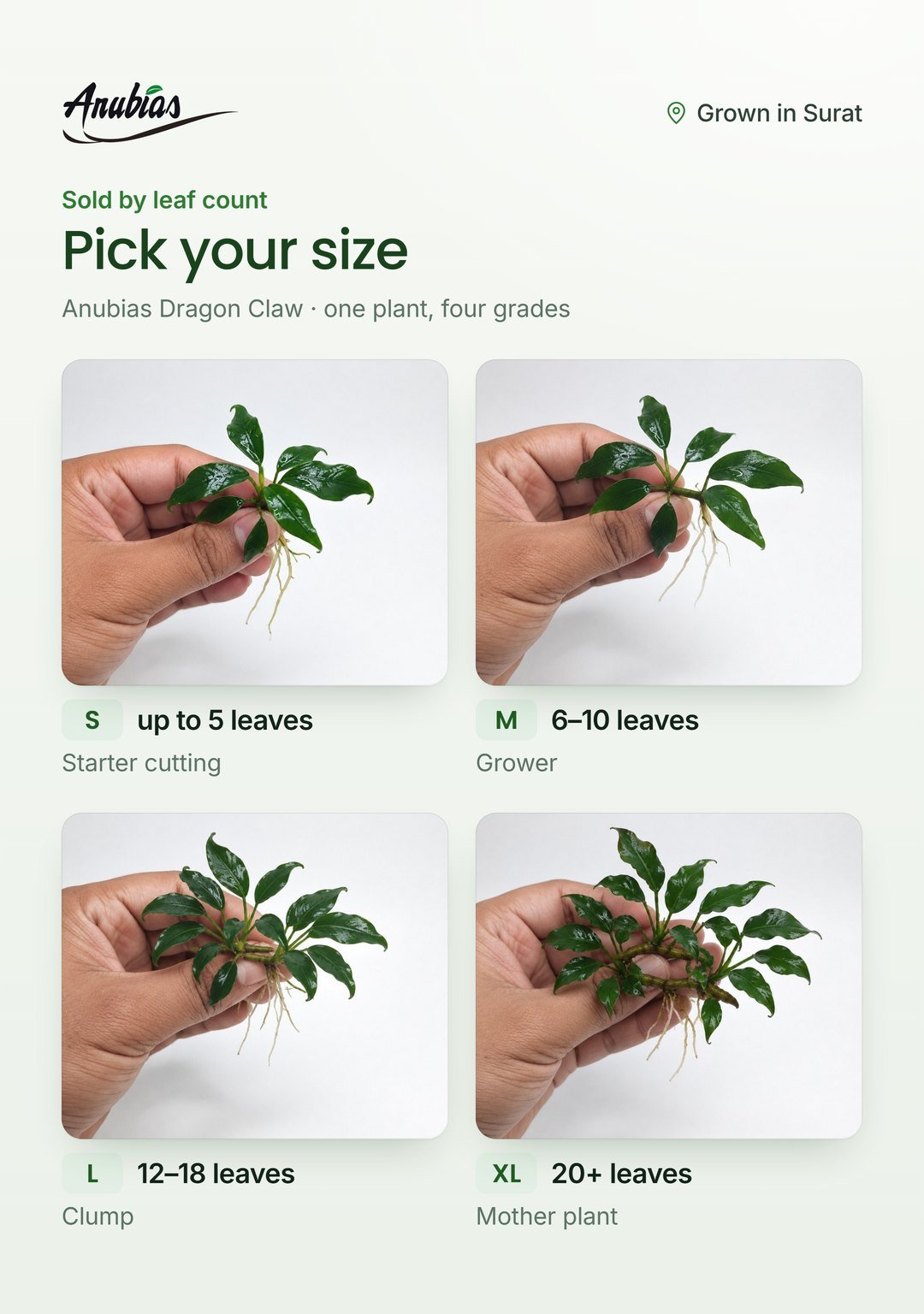
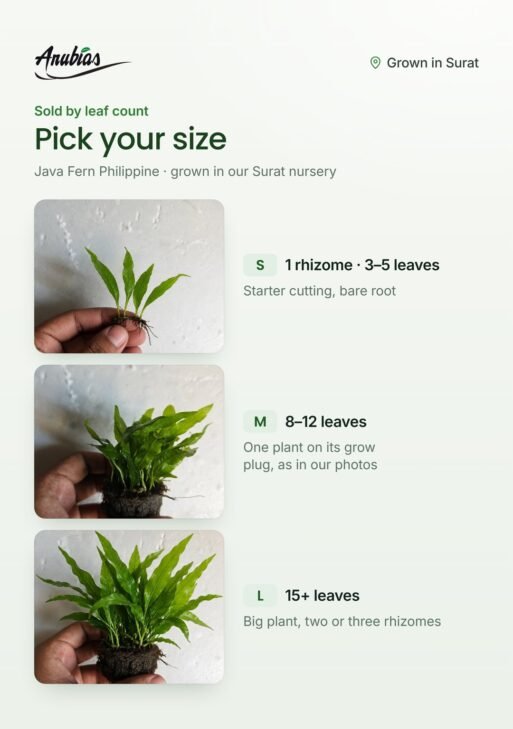
Anubias dragon claw is sold in five grades by leaf count. Because each leaf is curled and three-dimensional, a dragon claw plant looks fuller than a green nana with the same number of leaves.
- XS (grow-on): a rhizome tip with one or two leaves, for growing your own plant or tucking into a rock gap.
- S (starter): up to five leaves; a textured accent for a 1–1.5 ft tank of 15–40 litres.
- M (grower): six to ten leaves; the all-rounder for 2 ft tanks of 60 litres, where one M on a vertical piece of wood becomes the feature plant.
- L (clump): twelve to eighteen leaves; a full midground feature from day one for 2.5–3 ft tanks of 80–150 litres.
- XL (mother): twenty or more leaves on a long rhizome; a focal plant for 3–4 ft tanks of 120–250 litres, or one to divide into several starters.
Rule of thumb: one dragon claw as the feature, with two or three flat-leaved anubias around it for contrast.
How to plant anubias dragon claw
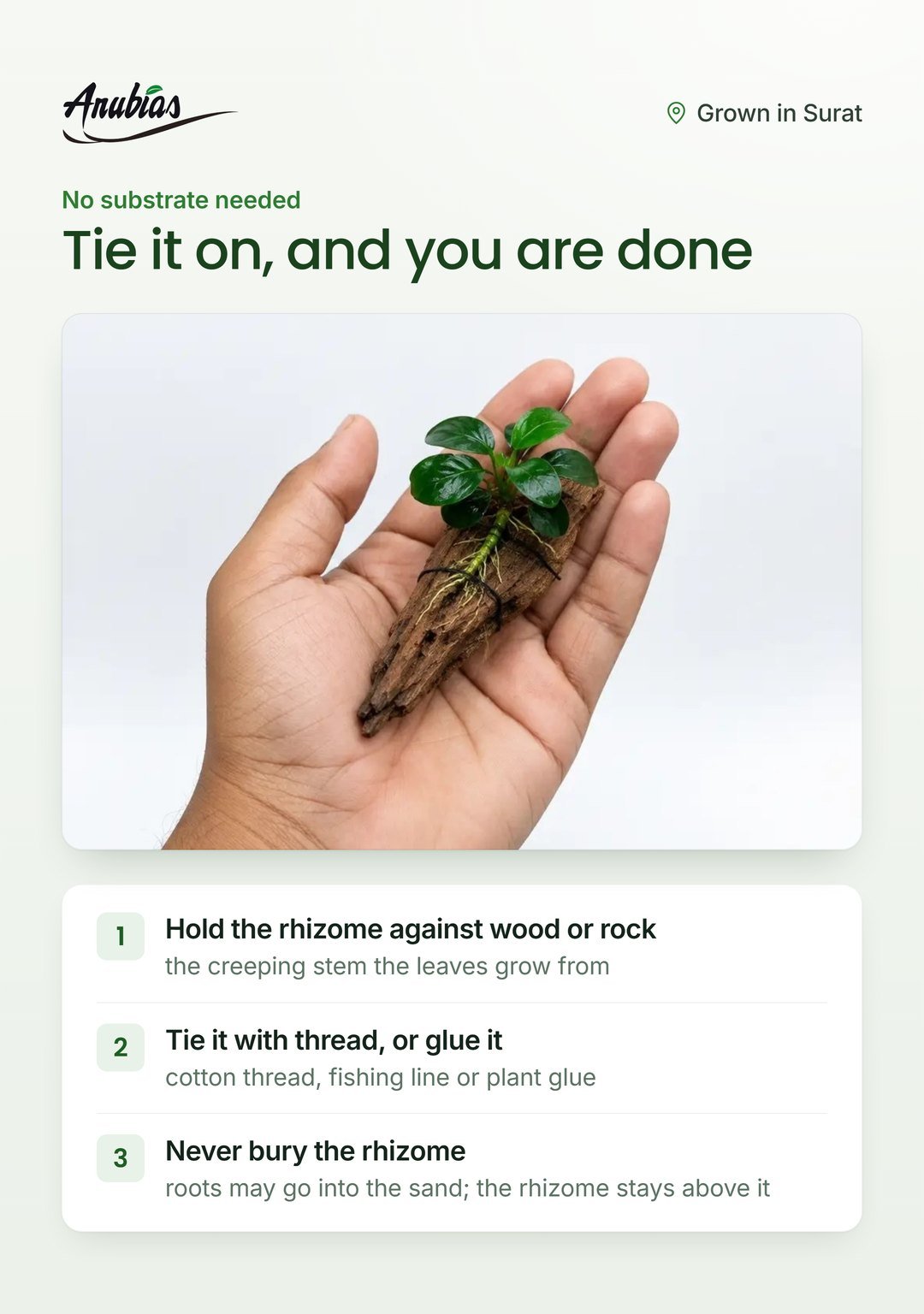
The rhizome, the thick horizontal stem the leaves grow from, must stay above the substrate. Bury it and it rots.
- Rinse the plant and trim roots longer than 2–3 cm.
- Choose a vertical face of driftwood or a tall stone; the curled leaves show best side-on at eye level.
- Tie the rhizome on with cotton thread or fix it with a small dot of cyanoacrylate gel on the rhizome and roots, never the leaves.
- Place it in gentle flow so debris does not settle inside the leaf folds.
- Keep it out of the strongest light; the folds trap algae if the light is too bright.
Roots grip within three to six weeks.
Anubias dragon claw care: light, CO2, fertiliser and water
Light. Low to moderate for 6–8 hours. The plant does not need strong light and the curled leaves collect algae more easily than flat ones, so err on the dim side and let taller or floating plants shade it.
CO2. Not required. CO2 injection speeds growth slightly, but the plant does well in a low-tech tank.
Fertiliser. A weekly dose of a complete liquid fertiliser with potassium, iron and trace elements keeps the leaves dark and prevents pinholes. Root tabs are not needed.
Water. Hard tap water is fine, pH 6–8. It is happiest at 22–28 °C; in Indian summers at 30–32 °C growth stalls but the plant survives with shade, surface agitation and weekly 25–30% water changes. Keep a little flow across the plant so the folds stay clean. A monsoon power cut of a day or two does not bother it.
Growth, trimming and propagation
Anubias dragon claw adds roughly one new leaf every two to four weeks. New leaves unfurl flat and take on their twist as they harden, so a plant always has a mix of newer, flatter leaves and older, tightly curled ones. The rhizome creeps along the hardscape and branches over time. Trimming is rare: cut old or algae-covered leaves at the base of the stalk.
Propagate by cutting the rhizome once it carries eight or more leaves, leaving at least three leaves and some roots on each section. Divisions keep the curled leaf shape; it is a stable cultivar.
Where to use it in an aquascape
Dragon claw is a feature plant for the midground. In a 1.5–2 ft tank of 30–60 litres, one S or M plant on the main branch of the driftwood, with smooth-leaved Anubias nana below it, makes a strong centrepiece. In 3 ft tanks of 100–150 litres, place an L plant at the point where the hardscape meets the open sand, with Java fern behind for height and carpeting plants in front. In 4 ft tanks of 180–250 litres, an XL plant on a central stump is the focal point. Green stem plants along the back glass give the twisted leaves a plain backdrop.
It is safe with bettas, shrimp and all community fish. Shrimp graze biofilm from inside the folds, which helps keep the plant clean. Goldfish and cichlids usually ignore the tough leaves; tie it firmly so diggers cannot loosen it.
Anubias dragon claw vs anubias nana vs anubias barteri
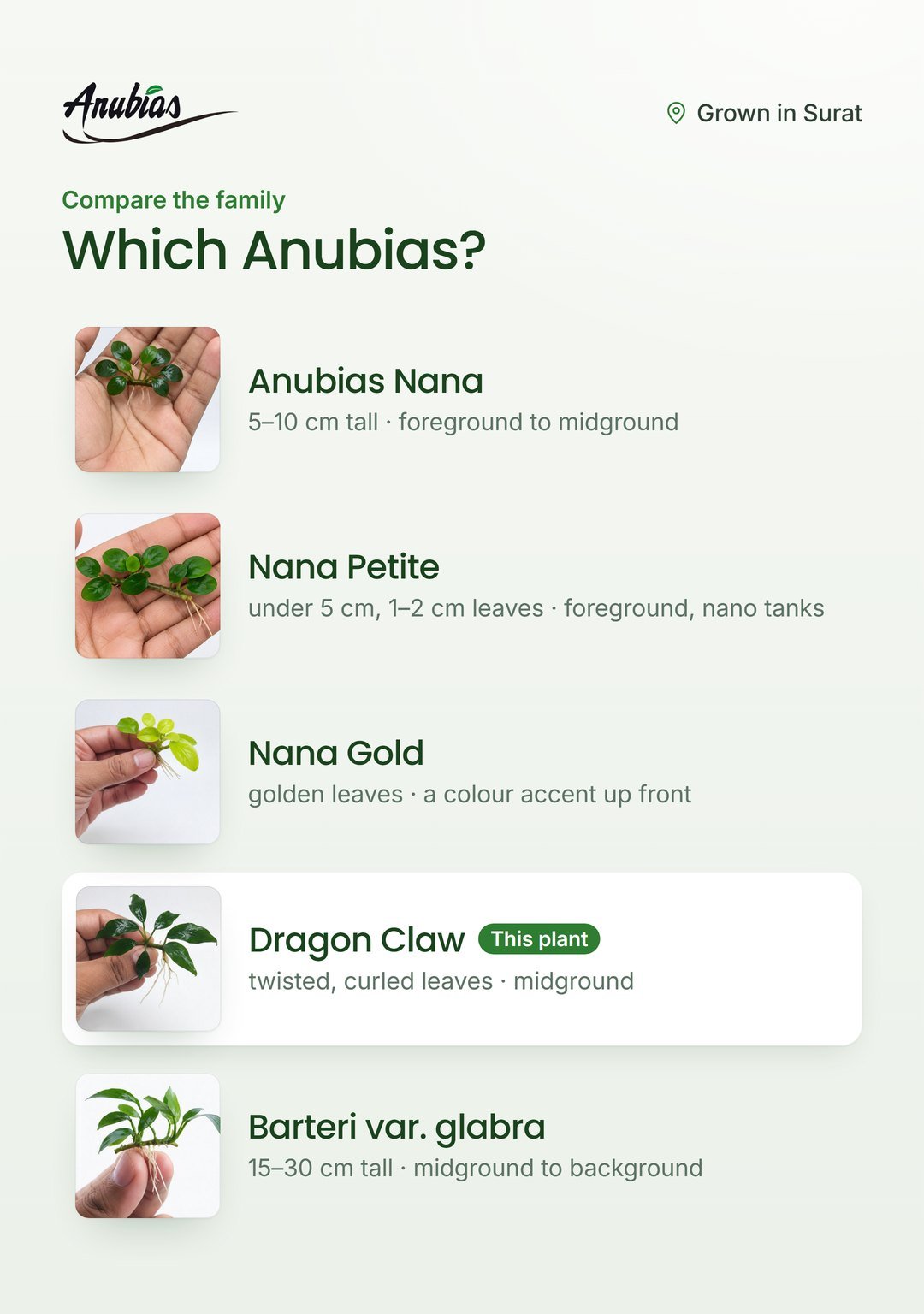
| Anubias dragon claw | Anubias nana | Anubias barteri var. glabra | |
|---|---|---|---|
| Height | 10–20 cm | 5–10 cm | 15–30 cm |
| Leaf | 5–8 cm, twisted and curled | 4–6 cm, rounded, flat | 8–15 cm, narrow, flat |
| Growth | One leaf every 2–4 weeks | One leaf every 1–3 weeks | One leaf every 1–3 weeks |
| Placement | Midground feature | Foreground to midground | Background |
| Best for | Texture and contrast | Filling space, nano tanks | Height in 2 ft+ tanks |
Buy Anubias nana to fill space quickly and cheaply, Anubias barteri var. glabra for height at the back, and dragon claw for the one plant that gives the tank texture. For colour instead of texture, Anubias nana gold adds golden leaves at the same easy care level. Dragon claw is less common than nana but not a slow variegated type, so it grows at a normal anubias pace.
Common problems and fixes
- Debris or algae inside the leaf folds. Cause: dead spots in the flow. Fix: point a gentle current across the plant, siphon the folds during water changes, add Amano shrimp and nerite snails.
- Green spot algae on older leaves. Cause: too much light for the slow growth. Fix: shorten the photoperiod to 6 hours, add shade, scrape the leaves.
- Rhizome rot. Soft, brown rhizome. Cause: buried rhizome. Fix: cut away the soft part and remount the healthy section above the substrate.
- New leaves flatter than the old ones. Normal. Leaves unfurl flat and curl as they mature.
- Yellow older leaves with pinholes. Cause: potassium deficiency. Fix: dose a complete liquid fertiliser weekly.
What you receive
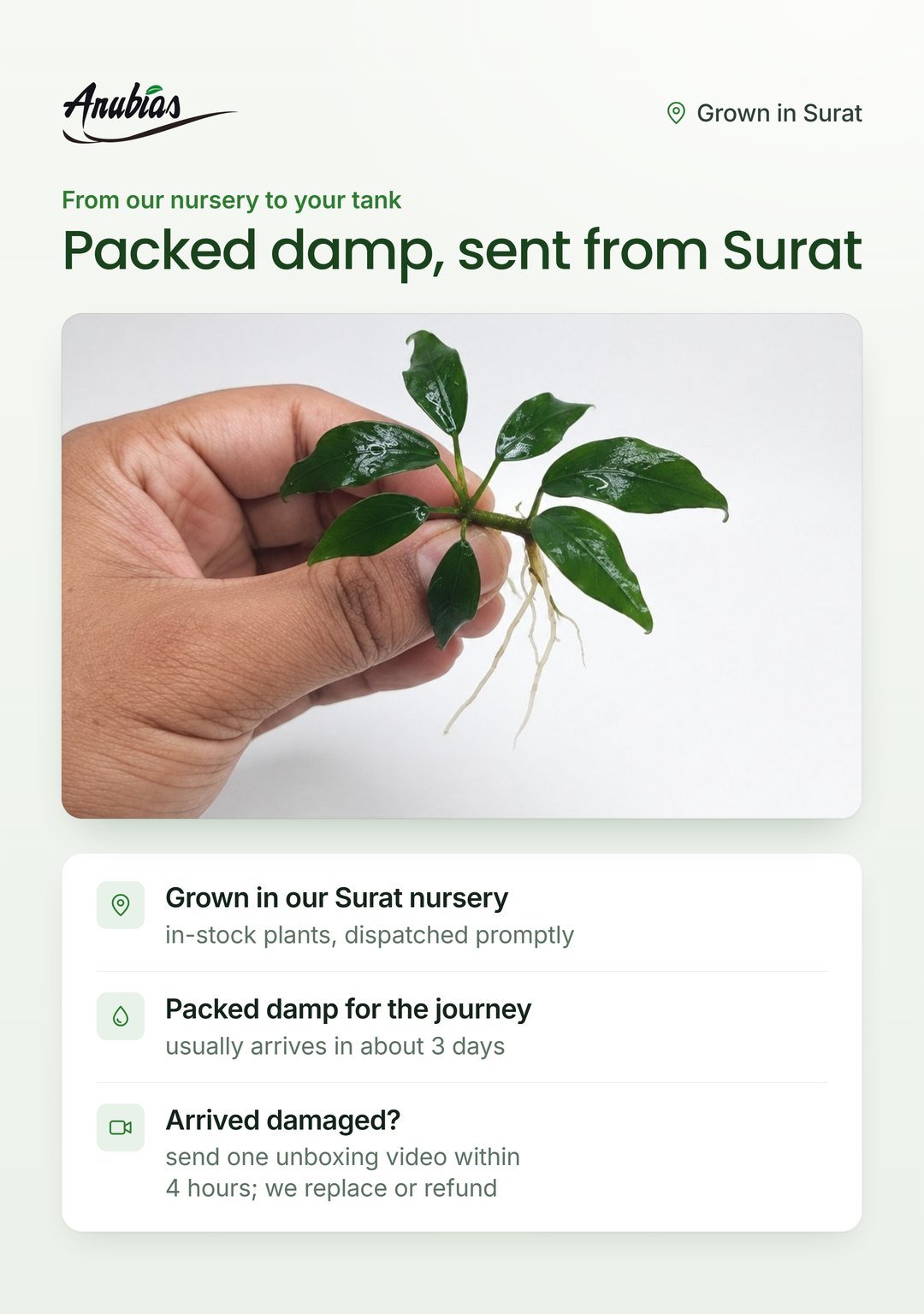
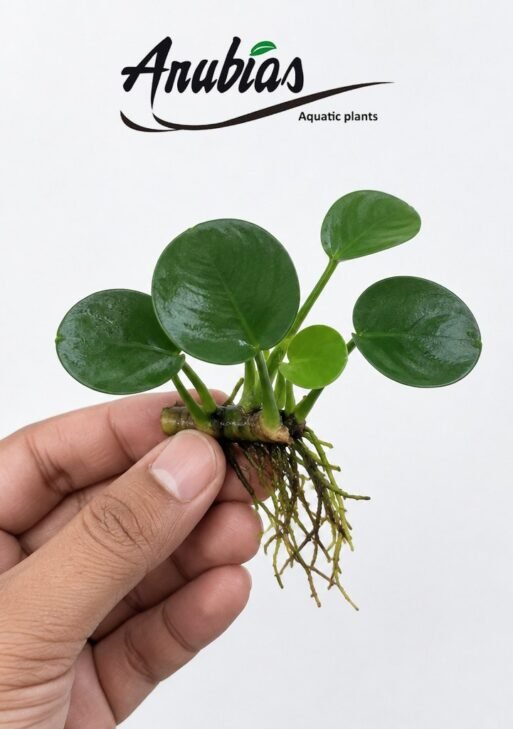
One healthy anubias dragon claw plant of the size you select (XS, S, M, L or XL), similar to the photo. Each plant is checked before packing, packed moist and shipped across India from Surat. ₹99 shipping, free on orders of ₹999 or more.
Live-arrival guarantee: record one continuous unboxing video within 4 hours of delivery and we will refund or replace a plant that arrived damaged.
FAQ
Does anubias dragon claw need CO2?
No. It grows well without CO2 in low to moderate light. CO2 speeds growth a little but is not needed.
Is anubias dragon claw good for beginners?
Yes. It needs the same easy care as Anubias nana: rhizome above the substrate, gentle light and a weekly liquid fertiliser. Add a little flow so the leaf folds stay clean.
Why are the leaves of anubias dragon claw twisted?
That is the cultivar. The curl is genetic and stable, not a sign of disease, deficiency or stress. New leaves open flat and curl as they harden.
How big does anubias dragon claw grow?
Usually 10–20 cm tall with leaves 5–8 cm long. It spreads sideways along the rhizome rather than growing taller with age.
How fast does anubias dragon claw grow?
Slowly: about one new leaf every two to four weeks in a tank without CO2. It rarely needs trimming and keeps its shape for months.
Is anubias dragon claw safe for shrimp, bettas and goldfish?
Yes. Shrimp graze the folds, bettas rest on the leaves and goldfish usually ignore them. Keep trimmings away from cats and dogs, as the leaves contain calcium oxalate.
Anubias dragon claw vs anubias nana: which should I buy?
Nana to fill space in any tank; dragon claw as a single textured feature in the midground of a 1.5 ft or larger tank. Most tanks look best with one dragon claw among several nana.
Not sure what fits your tank? Plan it with our free AI tank planner.













There are no reviews yet.