
Floating plants shade algae, soak up nutrients and give fish cover. Amazon frogbit, water lettuce and duckweed are the three most popular, and each suits a different setup.
Quick answer: Amazon frogbit is the best all-round floating plant for most aquariums: medium-sized rosettes, medium light, and easy to thin out. Water lettuce forms larger rosettes and suits bigger tanks, open tubs and ponds; it needs medium light and dislikes very intense direct light. Duckweed has tiny leaves and grows the fastest, which makes it great for tubs, ponds and nutrient control but hard to remove completely from a display tank. All three need calm surface water and dry leaf tops.
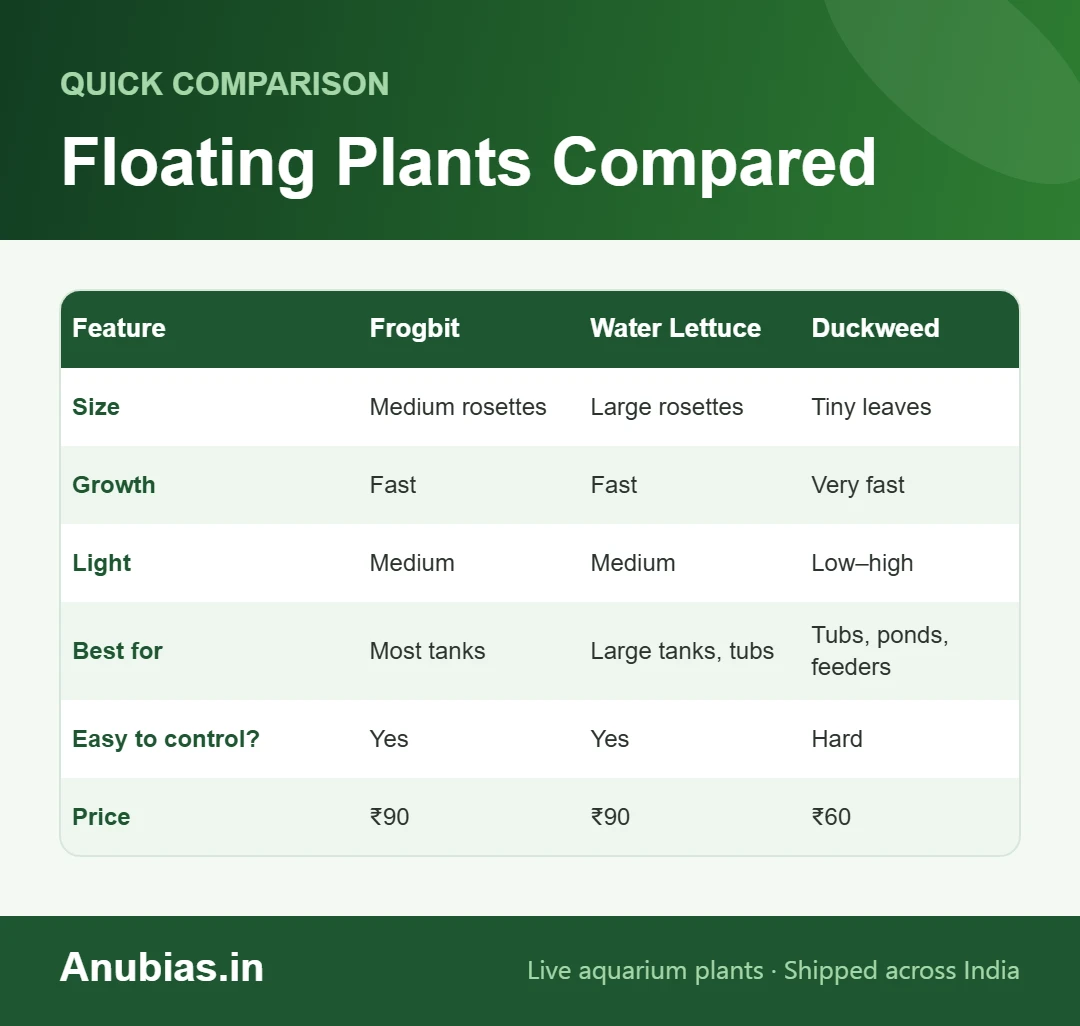
Amazon Frogbit (₹90)
Easy in medium light with calm water. Keep a gap between the lid and the water and remove extra plants weekly. Frogbit care guide.
Water Lettuce (₹90)
Larger rosettes for bigger tanks, tubs and ponds. Medium light is enough; very intense direct light can scorch it. Watch for root rot from poor water quality or strong flow. Water lettuce care guide.
Duckweed (₹60)
The fastest grower and a strong nutrient sponge, but its tiny leaves spread everywhere and are hard to remove completely. Net out extra weekly. Duckweed care guide.
Which should you choose?
- Most home aquariums: Amazon frogbit.
- Large tanks, balcony tubs, ponds: water lettuce, see plants for outdoor tubs.
- Tubs, ponds and feeder cultures: duckweed.
- Avoid covering the whole surface: plants below still need light.
More floating plant guides:
Keeping floaters where you want them
Left alone, floating plants drift to whichever end the filter outflow pushes them and pile up there. A simple corral solves it. Suction a length of airline tubing or a rigid plastic ring to the glass and let the floaters gather inside it, which keeps a clear surface for feeding and for surface film to break.
Flow matters as much as the barrier. Aim the filter outlet slightly downward or across the tank rather than along the surface, because constant water pushing over the crowns is what waterlogs the leaves of the larger rosette species. A gentle circular surface movement is ideal, a rippling torrent is not.
Air stones and floaters are a poor combination for the same reason. If you run one, place it away from the floating patch or accept that those plants will sit in permanent spray.
Floating plants through an Indian summer
Summer is when floaters either take over the tank or collapse entirely, and which one happens usually comes down to the space above the water.
Heat and evaporation are the first factors. A tank losing water steadily in May concentrates minerals in what remains, and hard tap water top-ups make that worse. Top up with the same dechlorinated water you always use, but do it in smaller, more frequent amounts so the plants are not shocked.
Condensation under a tight lid is the second, and it is the most common killer of frogbit and water lettuce here. Water sitting on the leaves rots them from the top down, which looks exactly like melt from poor water quality but is not. Leave a real gap between the water surface and the lid, and wipe or prop the cover glass in humid weather so drips do not fall onto the crowns.
The smallest of the three thrives in heat and will double alarmingly fast in warm months. Net out roughly a third of the surface population weekly rather than letting it blanket the tank, because full coverage will shade out everything planted below.
Plants in this guide
Frequently asked questions
Which floating plant is easiest to control?
Amazon frogbit and water lettuce, because their rosettes are large enough to scoop out by hand. Duckweed is the hardest.
Why are my floating plants melting?
Usually water or condensation on the leaves, strong surface flow, or too little light. Keep leaf tops dry and flow gentle.
Do floating plants reduce algae?
Yes. They absorb nutrients quickly and shade the water, which helps limit algae.
Can floating plants live in a tank with a lid?
Yes, provided there is a gap of a few centimetres between the water surface and the lid, and condensation does not drip onto the leaves. The larger rosette species are fussiest here and rot when their crowns stay permanently wet. Propping the lid slightly or wiping it during humid weather is usually enough.
Do floating plants need fertiliser?
They draw most of what they need straight from the water, so in a stocked tank they often need nothing extra. If your floaters yellow between the veins while your fish load is light, a modest dose of a liquid fertiliser containing iron and trace elements usually corrects it. Heavy dosing is unnecessary and tends to feed algae instead.
Will my fish eat floating plants?
Goldfish and larger cichlids will graze the trailing roots and often the leaves too, sometimes clearing a patch entirely. Most community fish ignore them and simply use the shade, which is one reason floaters suit tanks with shy species. If your fish are heavy grazers, the fastest-growing of the three keeps up best because it replaces itself so quickly.