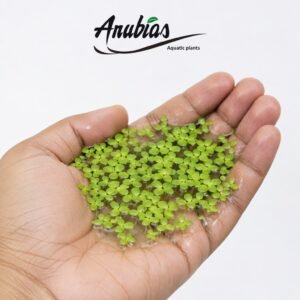


Duckweed has a reputation problem. Ask any fishkeeping forum and someone will warn you never to let it near your tank. Ask a breeder or a shrimp keeper, though, and you will hear the opposite: it is one of the most useful plants you can own, as long as you understand what it actually does. Lemna minor is a tiny floating plant that multiplies fast, soaks up excess nutrients, and gives fry and shrimp somewhere to hide. This guide covers what it needs, how it spreads, and how to keep a manageable patch instead of a solid green carpet across your whole tank.
How to care for duckweed in an aquarium
Quick answer: To care for duckweed, float a small portion in a calm corner away from the filter outflow; it needs no planting, CO2 or strong light. It grows at 18–30°C and pH 5.0–9.0, fastest at 6.5–7.5 in nutrient-rich water. Net out part of the cover every week or two so it never shades the whole surface.
What Is Duckweed?
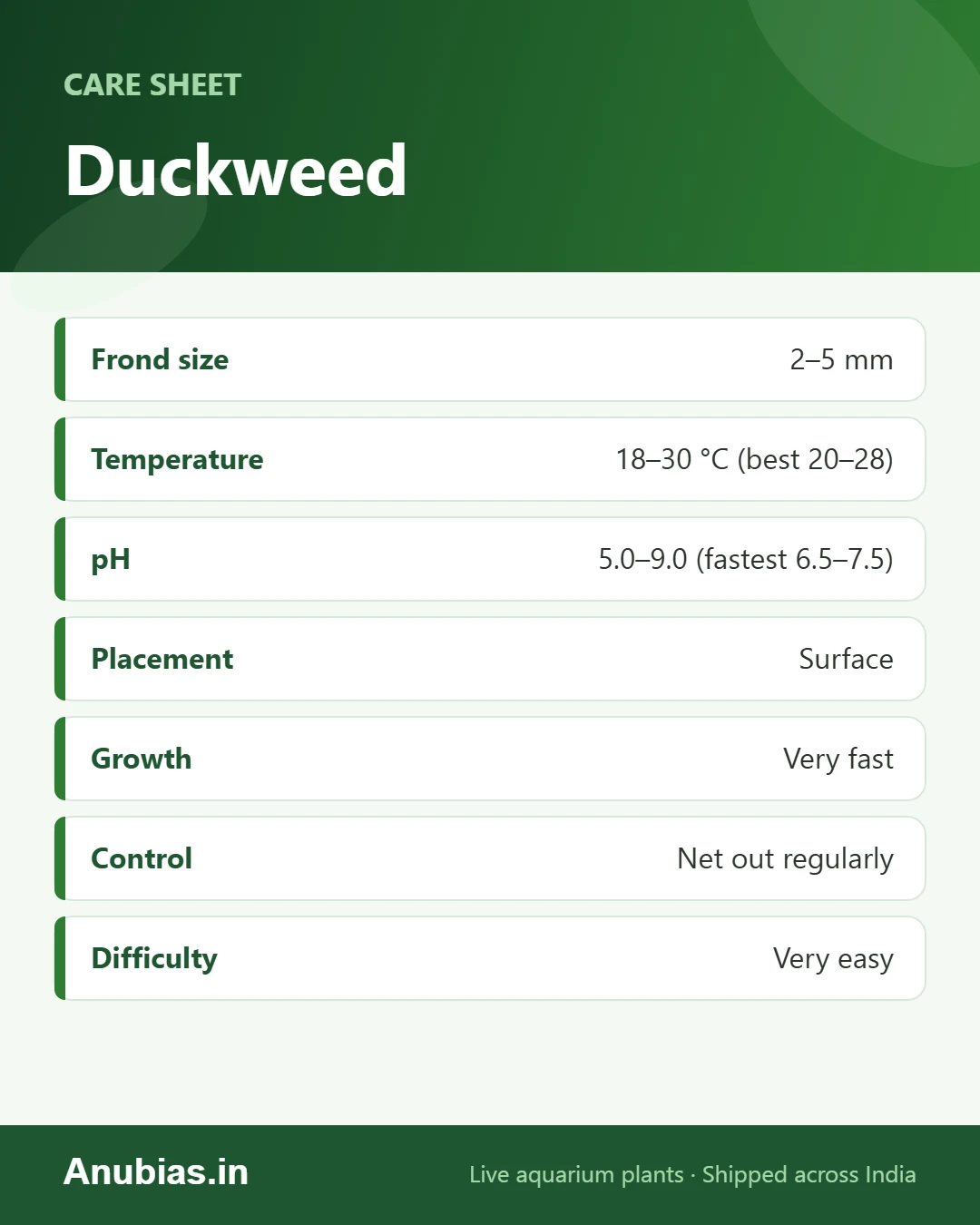
Duckweed (Lemna minor) is a free-floating aquatic plant made up of tiny oval leaves, called fronds, each about 2 to 5mm across, with a single fine root hanging beneath. It has no real stem; each frond is essentially a complete plant, and it reproduces by budding off a new frond from a pocket on its side. In the wild it forms dense mats on still ponds, ditches and slow-moving water across most of the world, including much of India, which is why it is so easy to source and so well adapted to Indian tap water and climate. In an aquarium it does the same thing, minus the mosquito problem, since fish eat the larvae that would otherwise breed under a still mat.
Ideal Water Parameters
Duckweed is one of the least fussy plants sold for aquariums. It grows in temperatures from about 18 to 30°C, with 20 to 28°C being the comfortable range for steady growth; growth slows noticeably in cold water and stalls below about 10°C. A pH between 6.5 and 7.5 gives the fastest growth, though the plant survives anywhere from 5.0 to 9.0 without dying back. Water hardness barely matters to it: soft, acidic water and hard, alkaline tap water both work, which is one reason it settles in so easily in Indian tanks running on harder borewell or municipal water. The one thing it does respond to strongly is nutrient load. In water rich in nitrate and phosphate, it multiplies rapidly, which is exactly why it is used as a natural filter in outdoor tubs and low-tech tanks.
Light Requirements
Because every frond floats right at the surface, duckweed gets more direct light than almost anything else in the tank, so it does not need a strong lamp to thrive. Low to moderate light is enough, and it will grow even under ambient room light near a window. What it will not tolerate is being shaded by taller floating plants like water lettuce or frogbit sitting above it; since duckweed cannot climb over its neighbours, whatever floats on top wins the light and the duckweed underneath thins out. If you keep it alongside other floaters, give it its own section of the surface.
Placement and Tank Setup
There is no planting involved. Simply float a small handful of fronds — a starter batch like our Duckweed (Lemna minor) listing is enough to begin a self-sustaining patch — on the surface and let it spread. It does best with little to no surface agitation, since strong ripples or filter outflow will push it around, pull it under, or pin it against the glass. A calm corner away from the filter return is all it needs. Because it has no substrate requirement at all, it is a good fit for bare-bottom breeding tanks, quarantine tubs and outdoor containers, not just planted aquariums.
Propagation and Growth Rate
Duckweed reproduces entirely by vegetative budding rather than seed or runners. A healthy frond produces a new, smaller frond from the side, which eventually separates into an independent plant. Under good light and nutrient-rich water, a population can double in as little as two to four days, faster than almost any other aquarium plant. This is exactly why it needs active management rather than a single planting session: scoop out a portion with a net or your hand every week or two to stop it covering the entire surface.
Practical Uses in a Planted Tank
Beyond looking green and floaty, duckweed earns its place in serious fishrooms. It is an extremely efficient nutrient sponge, pulling nitrate, phosphate and ammonia out of the water column faster than most rooted plants, which makes it a useful ally against algae in a new or overstocked tank — see our guide to plants that help reduce algae for more options like this. It also provides shaded cover that betta and gourami fry, along with shrimp, use to hide from larger tankmates, which is why many breeders deliberately seed a corner of a rearing tank with it. As a bonus, goldfish, mollies and silver dollars will happily graze on it as a supplemental green food.
Common Problems
The complaint you will hear most often is that duckweed takes over a tank. That is a management issue rather than a plant health issue — net some out on a schedule and it stays in check. A second common issue is duckweed arriving as an uninvited hitchhiker on new plants bought online; a few stray fronds can multiply into a full cover within weeks in a nutrient-rich tank, so it is worth inspecting new plant shipments carefully if you are trying to keep it out of a particular tank, as covered in our guide on how to quarantine new aquarium plants. Yellowing fronds usually mean a lack of nutrients or too little light reaching the surface, while fronds that keep getting pulled into the filter intake are a sign surface flow is too strong; a simple sponge pre-filter or a calmer corner solves that quickly.
More floating plant guides:
Frequently Asked Questions
Is duckweed hard to get rid of once it is in a tank? Yes — in a nutrient-rich tank, a few missed fronds can regrow a full cover within a couple of weeks, so most keepers manage it on an ongoing basis rather than try to eliminate it completely.
Does duckweed need fertiliser? Not usually. It feeds directly on the nitrate and phosphate already present in aquarium water and rarely needs extra dosing.
Will duckweed block light to plants growing below it? A thin, actively-thinned layer lets plenty of light through, but a thick, unmanaged mat will noticeably shade carpeting and stem plants underneath, so regular removal matters if you are growing both.
Ready to start a patch of your own? Our Duckweed (Lemna minor) ships across India and is enough to establish a self-sustaining floating cover within a few weeks. If you are deciding between floaters, our guide to floating plants for aquariums compares duckweed against frogbit, water lettuce and salvinia.
Looking for a floater that is easier to control? Try Amazon Frogbit.
Choosing a floater? Compare frogbit, water lettuce and duckweed.
Grown in Surat (pre-order plants imported to order) · live-arrival guarantee with a 4-hour unboxing video · ₹99 shipping, free from ₹999