

A dense, green, lawn-like carpet is one of the most requested looks in aquascaping, and Dwarf Hairgrass is the classic way to get it. Eleocharis acicularis is a true aquatic grass that spreads by runners to form a low, hair-fine carpet across the foreground of a planted tank. It is not difficult to keep alive, but keeping it low, dense and carpet-like instead of tall and sparse takes the right light, substrate and trimming routine, which is what this guide covers.
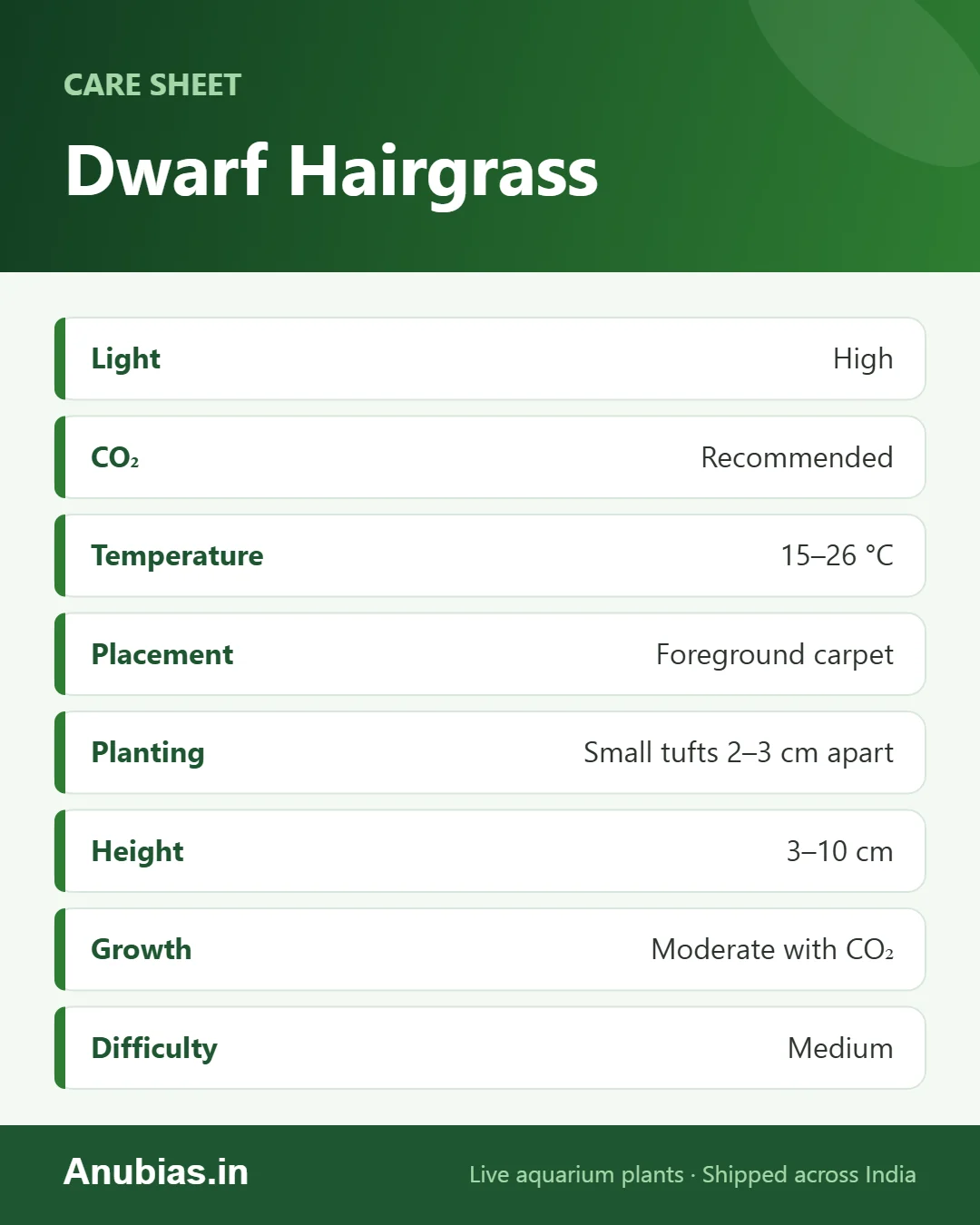
Quick answer: Dwarf Hairgrass carpets best when planted in small clusters of five to ten blades spaced roughly 2–4 cm apart; it stays 3–8 cm tall with regular trimming and spreads sideways by runners. It tolerates a wide 15–26°C range (fine for unheated tanks), pH 6.0–7.5 with 6.3–7.0 the sweet spot, and hardness of about 2–12 dKH.
What Is Dwarf Hairgrass?
Dwarf Hairgrass is a small, grass-like plant with thin, needle-fine blades that grow from a creeping rhizome just under the substrate. Unlike most aquarium “grasses,” it is a genuine sedge that also grows in shallow ponds and marshes above water, which is part of why it tolerates a wide range of aquarium conditions. In the tank it stays low, usually 3 to 8cm tall when trimmed regularly, and spreads sideways rather than upward, sending out runners that root and produce new blades a short distance from the parent plant.
Ideal Water Parameters
Dwarf Hairgrass is comfortable across a broad temperature range, roughly 15 to 26°C, which is one reason it also works in unheated or coldwater setups, though growth is fastest in the 20 to 25°C range typical of a tropical planted tank. It prefers a pH between 6.0 and 7.5, with 6.3 to 7.0 considered the sweet spot, and water hardness from about 2 to 12 dKH. It is tolerant enough of Indian tap water parameters to be a reasonably forgiving choice, provided the light and substrate are right.
Lighting and CO2
Light is the single most important factor in whether Dwarf Hairgrass carpets or simply survives. It needs medium to high light to stay short and dense; in low light it etiolates, growing tall, thin and pale as it stretches toward the surface instead of spreading sideways. As a rough guide, non-CO2 tanks should aim for higher light intensity to compensate, while CO2-injected tanks can get a good carpet with more moderate light. CO2 injection is not mandatory, but it noticeably speeds up carpeting and produces a denser mat; see our guide to DIY CO2 for planted aquariums in India if you are deciding whether to add it, and our aquarium light buyer’s guide for choosing a fixture strong enough to carpet with.
Substrate and Planting Method
Fine to medium substrates work best because they let the thin roots and runners spread easily; coarse sand or a nutrient-rich planted substrate are both good choices, and our substrate guide for planted tanks in India covers suitable options in detail. Plant in small clusters of five to ten blades, spaced roughly 2 to 4cm apart, pressing just the base into the substrate with tweezers. Planting in many small clusters rather than a few large clumps looks sparse at first but fills in faster and more evenly, since each cluster roots independently and sends runners outward to meet its neighbours.
Propagation and Spreading
Dwarf Hairgrass propagates on its own once established, spreading through underground runners that pop up as new blades a centimetre or two from the parent. There is no need to manually separate and replant it the way you would a stem plant; a healthy carpet fills in gaps by itself over four to eight weeks. If you want to speed up coverage or start a second area, you can lift a rooted section with some substrate attached and transplant it to a new spot.
Trimming and Maintenance
Regular trimming is what keeps the carpet looking like a lawn instead of an overgrown meadow. Once blades reach 6 to 8cm, trim the top third with scissors; this encourages the plant to send out more runners instead of growing taller, thickening the carpet over time. Newly planted hairgrass often melts back or turns yellow within the first one to two weeks after planting — this is a normal adjustment reaction, not plant death, and fresh green growth typically follows once the roots establish.
Common Problems
Floating is the most common early frustration: freshly planted blades are barely anchored and can pop loose and float to the surface until roots take hold, so keep the substrate undisturbed and trim any obviously loose blades rather than fighting the current. Etiolated, pale, leggy growth almost always means insufficient light. Green or brown algae dusting the blades usually points to a light and nutrient imbalance — often light that is too strong for the CO2 and fertiliser level in the tank — so dial in CO2 and dosing together with light intensity rather than increasing light alone. If you are comparing Dwarf Hairgrass against other low, spreading options, our carpeting plants comparison guide looks at how it stacks up against Staurogyne repens and Hydrocotyle.
Dwarf hairgrass without CO2
Without CO2, expect slower, looser growth and give the plant your strongest light, a nutrient-rich substrate or root tabs, and regular liquid fertiliser. Compare low-tech carpet options in easiest carpet plant without CO2.
Browning blades? See dwarf hairgrass turning brown.
More carpet plant guides:
Frequently Asked Questions
Does Dwarf Hairgrass need CO2 to carpet? No, but it carpets faster and denser with CO2 injection; without it, use stronger lighting and be patient, since coverage will take longer.
Why did my hairgrass turn yellow or melt after planting? This is a normal transplant reaction as the plant adjusts to being separated and replanted; keep parameters stable and new green blades should appear within one to two weeks.
How long does it take to form a full carpet? With good light, nutrients and small, evenly spaced clusters at planting, a full carpet typically fills in within six to ten weeks.
Ready to start your foreground carpet? Our Dwarf Hairgrass (Eleocharis acicularis) is available for pre-order and ships across India as soon as stock arrives, in the right small-cluster form for even carpeting.
Want a carpet that needs less light? Compare with Staurogyne Repens or Monte Carlo.
Grown in Surat (pre-order plants imported to order) · live-arrival guarantee with a 4-hour unboxing video · ₹99 shipping, free from ₹999