
The Amazon Sword (Echinodorus bleheri, sometimes sold as Echinodorus amazonicus) is one of the most recognisable aquarium plants in the world and a genuine classic for Indian planted tanks. Its broad, arching, deep-green leaves make an instant statement as a background or centrepiece plant, and unlike many showpiece species it is genuinely forgiving for a beginner. This guide covers exactly how to plant, feed and trim one so it grows the way you see in photos, rather than stalling out or melting after a few weeks.
Quick Overview
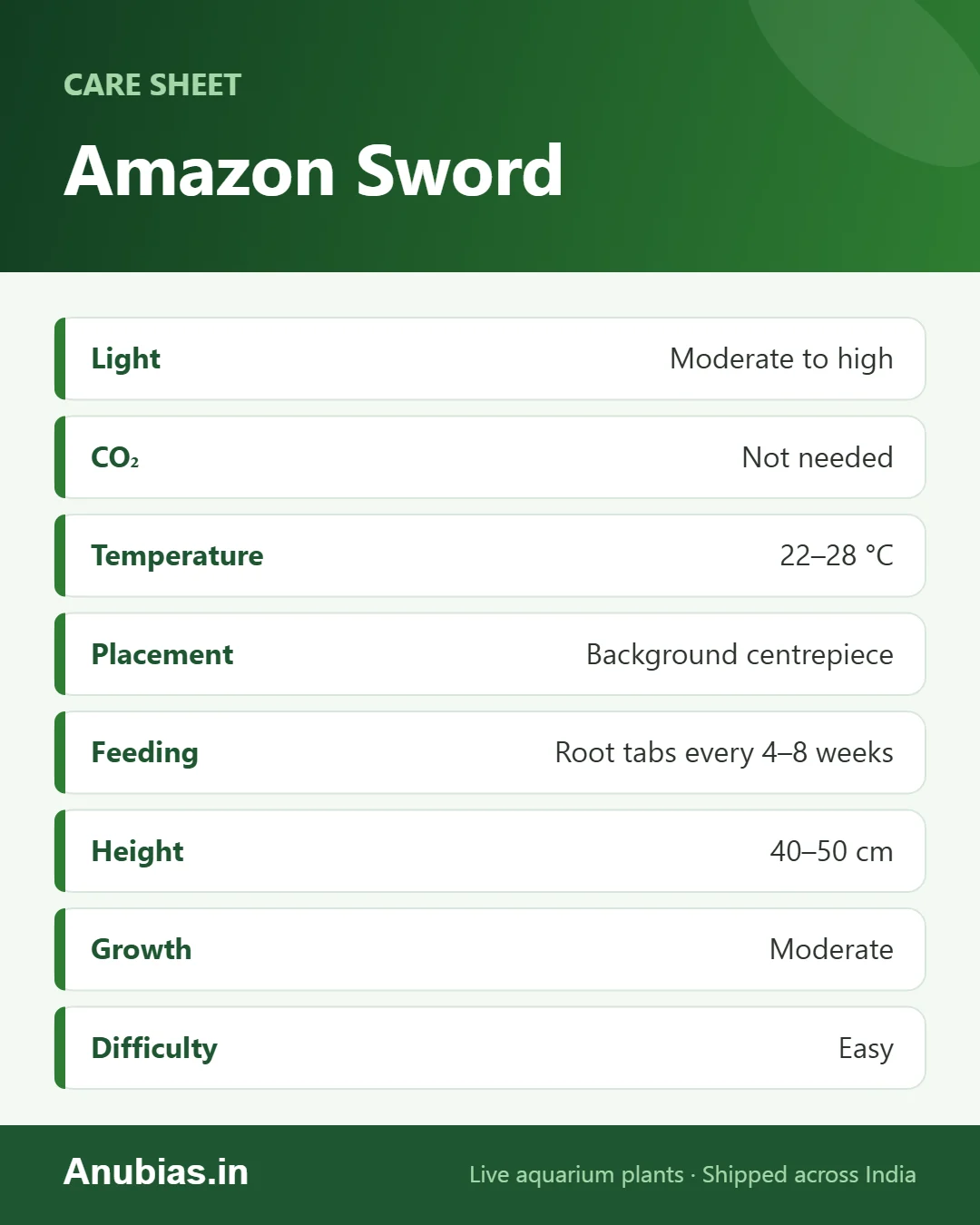
- Difficulty: Easy to moderate
- Placement: Background or centrepiece, rooted in substrate
- Light: Moderate to high (roughly 30–50 PAR at substrate level)
- CO2: Not required, but speeds up growth noticeably
- Water parameters: Temperature 22–28°C, pH 6.5–7.5, GH 5–12
- Growth habit: Rosette of broad leaves from a central crown, propagates via runners
Planting: Substrate and Placement
Amazon Sword is a heavy root feeder, so where and how you plant it matters more than for most epiphyte-style plants like Anubias or Java Fern. Bury the roots fully in at least 5–8 cm of substrate, leaving the crown – the point where the leaves meet the roots – sitting just above the surface. Burying the crown itself invites rot. Because a mature Amazon Sword can spread 30–40 cm across and grow leaves well over 40 cm tall, give it real space; it is not a plant for the front of a nano tank. Placed centrally or toward the back of a medium to large aquarium, it naturally becomes a focal point as it matures.
A nutrient-rich substrate or substrate with root tabs mixed in underneath gives it the strongest start. If you are using a purely inert substrate like plain gravel or sand, root tab feeding from day one is effectively mandatory rather than optional.
Light Requirements
Amazon Sword tolerates a wide light range, which is part of why it is such a popular beginner plant, but it performs best under moderate to fairly strong light. In low light it will still grow, but slower, with smaller and slightly paler leaves. Under moderate-to-high light with good root feeding, expect noticeably larger leaves and a fuller rosette shape. It does not need particularly intense light to look good, which makes it a good match for the mid-range LED fixtures most Indian planted tanks run.
Root Tab Feeding: The Single Most Important Habit
This is the one care point that makes or breaks an Amazon Sword. Its root system is extensive and built specifically to pull nutrients from the substrate rather than the water column, so liquid fertiliser dosed into the water alone will not feed it adequately – you will see this show up as pale new growth, thin leaves, or leaves developing holes and yellowing from the base outward. Push root tabs into the substrate near (not directly under) the root mass every four to eight weeks. As the plant grows larger, add a second tab on the opposite side of the root zone rather than increasing the dose of a single tab, so nutrients are available across the whole root system rather than concentrated in one spot.
Trimming and Managing Melt
New Amazon Swords, especially ones grown emersed (out of water) at the nursery before being sold, commonly melt back some or even most of their original leaves in the first two to three weeks after planting as they adjust to fully submersed growth. This is normal and not a sign of a dying plant – trim off melted leaves as they yellow or turn translucent, close to the base, and new growth adapted to your tank’s conditions will follow. Once established, older outer leaves naturally yellow and should be trimmed away regularly to keep the plant looking full and to prevent decaying leaf matter from affecting water quality. Trim with clean, sharp scissors close to the crown rather than tearing leaves off by hand, which can damage the crown tissue.
Propagation via Runners
A healthy, well-fed Amazon Sword will eventually send out a long horizontal runner (technically a flower stalk) that produces small plantlets at intervals along its length, each developing its own tiny root system. This is the plant’s natural method of spreading and the easiest way to propagate it at home. Leave a plantlet attached to the parent until it has grown four to five leaves and visible roots of its own, usually a few centimetres long, then snip it free with scissors and plant it separately. A single mature Amazon Sword can produce several plantlets per runner and multiple runners per year under good conditions, so one plant is often all you need to eventually fill a section of a larger tank.
Placement in an Aquascape
Because of its size and bold leaf shape, Amazon Sword works best as a background anchor or a deliberate centrepiece rather than scattered around a layout. It pairs well with finer-textured plants around its base – carpeting or short stem plants create contrast against its broad leaves and help hide the bare lower stem that develops as it matures. It also tends to hold up well against moderately boisterous fish, since its leaves are tougher than many stem plants, though very determined cichlids or goldfish can still shred younger growth.
Common Problems and Fixes
- Holes appearing in leaves: Usually a potassium or micronutrient deficiency – check your root tab schedule and consider adding a liquid micro fertiliser alongside it.
- New leaves small and pale, old leaves fine: Nitrogen or overall root-zone nutrient shortage – the plant is living off reserves in older leaves. Increase root tab frequency.
- Leaves turning translucent and mushy shortly after planting: Normal transition melt from emersed to submersed growth; trim affected leaves and be patient for new growth.
- Plant staying small despite feeding: Check light levels – very low light is the other common cause of stunted growth even with adequate root feeding.
For heavy root feeders like Amazon Sword, understanding the difference between root tab feeding and water-column dosing makes a real difference – our guide on how often to fertilise aquarium plants breaks down when each method matters.
Update: Amazon Sword is now available to pre-order on Anubias.in — head over to reserve one for your next aquascape.
Other Echinodorus (sword plants) in our shop: Echinodorus cordifolius, Echinodorus ‘Ozelot’, Echinodorus rubin, Echinodorus tenellus, Echinodorus major, Echinodorus parviflorus ‘Tropica’ and Echinodorus ‘Joyo Red’.
Frequently Asked Questions
How big does an Amazon Sword actually get in a home aquarium?
A mature, well-fed Amazon Sword commonly reaches 40–50 cm in height and spreads 30–40 cm wide, which is why it needs at least a medium-sized tank (60 cm/24 inches or longer) to have room to reach its full form without constant trimming against the glass.
Can Amazon Sword grow without CO2 injection?
Yes. It is a low-tech-friendly plant and grows well without added CO2, though growth is noticeably faster and leaves tend to be larger and more robust with CO2 injection. Root tab feeding matters more than CO2 for this particular species.
Why does my Amazon Sword keep melting after I replant it?
Repeated melt after replanting usually means the crown was buried too deep or roots were damaged during replanting. Always keep the crown at or just above the substrate surface, and handle the root ball gently when moving an established plant.
Not sure which fertiliser to use? Compare root tabs vs liquid fertiliser.
Sword leaves yellowing? Read Amazon sword yellow leaves and melting fixes.
Grown in Surat (pre-order plants imported to order) · live-arrival guarantee with a 4-hour unboxing video · ₹99 shipping, free from ₹999