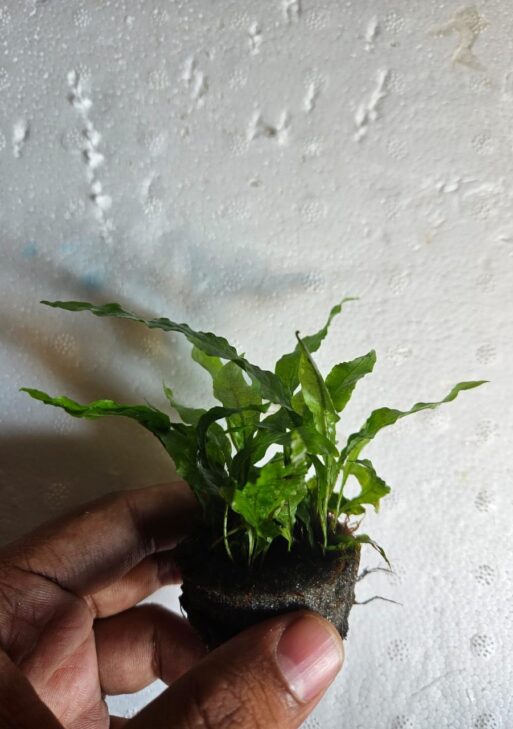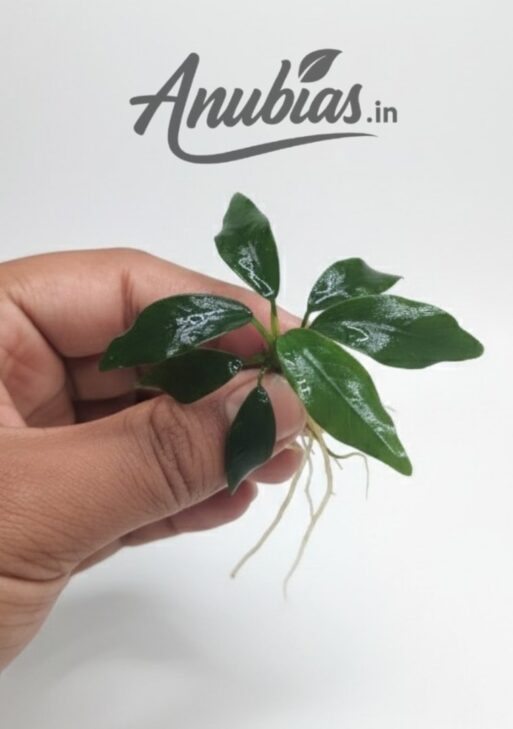


Anubias Nana and Anubias Barteri var. glabra are the two most popular Anubias in India. They need exactly the same care, so the choice comes down to size and where you want to place them.
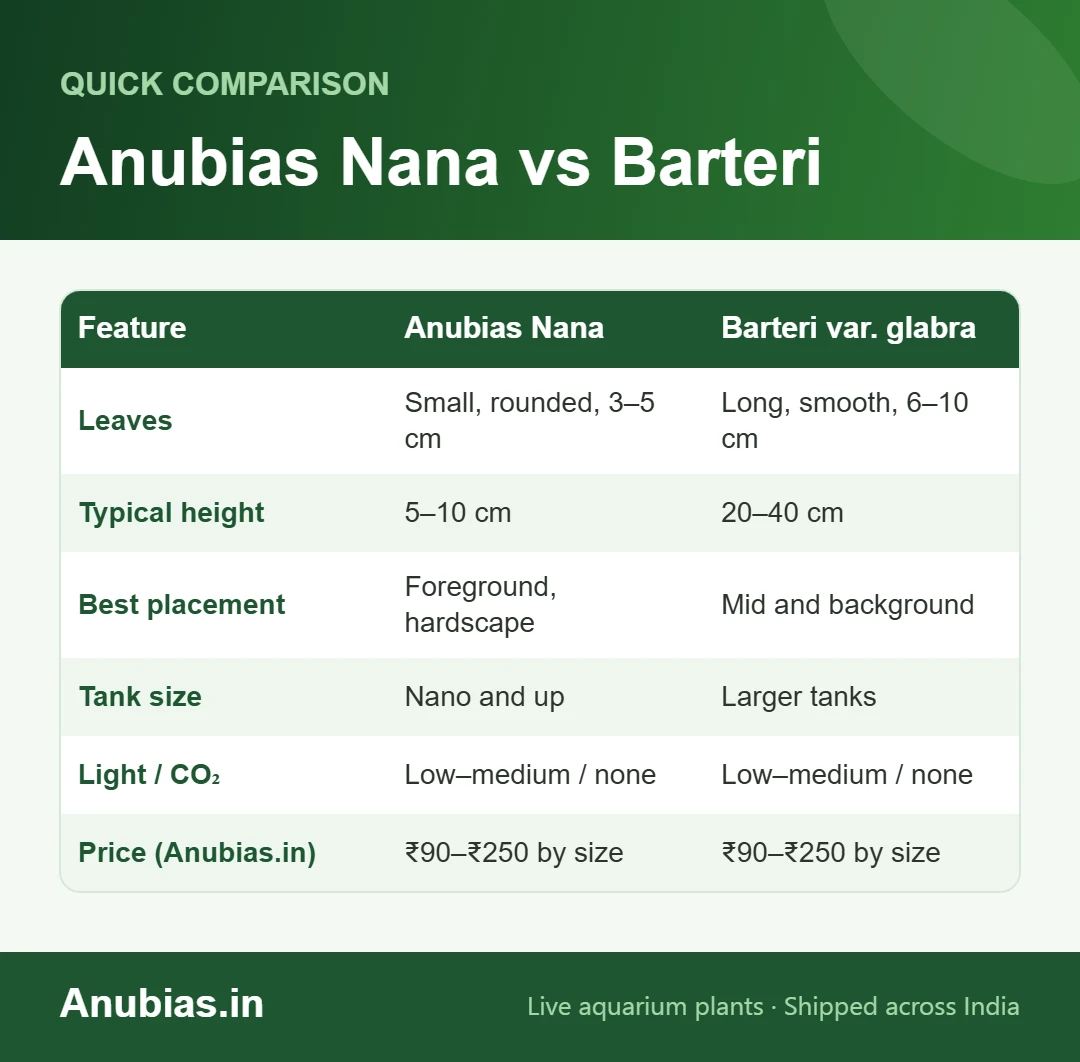
Quick answer: Anubias Nana is the compact choice: small, rounded 3–5 cm leaves and a typical height of 5–10 cm, ideal for the foreground and hardscape in tanks of any size. Anubias Barteri var. glabra has longer, smooth 6–10 cm leaves and grows about 20–40 cm tall, so it suits the midground and background of larger tanks. Both need low to medium light, no CO2 and a rhizome tied to wood or rock, and both cost ₹90–₹250 by size on Anubias.in.
Size and look
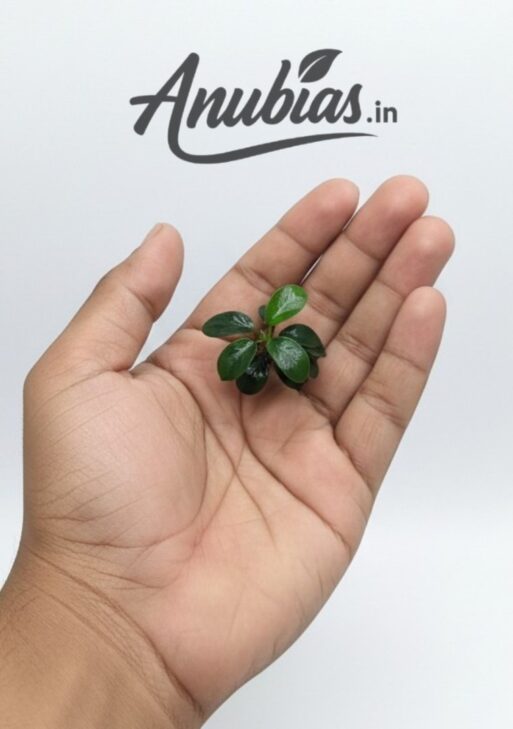
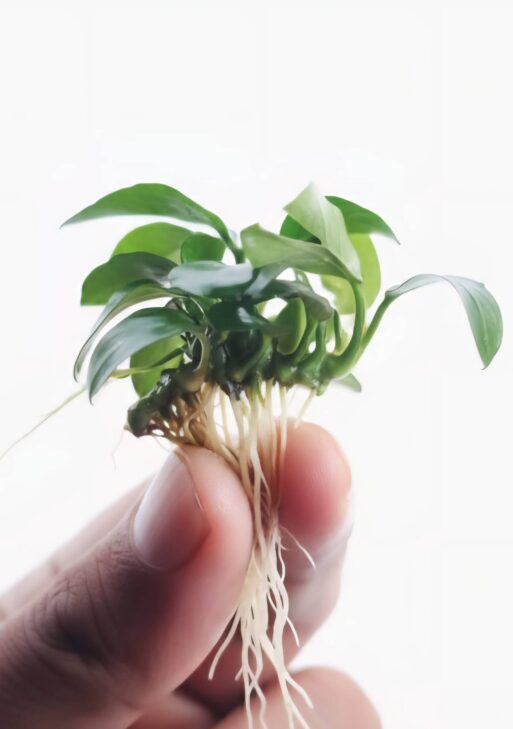
Nana has small, rounded, dark-green leaves and stays low. Barteri var. glabra has long, narrow, smooth bright-green leaves on taller stems, which gives height and a looser look.
Where to place each
- Anubias Nana: foreground, rock crevices, small driftwood, nano tanks.
- Barteri var. glabra: midground and background, large driftwood, 2-feet tanks and bigger. See plants for a 3-feet tank.
Care (the same for both)
- Low to medium light, no CO2.
- 22–28°C water and a light weekly liquid fertiliser.
- Tie or glue the rhizome to wood or rock; never bury it.
- Slow growth, so keep lighting moderate to avoid algae.
Which should you buy?
Choose Nana for small tanks or to decorate hardscape up front. Choose Barteri var. glabra to fill space and add height in bigger tanks. Many aquascapes use both: Nana in front, Barteri behind. Buy Anubias Nana or Anubias Barteri var. glabra.
Attaching each one properly
The rhizome is the thick horizontal stem the leaves and roots grow from, and it must stay in open water. Anything that covers it, including substrate, sand slides and thick moss, tends to cause rot.
- Choose a spot on wood or rock where the rhizome can lie flat against the surface.
- Tie it down with cotton thread or fishing line, passing the thread over the rhizome and not over the leaf bases.
- For gel superglue, dry the rhizome briefly on a towel, apply a small dab to the underside, and press it onto dry hardscape for a few seconds before returning it to the tank.
- Leave the thread for two to three months, by which time the roots will have gripped and you can cut it away.
The smaller plant is easier here because the rhizome is short and sits neatly in a crevice. The larger, longer-stemmed plant has a longer rhizome and more leverage from its leaves, so it needs two or three tie points rather than one, or it will lift and swing in the current.
Problems Anubias runs into in Indian tanks
Algae on old leaves is the commonest complaint, and it is a direct result of slow growth. A leaf that stays on the plant for a year gives spot algae and brush algae a year to colonise it. Keep light moderate rather than maximal, run about six to eight hours a day, and wipe the older leaves gently at water changes.
Heat is the second issue. Both do fine into the high twenties, but a tank that climbs past 30 degrees for weeks in summer often triggers leaf loss and, in bad cases, a soft patch in the rhizome. A fan blowing across the surface and a slightly lower water level buy you a couple of degrees.
The third is buried rhizomes, which is still the single fastest way to kill either plant. If a plant is going soft and smelling sour, lift it, cut back to firm white tissue, and reattach the healthy piece above the substrate.
Plants in this guide
Price range: ₹ 90 through ₹ 250
Price range: ₹ 90 through ₹ 250
Frequently asked questions
Is Anubias Nana a type of Barteri?
Yes. Anubias Nana is Anubias barteri var. nana, a compact variety of the same species as var. glabra.
Which grows faster, Nana or Barteri?
Both grow slowly, roughly one new leaf every 2–3 weeks in low-tech tanks.
Can Anubias Barteri go in a small tank?
It can, but its 20–40 cm height suits larger tanks; Nana or Nana Petite fit small tanks better.
How fast does an Anubias put out a new leaf?
Roughly one new leaf every two to four weeks in a healthy tank, which is slow by any standard. Warmth and liquid fertiliser speed this up modestly, but nothing turns Anubias into a fast grower. This is why buying a larger, more mature plant matters more with Anubias than with stem plants.
Why does my Anubias have dark spots on the leaves?
Hard dark green or black dots that you cannot wipe off are usually spot algae, which loves slow-growing leaves under long light periods. Shortening the photoperiod and letting shrimp or snails graze helps, and badly covered old leaves can simply be trimmed off at the rhizome. Soft brown or black patches that spread and smell are a different problem and point to rot rather than algae.
Can I split an Anubias into two plants?
Yes, as long as each piece keeps at least three or four leaves and its own roots. Cut the rhizome cleanly with a sharp blade rather than snapping it, and attach both halves to hardscape as usual. Splitting slows growth for a month or so while each piece recovers, so do it when the parent plant is clearly thriving.