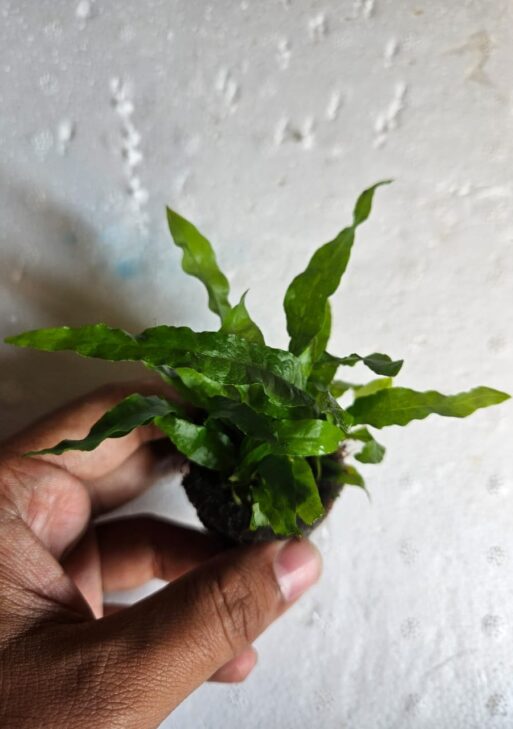

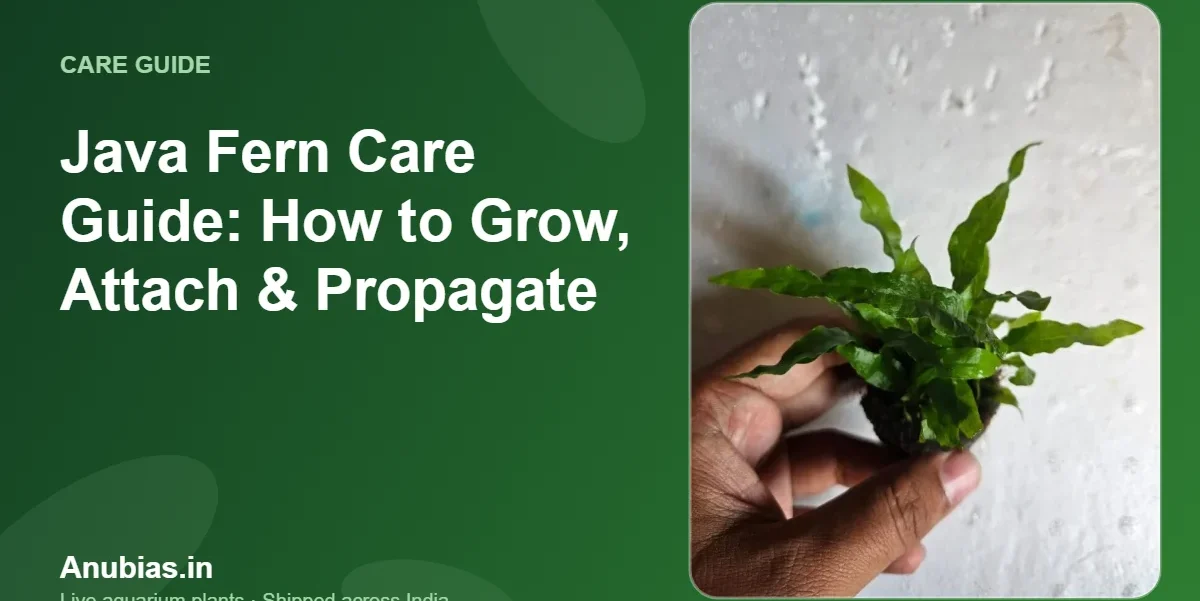
Java fern (Microsorum pteropus) is one of the most popular and forgiving aquarium plants you can own. Like Anubias, it’s an epiphyte — it attaches to wood and rock instead of rooting in substrate — and it thrives in low light without CO₂. Here’s everything you need to grow it well.
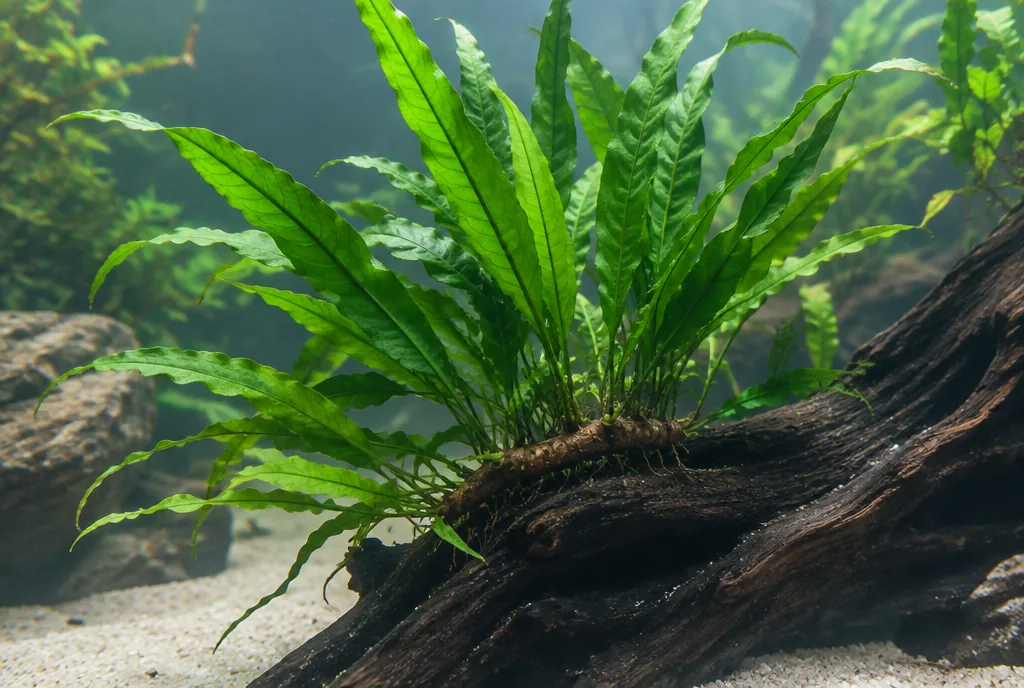
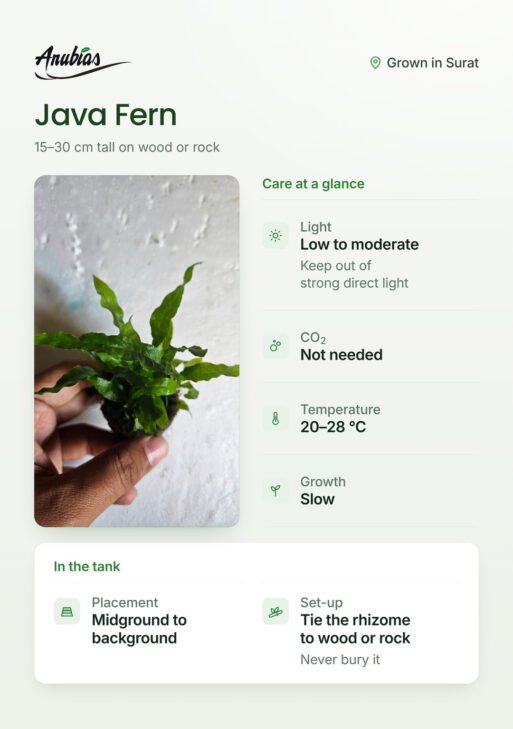
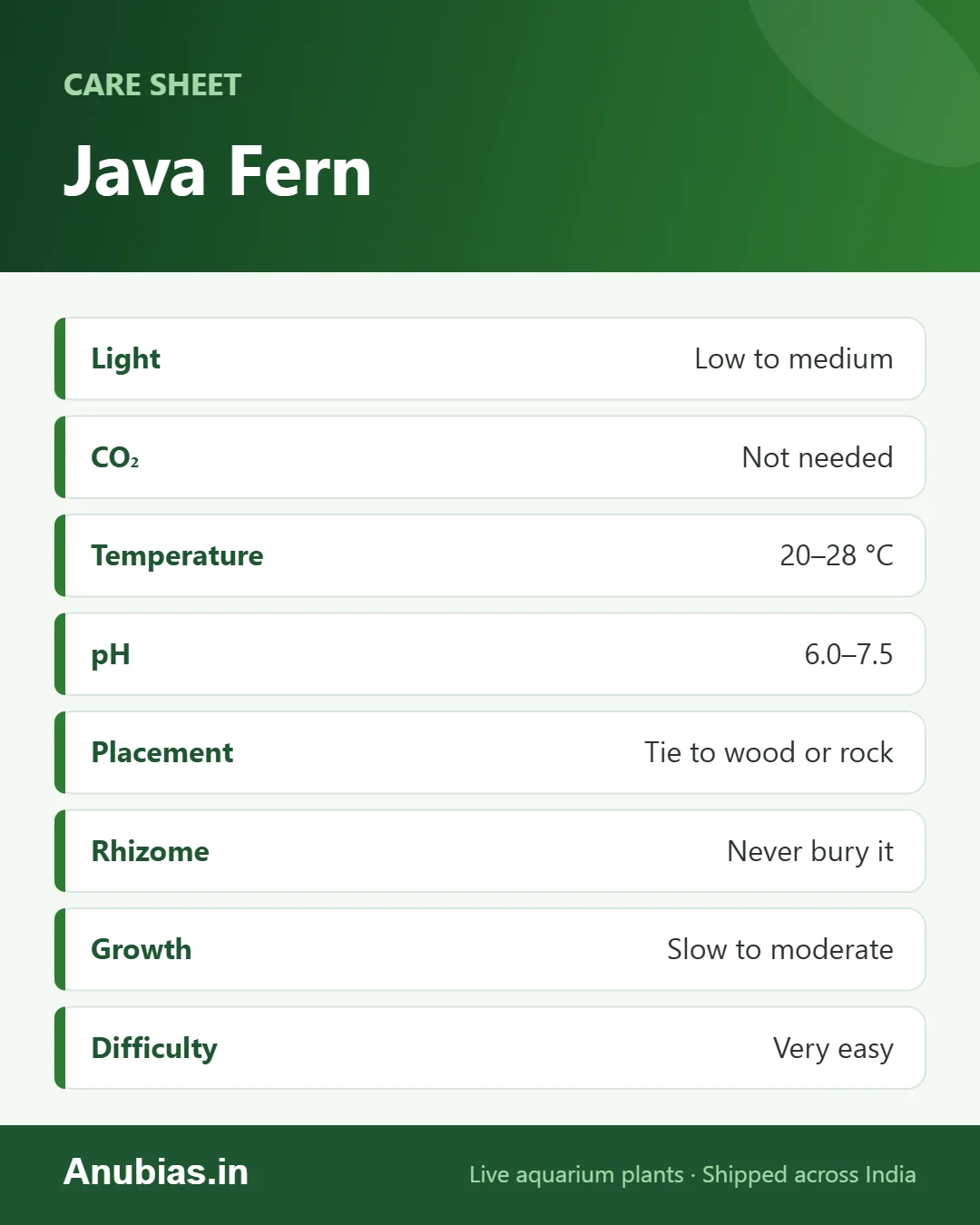
Quick answer: Java fern is a hardy, low-to-moderate-light epiphyte that needs no CO2 and tolerates 20–28°C across a broad pH range. Attach it to wood or rock rather than planting it in substrate — never bury the rhizome — and it will thrive with minimal care.
Why Java fern is so easy
Java fern is hardy, slow-growing and tolerant of a wide range of water conditions. It doesn’t need fertiliser-rich substrate, special lighting or CO₂, which makes it ideal for beginners and low-tech tanks. It also gives fish and shrimp natural cover.
What Java fern does in your tank
Java fern gives a tank height and cover without any fuss. Its fronds, usually 15–30 cm long, fill the midground and background, hide heaters and filters, and give shy fish and shrimp shade to retreat into. The leaves are smooth, so they will not tear a betta’s fins, and they are tough and bitter enough that goldfish and many cichlids usually leave them alone. Shrimp graze the film that grows on older leaves, and mature plants make small plantlets, so one plant slowly becomes several. It grows too slowly to take up much of the nitrate that feeds algae, so pair it with a fast grower if algae is a problem.
Light and water
Keep Java fern in low to moderate light — strong light encourages algae on its slow-growing leaves. It’s comfortable from about 20–28°C across a broad pH range. A weekly dose of liquid fertiliser keeps the leaves deep green.
Never bury the rhizome
The single most important rule: never bury the rhizome (the thick horizontal stem the leaves grow from). Buried, it rots. Instead, attach Java fern to driftwood or rock with cotton thread or a dab of cyanoacrylate super-glue gel — the same way you would attach Anubias. Within weeks the roots grip on their own.
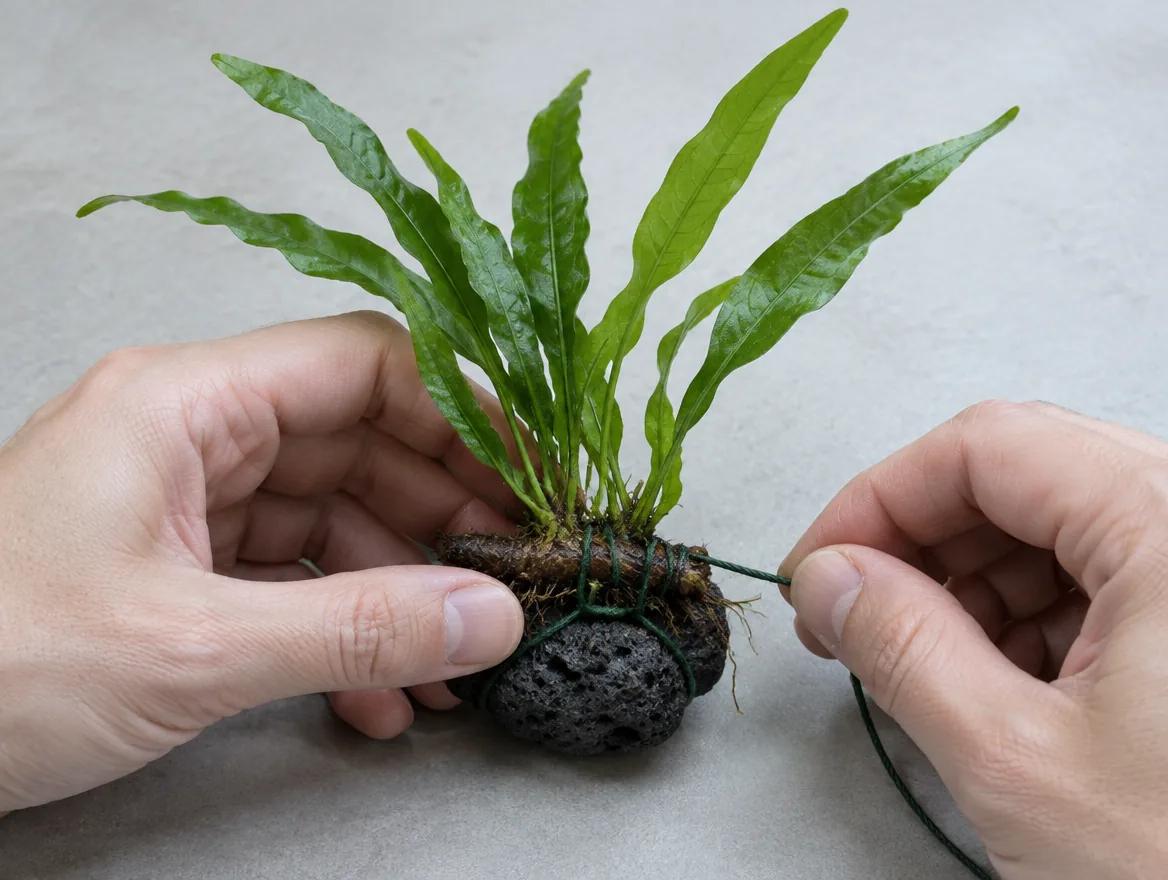
How to attach Java fern
- Take the plant out of its pot and gently pull away the grow plug or rock wool from around the roots.
- Hold the rhizome against the wood or rock and wrap cotton thread or fishing line over it three or four times, between the fronds, then knot it underneath. Or glue it: put a small dab of gel superglue on a dry spot and press the rhizome on for 20 to 30 seconds.
- Keep the rhizome uncovered. The roots may hang down into the gravel.
- Put it back in the tank. The roots grip within a few weeks; cotton thread breaks down on its own, and fishing line can be cut off once the plant holds.
Propagation
Java fern propagates itself: tiny plantlets (“baby ferns”) sprout on mature leaves. Once they have a few leaves and small roots, gently detach them and attach them to new hardscape. You can also split the rhizome into sections, each with leaves and roots.
Common problems
Small black spots on leaves are usually plantlets forming or a minor nutrient shortfall — not a disease. Browning often follows transplant shock; trim badly affected leaves and new growth will come in clean. Reduce light if you see algae.
Where to use it
Java fern suits the midground and background, and looks superb tied along a piece of driftwood. It pairs beautifully with Anubias, mosses and Bucephalandra in a low-tech aquascape.
Torn between the two classic epiphytes? Read our Java fern vs Anubias comparison, or browse all the Java fern varieties we stock to pick your starting plant.
Ready to add one? Browse our ferns & mosses collection and Anubias — hand-picked and shipped across India with a live-arrival guarantee.
Growing moss alongside your fern? See our Java moss care guide for attachment and trimming tips.
Grown in Surat (pre-order plants imported to order) · live-arrival guarantee with a 4-hour unboxing video · ₹99 shipping, free from ₹999
More Java fern guides:
Java fern care sheet
| Factor | What Java fern needs |
|---|---|
| Light | Low to moderate |
| CO₂ | Not required |
| Temperature | 20–28°C |
| Water | Tolerates a broad pH range |
| Placement | Rhizome tied to wood or rock, never buried |
| Growth | Slow to moderate |
| Difficulty | Very easy |
Java fern types
| Type | Leaves | Typical height | Price on Anubias.in |
|---|---|---|---|
| Classic Java fern | Broad, smooth, lance-shaped | 15–30 cm | ₹175 |
| Java Fern Philippine | Broad, prominently veined | 15–30 cm | ₹175 |
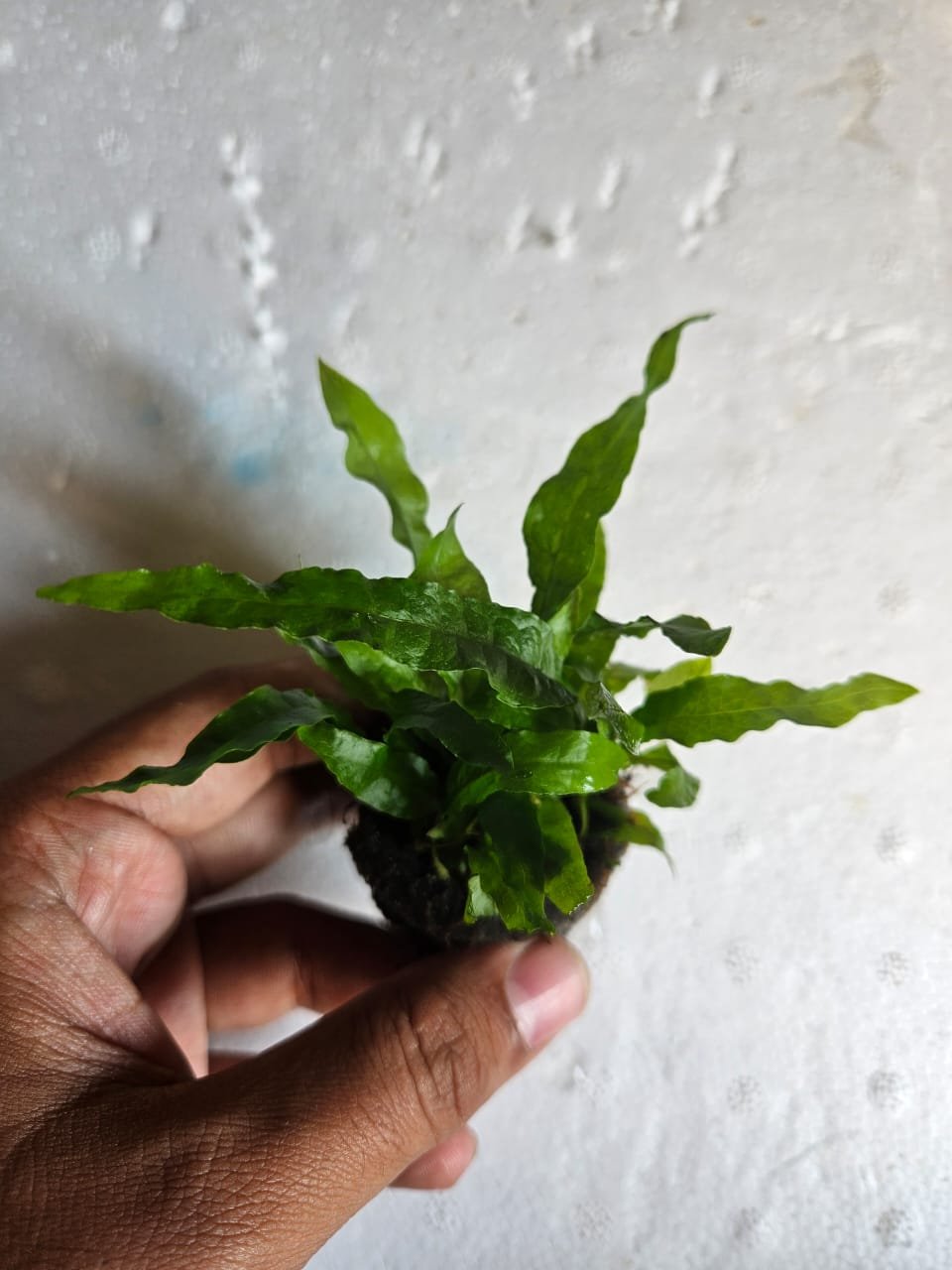
| Java Fern Wrinkled Leaf | Deeply crinkled | 15–25 cm | ₹175 |
| Dwarf Java Fern (Mini) | Small, bushy | Up to about 15 cm | ₹175 |
All types share the same care. Compare all eight in our Java fern types guide.
Plantlets and propagation
Java fern grows small plantlets on older leaves. Once they have roots and a few leaves, detach them and tie them to wood or rock. You can also cut a long rhizome into sections that each keep several leaves. See when plantlets are ready and how to attach them in our Java fern plantlets guide.
Brown dots, black leaves and melting
Neat rows of dark dots under the leaves are usually spores and are normal. Brown or black patches that spread often come from a buried rhizome, too much light, or nutrient shortage. Java fern problems and fixes
Tank mates
Java fern’s leathery, bad-tasting leaves make it one of the few plants that goldfish and many cichlids usually leave alone, and it is safe with bettas, shrimp and community fish. Tie it firmly so diggers cannot pull it loose. Plants goldfish won’t destroy
Java fern in Indian conditions
- Keep water at or below about 28°C in summer.
- Dechlorinate tap water; Java fern tolerates a wide range of hardness.
- Avoid direct sunlight, which encourages algae on slow leaves.
Java fern or Anubias?
Both are easy epiphytes. Java fern grows taller with thinner leaves; Anubias has thicker, rounder leaves and grows slower. Many tanks use both. Java fern vs Anubias
Start with the Anubias Five
One of each of our five Surat-grown Anubias, sized by leaf count.
Build your setFrequently asked questions
Does Java fern need CO2?
No. Java fern grows in low to moderate light without CO2.
Can I plant Java fern in gravel?
Do not bury the rhizome. Tie Java fern to wood or rock; the roots can touch the gravel, but the rhizome must stay uncovered.
Why does my Java fern have black dots under the leaves?
Neat rows of dark dots are usually spores, which are a normal part of the plant.
How fast does Java fern grow?
Slowly to moderately. New leaves and plantlets appear over weeks rather than days.