
What Isopods Actually Are
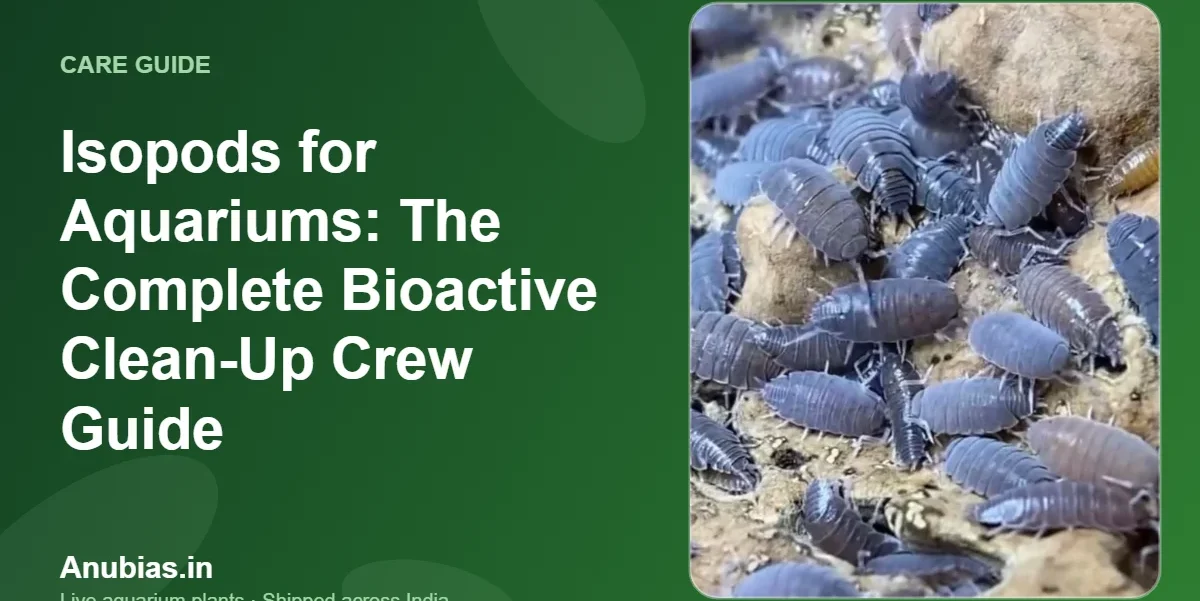
Isopods are crustaceans, related to shrimp and crabs, though the ones sold for bioactive setups moved onto land long ago. You’ve almost certainly met them already as woodlice, pillbugs, or roly-polies. They breathe through modified gill structures on the underside of their bodies, and those structures need consistent moisture to work — a very different system from how a fish, or an aquatic shrimp, pulls oxygen straight out of water.
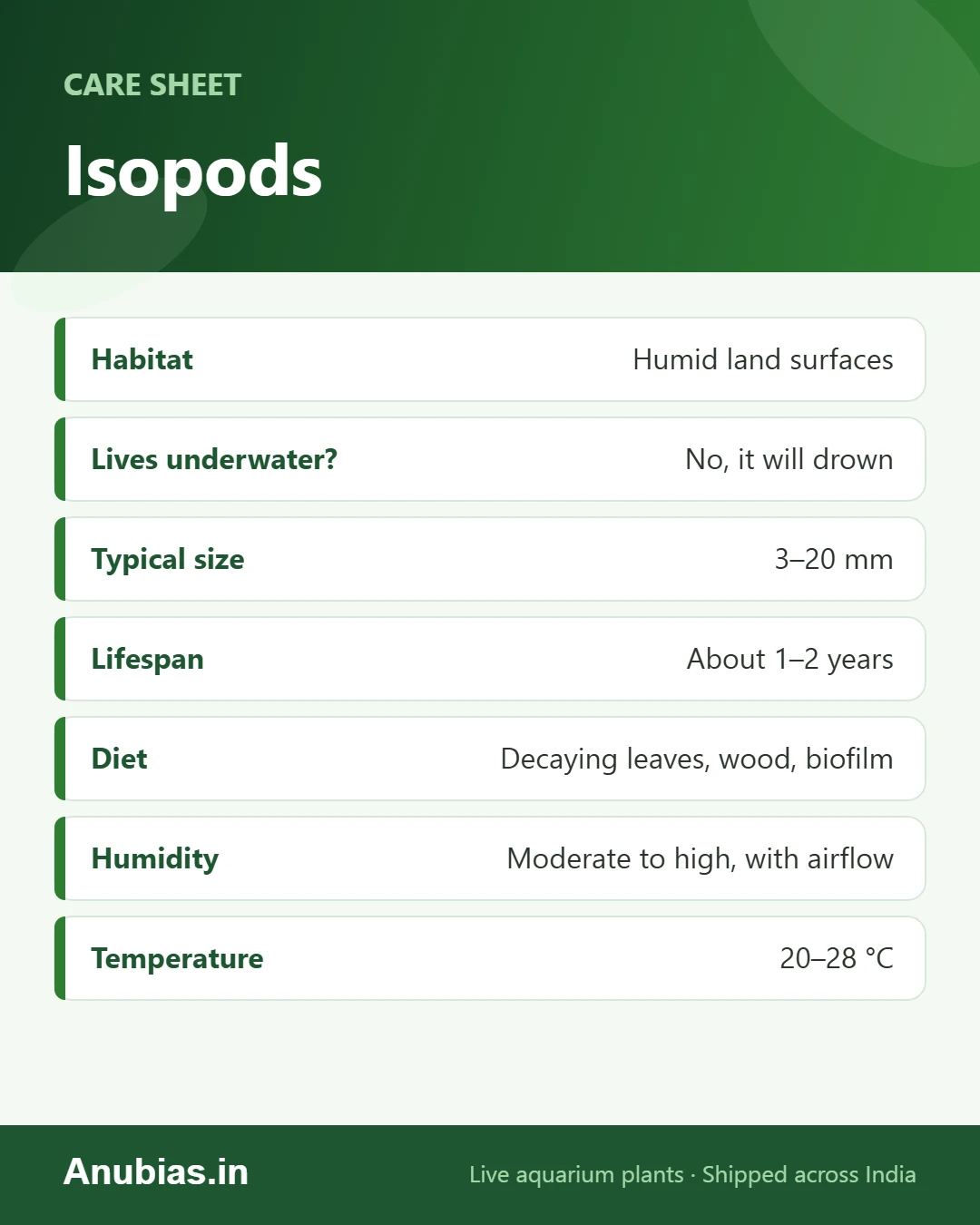
Quick answer: Isopods are land-dwelling crustaceans for the terrestrial side of a bioactive setup — kept fully underwater they will drown, so treat them as a clean-up crew above the waterline, not inside the aquarium. Most species measure 3–20 mm, live roughly 1–2 years, feed on decaying leaves and organic waste, and are comfortable at normal Indian room temperatures of about 20–28°C. A starter colony costs ₹700 on anubias.in.
This matters for anyone buying isopods to go with a planted tank. Terrestrial and semi-aquatic isopods cannot live permanently submerged. Drop them into a fully underwater aquarium and they’ll drown within a day or two. They are not a substitute for aquatic snails, shrimp, or algae-eating fish, and treating them like one will just kill them.
Where isopods do belong is anywhere there’s a humid land surface: paludariums, ripariums (aquariums with an emersed planting shelf that sits above the waterline), terrariums, and bioactive vivarium substrates. If your setup has a dry or humid land zone that stays out of the water, isopods have real work to do there. If it doesn’t, skip them.
Quick Facts
| Attribute | Detail |
|---|---|
| Classification | Crustacea, order Isopoda, suborder Oniscidea |
| Habitat | Terrestrial / semi-aquatic — humid land surfaces |
| Lives submerged? | No — will drown if kept fully underwater long-term |
| Typical size | 3–20 mm, depending on species |
| Lifespan | Roughly 1–2 years, longer in stable colonies |
| Diet | Decaying leaves and wood, biofilm, mold, leftover food |
| Humidity needs | Moderate to high, with some airflow |
| Temperature range | 20–28°C (68–82°F) for most tropical species |
| Best used in | Riparium land shelves, paludariums, terrariums, bioactive substrate |
What “Bioactive Clean-Up Crew” Actually Means
“Bioactive” describes a setup where a living substrate does the janitorial work on its own, instead of you pulling out rotting leaves and scraping mold by hand. Isopods are one of the main workers in that system, usually alongside springtails.
In the emersed zone of a riparium or paludarium, isopods eat decaying plant matter — dead or dying leaves, softened wood, mold and fungal growth on damp surfaces, biofilm, and any leftover food that lands on the land portion of the setup. What comes out the other end is frass, which breaks down further and feeds nearby plants. It’s a small nutrient loop: dead matter goes in, usable nutrients come out, and mold never gets the chance to take over.
That’s genuinely useful in a humid, semi-enclosed space, since damp leaf litter and decaying wood mold fast without something working through it. It’s not useful in a standard fully submerged aquarium — there’s no land surface for isopods to work on, and no way for them to survive there.
Common Species Sold in the Hobby
A handful of species turn up again and again in bioactive and terrarium keeping: Porcellio scaber, Porcellio laevis, Trichorhina tomentosa (the dwarf white isopod), Armadillidium species (true pillbugs), and Cubaris species. They differ mainly in size, breeding speed, and how much humidity they need to stay healthy.
Species Comparison
| Species | Size | Humidity Need | Notes |
|---|---|---|---|
| Porcellio scaber | Medium | Moderate | Hardy, widely available, several colour morphs |
| Porcellio laevis | Large | Moderate–low | Fast, prolific breeder; tolerates drier conditions |
| Trichorhina tomentosa | Small | High | Burrowing, prolific, suited to small enclosures |
| Armadillidium spp. | Medium | Moderate | Can roll into a ball; slower breeder |
| Cubaris spp. | Medium | High | Tropical, less tolerant of fluctuation |
Which species actually ship in a “Bioactive Clean-Up Crew” order varies by supplier and season — check the product listing for what’s included before you buy, and don’t assume every isopod product on the market contains the same species.
Safe Setups and Tankmates
Isopods are not built for a standard, fully submerged planted community tank. If your aquarium is 100% water with no emersed land area, there’s nowhere for them to live and nothing for them to clean. Adding them there just means watching them drown, or watching your fish eat them as a one-time snack.
They belong in the parts of a build that stay out of the water:
- The land shelf or background of a riparium, where plants like Anubias, Bucephalandra, or Cryptocoryne root in wet substrate but grow their leaves in open air.
- The land side of a paludarium, alongside emersed plants and driftwood.
- A terrarium or bioactive vivarium substrate, often paired with springtails and, where appropriate, small amphibians such as dart frogs.
Keep them away from areas that flood regularly or stay waterlogged — they need dry ground to retreat to. In a vivarium with frogs or other small livestock, isopods are generally considered safe tankmates, and getting occasionally eaten by larger residents is normal, not a problem to solve.
Basic Care
Humidity and Ventilation
Most species need substrate that’s consistently damp, not soaked, plus enough airflow to keep mold from taking over completely. Too dry and they desiccate. Too wet and stagnant, and the substrate turns sour and anaerobic. Aim for the middle.
Substrate
Leaf litter is the backbone of any isopod enclosure — oak, magnolia, or Indian almond (catappa) leaves all work well. Mix in cocoa fiber or coco coir as a moisture-retentive base, and add a piece of decaying wood for burrowing and grazing. Skip any leaf litter or wood that’s been treated with pesticide or fertilizer.
Temperature
Most tropical isopod species do fine at normal Indian room temperature, roughly 20–28°C. Avoid direct sun and avoid placing the enclosure near a heater vent — either will dry things out fast or push temperatures too high.
Feeding
Leaf litter and decaying wood cover most of an isopod colony’s diet without any extra effort. Supplement occasionally with fish flake, blanched vegetables like carrot or spinach, and a calcium source — crushed eggshell or cuttlebone — to support healthy molting.
Common Mistakes
- Adding isopods to a fully aquatic tank, expecting them to clean algae or leftover food underwater. They can’t survive submerged, and this is the single most common misunderstanding new buyers have.
- Letting the substrate dry out. Isopods desiccate fast without consistent humidity.
- Oversaturating the substrate. Waterlogged, stagnant conditions are just as harmful as bone-dry ones.
- Skipping leaf litter. Without it, isopods have nothing to eat and nowhere to hide during molting — which leads to stress and cannibalism.
- Expecting instant results. A new colony needs weeks to establish before you’ll notice a real dent in detritus or mold.
Why Isopods Pair Well With Anubias and Bucephalandra
Anubias, Bucephalandra, and Cryptocoryne are all plants that get grown emersed in riparium and paludarium builds — tied to driftwood or rock with their leaves reaching into humid air rather than staying fully submerged. That emersed growth habit is exactly where isopods earn their keep. The same applies to a small wabi-kusa planted with Anubias and Bucephalandra, once the mound has been damp and stable for two or three weeks.
When emersed leaves melt, yellow, or die back during acclimation — which happens routinely as these plants shift from tissue culture or fully aquatic form into emersed growth — that dead matter doesn’t need to sit there rotting and feeding mold. Isopods process it, along with any biofilm building up on the wood or rockwork the plants are mounted to. The result is a cleaner emersed zone and a small stream of nutrients cycling back into the setup, without you needing to pick out every dying leaf by hand.
It’s a low-effort pairing: plants that spend part of their life above the waterline, and a clean-up crew built specifically for that above-water environment.
Shop the plants in this guide: Pick up a starter colony from our Isopods (Bioactive Clean-Up Crew) listing (₹700), and browse the Anubias and Bucephalandra ranges on anubias.in for epiphyte plants suited to the emersed shelf of a riparium or paludarium build.
Adding isopods to an established tank? Our quarantine guide covers safely introducing new livestock and plants.
Comparing isopod costs? See isopods price in India.
Frequently asked questions
Can isopods live in a fully submerged aquarium?
No. Terrestrial and semi-aquatic isopods cannot live permanently submerged and will drown within a day or two in a fully underwater aquarium. They are not a substitute for aquatic snails, shrimp or algae-eating fish, and belong on humid land surfaces such as riparium shelves, paludariums and terrariums.
What do isopods eat in a bioactive setup?
Isopods eat decaying leaves and wood, mould and fungal growth, biofilm and leftover food on the land portion of a setup. Leaf litter and decaying wood cover most of their diet, supplemented occasionally with fish flake, blanched carrot or spinach, and crushed eggshell or cuttlebone for calcium.
What temperature and humidity do isopods need?
Most tropical isopod species do fine at normal Indian room temperature of roughly 20–28°C. They need substrate that is consistently damp but not soaked, plus enough airflow to stop mould taking over. Avoid direct sun and heater vents, which dry the enclosure out or push temperatures too high.
Are isopods insects?
No. Isopods are crustaceans, more closely related to crabs and shrimp than to insects. Insects have six legs and three body sections, while isopods have seven pairs of legs and breathe through gill-like structures, which is why land isopods need a humid enclosure to survive.
Grown in Surat (pre-order plants imported to order) · live-arrival guarantee with a 4-hour unboxing video · ₹99 shipping, free from ₹999