
Cryptocoryne wendtii is already one of the most trusted low-light plants in the hobby, and the ‘Red’ (sometimes sold as ‘Bronze’ or ‘Mahogany’) colour form gives you the same rock-solid reliability with a warm reddish-brown palette instead of plain green. It’s one of the easiest ways to add contrast to a foreground or midground without touching your lighting setup or adding CO2 — see our full list of aquarium plants that don’t need CO2 for more like it. This guide covers planting, colour development, and the “crypt melt” that catches out most first-time buyers.
Quick Overview
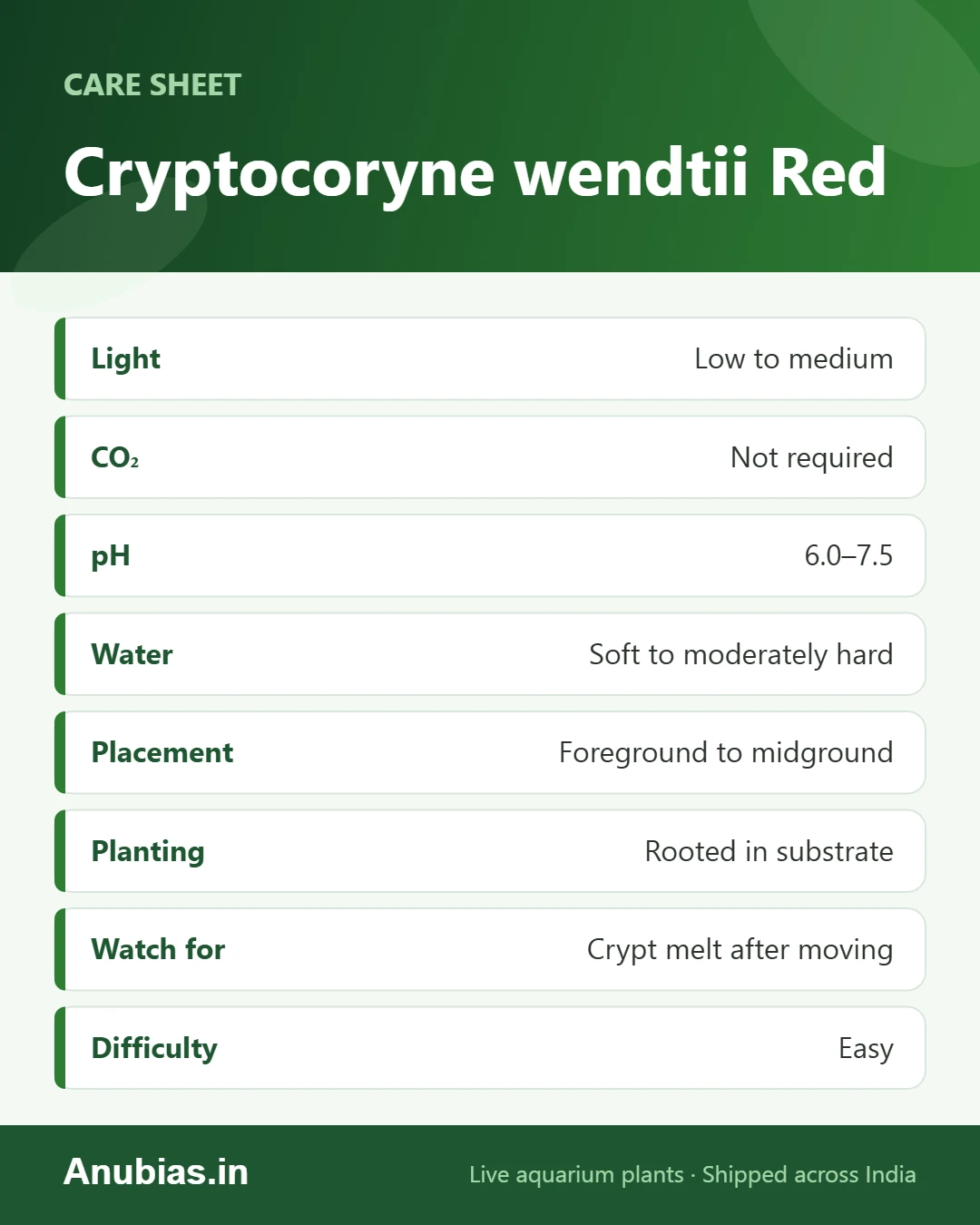
- Difficulty: Easy
- Placement: Foreground to midground, rooted in substrate
- Light: Low to medium
- CO2: Not required
- Water parameters: Wide tolerance; pH 6.0–7.5, soft to moderately hard water
What Makes the Red Form Different
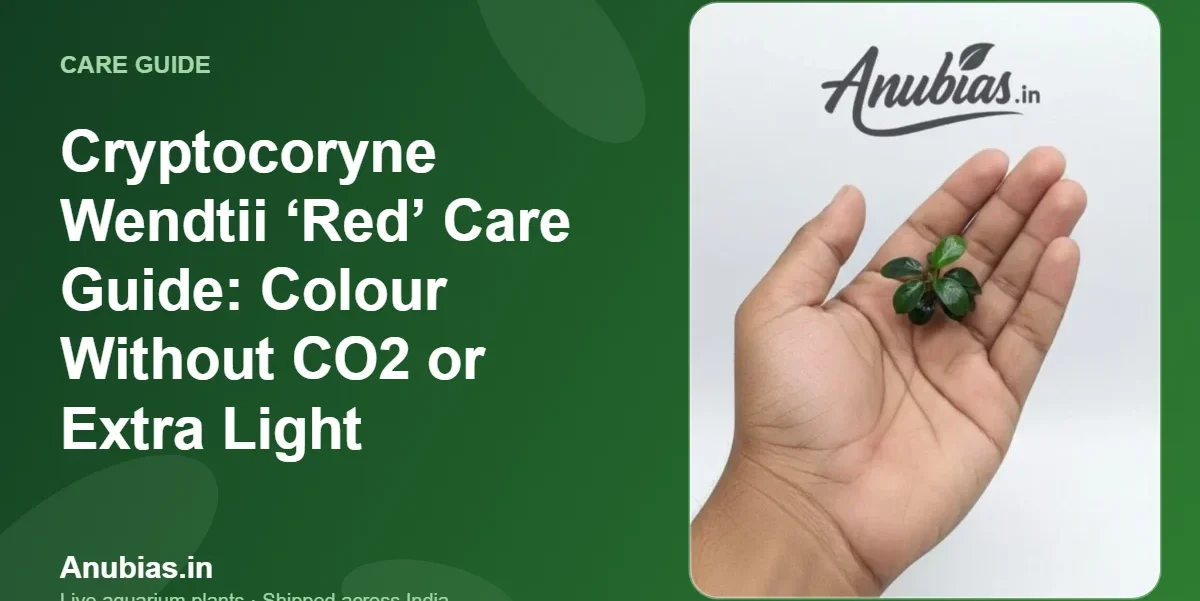
Cryptocoryne wendtii is a naturally variable species — wild and cultivated populations range from green through brown to deep red, all under the same species name. The ‘Red’ or ‘Bronze’ form is a colour-stable cultivar selected for consistent reddish-brown leaves rather than the plain green of standard wendtii. Leaf shape, wavy margins and growth habit are otherwise identical: low rosettes that slowly bulk out into a dense clump.
Planting and Substrate
Plant individual crowns 2–4 cm apart in a nutrient-rich substrate, with the crown — the point where leaves meet roots — sitting at or just above the surface. Burying it too deep slows growth and can encourage rot. Root tabs pushed in near the root zone noticeably speed up leaf production, since crypts feed through their roots more than through the water column.
Light and Colour Development
Unlike many “red” aquarium plants, this crypt does not need strong light to survive, but colour intensity does track light levels. Under low light it settles into an olive-bronze tone; under medium light with good root nutrition it deepens into a richer red-brown. There’s no need to push high light purely for colour — it stays visibly warmer-toned than the green form even in a low-tech, low-light tank.
Water Parameters and Adaptability
This is one of the most adaptable plants sold for freshwater aquariums, tolerating a wide pH and hardness range in the wild. That makes it forgiving of ordinary Indian tap water without much adjustment, and a safe foreground choice for community tanks that also house livebearers or other species that prefer harder water than typical soft-water plant specialists.
Dealing with Crypt Melt
New crypts frequently lose most or all of their leaves within one to two weeks of planting — a phenomenon known as “crypt melt,” usually triggered by the change in water chemistry between the grower’s setup and your tank, or by physical disturbance during transport and planting. It looks alarming but is rarely fatal: leave the roots undisturbed, keep parameters stable, and fresh, better-adapted leaves typically emerge within three to six weeks.
Propagation and Spreading
Established plants send out runners that produce new plantlets a short distance from the parent crown, gradually forming a dense clump or carpet-like patch over several months. Plantlets can be left in place to fill in naturally, or separated and replanted once they have two or three leaves of their own and a small root system.
Pairing It With Other Plants
Because it stays low and doesn’t need strong light, this red crypt works well as a foreground-to-midground colour block in front of taller green plants, along the base of hardscape, or as a warm-toned contrast next to green carpeting plants like Dwarf Hairgrass or Dwarf Sagittaria. If you’re deciding between crypts and other easy low-light staples, our Cryptocoryne vs Anubias comparison is a useful next read.
More Cryptocoryne guides:
Frequently Asked Questions
Is Cryptocoryne wendtii ‘Red’ harder to keep than the green form?
No — care requirements are identical to standard green wendtii. The only difference is leaf colour, which is a stable, genetically fixed trait of this particular form, not a result of special care.
Why did all my crypt’s leaves disappear after I planted it?
This is classic crypt melt, triggered by the shift in water conditions and handling during transplanting. Leave the root system in place and stable; new, better-adapted leaves almost always regrow within three to six weeks.
Do I need to dose fertiliser for good colour?
Root tabs or a nutrient-rich substrate make the biggest difference, since crypts feed mainly through their roots. Liquid fertiliser helps overall health but is secondary to what’s available at the root zone.
When will my pre-order ship?
This plant is imported to order; typical arrival is around 15 days from purchase, and we’ll email dispatch and tracking details.
Ready to add some colour to your foreground? Cryptocoryne Wendtii ‘Red’ is available to pre-order here.
Wendtii ‘Red’ follows the same rhythm as the rest of the genus — brush up with the full Cryptocoryne care guide, or browse the Cryptocoryne we have in stock.
Leaves dissolving? See crypt melt explained.
Choosing a crypt? Compare Crypt wendtii Green vs Red.
Grown in Surat (pre-order plants imported to order) · live-arrival guarantee with a 4-hour unboxing video · ₹99 shipping, free from ₹999