

Anubias Nana Gold is one of those plants that quietly upgrades a tank the moment it’s added. It isn’t loud like a red stem plant and it doesn’t carpet the substrate like monte carlo — it just sits on a piece of wood or rock, growing a handful of thick, glossy leaves a year, and somehow becomes the plant everyone asks about. If you’ve kept regular Anubias barteri var. nana before, Nana Gold looks familiar at first glance but reveals its differences as it matures, and it rewards a little extra attention to detail that most nano plants don’t need.
Quick answer: Anubias Nana Gold needs only low to medium light (15-30 PAR), no CO2, 22-28°C water, pH 6.5-7.5 and GH 3-8 — and the rhizome must be glued or tied to wood or rock, never buried, or it rots within weeks. It stays compact under 8-10 cm and grows one new leaf every 3-4 weeks under decent light (6-8 weeks in low light). Stronger light keeps the golden-lime colour brighter; low-light plants trend green-gold.
What Makes Nana Gold Different
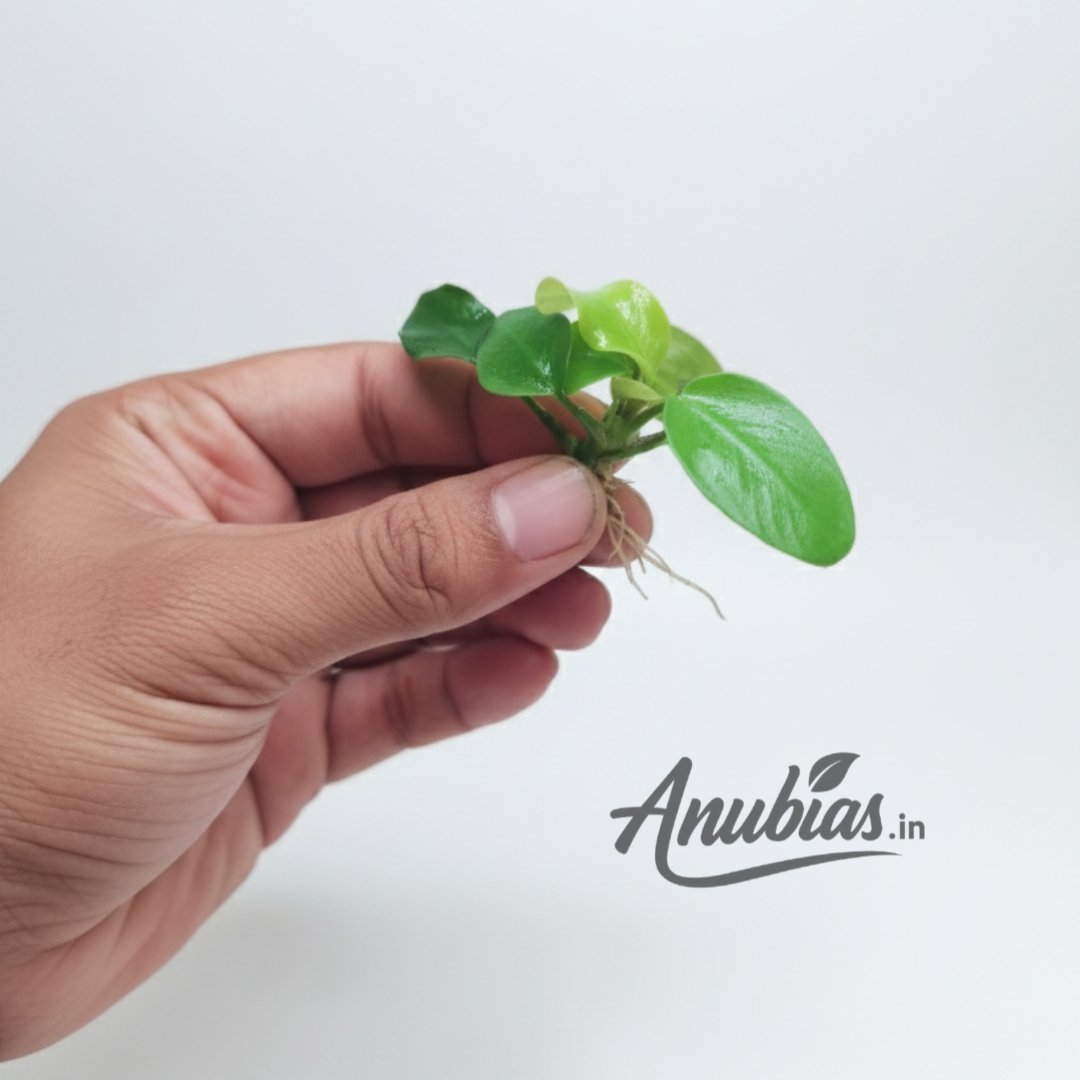
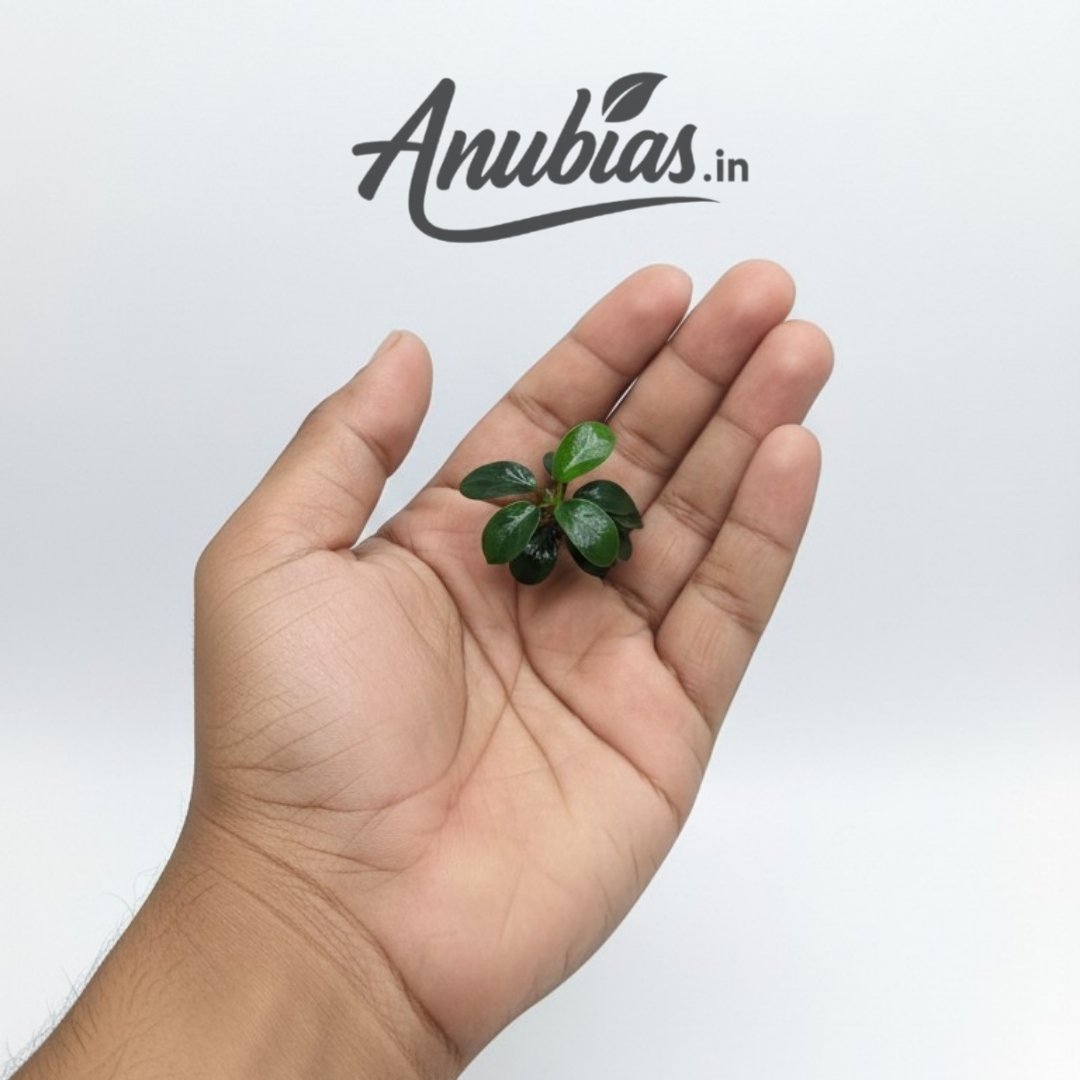
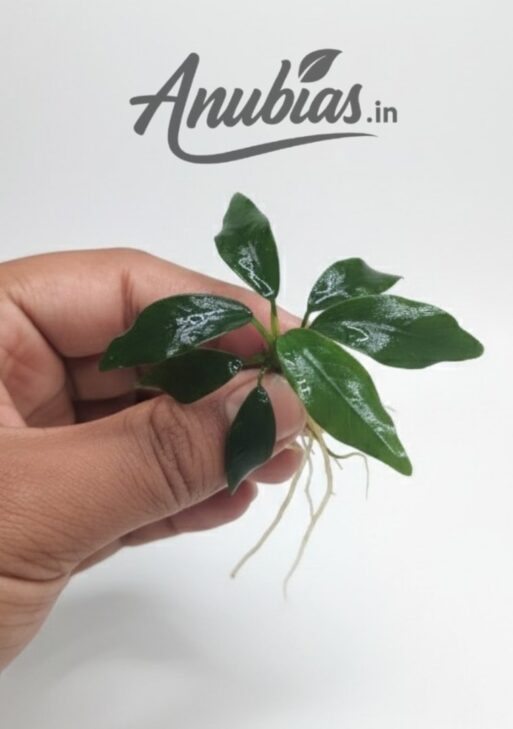
Regular nana is uniformly dark green. Nana Gold starts life with new leaves that emerge a bright, almost lime-yellow colour with visible dark green mottling along the veins, and as the leaf hardens off over a few weeks it settles into a mustard-gold to olive tone that never fully reverts to plain green. The variegation pattern isn’t identical leaf to leaf, which is part of the appeal — no two plants look quite the same. It’s also noticeably more compact than standard nana, staying under 8-10 cm even in ideal conditions, which makes it a natural fit for nano and mid-sized tanks where regular nana would eventually look oversized. Because the gold pigmentation is partly a response to light intensity, plants kept under stronger light tend to hold a brighter gold colour, while low-light specimens trend more green-gold. This is one of the few Anubias where light level visibly changes the plant’s colour rather than just its growth rate.
Light, CO2 and Water Parameters
Anubias as a genus evolved growing on riverbank rocks and roots in shaded West African streams, often partially emersed, so it’s naturally adapted to low light and doesn’t need pressurised CO2 to look good. That said, a bit of both speeds up growth and improves leaf colour without any real downside.
| Parameter | Recommended range | Notes for Indian tanks |
|---|---|---|
| Light | Low to medium (15-30 PAR) | Avoid placing directly under high-output LEDs; shade under floaters or taller plants if needed |
| CO2 | Not required, but 15-25 ppm helps | Optional pressurised or liquid carbon |
| Temperature | 22-28°C | Comfortable through most of the year except peak summer in cities like Delhi, Nagpur or Ahmedabad where 30°C+ room temps need a chiller or fan cooling |
| GH | 3-8 dGH | RO/DM water users should remineralise; straight RO with zero GH will stunt growth over time |
| KH | 2-6 dKH | Borewell and municipal water in much of Gujarat and Rajasthan runs hard and is generally fine as-is |
| pH | 6.5-7.5 | Tolerates a wider range than most stem plants |
Water hardness is genuinely the variable most Indian hobbyists get wrong with Anubias, mostly because it isn’t a problem they’re watching for. Cities on borewell or groundwater supply — much of Gujarat, Rajasthan and parts of Tamil Nadu — often run hard tap water that’s perfectly fine for Anubias straight from the tap after dechlorination. If you want to plan a whole tank around that water, see our list of plants that grow well in hard Indian tap water. Hobbyists using RO or DM (demineralised) water for softer, more stable tanks sometimes over-correct and run near-zero GH, which starves Anubias of the calcium and magnesium it needs for firm, dark leaves. If your leaves are thin, pale and floppy despite good light, check your GH before assuming it’s a light or fertiliser issue.
Growth Rate and What to Expect
This is a genuinely slow plant, and that’s the entire appeal for people who don’t want to trim weekly. Under decent light and some CO2, expect one new leaf every 3-4 weeks. Under low light with no supplementation, that can stretch to 6-8 weeks per leaf. A healthy rhizome will also push out new leaves in flushes rather than a steady trickle, so don’t panic if it looks static for a month and then suddenly unfurls two leaves in a week. Because growth is slow, algae has more time to colonise older leaves before new growth outcompetes it — a bit of green spot or green dust algae on the oldest leaves is normal and not a sign of failing plant health.
How to Attach Anubias Nana Gold to Hardscape
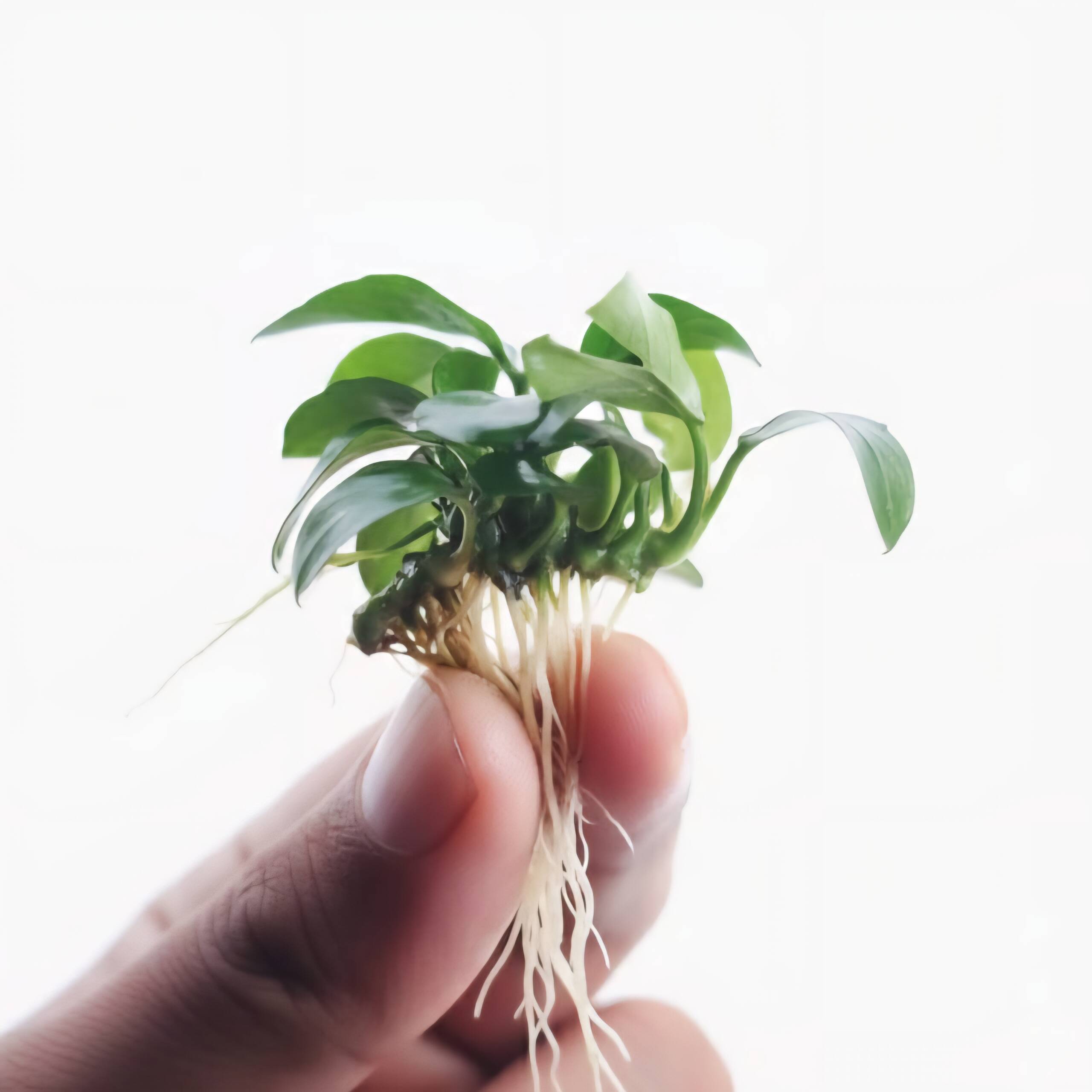
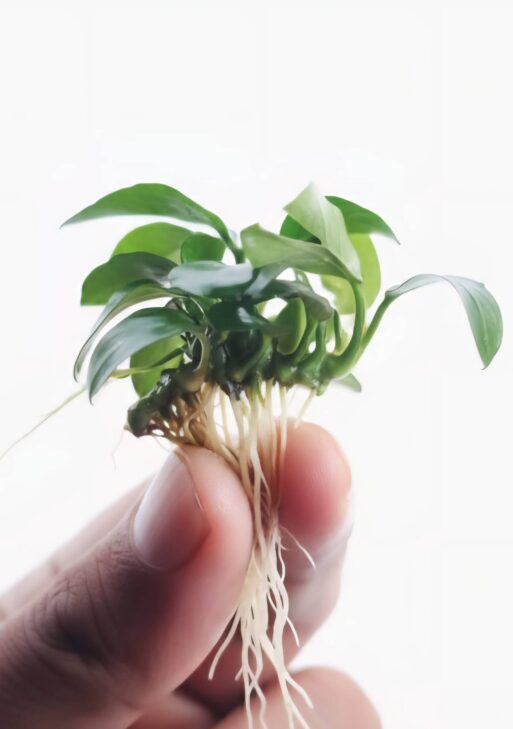
The one rule that matters more than any other with Anubias: the rhizome — the thick horizontal stem the leaves and roots grow from — must never be buried in substrate. Buried rhizomes rot within weeks regardless of everything else being correct. Mount it on wood or rock instead.
The most reliable method is cyanoacrylate aquarium-safe superglue gel. Dry the rhizome slightly with a paper towel, apply a small dab of gel directly to the rhizome (not the leaves or roots), and press it firmly against the hardscape for about 20-30 seconds until it sets. It cures fully underwater within a few minutes and is completely inert once hardened. For larger pieces of wood or rougher rock where glue won’t hold well, cotton thread or fine fishing line tied loosely around the rhizome works just as well — the roots will grip the surface within 3-4 weeks and the thread can be cut away once anchored. Avoid rubber bands, which degrade and can girdle the rhizome over time.
Propagation
Propagation is simply rhizome division. Once a rhizome has grown to 6-8 leaves with visible growth points or side shoots branching off the main stem, use a clean, sharp blade to cut through the rhizome, making sure each section retains at least two to three leaves and some root mass. Both halves can be reattached to hardscape independently. Cut sections are slow to recover — expect a few weeks of no visible growth while the plant establishes at the cut site before new leaves resume.
Common Problems
Yellowing on older, lower leaves while new growth stays green-gold is normal ageing and nothing to fix. Yellowing that spreads to newer leaves usually points to a potassium or micronutrient deficiency and responds well to a liquid all-in-one fertiliser dosed at low-tech rates. Leaves that turn translucent, dark and mushy at the base, especially right after purchase, are melting — a stress response to the shift from nursery conditions, such as emersed (grown above water) plants or tissue-culture cups, to fully submerged life. This is cosmetic in the vast majority of cases; leave the rhizome mounted and new, fully aquatic leaves will replace the melted ones within a month. Black or brown spotting on otherwise firm leaves is usually just older-leaf algae rather than disease, and can be gently rubbed off with a soft toothbrush during water changes.
Shop the plants in this guide: Browse the Anubias Nana Gold product page for tissue-culture and mature mounted specimens, or explore the full Anubias category page to compare Nana Gold against other varieties like Anubias Nana Petite and Anubias Coffeefolia — or see every Anubias plant type compared in one guide.
Nana Gold shares the same care needs as standard Anubias — see our full Anubias care guide for propagation and attachment basics, or compare it with regular Nana in our Nana vs Nana Petite guide, or see all three sizes head-to-head in our Nana vs Nana Petite vs Nana Gold comparison.
Seeing holes, spots or brown leaves? Use our Anubias leaf problem diagnosis chart.
Frequently asked questions
What light and water does Anubias Nana Gold need?
Anubias Nana Gold needs low to medium light, 22–28°C water and a pH of about 6.5–7.5. CO2 is not required, though a little CO2 helps growth and leaf colour.
How fast does Anubias Nana Gold grow?
Slowly. Expect a new leaf every few weeks under decent light, and slower growth in low light without fertiliser. It often pushes out leaves in flushes, so a month without change followed by two leaves in a week is normal.
Why is my Anubias Nana Gold turning green?
The gold pigmentation is partly a response to light intensity. Plants under stronger light hold a brighter gold colour, while low-light specimens trend green-gold. New leaves emerge lime-yellow and settle into a mustard-gold to olive tone that never fully reverts to plain green.
Grown in Surat (pre-order plants imported to order) · live-arrival guarantee with a 4-hour unboxing video · ₹99 shipping, free from ₹999