

Red Tiger Lotus is one of the few aquarium plants that looks like a genuine centrepiece from the day it arrives. Nymphaea rubra ships as a dormant-looking bulb rather than a rooted plant, which throws off a lot of first-time buyers — there are no leaves, no roots, nothing green at all in the packet. Within days that same bulb sends up dramatic red-and-green mottled leaves on tall stems, and within weeks it can dominate the midground to background of a tank. This guide covers how to plant the bulb correctly, what makes the leaves turn red, and how to manage its habit of racing to the surface.
How to care for Red Tiger Lotus
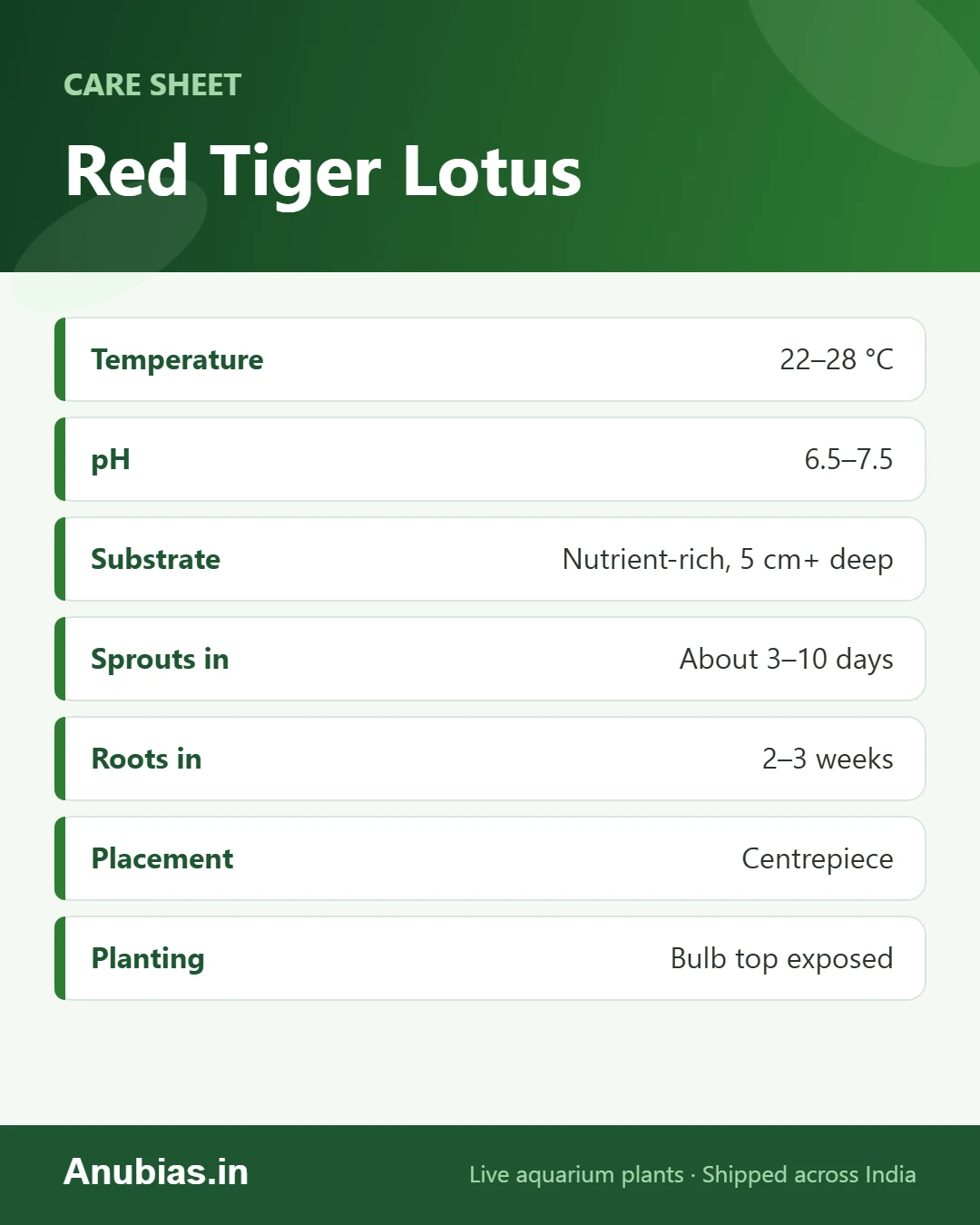
Quick answer: To care for Red Tiger Lotus, plant the bulb only a third to half deep with the pointed tip exposed, in nutrient-rich substrate at least 5 cm deep. Keep it at 22–28°C and pH 6.5–7.5, give medium to high light for red leaves, add root tabs near the bulb, and trim stems that reach for the surface.
What Is Red Tiger Lotus?
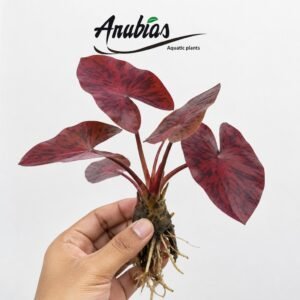
Red Tiger Lotus, sold botanically as Nymphaea rubra and often labelled Nymphaea zenkeri in the trade, is a bulb plant in the water lily family. Underwater it produces broad, arrowhead-shaped leaves in deep red or a red-and-green tiger-striped pattern, held up on long stems from a central bulb rather than a rhizome or root system like Anubias or Cryptocoryne. Left alone, it will eventually send leaves all the way to the surface where they flatten out and float like a true lily pad; most aquarists trim these off to keep the plant bushy and fully submerged instead.
Ideal Water Parameters
Red Tiger Lotus is a tolerant, adaptable plant that does well across the normal range of a community planted tank. Aim for a temperature of 22 to 28°C and a pH between 6.5 and 7.5, though it copes with some drift outside that range without much complaint. It is not particular about hardness either, which combined with its tolerance of temperature swings makes it a fairly forgiving centrepiece plant for Indian tanks that see some seasonal temperature variation.
Lighting and Leaf Colour
Light intensity is the main lever that controls how red the leaves get. Under medium to high light, new leaves emerge in deep red with dark, pronounced mottling — the “tiger” look the plant is named for. Under low light, the plant still grows but leaves come in greener and less vividly patterned. Because it is a heavy root feeder as well, colour and vigour both improve with a nutrient-rich substrate or root tabs placed near the bulb, alongside decent light; light alone without root feeding tends to produce a paler, slower-growing plant.
Planting the Bulb
Correct planting makes the difference between a bulb that thrives and one that rots. Push the bulb into the substrate so that only about one-third to one-half of it is buried, with the growth point — the slightly pointed end where shoots emerge — left uncovered and facing up. Burying the whole bulb is the single most common mistake and a common cause of rot, since the crown needs contact with the water column, not just substrate. Use a nutrient-rich substrate at least 5cm deep where possible, since the roots that follow will spread and feed heavily once established. New shoots often appear within three to ten days, sometimes as fast as 24 hours, with roots anchoring the bulb firmly over the following two to three weeks.
Growth Habit and Trimming
Left untrimmed, Red Tiger Lotus will keep sending leaves upward until they reach the surface and unfurl flat, exactly like an outdoor lily pond. Surface pads block light to everything below them and can quickly overrun a smaller tank, so most keepers trim any stem that starts angling toward the surface, cutting it near the base with scissors. This does not harm the plant; it responds by pushing out fresh leaves at a lower, bushier height, which is the look most people actually want from this plant in an aquarium rather than a pond.
Propagation
An established, healthy bulb periodically produces small plantlets, either as offset bulbs budding from the base of the parent or as tiny new plants forming at a leaf junction on a mature leaf. Once a plantlet has grown a few small leaves and roots of its own, it can be gently separated and replanted elsewhere in the tank or in a new setup entirely. The parent bulb continues growing and producing leaves as normal after offsets are removed.
Common Problems
New bulbs sometimes go through a resting or dormancy phase shortly after planting, especially after the stress of shipping, where all the leaves melt away and nothing appears to be happening. This is not necessarily the bulb dying — as long as it stays firm rather than soft and mushy, keep the substrate undisturbed and it will usually sprout again within a few weeks once it settles in. Soft, mushy, foul-smelling bulbs, on the other hand, indicate rot, usually from being buried too deep or planted in compacted substrate with no oxygen exchange. Constant surface leaves are not a health problem, just a maintenance one, and are fixed with regular trimming as described above. For general root-feeding guidance that applies well to a heavy feeder like this, see our NPK and micronutrient dosing guide.
More water lilies in our shop: Nymphaea ‘Colorado’, Nymphaea capensis ‘Blue’ (variegated leaves), Nymphaea capensis ‘White’ (variegated leaves), Nymphaea ‘Marliacea Chromatella’, Nymphaea pubescens (white, small flower) and Nymphaea pubescens ‘Rubra’.
Frequently Asked Questions
Why does my Red Tiger Lotus bulb have no leaves yet? New bulbs can take anywhere from a day to a couple of weeks to sprout, and some go through a resting phase after shipping before growth starts; as long as the bulb feels firm, be patient rather than discarding it.
Should I bury the whole bulb in the substrate? No — bury only about a third to half of it, keeping the pointed growth tip exposed, since fully burying it is a common cause of rot.
How do I stop it from growing lily pads to the surface? Trim any stem angling upward near its base as soon as you notice it; the plant will respond with new, lower growth instead.
Ready to add a true centrepiece plant? Our Red Water Lily (Nymphaea rubra) ships as a healthy bulb across India, ready to plant using the method above.
Planning a balcony tub or urli? See the best plants for outdoor tubs and balcony ponds in India.
Grown in Surat (pre-order plants imported to order) · live-arrival guarantee with a 4-hour unboxing video · ₹99 shipping, free from ₹999