

If you have been told your tap water is too hard for a planted tank, Vallisneria is the plant that proves otherwise. Vallisneria nana is a grass-like background plant that spreads across the back of a tank on its own runners, throwing up long, ribbon-like leaves that sway in the current instead of sitting still like a rosette plant. It tolerates a wide range of water and grows best in moderately hard water, which is part of why it has stayed a fixture in Indian fishrooms running on borewell or municipal supply for decades. This guide covers what it needs, how it spreads, and the melting phase almost every new Vallisneria goes through before it settles in.
Quick answer: Vallisneria nana tolerates roughly pH 6.5–8.5 and 4–18 dGH and grows best in moderately hard water, so it suits most Indian tap or borewell water. Leaves stay under 1 cm wide but reach 25–40 cm long; it spreads by runners and needs no injected CO2. Below about pH 6.5 it grows slowly and may yellow or melt.
What Is Vallisneria Nana (Jungle Val)?
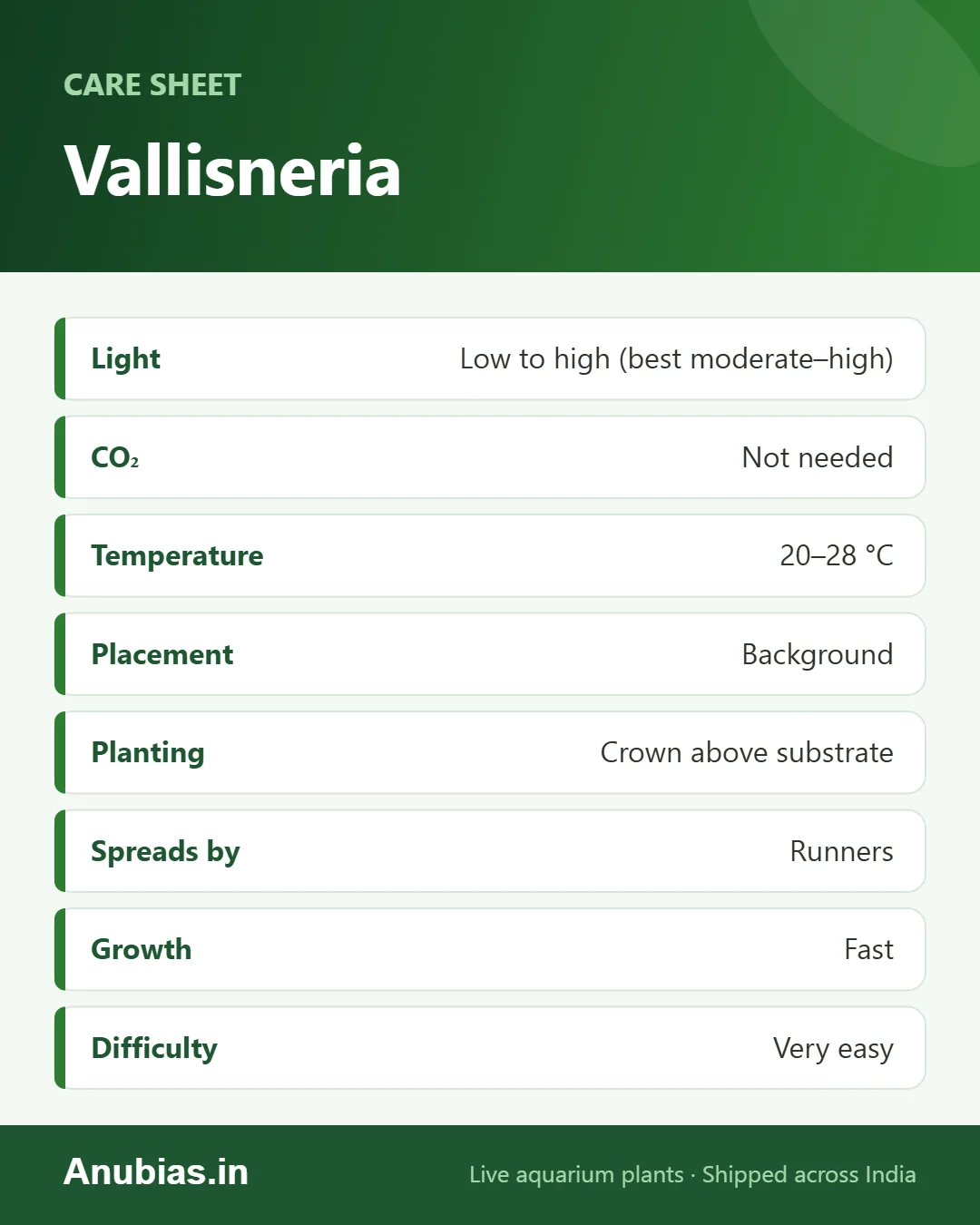
Vallisneria nana is a rosette-forming aquatic plant with narrow, ribbon-like leaves under about 1cm wide that can reach 25 to 40cm long in a healthy tank, arching gently rather than standing bolt upright. Each plant grows from a central crown, the point where the leaves meet the roots, and sends out horizontal runners just under the substrate that pop up as new plantlets a few centimetres away. Left alone, a single crown will fill an entire background wall of a tank within a couple of months. We list it as Jungle Val, but many shops use that name for Vallisneria americana var. gigantea, a different and much larger plant whose leaves can grow past 1 metre. Vallisneria nana stays a manageable size for most home aquariums, with the same easy runner growth. Check the species name when you compare prices. Our Vallisneria types and price guide shows which one suits a 2 ft or 3 ft tank.
Ideal Water Parameters
Vallisneria is comfortable across a wide temperature range, from about 15 to 30°C, with 20 to 28°C being the range where it grows fastest and stays healthiest. It tolerates a wide range of water, roughly pH 6.5 to 8.5 and 4 to 18 dGH, and grows best in moderately hard water. This makes it a natural fit for Indian tap and borewell water, which tends to run harder and more alkaline than the soft, acidic water most tropical plants are bred to expect. In very soft, acidic water below about pH 6.5, growth slows and leaves may yellow or melt, so if your local water is very soft, this is not the easiest background plant to reach for. If your supply is on the hard side, our list of aquarium plants that do well in hard borewell water covers the Anubias, Java fern and Cryptocoryne that pair well with it.
Light Requirements
Vallisneria nana grows fastest in moderate to high light, with the lights on about 6 to 8 hours a day, reflecting its natural habitat in shallow, sun-exposed streams and ditches. It still grows under low to moderate lighting, just more slowly and with slightly shorter leaves, so it is forgiving enough for tanks that are not running high-output LEDs. What it does not tolerate well is deep shade from taller plants or hardscape blocking the back of the tank, since weak light is one of the more common reasons growth stalls out completely.
Substrate and Planting Method
Plant each crown so that the point where the leaves meet the roots sits right at the substrate surface, not buried. Covering the crown with gravel or soil is one of the most common planting mistakes with Vallisneria and a frequent cause of crown rot and melting afterwards. Beyond that, it is not fussy about substrate type: plain gravel, sand or a nutrient-rich planted substrate all work, since the plant draws a good share of its nutrients from the water column through its leaves as well as through its roots. Space individual crowns roughly 10 to 15cm apart along the back or sides of the tank to leave room for runners to spread outward before they start competing for space.
Propagation via Runners
Vallisneria propagates almost entirely on its own once it is settled in. Each crown sends out thin, horizontal runners that travel just under or along the substrate and produce a new daughter plantlet a short distance away. Once a daughter plantlet has grown four or five leaves of its own and developed its own root system, it is self-sufficient and can be snipped free of the runner and moved elsewhere in the tank, or simply left in place to keep the colony spreading. There is no cutting or grafting involved, which makes it one of the easiest plants to multiply for anyone wanting to fill a tank without buying more stock.
Trimming and Its Role in the Tank
Left untrimmed, Vallisneria’s leaves will eventually reach the surface and trail across it, which some aquascapers like for the shaded look it gives fish underneath. If you would rather keep leaves from carpeting the surface, trim the tips back with scissors rather than pulling on the leaves, since tugging can loosen the crown or uproot connected runners. As a background plant, it does double duty as a mild water polisher, taking up nitrate through both roots and leaves, and gives fish and shrimp constant cover to dart into, similar to the role floating plants play nearer the surface.
Common Problems
The single most common complaint is melting shortly after planting: older leaves turn translucent, brown at the edges and eventually dissolve. In a newly planted or newly set up tank this is almost always a normal adjustment to new water rather than a sign of a dying plant, and fresh growth should appear from the crown within a few weeks provided parameters stay stable. Ongoing melting in an established tank more often points to unstable or low CO2 and nitrate levels, or to liquid carbon products such as Seachem Excel, which Vallisneria is known to be sensitive to. Yellowing combined with melting in soft, acidic water usually means the pH has drifted below what the plant is comfortable with. Separately, twisted or spiralling leaves are usually a distinct variety sold as corkscrew Vallisneria rather than a symptom of a problem in the straight-leafed Vallisneria nana sold here; that variety’s delicate spiral leaves are best kept out of strong filter flow, which can tear them.
Frequently Asked Questions
Is it normal for new Vallisneria to melt after planting? Yes. Older leaves browning and dissolving in the first few weeks is a typical adjustment to new tank water rather than a sign of a dying plant, and new growth should appear from the crown as it settles in.
Does Vallisneria nana need CO2? No. Vallisneria nana grows well in ordinary tap or borewell water without injected CO2, and it needs no special fertiliser either: it mainly benefits from stable nitrate levels rather than heavy dosing. Avoid liquid carbon products, which it tends to react badly to.
Will Vallisneria take over my tank? It spreads steadily through runners and can fill a background area within a couple of months, but it is easy to manage by separating and removing daughter plantlets on a regular basis, the same way you would thin out a fast-growing floater.
Ready to start a colony of your own? Our Vallisneria Nana (Jungle Val) settles into most Indian tap and borewell water without any special preparation. If your tank is not running CO2, our guide to aquarium plants that don’t need CO2 has more low-maintenance options that pair well with it.
Planting a goldfish tank? Compare Anacharis vs Cabomba vs Vallisneria.
Grass-like plants compared: Vallisneria vs Dwarf Sagittaria.
Grown in Surat (pre-order plants imported to order) · live-arrival guarantee with a 4-hour unboxing video · ₹99 shipping, free from ₹999