
Why NPK Alone Isn’t the Whole Story
Most fertilizer conversations in the hobby stop at “how often should I dose,” which is useful but skips the more important question: what is actually in the bottle, and what does each part do for the plant in front of you? Anubias, Cryptocoryne, Bucephalandra and stem plants draw on the same handful of nutrients, but show deficiencies differently and need different delivery methods depending on how they feed. Understanding what nitrogen, phosphorus, potassium and the trace elements actually do makes it far easier to read your plants and adjust, rather than guessing at a fixed schedule.
Quick answer: Aquarium plants need the NPK macronutrients — nitrogen (a modest 5–20 ppm nitrate is healthy), phosphorus and potassium — plus micronutrients like iron and magnesium. Epiphytes such as Anubias, Bucephalandra and Java fern feed from the water column, so liquid dosing does the work; Cryptocoryne and stem plants feed through roots and benefit from root tabs. For a low-tech tank, a lean routine works: trace dose Monday and Friday, a light NPK dose Wednesday, and a 20–30% water change at the weekend. Pinholes on older leaves mean potassium deficiency; yellowing new growth points to iron.
Nitrogen, Phosphorus and Potassium: The Macronutrients
Nitrogen (N)
Nitrogen, taken up mainly as nitrate, is the building block of chlorophyll and plant proteins, and it’s usually the nutrient most responsible for overall leaf size and growth rate. Because it’s mobile — the plant relocates it from old tissue to new growth when supply runs short — deficiency shows up first as pale, yellowing older leaves and stunted, washed-out new growth. Worth correcting a common myth: nitrate isn’t the main driver of algae outbreaks — light and overall nutrient imbalance matter far more — and keeping a modest nitrate level, commonly cited at 5–20 ppm, produces healthier plants than starving the tank out of algae anxiety.
Phosphorus (P)
Phosphorus, taken up as phosphate, drives energy transfer within the plant and plays a major role in root and rhizome development. A phosphorus-deficient plant often stays deceptively dark green but grows slowly, with smaller-than-normal leaves and weak roots; older leaves can occasionally show small necrotic spots as it progresses. Like nitrogen, phosphate gets blamed for algae more than it deserves — the real trigger is almost always excess nutrients combined with excess light, not phosphate alone.
Potassium (K)
Potassium is the easiest deficiency to diagnose on sight. It handles enzyme activation and the movement of nutrients and water within plant tissue, and running short shows up as small, distinct pinholes or speckled necrotic spots on older leaves — a pattern that’s hard to mistake for anything else, and one that shows up clearly on the broader leaves of Cryptocoryne and Amazon swords, and occasionally on mature Anubias leaves too.
Micronutrients: The Small Doses That Matter More Than You’d Think
Iron (Fe)
Iron isn’t part of the chlorophyll molecule itself, but plants need it to synthesise chlorophyll, and it’s an immobile nutrient — the plant can’t relocate it once used, so deficiency always shows up on new growth first. Iron deficiency looks like yellowing between the veins of the newest leaves while veins stay green, distinctly different from nitrogen deficiency, which hits older leaves. It’s an extremely common sight in Anubias and Bucephalandra tanks under decent light without regular dosing, since both are epiphytes leaning almost entirely on the water column for nutrition.
Magnesium (Mg) and the rest of the trace list
Magnesium sits at the literal centre of the chlorophyll molecule, and because it’s mobile within the plant, deficiency shows the same interveinal yellowing pattern as iron but on older leaves instead of new ones — the clearest way to tell the two apart at a glance. It’s sometimes confused with potassium deficiency, but magnesium produces yellowing rather than potassium’s distinctive pinholes.
Manganese, boron and zinc round out the trace list; true deficiencies are rare in a well-maintained tank and usually show as generalised stunted or deformed new growth rather than one clear symptom. Copper deserves its own warning: essential to plants in tiny amounts, but toxic to shrimp and snails at levels a careless fertilizer overdose could easily reach — anyone keeping Neocaridina or Caridina alongside Anubias and Bucephalandra should check their fertilizer is labelled shrimp-safe or copper-free.
Epiphytes vs Root Feeders: Why Dosing Method Matters
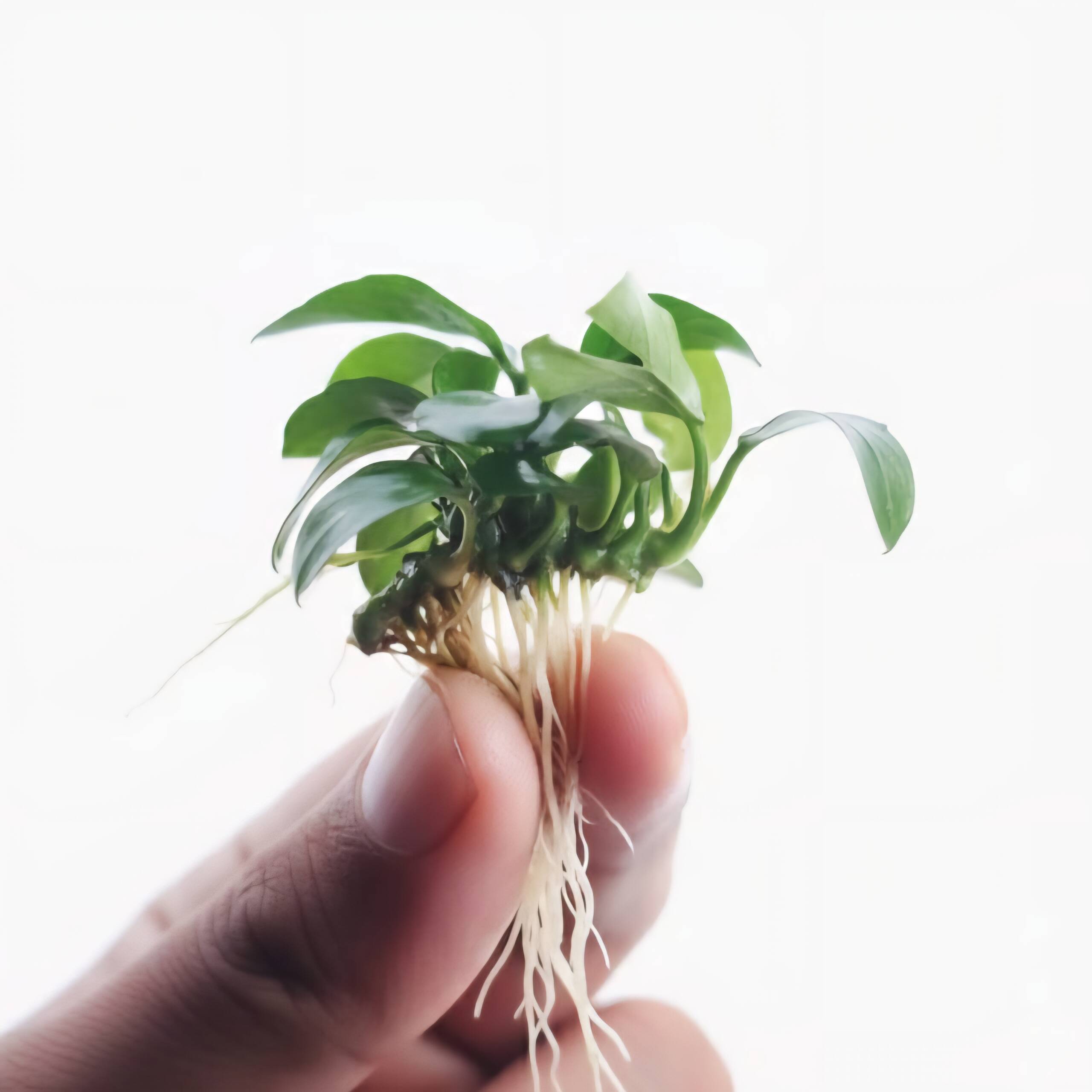
Anubias, Bucephalandra and Java fern are epiphytes — in nature they cling to wood and rock with minimal functional roots, drawing almost all their nutrition from the water column, so liquid dosing does nearly all the work; root tabs near a rhizome that isn’t even in the substrate do very little. Cryptocoryne and true stem or carpet plants are the opposite: they root into the substrate and benefit substantially from root tabs placed near the root zone, delivering a slow-release macronutrient dose right where roots can use it. A mixed tank benefits from doing both — water column dosing for epiphytes, root tabs for anything substrate-rooted.
A Simple Low-Tech Dosing Routine
Low-tech, no-CO2 tanks have limited light-driven growth, which means limited nutrient uptake — dosing heavily the way a high-light, CO2-injected tank would just leaves nutrients unused in the water column, precisely the condition algae exploits. Lean, consistent dosing beats occasional heavy dosing here. A simple weekly routine that suits most low-tech Anubias, Bucephalandra, Java fern and Cryptocoryne setups looks like this:
| Day | Dose | Notes |
|---|---|---|
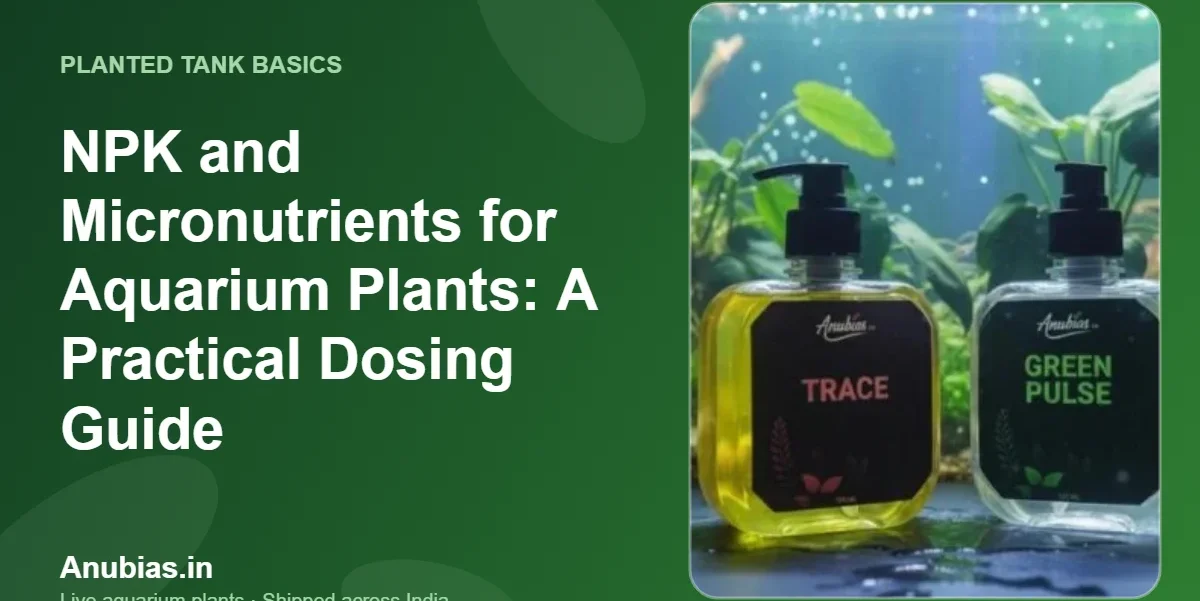
| Monday | Trace/micronutrient dose (iron-rich, e.g. Green Plus Trace) | Follow label rate for your tank’s litres, not the bottle’s generic guess |
| Wednesday | Light macronutrient (NPK) dose | Skip this dose if a nitrate/phosphate test already reads adequate |
| Friday | Trace/micronutrient dose | Second weekly trace dose |
| Weekend | 20–30% water change | Resets any nutrient build-up and tops up minerals from tap, depending on local hardness |
A basic liquid test kit for nitrate and phosphate is worth the small outlay for the first month or two, simply to calibrate this routine against your actual tank rather than a schedule copied from someone else’s water and light setup.
India’s Water Hardness Changes the Equation
Where you live changes what your tap or borewell water already contributes before a single drop of fertilizer goes in. Delhi-NCR, Rajasthan, inland and coastal Gujarat, and Chennai typically draw on hard to very hard groundwater rich in dissolved calcium and magnesium carbonate, so water changes alone already inject meaningful GH — extra magnesium or calcium supplementation is often unnecessary. Mumbai, Kolkata, Kerala and the Northeast lean softer, on lake- or monsoon-fed supplies lower in minerals; here, hardness can run low enough that plants show deficiency symptoms despite diligent dosing, and a GH booster or a little crushed coral in the filter helps close the gap.
With RO purifiers now standard in most Indian kitchens, some hobbyists also fill tanks with RO product water assuming purer is better. RO strips out essentially all dissolved minerals, including magnesium, calcium and trace elements — used alone, it produces deficiencies no dosing routine can fix. Test your specific water source once with a basic GH/KH kit before building a routine; it tells you more than any general guide can.
Shop the plants in this guide
Green Plus Trace covers the micronutrient side of this routine for Anubias, Bucephalandra and Java fern; pair it with root tabs for Cryptocoryne and the stem and carpet plant range in a mixed tank.
Not sure how often to dose? See our guide on how often to fertilize aquarium plants, or check whether DIY CO2 is worth adding too.
Leaves turning yellow? Use our yellow leaves diagnosis chart.
Not sure which fertiliser to use? Compare root tabs vs liquid fertiliser.
Frequently asked questions
How can I tell potassium deficiency from iron deficiency?
Potassium deficiency shows as small pinholes or speckled necrotic spots on older leaves. Iron deficiency appears on new growth first, as yellowing between the veins while the veins stay green. Magnesium causes similar interveinal yellowing, but on older leaves instead of new ones.
Do Anubias need root tabs or liquid fertiliser?
Anubias, Bucephalandra and Java fern are epiphytes that draw almost all their nutrition from the water column, so liquid dosing does nearly all the work. Root tabs suit Cryptocoryne and stem or carpet plants that root into the substrate, and a mixed tank benefits from both.
What is a simple fertiliser routine for a low-tech tank?
Dose trace or micronutrients on Monday and Friday, a light NPK dose on Wednesday, and do a 20–30% water change at the weekend. Skip the Wednesday dose if a nitrate or phosphate test already reads adequate, and follow the label rate for your tank’s litres.
Mixing your own ferts? See DIY dry fertiliser dosing in India for salts, sources and safe doses.
Grown in Surat (pre-order plants imported to order) · live-arrival guarantee with a 4-hour unboxing video · ₹99 shipping, free from ₹999