

Three Ways the Same Plant Reaches Your Tank
Buy the same species of Cryptocoryne from three different sellers and you might get three genuinely different products: a bunch of stems held together with a lead strip, a small plant in a plastic net pot, or a handful of tiny plantlets sitting in sterile gel. All three are the same plant, grown and supplied in different ways, and the differences between them explain most of the price spread — and most of the pest problems — that show up in this hobby.
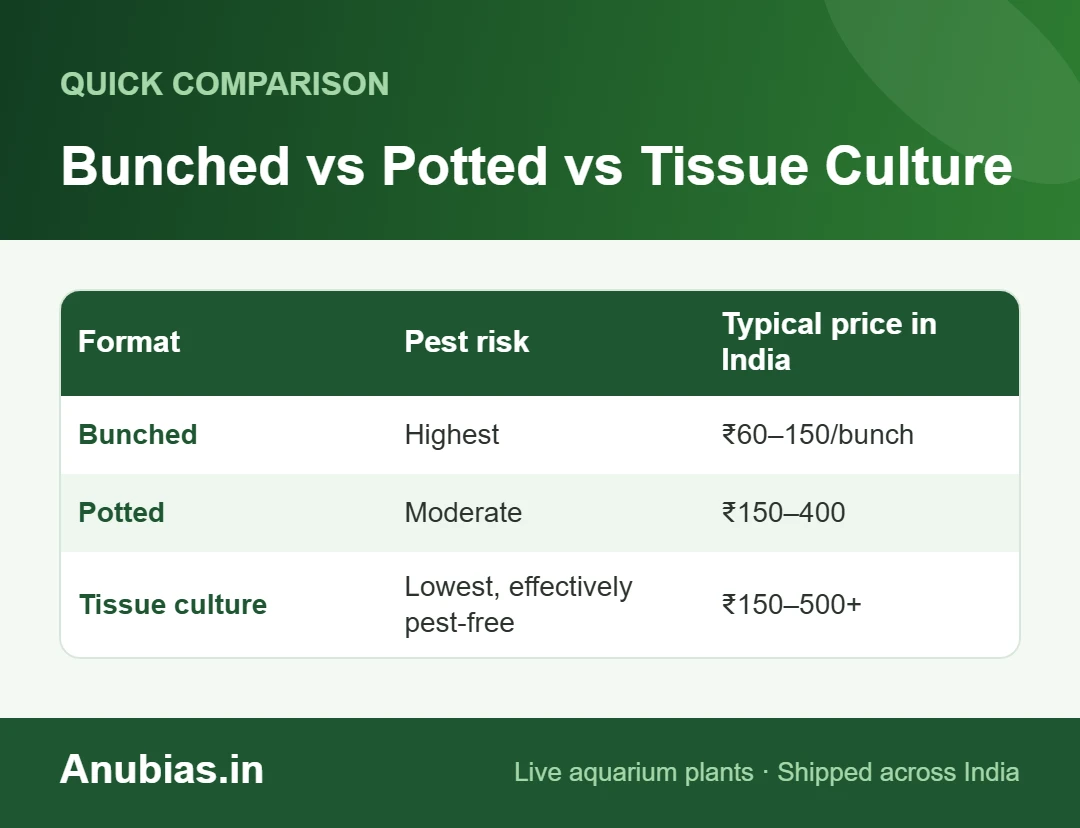
Quick answer: Tissue culture (TC) aquarium plants are cloned in sterile lab gel cups, so they arrive genuinely free of snail eggs, algae spores and pests — unlike bunched stems (₹60–150, highest pest risk) or potted plants (₹150–400, moderate risk). TC cups run ₹150–350 for common species in India, past ₹500 for rare Bucephalandra, and start as tiny plantlets that take weeks to a couple of months to bulk up. Rinse all gel off before planting; they are the safest choice for shrimp tanks and pest-sensitive nano scapes.
Bunched Plants
Bunching is the oldest and simplest supply method, mostly used for stem plants like rotala, hygrophila and bacopa. Nurseries grow these emersed — out of water, in mud beds or shallow ponds — then cut, gather and tie a handful of stems together with a lead strip, foil clip or rubber band for transport and shelf display. It’s the cheapest format by a clear margin, typically ₹60–150 a bunch depending on species and how common it is, and it’s how most stem and carpet plants have been sold for decades.
The trade-off is exposure. Grown outdoors in open soil and pond water, bunched plants carry the highest risk of hitchhiking pests — snail eggs, algae spores, and occasionally the odd insect larva tucked between stems. It’s also normal, not a sign of a dying plant, for the emersed-grown leaves to melt away over the first week or two underwater as the plant converts to its submersed growth form and pushes out new leaves suited to being fully submerged. The one thing worth doing immediately on arrival is cutting away the lead or metal tie — leaving it wrapped around the stems restricts growth and the metal itself has no business sitting in your tank long-term — then rinsing the bunch well and giving it the same quarantine attention you’d give new fish.
Potted Plants
Rhizome and crypt-type plants — Anubias, Cryptocoryne, sometimes Java fern — are more commonly sold potted: a small plastic net pot holding a rockwool or substrate plug, with the plant grown semi-submersed or in a humid greenhouse bed at the nursery. It sits in the middle of the price range, roughly ₹150–400 for a typical Anubias or Cryptocoryne depending on the variety, with rarer variegated or pinto-leaf types running higher. Pest risk is lower than bunched plants since growing conditions are more controlled, though rockwool and substrate can still carry the odd snail egg or bit of organic debris.
The most common mistake with potted plants isn’t pest-related, though — it’s planting the entire pot, rockwool and all, straight into the substrate. That plastic net restricts the rhizome as it tries to grow outward, and trapped rockwool debris against the rhizome is a good way to invite rot. Take the plant out of the pot entirely, gently tease the rockwool away from the roots, and remember that only the roots go into the substrate — the rhizome itself should stay exposed, tied or wedged onto driftwood or rock rather than buried.
Tissue Culture (TC)
Tissue culture plants are grown entirely differently: lab-propagated through micropropagation, where tiny plantlets are cloned from sterilized plant tissue and grown inside a sealed, sterile agar or gel cup under controlled lab conditions. No soil, no pond water, no outdoor exposure at any stage of growth.
The appeal is straightforward — TC plants are genuinely pest and snail-egg free, with no algae hitchhikers and no risk of the mislabeling that sometimes happens with wild-collected or farm-grown stock sold under an inconsistent name. That combination has made TC especially popular in India among shrimp keepers breeding Neocaridina or Caridina, who can’t afford to introduce planaria, hydra or predatory snails that prey on shrimplets, and among anyone building a pest-sensitive nano tank where a single snail outbreak means tearing the whole scape down.
It comes at a price, literally: TC cups typically run ₹150–350 for common species in India, climbing past ₹500 for rare Bucephalandra cultivars or newer imported varieties, reflecting genuine lab propagation costs. The plants themselves also start small — tiny plantlets rather than mature specimens — so they need real time to bulk up to a size comparable to a potted plant, often several weeks to a couple of months depending on species and light. There’s also a short transition period as the plant adjusts from the sterile, high-humidity gel-cup environment to open tank water; losing a leaf or two in the first week or so is normal and not a sign the plant has failed. The one step worth taking seriously on arrival is rinsing off all the gel thoroughly in room-temperature water before planting — leftover gel clouds the water and can trigger a small fungal bloom in the first few days if left on.
Comparing the Three at a Glance
| Format | Pest risk | Typical price in India | Time to establish |
|---|---|---|---|
| Bunched | Highest | ₹60–150/bunch | Fast bulk, but expect an initial melt period |
| Potted | Moderate | ₹150–400 | Fast — near mature size on arrival |
| Tissue culture | Lowest, effectively pest-free | ₹150–500+ | Slower — starts small, bulks up over weeks |
What This Means for Indian Buyers Specifically
Shipping and biosecurity
For a grower that also imports to order and ships pan-India, the format matters beyond the pest question. TC stock carries no soil or pond water, which means less biosecurity risk on interstate and international movement — a growing consideration as scrutiny around plant material shipping increases. It’s also part of why a growing number of Indian nurseries and hobbyist-adjacent labs have started producing TC stock domestically, gradually reducing the country’s historical reliance on imported aquascaping plants for the more sought-after Bucephalandra and carpet plant cultivars.
Monsoon transit
Transit conditions favour TC too, in a fairly practical way: TC cups ship light and dry, with nothing to retain moisture or generate heat if a courier run gets delayed a day during monsoon disruptions. A potted plant’s damp rockwool or a bunched plant’s wet paper wrap, by comparison, can turn mildewy or start smelling of rot if a shipment sits longer than expected in humid weather. That said, all three formats are still living plant material sensitive to temperature swings and time spent in transit, which is exactly why a live-arrival guarantee matters regardless of which format you choose — TC’s sealed, compact packaging just tends to travel the most predictably of the three.
Shop the plants in this guide
anubias.in stocks all three formats depending on species: tissue culture cups across the Bucephalandra range, potted specimens through the 16-variety Anubias and Cryptocoryne collections, and bunched stems in the stem and carpet plant range — plus Java Fern and moss for hardscape planting alongside any of them. To see who grows, imports and packs these plants, read about our nursery in Surat.
Even pest-free tissue-culture plants benefit from a settling-in period — see our quarantine guide.
Frequently asked questions
What are tissue culture aquarium plants?
Tissue culture plants are lab-propagated by micropropagation, with tiny plantlets cloned from sterilised plant tissue and grown in a sealed, sterile agar or gel cup. They never touch soil, pond water or outdoor conditions, so they arrive free of pests, snail eggs and algae.
How much do tissue culture plants cost in India?
Tissue culture cups typically run ₹150–350 for common species in India, climbing past ₹500 for rare Bucephalandra cultivars or newer imported varieties. By comparison, bunched stem plants cost about ₹60–150 a bunch and potted plants roughly ₹150–400.
How do I plant a tissue culture cup?
Rinse off all the gel thoroughly in room-temperature water before planting, as leftover gel clouds the water and can trigger a small fungal bloom. Expect a leaf or two to drop in the first week or so, and allow several weeks to a couple of months for plantlets to bulk up.
Grown in Surat (pre-order plants imported to order) · live-arrival guarantee with a 4-hour unboxing video · ₹99 shipping, free from ₹999