

Quick answer: The dry start method means planting a carpet in damp substrate and growing it in air under cling film for four to eight weeks before you flood the tank. Plants use atmospheric CO2, root deeply and knit together without algae or uprooting. It works well for Monte Carlo, dwarf hairgrass and Hydrocotyle Japan in Indian tanks, but needs daily misting, 6-8 hours of light and attention to heat and mould.
What the dry start method actually is
The dry start method, usually shortened to DSM, means planting your carpet into damp substrate and growing it in air instead of water for the first few weeks. The tank sits sealed under cling film, the substrate stays wet, and the plants grow emersed, which is exactly how they were grown at the nursery before they reached you. Once the carpet has knitted together and rooted properly, you flood the tank and it converts to submerged growth.
There is no trick to it. You are simply letting the plant use atmospheric CO2, which is far more freely available in air than in still water, until it has built a root system strong enough to hold on when the water goes in.
Why DSM beats CO2 for a first carpet
A pressurised CO2 setup is a cylinder, a regulator, a diffuser, a drop checker and a fair amount of learning about how not to gas your fish. For one carpet in one tank, that is a heavy first purchase. A dry start gets you a comparable result with a roll of cling film and some patience.
The trade is time for money. With CO2, Monte Carlo can fill in within 4-8 weeks; a dry start usually wants 4-8 weeks in air, then two to three more weeks to settle once flooded. If you are not in a rush, that is a fair swap.
DSM also removes the two things that ruin most first carpets: algae and floating plantlets. With no standing water there is nothing for algae to bloom in, and nothing to lift your carefully placed portions off the substrate at 2 a.m.
Which plants work emersed, and which just die
Only plants that naturally grow on wet ground will do well in a dry start. Carpeting species mostly qualify, because they come from stream margins and marshes that flood and drain through the year.
| Plant | DSM suitability | Price |
|---|---|---|
| Micranthemum Monte Carlo | Excellent; the classic DSM carpet | Rs 150 |
| Dwarf Hairgrass (Eleocharis) | Excellent; slow but very reliable | Rs 150 |
| Hydrocotyle Tripartita Japan | Very good; fast and forgiving | Rs 170 |
| Staurogyne Repens | Good; stays compact emersed | Rs 180 |
| Dwarf Sagittaria | Workable, but grows taller in air | Rs 140 |
The plants that fail are the ones people add on impulse. Soft stems such as Rotala and Ludwigia stretch, dry out at the tips and look terrible by week three. Mosses like Java moss and Christmas moss survive but turn into a dense, mould-prone mat that is hard to rinse clean before flooding.
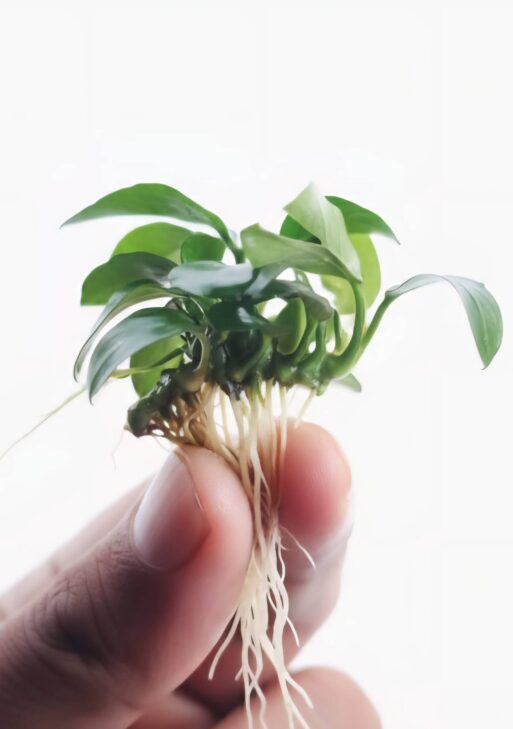
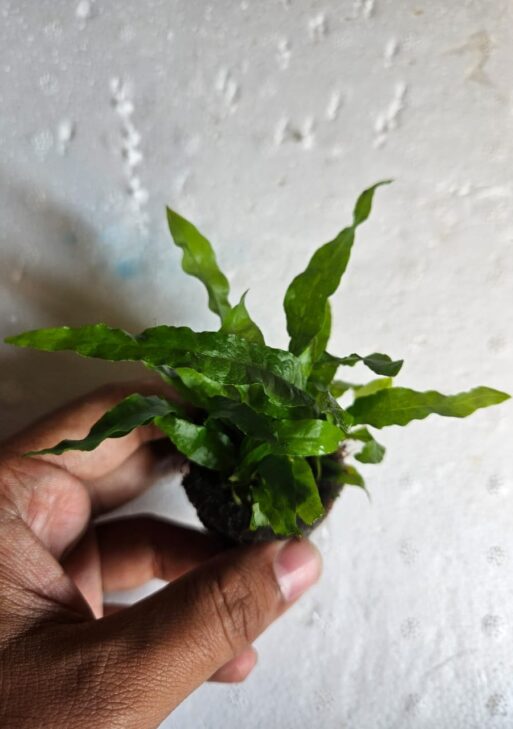
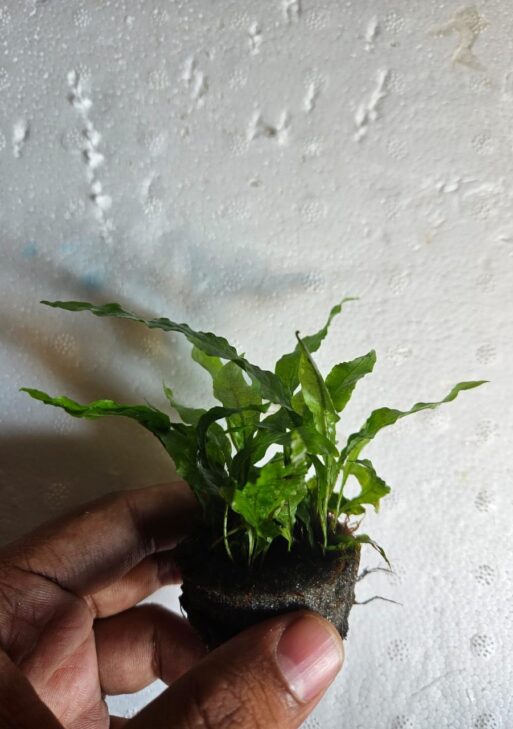
Epiphytes are a straight no. Anubias, Java fern and Bucephalandra are rhizome plants tied to wood or rock, never buried in substrate, and they have no business in a dry start. Add them on flooding day instead, tied or glued to hardscape as usual.
Setting up the dry start
- Lay your substrate first, sloping from about 3 cm at the front to 6-7 cm at the back. Slopes hold their shape much better dry than wet, so this is the easiest time to build one.
- Place hardscape now, not later. Moving a rock after the carpet has rooted tears a hole you cannot repair.
- Wet the substrate until it is uniformly damp and there is a shallow film of water sitting in the lowest point, roughly level with the substrate surface. Standing water above the surface will rot roots.
- Split your portions small. One pot of Monte Carlo should become 15-20 clumps, each with a few leaves, pushed in so the roots are covered and the leaves sit on the surface.
- Seal the top with cling film, leaving no large gaps. Condensation on the inside of the film is your sign that humidity is where it should be.
- Run lights for 6-8 hours a day. Longer does not speed anything up; it mostly adds heat.
- Mist once or twice a day with plain dechlorinated water, and open the film for 10-15 minutes while you do it so stale air is exchanged.
The Indian climate problem
Every DSM guide written for a European flat assumes a room that sits at 22 degrees. Indian rooms do not, and a sealed glass box under a light amplifies whatever the weather is doing outside.
In a Gujarat or Rajasthan summer, the real risk is cooking your plants. Our open tanks already sit at 28-32 degrees through April to June, and a sealed dry start can run several degrees hotter than the room. Monte Carlo in particular struggles past 28 degrees. Move the light higher, drop to 6 hours, run the setup in the coolest room you have, and leave a finger-width vent in the film during the hottest part of the day.
In the monsoon the problem inverts. Humidity is already high, air movement is poor, and a sealed tank grows white fuzzy mould on driftwood and on any dead leaf you left behind. Open the film for a few minutes twice a day, remove every yellowing leaf you see, and point a small fan across the room rather than into the tank.
In a dry north Indian winter the substrate dries out faster than you expect, especially at the front edge where the slope is thinnest. Check the film every morning. If there is no condensation on it, you are already behind and should mist immediately.
Week by week, and what healthy growth looks like
Week 1 usually looks like nothing happening, and some of your portions may yellow slightly as they recover from being split. That is normal. Do not pull anything out.
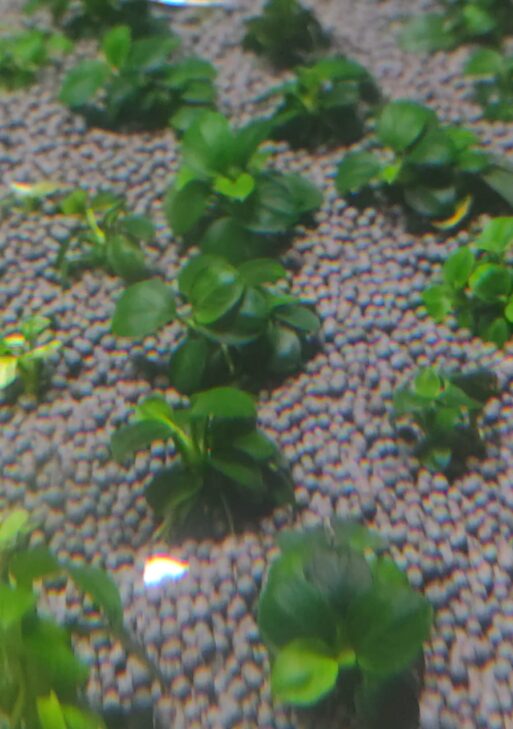
By weeks 2-3 you should see small, thick, dark green new leaves sitting tight against the substrate, and fine white roots visible where the substrate meets the glass. Emersed growth looks noticeably smaller and sturdier than the submerged leaves you see in photos, which is what you want.
Weeks 4-6 are when the carpet actually spreads, sending runners sideways into the bare gaps. Weeks 7-8 are for closing the last patches. Flood when you can no longer see much substrate through the growth, not on a fixed date.
Flooding day
Fill slowly and never straight onto the carpet. Lay a plate, a bowl or a folded polythene sheet over the planted area and pour onto that, so the water spreads sideways instead of drilling into your roots. Filling a two-foot tank should take fifteen minutes, not two.
Do a large water change the next day, and another the day after, because fresh aqua soil leaches ammonia and you are starting a cycle. Expect some melt: the emersed leaves your carpet built in air are not the leaves it needs underwater, and a portion of them will go transparent and drop over the first fortnight. New submerged growth usually appears within 2-3 weeks. Siphon the dead material off rather than leaving it to rot.
Start dosing a liquid fertiliser once the melt slows, roughly a week or two after flooding. A Green Plus and Trace pack at Rs 250 covers a small tank for months.
Common DSM failures and how to recover
White fuzzy mould on wood or substrate is the most common complaint, and it is almost always too little air exchange. Vent daily, remove the affected surface material and it clears on its own; it does not usually harm healthy plants.
Black, slimy, rotting portions mean standing water, not damp substrate. Tip the tank gently to drain the excess, or siphon it out with airline tubing, and replant the surviving clumps.
Leggy, pale, stretched growth means the light is too weak or too far away. Bring it closer and keep the photoperiod at 6-8 hours rather than extending it.
A carpet that simply does nothing for six weeks in peak summer is usually a heat problem, not a technique problem. Either move it somewhere cooler or accept that you are restarting in October.
When not to bother with DSM
If your tank is already running with fish, DSM is off the table; you cannot drain an occupied tank for two months. Replant into the existing setup and accept a slower fill.
If you are growing Dwarf Sagittaria or Staurogyne Repens as an easy no-CO2 foreground, the dry start adds weeks for a modest gain, because both establish reasonably well underwater anyway. And if you are setting up in May in a room that already hits 35 degrees, the honest answer is to wait. Starting a dry start into an Indian peak summer is the most reliable way to waste two months and four pots of plants.
Plants in this guide

Frequently asked questions
How long should a dry start run before flooding?
Four to eight weeks for most carpets, but judge by coverage rather than the calendar. Flood when runners have spread across the gaps and you can barely see bare substrate. Flooding a thin, patchy carpet early is the main reason dry starts fail at the transition.
Can I do the dry start method without CO2 afterwards?
Yes, and that is the usual reason people choose it. The carpet builds its roots in air where CO2 is freely available, then continues underwater on light and fertiliser alone. Growth after flooding will be slower than a CO2 tank, so keep the light strong and the photoperiod at 6-8 hours.
Why is my dry start growing white mould?
Almost always poor air exchange combined with dead plant material. Open the cling film for ten to fifteen minutes twice a day, pick out every yellowed or rotting leaf, and improve air movement in the room. The mould feeds on decaying matter, not on healthy plants, and clears once the conditions change.
Should I dry start Anubias, Java fern or Bucephalandra?
No. These are rhizome plants that attach to wood or rock and are never buried in substrate, so a dry start gives them nothing. Tie or glue them to hardscape on flooding day. They are among the few plants that genuinely do not need CO2 or a special start.
Is a dry start possible in a 40 degree Indian summer?
It is difficult and often not worth attempting. A sealed tank runs hotter than the room, and Monte Carlo already struggles above 28 degrees, with our tanks sitting at 28-32 degrees through April to June. Use the coolest room you have, vent the film during the afternoon, drop the light to 6 hours, or simply wait for the weather to break.
Carpet plants to start with
Monte Carlo, dwarf hairgrass, Hydrocotyle and Staurogyne are all in the carpeting plants category. Compare their light and CO2 needs in the plant care chart.