
Search “plants that reduce algae” and you’ll find lists promising a fix as simple as dropping the right species into your tank. The plants on those lists usually aren’t wrong, but the framing around them often is. No plant eats algae — that’s the job of algae-eating fish, shrimp and snails, which is a completely different subject. What certain plants actually do is out-compete algae for the same limited resources, and only some plants grow fast enough to pull that off.
Quick answer: Plants suppress algae by out-competing it for light, CO2, nitrate and phosphate, not by eating it. Only fast growers do this well: quick stem plants, hornwort and floaters such as frogbit, salvinia and duckweed. Slow growers like Anubias, Bucephalandra and Crypts barely compete, and no plant fixes the root trigger, such as a photoperiod running too long.
The Real Mechanism: Competitive Exclusion, Not Predation
Algae and aquatic plants draw from the same pool of light, dissolved CO2, nitrate, phosphate, iron and other micronutrients. Algae is opportunistic and reproduces quickly, but it has no real advantage over a healthy plant in identical conditions beyond thriving on whatever’s left over. When a tank is heavily planted with fast-growing species pulling hard on that shared pool, there’s simply less left for algae to use, and growth slows or stalls. A few fast growers — hornwort is the most commonly cited — are also credited with releasing mild allelopathic compounds that may suppress algae directly, though nutrient competition remains the dominant, better-understood mechanism. Either way, the plants that actually move the needle on an algae problem are, without exception, the fast ones. Slow growers simply don’t pull enough nutrient volume to make a difference.
Fast Growers That Actually Compete With Algae
The aquarium plants that reduce algae are the fast growers: stem plants such as Rotala, Ludwigia, Hygrophila, Bacopa and Limnophila, plus hornwort, water sprite, water wisteria and floaters like frogbit, salvinia and duckweed. Keep them growing and trim them often so the nutrients they lock up leave the tank. See our list of fast-growing aquarium plants.
Stem plants
Rotala, Ludwigia, Hygrophila, Bacopa and Limnophila all have genuinely fast leaf and biomass turnover under reasonable light and nutrients, constantly demanding fresh nitrate and phosphate — exactly the resource pool algae is also trying to tap. A dense stem-plant background, kept actually growing rather than static, is one of the more reliable long-term algae suppressors available in a moderately lit tank.
Floating plants
Floating plants like frogbit, salvinia and duckweed grow faster than almost anything submerged, because their leaves sit in open air with unrestricted access to atmospheric CO2 — there’s no carbon bottleneck limiting them at all. That lets them outpace algae for nutrient uptake even in a tank with no CO2 injection, which is precisely the situation where algae usually has the upper hand. Duckweed in particular is almost aggressively effective at this, which is part of why it’s simultaneously recommended for algae control and cursed at for being nearly impossible to remove afterward.
Hornwort and other rapid growers
Hornwort (Ceratophyllum demersum) doesn’t need substrate at all, grows loose or lightly anchored, and adds visible length week to week even under modest light. It’s frequently used specifically as a “nutrient sponge” in new tanks going through the nitrogen cycle, when ammonia and nitrite spikes would otherwise feed an early algae bloom. Water sprite and water wisteria are two more genuinely fast growers worth mentioning, with water sprite in particular growing equally well floating or planted.
Why Anubias, Bucephalandra and Crypts Don’t Do This Job
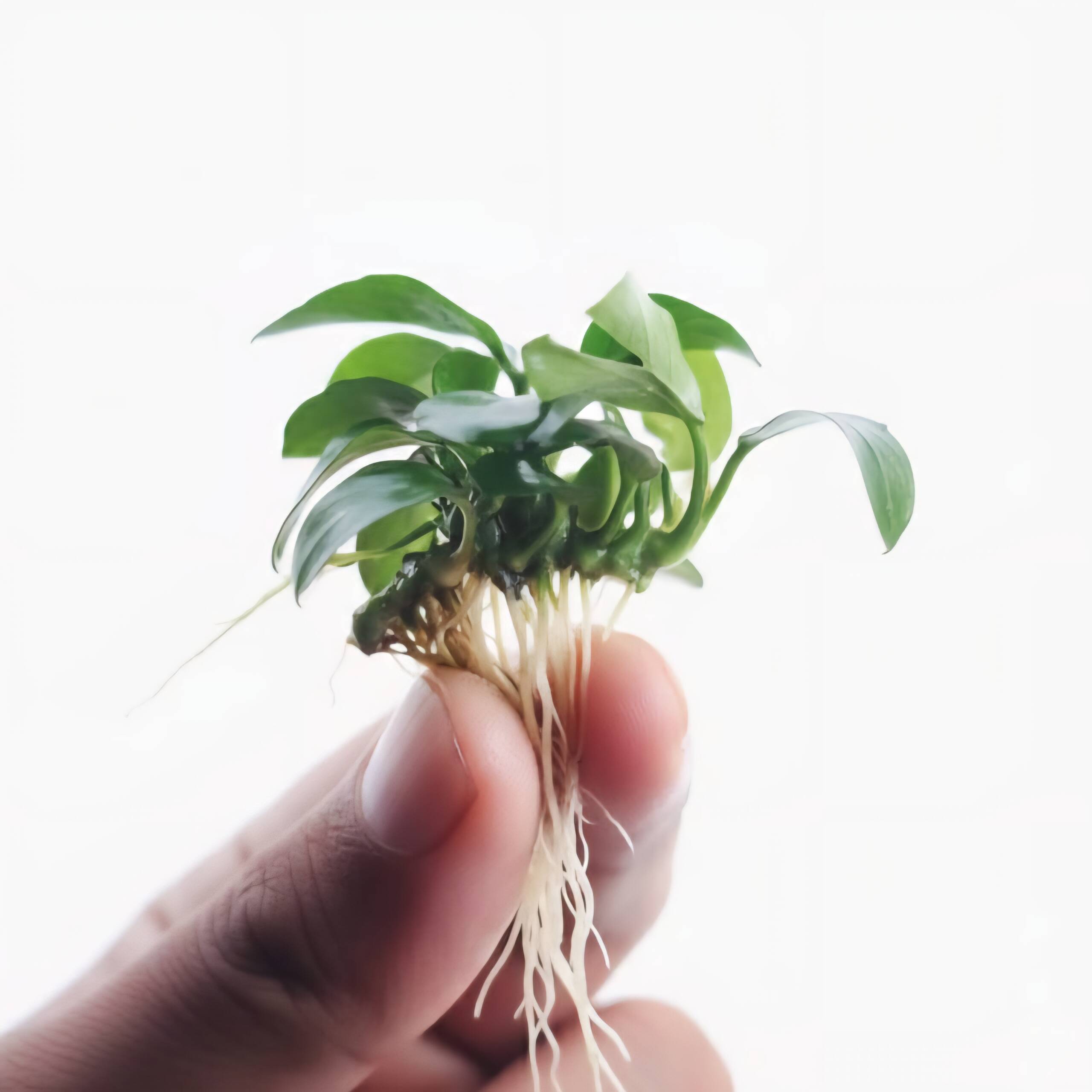
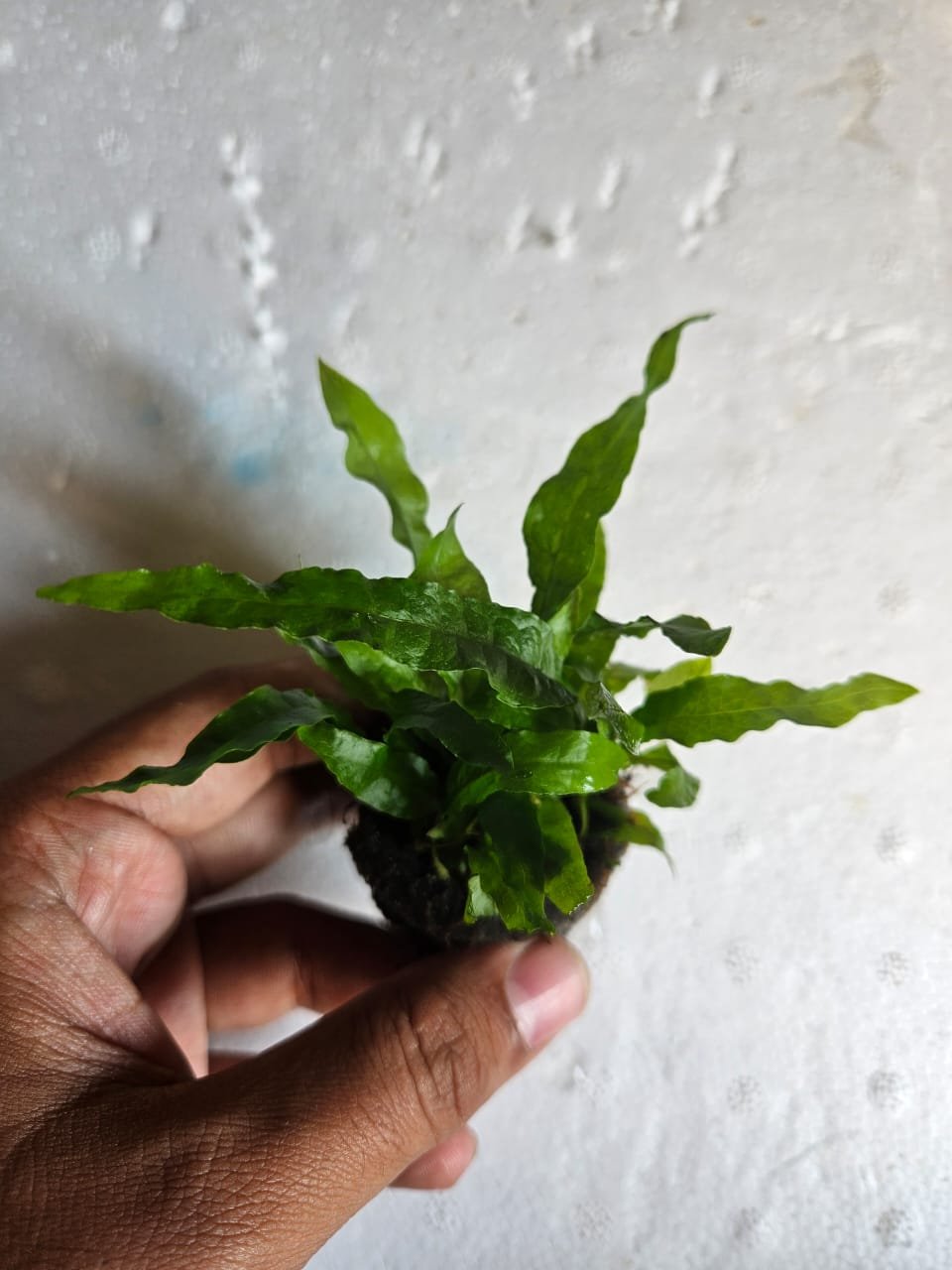
Anubias, Bucephalandra and Cryptocoryne are understory and epiphyte plants, adapted to low light in their native streams and forest floors. Slow growth is the whole survival strategy there, not a flaw — a single Anubias leaf can live a year or more, compared with a stem-plant node that’s replaced within weeks. That slow metabolism means low nutrient demand, which is genuinely useful for a low-maintenance tank, but it also means these plants pull only a fraction of the nutrient volume a stem hedge or a floating mat pulls — nowhere near enough to out-compete an active algae bloom.
Worse, because individual leaves stick around for so long, they have plenty of time to accumulate green spot algae, black beard algae or a general biofilm coating, especially under inconsistent CO2 or flow. A tank leaning entirely on Anubias, Bucephalandra and Cryptocoryne for its planting can end up with algae on the plants themselves while doing nothing to bring an existing bloom under control elsewhere in the tank. That’s not a mark against these plants — their low demands are exactly why they’re forgiving, beginner-friendly choices — it’s simply not the job they’re suited for. If algae has already settled on the leaves, see how to remove algae from Anubias.
What Algae Control Actually Requires
Adding fast plants shifts the balance in your favour over time; it isn’t an instant fix. You still need to address whatever’s actually triggering the bloom — a photoperiod running longer than 8 hours, light intensity mismatched to the CO2 and nutrients available, overfeeding or overstocking pushing ammonia and nitrate higher than any plant can absorb in real time, or irregular fertilizer dosing that leaves phosphate or iron spiking and crashing.
In India specifically, tanks placed near a window catch hours of uncontrolled natural sunlight that no timer can regulate, which is one of the more common, unrecognized algae triggers here. Source water matters too — borewell water in some agricultural regions carries meaningful background nitrate or phosphate before you’ve dosed anything at all, so testing your fill water is worth doing if algae won’t let up despite a heavily planted tank. Manually removing existing algae, doing a partial water change, and trimming back the photoperiod before adding a wall of stem plants gets a tank stable faster than plants alone ever will.
Realistic Expectations
Think of fast plants as tipping an ongoing competition in your favour, not as a treatment you dose once. A dense mass of stem plants or a well-managed floating cover, kept actively growing and regularly trimmed or harvested — removing the nutrients they’ve locked up rather than leaving trimmings to decompose back into the tank — will keep a well-balanced tank clean for the long run. Drop the same plants into a tank with mismatched light and overfeeding, and algae will still win, regardless of how many fast growers you throw at it.
Shop the plants in this guide: our stem and carpet plants collection covers the genuinely fast growers that compete with algae, paired well with Green Plus Trace fertilizer for balanced dosing. If you’re building around slower, low-maintenance Anubias, Bucephalandra or Cryptocoryne instead, budget for separate algae management rather than expecting the plants themselves to handle it.
Already dealing with an outbreak? See our guide on how to get rid of algae on Anubias and aquarium plants.
Need plants that fill in quickly? See the fastest-growing aquarium plants.
Thinking of adding a money plant? Read how to grow money plant in an aquarium.
Frequently asked questions
Do aquarium plants eat algae?
No plant eats algae. Plants suppress algae through competitive exclusion, out-competing it for the same light, CO2, nitrate, phosphate and micronutrients. When fast-growing species pull hard on that shared pool, less is left for algae and its growth slows or stalls.
Which plants are best for fighting algae?
Fast growers do the job: stem plants such as Rotala, Ludwigia, Hygrophila, Bacopa and Limnophila, hornwort, and floating plants like frogbit, salvinia and duckweed. Floaters have unrestricted access to atmospheric CO2, letting them outpace algae for nutrients even in tanks without CO2 injection.
Why don’t Anubias and Cryptocoryne help control algae?
Anubias, Bucephalandra and Cryptocoryne grow slowly with low nutrient demand, so they pull only a fraction of the nutrients a stem hedge or floating mat does. Their long-lived leaves can also collect green spot or black beard algae, so budget for separate algae management in tanks built around them.
Black tufts on the leaves? See how to clear black beard algae from Anubias.
Algae getting ahead of you? See which clean-up crew actually works in Indian tanks.
Grown in Surat (pre-order plants imported to order) · live-arrival guarantee with a 4-hour unboxing video · ₹99 shipping, free from ₹999