
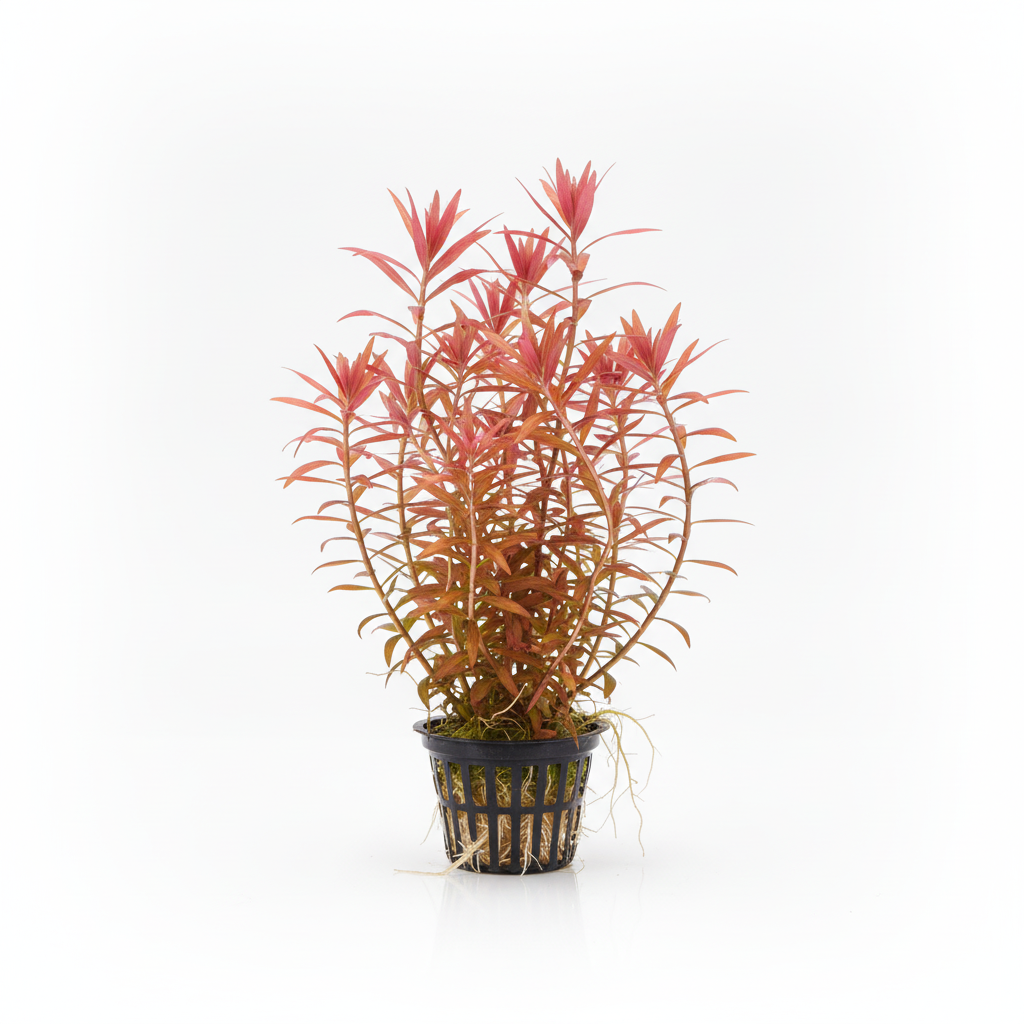
Description
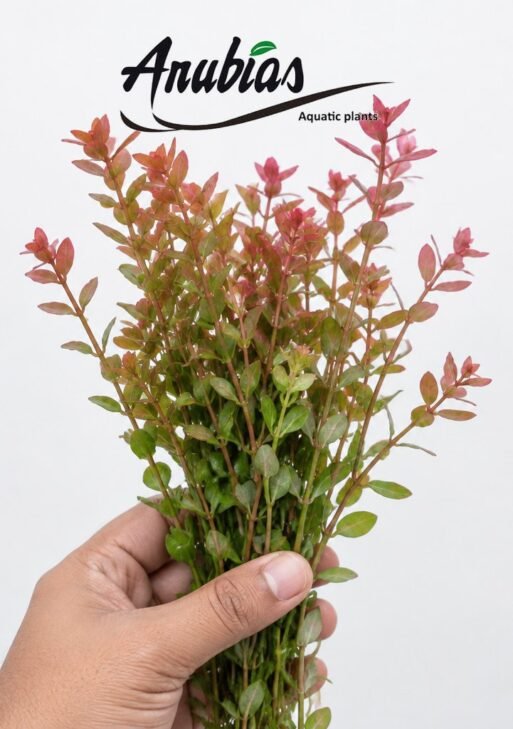
Rotala Blood Red (Rotala sp. ‘Blood Red’) is a compact red stem plant that colours up more easily than most reds, which is why it has become a favourite for Indian aquascapers who want deep crimson tops without a fully high-tech setup. Botanically it is treated as a selected form of Rotala rotundifolia, so it shares that species’ tough, adaptable nature while holding its red far better. It suits anyone who already runs decent light and wants a mid-to-background red that stays bushy and forgiving.
Rotala Blood Red at a glance
| Scientific name | Rotala sp. ‘Blood Red’ (a form of Rotala rotundifolia) |
|---|---|
| Family | Lythraceae |
| Origin | Cultivated form; parent species native to South and Southeast Asia |
| Difficulty | Easy to medium |
| Light | Medium to high (high for the deepest red) |
| CO2 | Optional; strongly recommended for colour and density |
| Temperature | 20–28 °C |
| pH | 5.5–7.5 |
| Growth rate | Fast |
| Height/size | 15–40 cm tall, stems 2–3 cm wide |
| Placement | Midground to background |
| Propagation | Stem cuttings and side shoots |
How to plant Rotala Blood Red
Rotala Blood Red is a classic stem plant and is planted stem by stem, not as a clump.
- Rinse the portion gently in dechlorinated water and remove any damaged or mushy leaves at the base.
- Strip the leaves from the bottom 2–3 cm of each stem so bare stem goes into the substrate.
- Using pinsettes (aquascaping tweezers), push each stem 3–4 cm into the substrate at a slight angle. Space stems about 2–3 cm apart so light reaches the lower leaves.
- Plant in small groups of five to ten stems rather than one dense bunch; the group fills out within weeks.
- Keep flow gentle for the first few days so stems are not dislodged before roots form.
Aquasoil gives the fastest start, but it roots happily in sand or gravel with liquid fertiliser.
Rotala Blood Red care: light, CO2, fertiliser and water
Light is the single biggest factor in colour. Under moderate light (roughly 30–50 PAR at the substrate) the plant grows green with reddish tops. Under strong light (60 PAR and above) with CO2, the top third turns a saturated blood red. If you run a budget LED, raise intensity gradually over a week to avoid an algae spike.
CO2 is not mandatory for survival; Rotala Blood Red will live in a low-tech tank. But without CO2 the stems stretch, the internodes lengthen and the red fades towards pink or bronze. Injected CO2 at 20–30 ppm is what produces the dense, compact crimson look seen in competition tanks.
Fertiliser: dose a complete liquid fertiliser with micronutrients, and add iron if your mix is light on it. Reds generally colour best when nitrate is kept moderate (around 5–10 ppm) while phosphate, potassium and iron are not limiting. Do not starve the tank of nitrogen entirely; the plant will stunt.
Indian water conditions: this is one of the more tolerant reds. Hard borewell or municipal tap water (GH 8–15) is fine, with slightly less intense colour than in soft water. Summer tank temperatures of 28–32 °C slow it down and can cause lower leaves to drop; a small fan across the surface in May–June helps. It copes with monsoon power cuts of several hours without damage.
Growth, trimming and propagation
Expect 3–8 cm of growth per week once established. Trim the tops every two to three weeks before they reach the surface; stems that hit the surface lose their lower leaves and go leggy.
Trim by cutting the stem just above a leaf node, leaving at least 8–10 cm in the substrate. The base throws out two or more side shoots, which is how you build a dense, rounded bush. Replant the cut tops beside the group; every few trims, replace old bases with fresh tops to keep the stand compact. Propagation is simply this trim-and-replant cycle, and one portion becomes a full background stand in two to three months.
Where to use it in an aquascape
Rotala Blood Red is a midground or background plant for tanks of 2 ft (about 60 litres) and larger. In a 2 ft tank it works as the red accent in the back corner; in 3 ft (120–150 litres) and 4 ft (200–250 litres) tanks it forms a large red hill behind a green carpet or stone layout.
Pair it with green stem plants such as Rotala rotundifolia green forms or Hygrophila polysperma for contrast, a low carpeting plant at the front, and Anubias nana or Java fern tied to wood in the midground.
It is safe with all community fish and shrimp; avoid goldfish and silver dollars.
Common problems and fixes
- Plant stays green: light is too weak or too far from the plant. Increase intensity or lower the fixture, and add CO2 if possible.
- Leggy stems with wide gaps between leaves: same cause as above, plus a lack of CO2. Trim and replant tops under stronger light.
- Lower leaves yellow or drop: shading from the upper canopy or nitrogen shortage. Trim more often and check nitrate is not at zero.
- Tops stunt and twist: usually a micronutrient issue (often calcium or boron in very soft RO water) or a CO2 fluctuation. Stabilise CO2 and dose a full micro mix.
- Hair algae on the tops: light is running ahead of CO2 and nutrients. Shorten the photoperiod to 6–7 hours until balanced.
- Melt after shipping: a few leaves may drop in the first week; new tips show it has settled.
What you receive
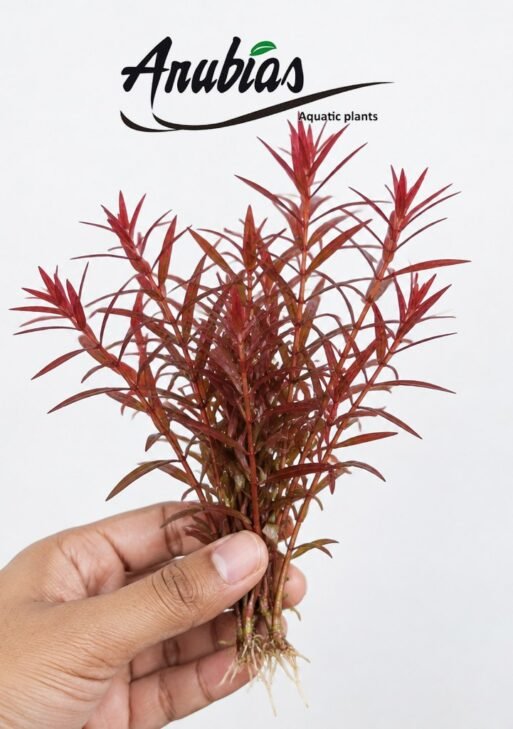
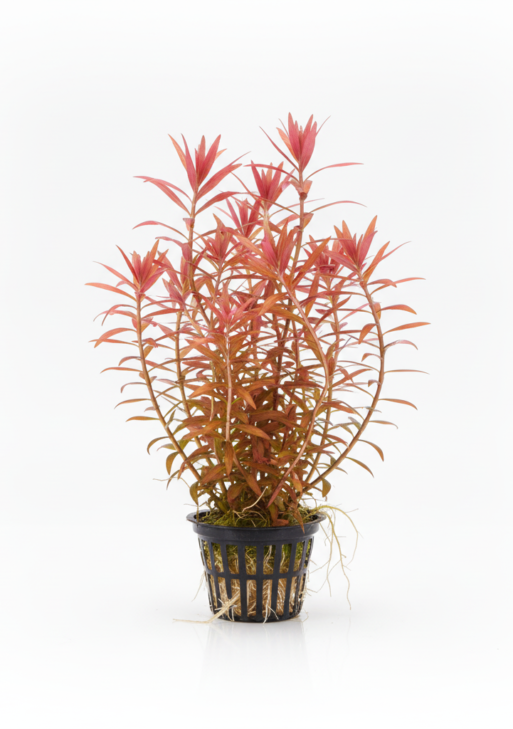
You receive one healthy portion of Rotala Blood Red in the size you select (Small or Standard), similar to the plant in the photo. It is checked before packing, wrapped moist and shipped across India from Surat. Every order carries our live-arrival guarantee: record one continuous unboxing video within 4 hours of delivery, and if the plant has arrived damaged we refund or replace it.
FAQ
Does Rotala Blood Red need CO2?
No, it survives without CO2, but it grows compact and turns deep red only with injected CO2 and strong light. In a low-tech tank expect green to pinkish growth.
Is Rotala Blood Red good for beginners?
Yes, among red stem plants it is one of the most forgiving. It tolerates hard Indian tap water and colours more readily than Rotala macrandra or Ludwigia senegalensis.
How much light does Rotala Blood Red need to turn red?
Medium light keeps it alive and pinkish; high light (roughly 60 PAR or more at the plant) with CO2 and iron gives the full blood-red colour.
Can Rotala Blood Red grow in sand or gravel?
Yes. It roots in inert sand or gravel as long as you dose liquid fertiliser or place root tabs under the group. Aquasoil gives faster, denser growth.
Rotala Blood Red vs Rotala rotundifolia: what is the difference?
Blood Red is a selected form of rotundifolia with much stronger red pigment and a slightly more compact habit. Standard rotundifolia stays green to orange-pink under the same light.
How fast does Rotala Blood Red grow?
Fast, around 3–8 cm per week in a CO2 tank. Trim every two to three weeks to keep it bushy.
Not sure what fits your tank? Plan it with our free AI tank planner.












There are no reviews yet.