

Description
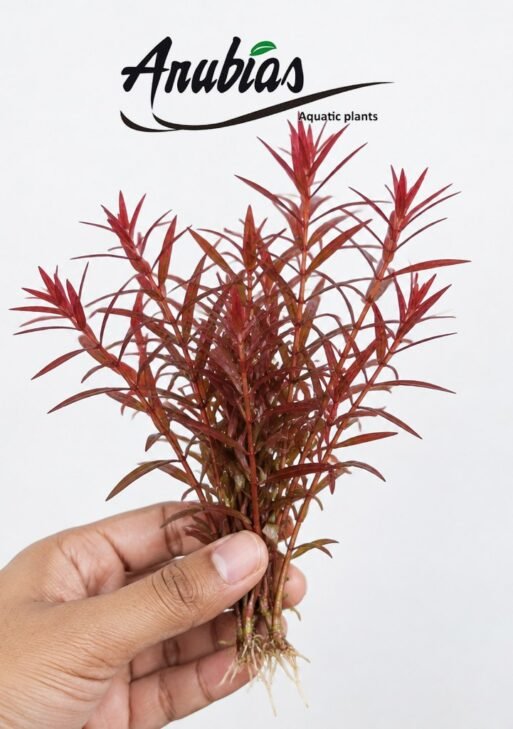
Ludwigia arcuata ‘Dark Red’ is a fine, needle-leaved stem plant from the south-eastern United States whose narrow leaves turn orange to dark red under strong light. It has a delicate, grassy look quite different from the broad-leaved Ludwigias, which makes it useful for adding fine red texture to a layout. It suits hobbyists with medium-high light and ideally CO2; it will live in a low-tech tank but stays green and sparse there.
Ludwigia arcuata ‘Dark Red’ at a glance
| Scientific name | Ludwigia arcuata ‘Dark Red’ |
|---|---|
| Family | Onagraceae |
| Origin | South-eastern United States (Florida to the Carolinas) |
| Difficulty | Medium |
| Light | Medium-high to high |
| CO2 | Recommended for compact red growth |
| Temperature | 18–26 °C; tolerates up to 28 °C |
| pH | 5.5–7.5 |
| Growth rate | Medium to fast |
| Height/size | 20–50 cm tall; stems 2–3 cm wide |
| Placement | Midground to background |
| Propagation | Stem cuttings and side shoots |
How to plant Ludwigia arcuata ‘Dark Red’
- Rinse the portion in dechlorinated water. The stems are thin, so separate them carefully.
- Strip the needle leaves from the bottom 2–3 cm of each stem.
- Plant stems one at a time with fine tweezers, 2–3 cm deep and about 2 cm apart. Close spacing gives the bushy, grass-like effect this plant is grown for.
- Place the group where light is strongest; it colours only on the upper, best-lit part of the plant.
- Keep flow gentle for the first week until the roots anchor.
Aquasoil is ideal. Sand or gravel works with regular liquid fertiliser and a root tab under the group.
Ludwigia arcuata ‘Dark Red’ care: light, CO2, fertiliser and water
Light: under medium light Ludwigia arcuata grows green with orange tips and the stems lean. Under high light (roughly 60 PAR or more at the plant) the leaves turn orange-red to dark red and the plant grows compact and upright. Colour is driven by light first, CO2 second, iron third.
CO2: strongly recommended. Without CO2 the plant survives but grows slowly with long gaps between leaves and little colour. With CO2 at 20–30 ppm it bushes out and holds its red.
Fertiliser: dose a complete liquid fertiliser two or three times a week. Keep nitrate moderate (5–10 ppm) and iron present for the strongest red; very high nitrate turns it orange-green. Potassium deficiency shows as pinholes in older leaves.
Indian conditions: Ludwigia arcuata accepts moderately hard tap water (GH up to about 12) but prefers softer water; colour is best at GH 4–8. It is a cool-water plant by nature, so Indian summers are its weak point: above 28 °C the needles shorten and lower leaves drop. A surface fan or chiller in May–June helps. Monsoon power cuts of a few hours are harmless if CO2 and lights stop together.
Growth, trimming and propagation
Expect 3–5 cm of growth a week in a CO2 tank. Trim every two to three weeks, cutting just above a node and leaving 8–12 cm in the substrate. Each cut base produces side shoots, and the group thickens into a fine red “grass” that can be shaped into mounds. Replant the tops, which carry the best colour, at the front of the group.
Older bases become sparse over time; every few trims, replace them with fresh tops. Propagation is simply this trim-and-replant cycle. Allow two to three months for one portion to fill a midground group in a 2 ft tank.
Where to use it in an aquascape
Ludwigia arcuata is a midground to background plant for tanks of 2 ft (60–70 litres) and larger; in 3 ft and 4 ft tanks (120–250 litres) a dense stand gives a fine-textured red that contrasts with broad-leaved plants. It is a staple in Dutch and nature-style layouts as the “fine red” group.
Pair it with broad-leaved green stem plants such as Hygrophila polysperma or Hygrophila difformis, with Anubias nana or Java fern on wood in front, and a carpeting plant at the base. Its fine leaves also hide filter pipes well.
Safe with small community fish and shrimp. Fish that pick at plants, and any strong digger, will damage the thin stems.
Common problems and fixes
- Plant stays green and leans: light too low. Raise intensity and add CO2; new growth colours within two to three weeks.
- Leaves shorten and lower leaves drop in summer: water too warm. Cool the tank and trim affected stems.
- Thin, stretched stems: low light or no CO2. Trim and replant tops closer to the light.
- Pinholes in older leaves: potassium deficiency. Dose potassium.
- Hair algae in the needles: light outrunning CO2. Shorten the photoperiod and trim affected tops.
- Melt after arrival: some leaf loss is normal in week one; new tips confirm recovery.
What you receive
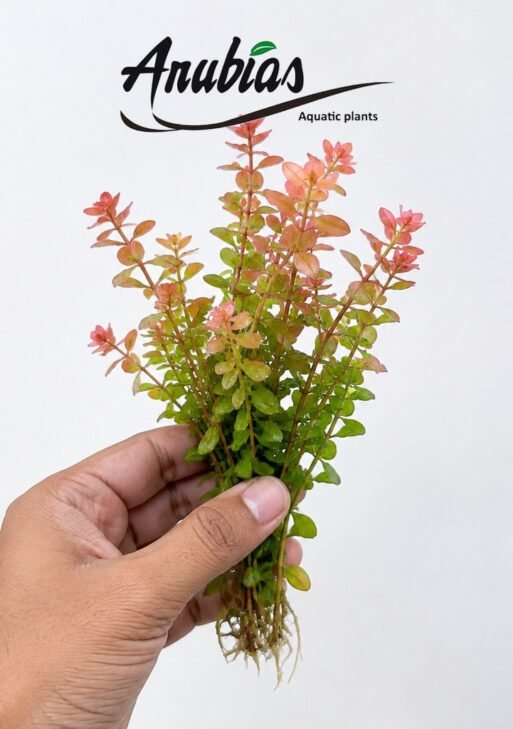
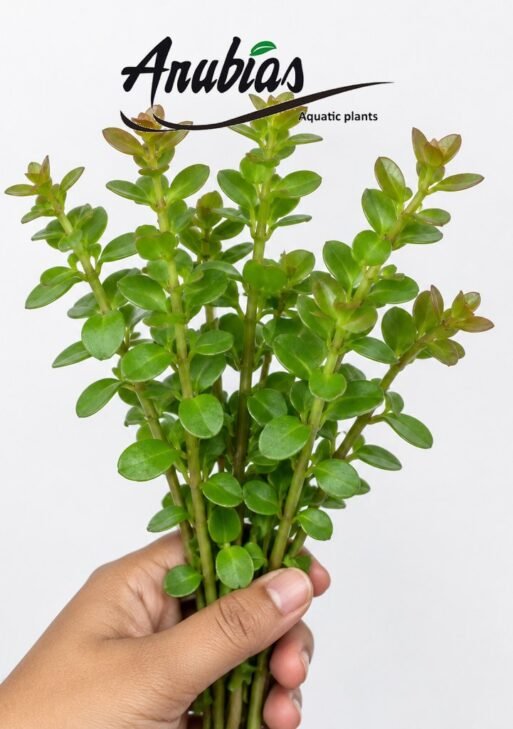
You receive one healthy portion of Ludwigia arcuata ‘Dark Red’ in the size you select (Small or Standard), similar to the photo. It is checked before packing, wrapped moist and shipped across India from Surat. Live-arrival guarantee: record one continuous unboxing video within 4 hours of delivery and we refund or replace any plant that arrives damaged.
FAQ
Does Ludwigia arcuata need CO2?
Not strictly, but it grows green, slow and sparse without it. CO2 with high light is what gives the compact dark-red growth.
Is Ludwigia arcuata good for beginners?
It is a medium-difficulty plant. Beginners can keep it alive, but the red colour needs high light and CO2. Ludwigia Mini Super Red is the easier red option.
Ludwigia arcuata vs Ludwigia brevipes: what is the difference?
They look alike, but arcuata has narrower, needle-like leaves and tends to colour redder, while brevipes has slightly broader leaves and leans more orange.
Can Ludwigia arcuata grow in hard water?
Moderately hard water (GH up to about 12) is acceptable. Colour and compactness are better at GH 4–8, so mix RO water in if your tap is very hard.
How fast does Ludwigia arcuata grow?
Medium to fast, 3–5 cm per week in a CO2 tank. Trim every two to three weeks.
Why is my Ludwigia arcuata losing its lower leaves?
Usually heat above 28 °C or shading by the upper canopy. Cool the water, trim regularly and replant tops.
Not sure what fits your tank? Plan it with our free AI tank planner.











There are no reviews yet.