
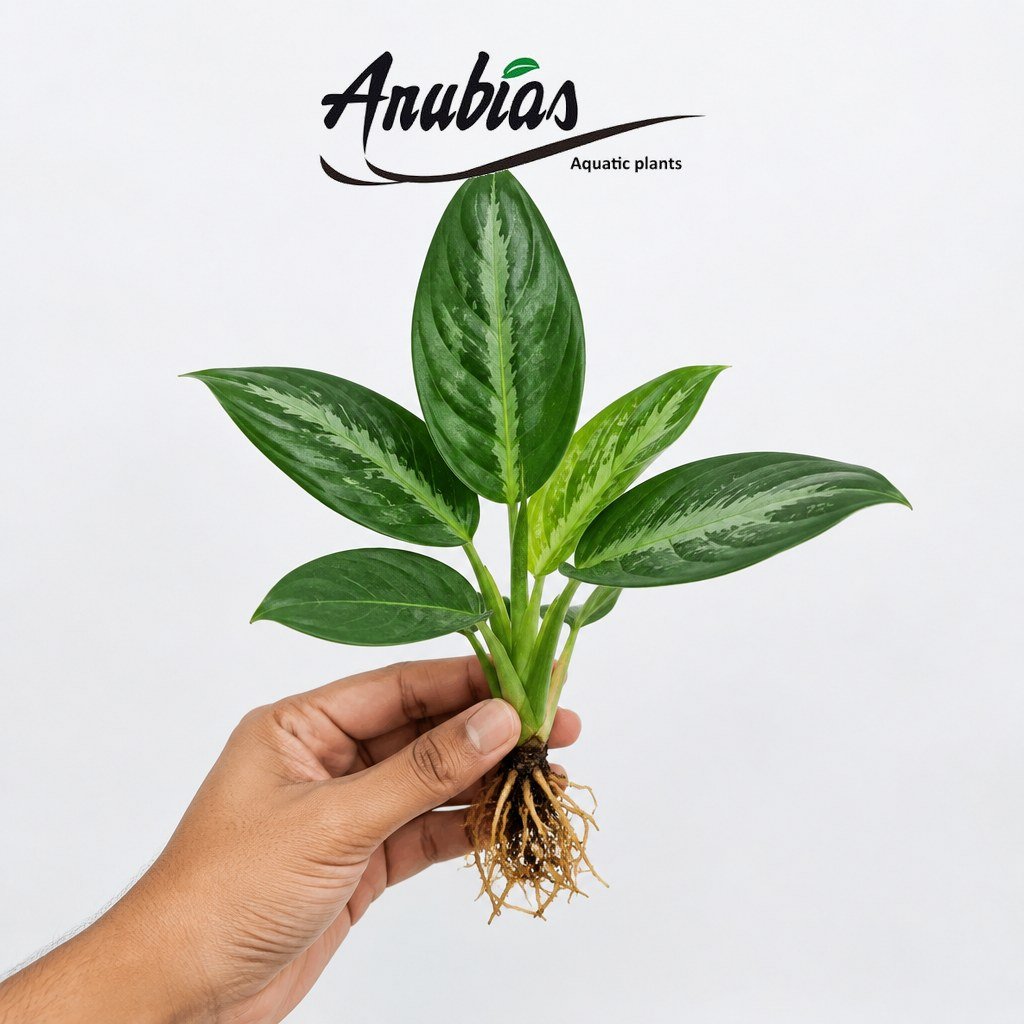
Description
Aglaonema simplex is a Southeast Asian marsh aroid with glossy, lance-shaped green leaves on upright stems, a close relative of the Chinese evergreen houseplant that has adapted to life along stream banks. In the aquarium it is a slow, tough background plant that tolerates low light and hard water without CO2, and in a paludarium or riparium it grows faster and larger with its leaves in the air. Aglaonema simplex suits hobbyists who want a bold, broad-leaved plant that fish will not eat, and anyone building a planted terrarium with a water section.
Aglaonema simplex at a glance
| Scientific name | Aglaonema simplex |
|---|---|
| Family | Araceae |
| Origin | Southeast Asia (Thailand, Malaysia, Indonesia, Philippines), along forest streams |
| Difficulty | Easy to moderate |
| Light | Low to medium |
| CO2 | Not required; helps submerged growth |
| Temperature | 22–28 °C (tolerates short spells to 30 °C) |
| pH | 6.0–7.5 |
| Growth rate | Slow |
| Height/size | 20–40 cm submerged; taller emersed |
| Placement | Background; paludarium and riparium |
| Propagation | Stem cuttings; division of side shoots |
How to plant Aglaonema simplex
Unlike anubias, Aglaonema simplex is a rooted stem plant and goes into the substrate.
- Rinse the plant and trim any damaged roots or yellow leaves. If it was grown emersed, the existing leaves may be shed after submersion; the stem and growing tip are what matter.
- Use a nutrient-rich substrate such as aquasoil, or gravel with root tabs. The plant is a heavy root feeder.
- Plant the base of the stem 2–3 cm deep with tweezers, keeping the crown and growing tip above the substrate.
- Place it at the back of the tank in moderate flow, with space around it for the leaves to spread.
- In a paludarium, plant the roots in wet soil or gravel at the waterline with the stem and leaves in humid air.
Expect a slow start of a few weeks while the roots establish.
Aglaonema simplex care: light, CO2, fertiliser and water
Light. Low to medium light. The plant comes from shaded forest streams and keeps its deep green colour in modest light. Strong light is unnecessary and invites algae on the slow-growing leaves.
CO2. Not required, but it helps. Fully submerged, Aglaonema simplex grows slowly and can stall in a low-tech tank, especially in warm water; CO2 injection makes submerged growth more reliable. Grown emersed it needs no CO2 at all. Be realistic: this is a marsh plant that tolerates submersion rather than a true aquatic, and it is at its best in a paludarium or with its leaves above the surface.
Fertiliser. Feed the roots with root tabs every two to three months and dose a complete liquid fertiliser weekly for potassium and iron. Pale new leaves usually mean an iron shortage.
Water. Moderately hard Indian tap water is fine. It prefers 22–28 °C; summer spikes above 30 °C slow growth and may cause leaf loss, so keep the tank shaded and the surface agitated. It survives monsoon power cuts well thanks to a low oxygen demand. Weekly 25–30% water changes keep the water clean.
Growth, trimming and propagation
Submerged growth is slow, with a new leaf every four to six weeks. The stem thickens and gradually gains height, and older lower leaves are shed as it grows. Remove yellowing lower leaves at the stem. If the plant becomes leggy, cut the top with a few leaves and replant it; the base usually sends out side shoots.
Propagation is by stem cuttings and by separating side shoots that form at the base. A cutting with at least three leaves and a short length of stem roots within a few weeks in nutrient-rich substrate. Emersed plants in a paludarium produce side shoots more readily and can be divided every year.
Where to use it in an aquascape
Aglaonema simplex is a background plant for medium and large tanks of 2.5 ft (around 100 litres) to 5 ft (around 400 litres), where its broad, glossy leaves form a solid green backdrop. In smaller tanks it is best used emersed in a riparium planter or paludarium, where it looks like a miniature Chinese evergreen rising from the water.
Pair it with Anubias nana and Java fern on hardscape in front, cryptocorynes in the midground and floating plants to soften the light. The combination of all four gives a low-tech jungle look that holds for years.
It is safe with all community fish, and its thick leaves survive goldfish, cichlids and plecos. Shrimp and snails keep the leaves clean.
Common problems and fixes
- Leaves melting after submersion. Emersed-grown leaves die back underwater. Keep the stem planted and wait for new submerged leaves, which are thinner and narrower. If the stem stays firm, the plant is alive.
- No growth for weeks. Common in warm, low-tech tanks. Add CO2, feed the roots with a tab, or grow it emersed.
- Yellowing lower leaves. Normal ageing, or nitrogen shortage if many yellow at once. Remove old leaves and dose a complete fertiliser.
- Pale, small new leaves. Iron or trace deficiency, or low light. Dose micronutrients and check the plant is not shaded out.
- Stem rot at the base. Planted too deep or substrate too anaerobic. Replant the healthy upper section shallower.
- Algae on old leaves. Slow growth under strong light. Reduce lighting and add nerite snails.
What you receive
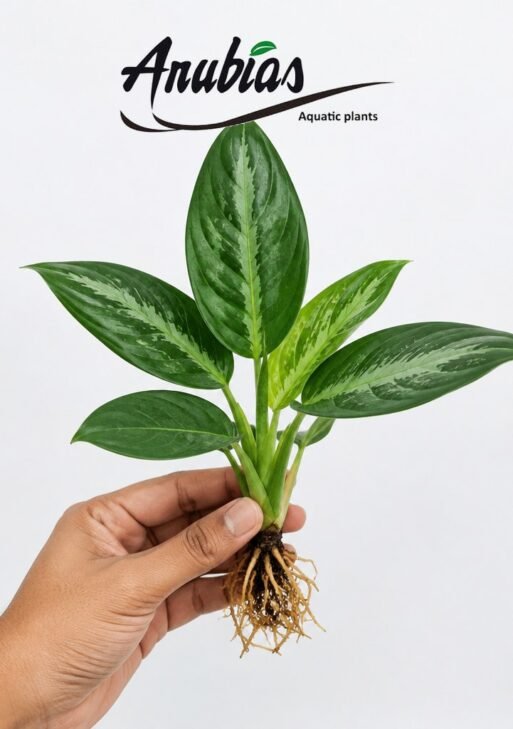
One healthy Aglaonema simplex plant of the size you select (Small or Standard), similar to the photo. Each plant is checked before packing, packed moist and shipped across India from Surat. ₹99 shipping, free on orders of ₹999 or more.
Live-arrival guarantee: record one continuous unboxing video within 4 hours of delivery and we will refund or replace a plant that arrived damaged.
FAQ
Can Aglaonema simplex grow fully underwater?
Yes, but slowly. It tolerates full submersion in cool, clean water and does better with CO2. It grows faster and larger with its leaves above the waterline in a paludarium.
Does Aglaonema simplex need CO2?
Not strictly. It survives without CO2 in a low-tech tank, but submerged growth is more reliable with injection. Emersed plants need no CO2.
Is Aglaonema simplex good for beginners?
Yes for paludariums and low-tech tanks with patience. It is tough and fish-proof, but slow underwater, so do not expect quick results.
How fast does Aglaonema simplex grow?
Slowly submerged, about one leaf every four to six weeks. Emersed growth is noticeably faster.
Aglaonema simplex vs anubias: which is better for a low-tech background?
Anubias is the safer long-term aquarium plant; Aglaonema simplex offers larger, glossier upright leaves and is better where part of the plant can grow above water. Many keepers use both.
Can I keep Aglaonema simplex with goldfish or cichlids?
Yes. The leaves are thick and unpalatable and the plant roots firmly, so it survives tanks that destroy softer plants.
Not sure what fits your tank? Plan it with our free AI tank planner.











There are no reviews yet.