
Description
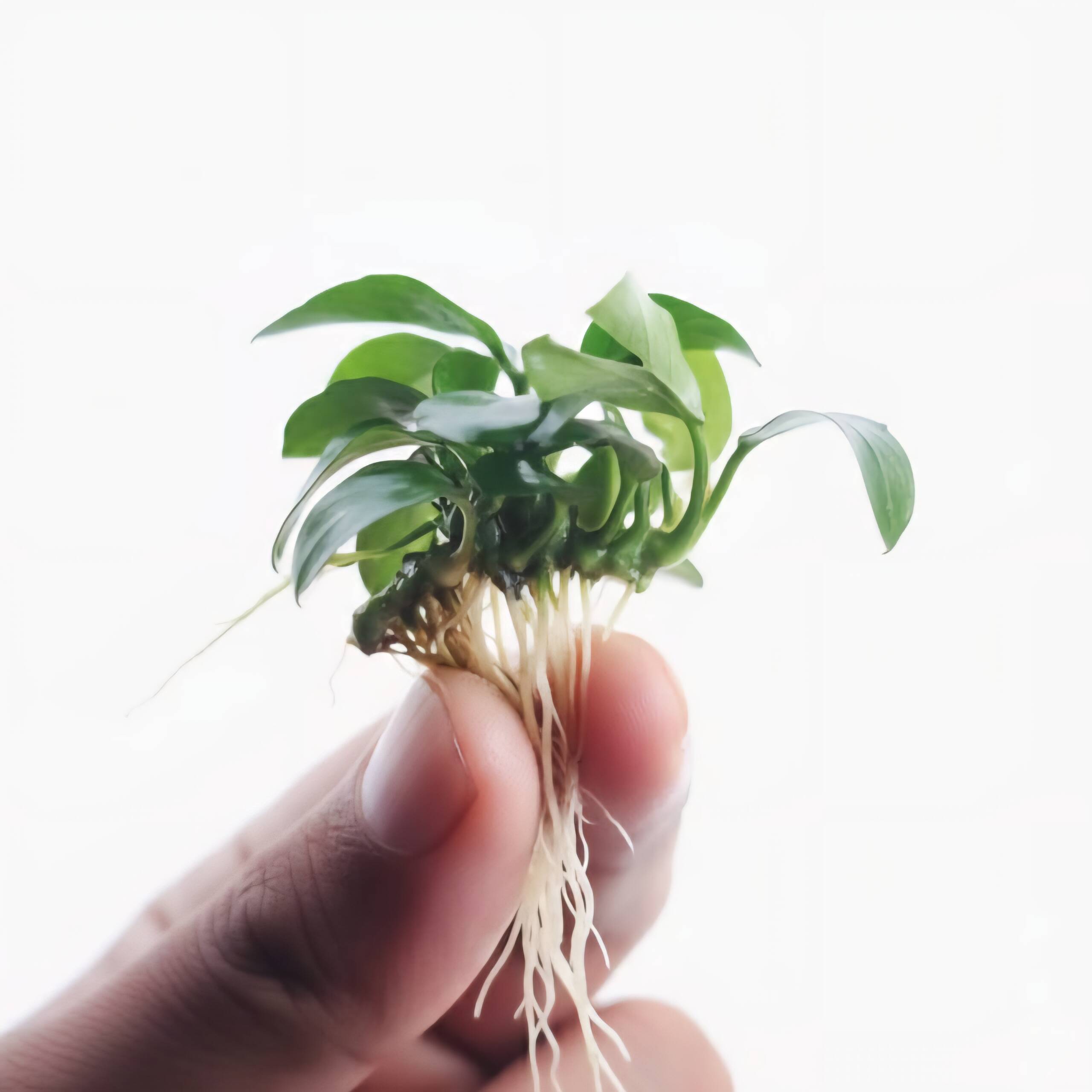
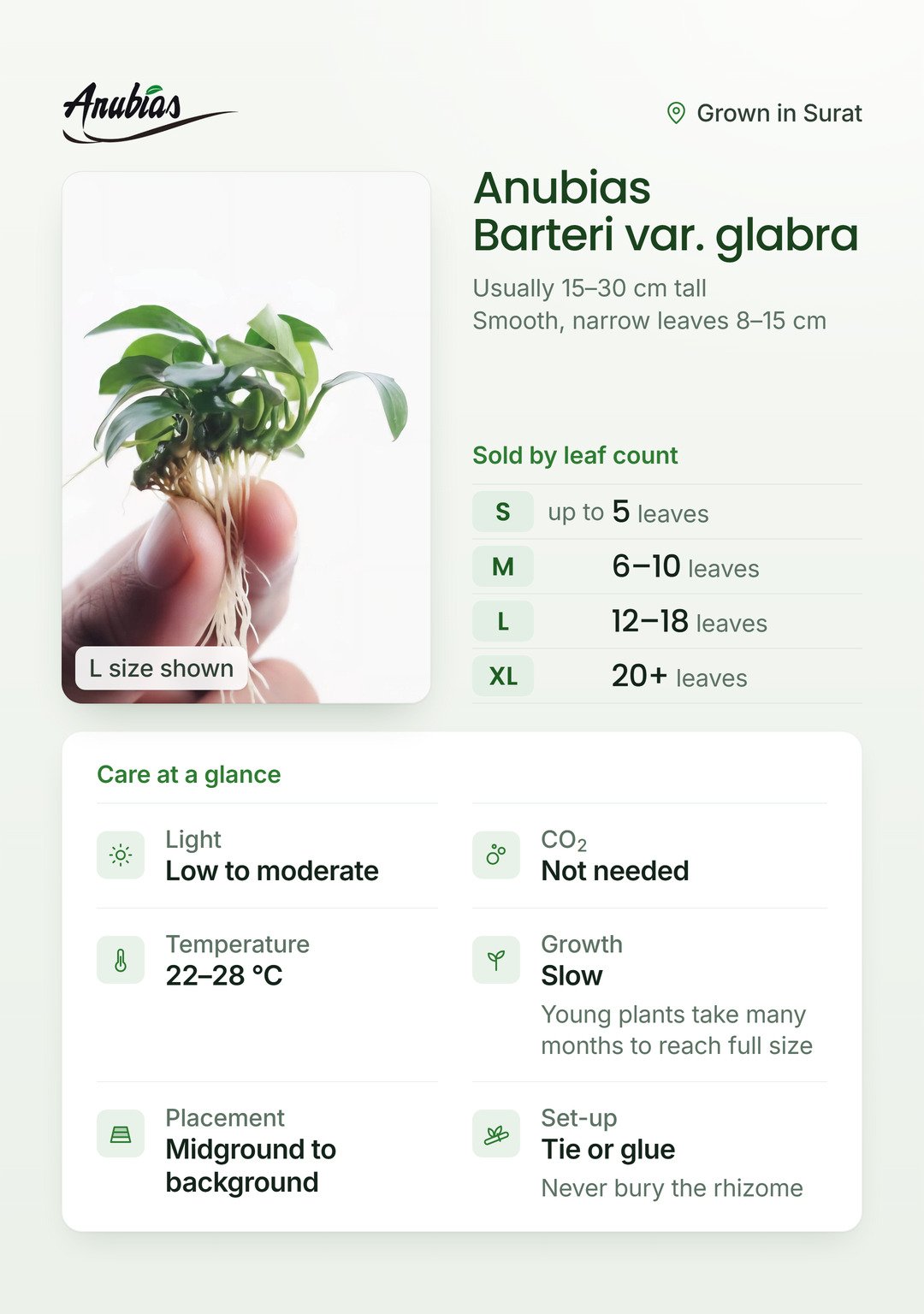
Anubias barteri var. glabra (often searched simply as anubias barteri or anubias glabra) is the larger, taller member of the anubias family: a West African rhizome plant with smooth, lance-shaped leaves 8–15 cm long on slender stalks, on a plant that reaches 15–30 cm tall. It keeps all the toughness of Anubias nana, growing on driftwood or rock in low light, without CO2 and in hard Indian tap water, but it fills the midground and background of a 2 ft or larger tank where nana would disappear. Anubias barteri suits beginners who want a big, dependable plant, and goldfish and cichlid keepers whose fish destroy softer plants.
Anubias barteri var. glabra at a glance
| Scientific name | Anubias barteri var. glabra (older names: Anubias lanceolata, Anubias minima) |
|---|---|
| Family | Araceae |
| Origin | Streams of West Africa: Cameroon, Nigeria, Guinea, Liberia |
| Difficulty | Easy |
| Light | Low to moderate |
| CO2 | Not required |
| Temperature | 22–28 °C |
| pH | 6.0–8.0 |
| Growth rate | Slow; roughly one new leaf every one to three weeks |
| Height/size | 15–30 cm tall; leaf blades 8–15 cm long, narrow and smooth |
| Placement | Midground to background, epiphyte on wood or rock |
| Propagation | Rhizome division |
Which size should I buy?
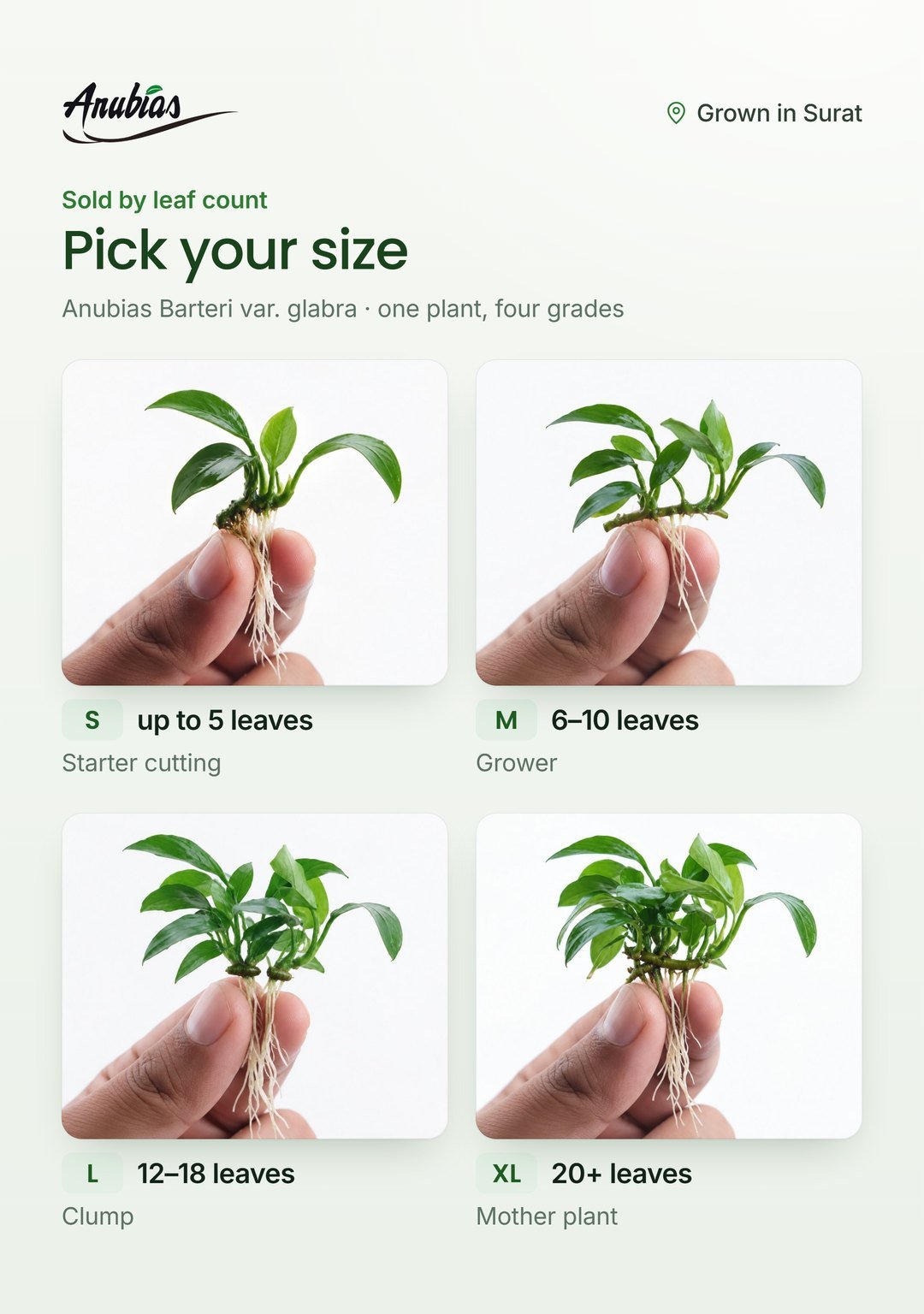
Anubias barteri var. glabra is sold in five grades by leaf count. Even a small grade has real height; a large grade is a bush that fills a corner.
- XS (grow-on): a rhizome tip with one or two leaves, for growing on or tucking into a rock gap.
- S (starter): a cutting with up to five leaves; one tall accent on wood in a 2 ft tank of 60 litres.
- M (grower): six to ten leaves; the all-rounder for 2–3 ft tanks of 60–120 litres.
- L (clump): twelve to eighteen leaves; a full background bush from day one for 3 ft tanks of 100–150 litres.
- XL (mother): twenty or more leaves; a focal plant for 4 ft tanks of 180–250 litres, or one to divide into several starters.
Rule of thumb: one M per 1.5 ft of tank length fills the back within a few months. For a tank under 2 ft, choose Anubias nana instead; glabra will outgrow the space.
How to plant anubias barteri var. glabra
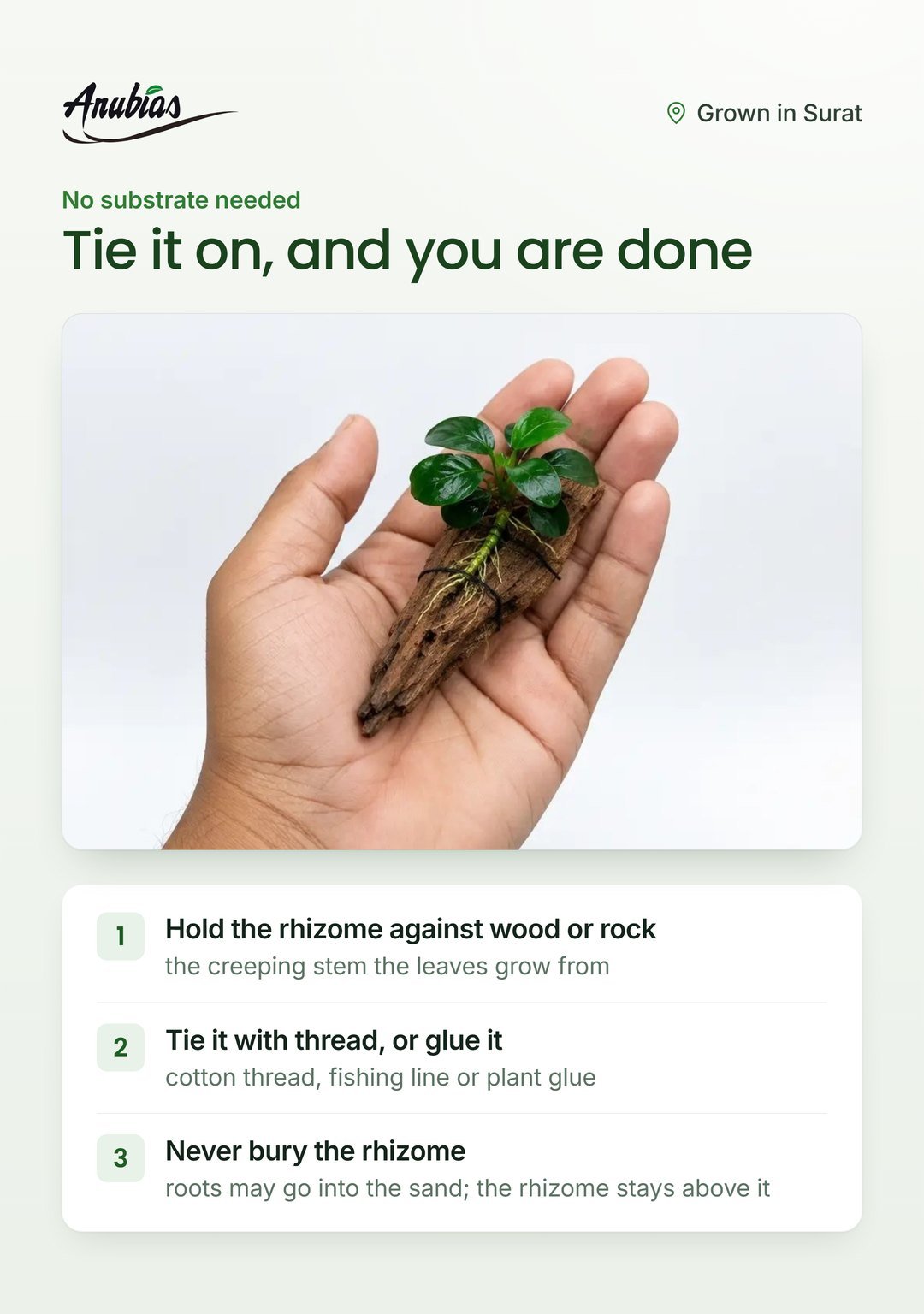
Like every anubias, the rhizome must stay above the substrate or it rots.
- Rinse the plant and trim roots longer than 3 cm; new roots will grip the surface.
- Choose a heavy, textured base: driftwood, lava rock or dragon stone. A tall plant on a light stone topples.
- Tie the rhizome on with cotton thread or fix it with a small dot of cyanoacrylate gel on the rhizome and roots.
- Mount it at the back or in a rear corner, with the leaves angled towards the front glass.
Roots grip within four to six weeks.
Anubias barteri care: light, CO2, fertiliser and water
Light. Low to moderate. The tall upper leaves sit close to the light and collect algae first in a bright tank, so keep the photoperiod to 6–8 hours and let floating or stem plants cast some shade.
CO2. Not required. With CO2 injection the leaves come in faster and larger, but the plant grows well without it.
Fertiliser. A weekly dose of a complete liquid fertiliser with potassium and iron keeps the long leaves dark green and free of pinholes. Root tabs are not needed.
Water. Hard tap water is fine, pH 6–8. It is happiest at 22–28 °C. In peak Indian summers at 30–32 °C growth slows but the plant survives; keep up 25–30% weekly water changes and add surface agitation. A monsoon power cut of a day or two does not bother it.
Growth, trimming and propagation
Anubias barteri var. glabra adds roughly one new leaf every one to three weeks. Young plants take many months to reach full height; the rhizome creeps sideways, so the plant widens over time. Trimming is rare: cut old or algae-covered leaves at the base of the stalk.
Propagate by cutting the rhizome once it carries eight or more leaves, leaving at least three leaves and some roots on each section. A mother plant divides into three or four starters.
Where to use it in an aquascape
This is the anubias for height. In a 2 ft tank of 60 litres, one S or M plant on a tall piece of driftwood at the back gives the tank a backdrop without any substrate planting. In 3 ft tanks of 100–150 litres, group two or three plants across the rear hardscape, with Anubias nana in front for a step down in leaf size and carpeting plants at the front. In 4 ft tanks of 180–250 litres, an XL plant in each rear corner frames stem plants along the back glass. The narrow leaves pair well with the broader fronds of Java fern.
It is the first choice for goldfish, cichlid and large barb tanks, where its thick leaves are usually ignored. It is safe with shrimp and bettas, and the tall leaves give cover to shy fish such as gouramis and angelfish.
Anubias barteri vs anubias nana
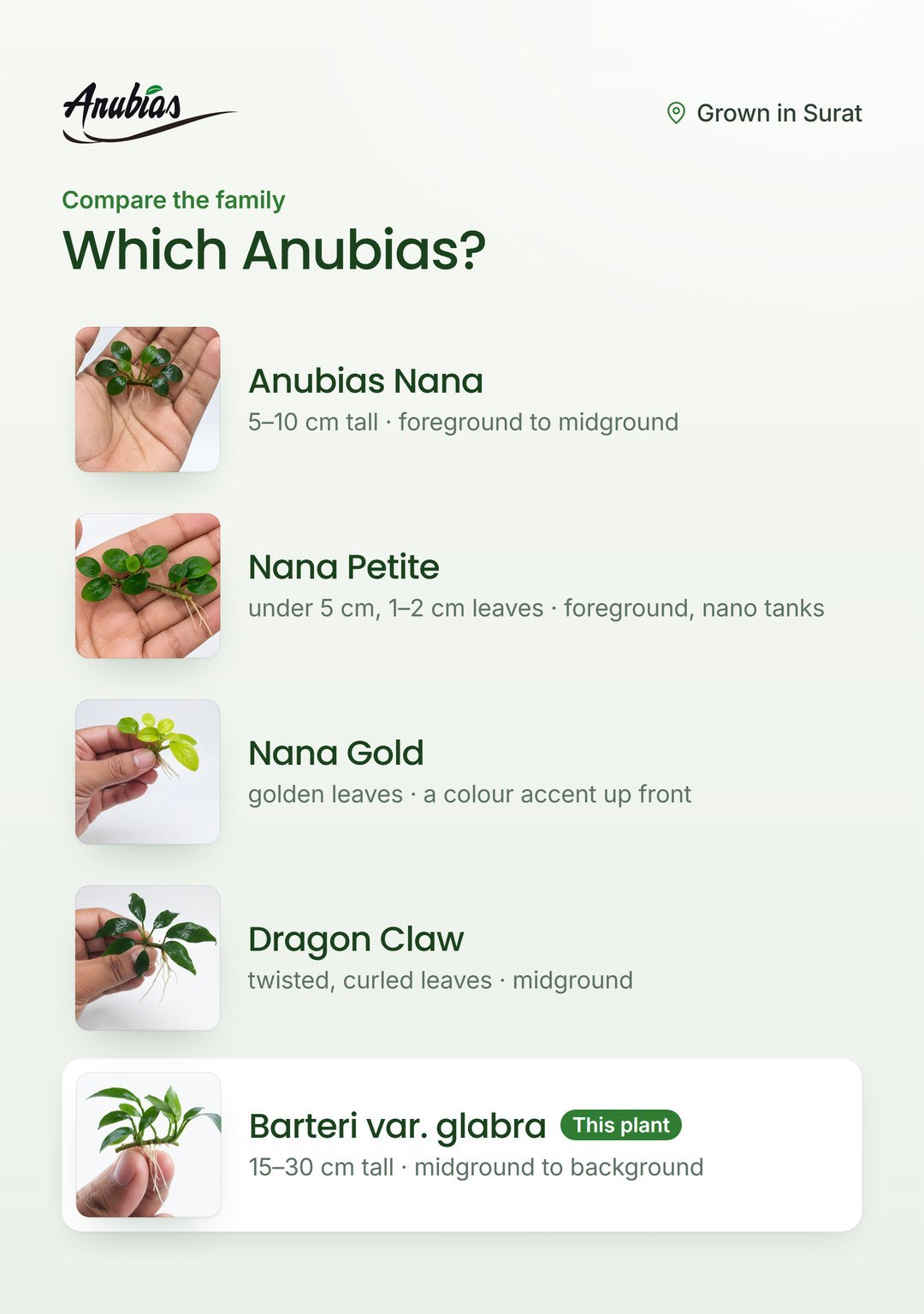
Both are forms of the same species, Anubias barteri, with identical care. The difference is scale.
| Anubias barteri var. glabra | Anubias nana | |
|---|---|---|
| Height | 15–30 cm | 5–10 cm |
| Leaf | 8–15 cm, narrow, lance-shaped | 4–6 cm, rounded |
| Placement | Midground to background | Foreground to midground |
| Minimum tank | 2 ft, 60 litres | 1 ft, 15 litres |
| Best for | Height, large fish, hiding equipment | Nano tanks, bettas, detail |
Choose barteri var. glabra for the back of a 2 ft or larger tank, and Anubias nana or Anubias nana petite for anything smaller or for the front of the tank. Many tanks use both, glabra behind and nana in front. For a textured alternative at a similar height, see Anubias dragon claw.
Common problems and fixes
- Rhizome rot. Soft, brown rhizome and detaching leaves. Cause: buried rhizome. Fix: cut away the soft section and remount the healthy part above the substrate.
- Green spot algae on upper leaves. Cause: the tall leaves sit close to a strong light. Fix: shorten the photoperiod, add floating plants for shade, scrape the leaves, add nerite snails.
- Yellow older leaves with pinholes. Cause: potassium deficiency. Fix: dose a complete liquid fertiliser weekly.
- Plant toppling or floating. Cause: tied to a light stone or loosened by diggers. Fix: anchor to a heavy piece of wood or rock and tie more firmly.
What you receive
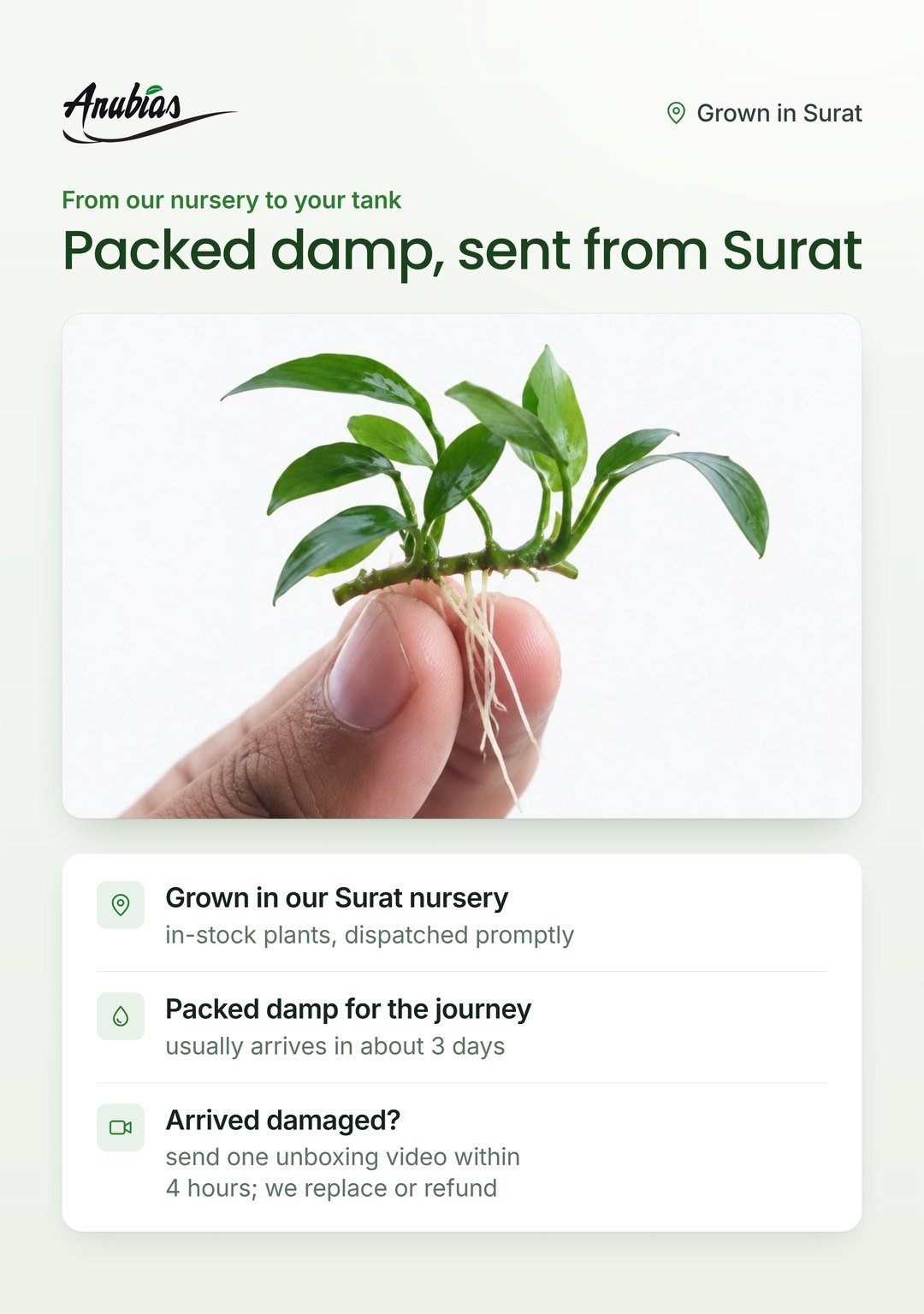
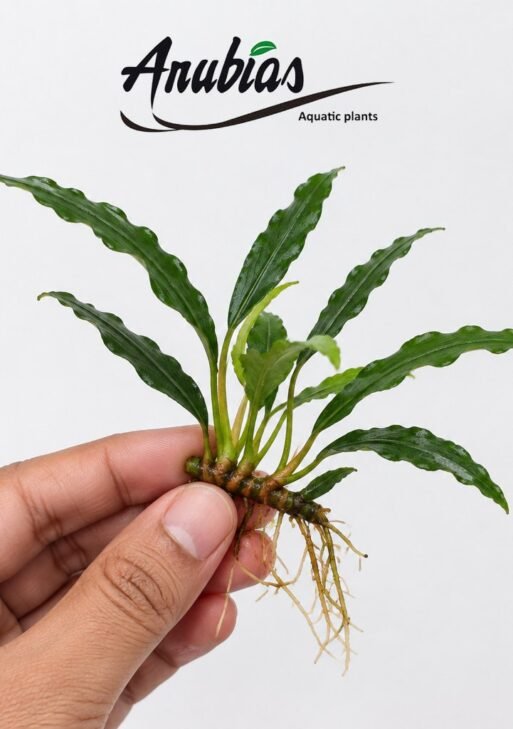
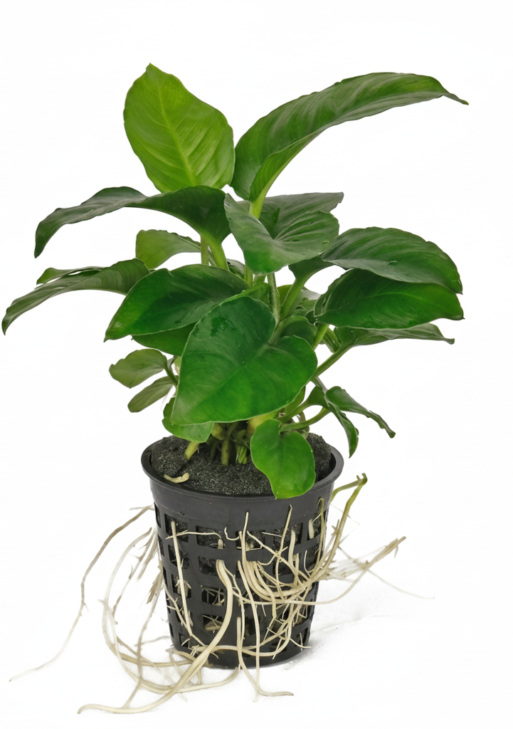
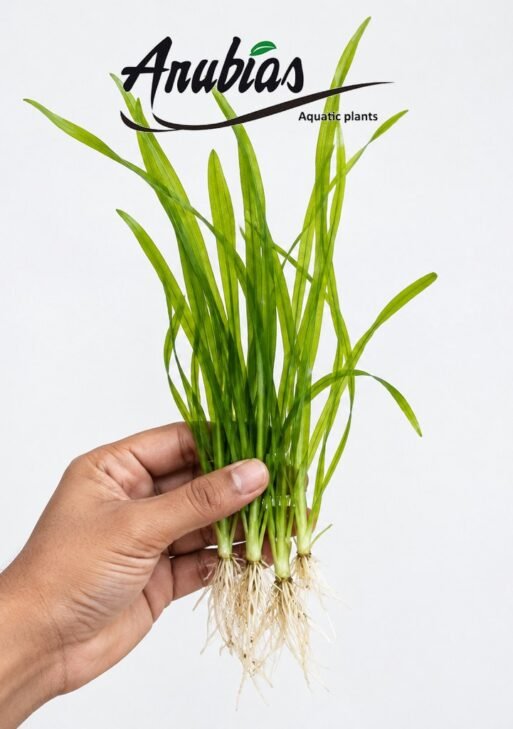
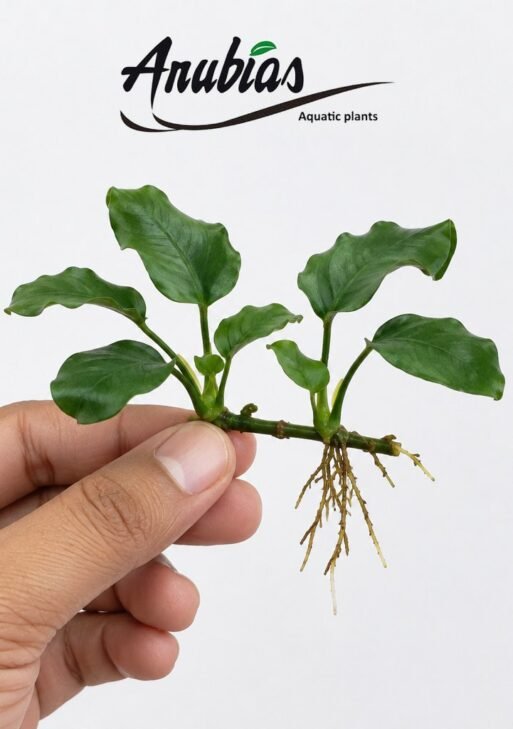
One healthy anubias barteri var. glabra plant of the size you select (XS, S, M, L or XL), similar to the photo. Each plant is checked before packing, packed moist and shipped across India from Surat. ₹99 shipping, free on orders of ₹999 or more.
Live-arrival guarantee: record one continuous unboxing video within 4 hours of delivery and we will refund or replace a plant that arrived damaged.
FAQ
Does anubias barteri need CO2?
No. It grows well in a low-tech tank without CO2 and in low to moderate light. CO2 and brighter light speed growth a little, but strong light mostly brings algae onto the slow-growing leaves.
Is anubias barteri var. glabra good for beginners?
Yes. It needs the same easy care as Anubias nana: keep the rhizome above the substrate, give it gentle light and a weekly liquid fertiliser. Just give it a tank of 2 ft or larger.
How big does anubias barteri grow?
Usually 15–30 cm tall with leaf blades 8–15 cm long. It spreads sideways along the rhizome rather than growing taller with age.
Anubias barteri vs anubias nana: which should I buy?
Barteri var. glabra for the midground or background of a 2 ft or larger tank; nana for tanks under 2 ft or for the front of any tank. Care is identical.
Is anubias barteri safe for goldfish and cichlids?
Yes. Goldfish and most cichlids leave its thick, bitter leaves alone. Tie it firmly to heavy wood or rock so diggers cannot uproot it. Keep trimmings away from cats and dogs, as the leaves contain calcium oxalate.
Can anubias barteri grow in sand or gravel?
Yes, if the rhizome rests on top of the substrate with only the roots buried, or if the plant is wedged between stones. Tying it to wood or rock is safer for a plant this tall.
How fast does anubias barteri grow?
Slowly: about one new leaf every one to three weeks. A starter plant takes many months to reach full height, which is why larger grades cost more.
Not sure what fits your tank? Plan it with our free AI tank planner.













There are no reviews yet.