
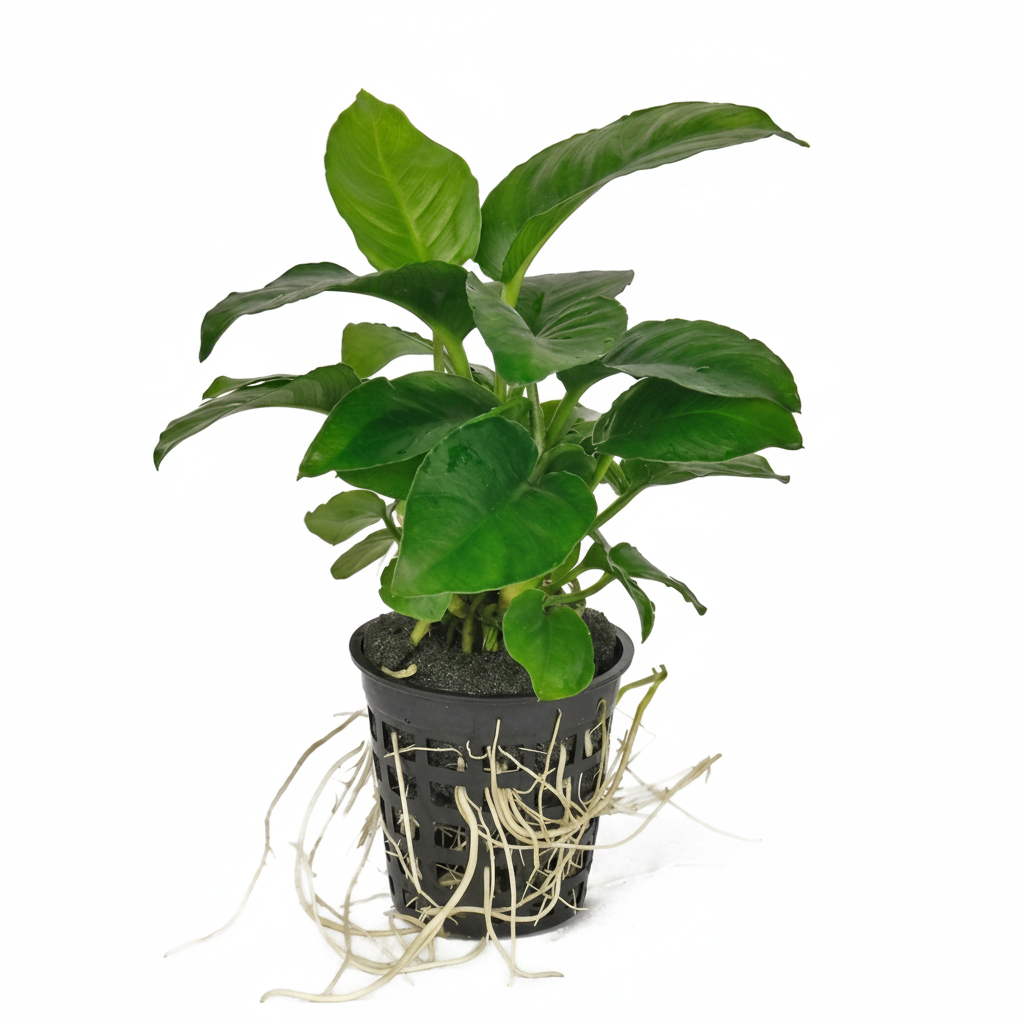
Description
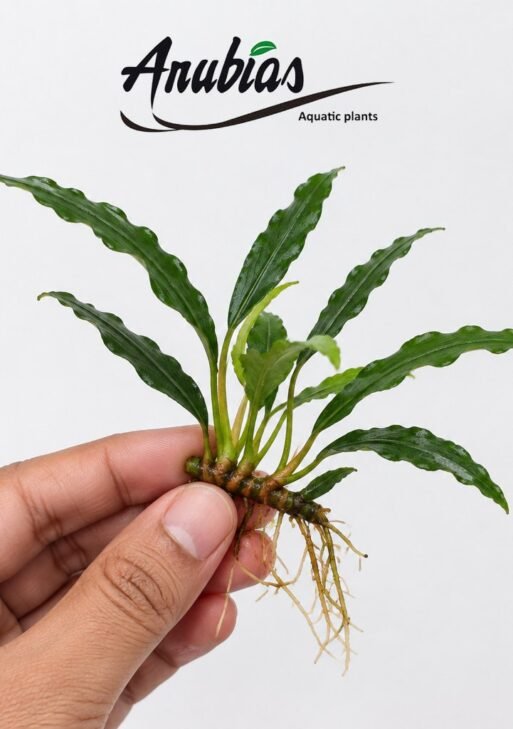
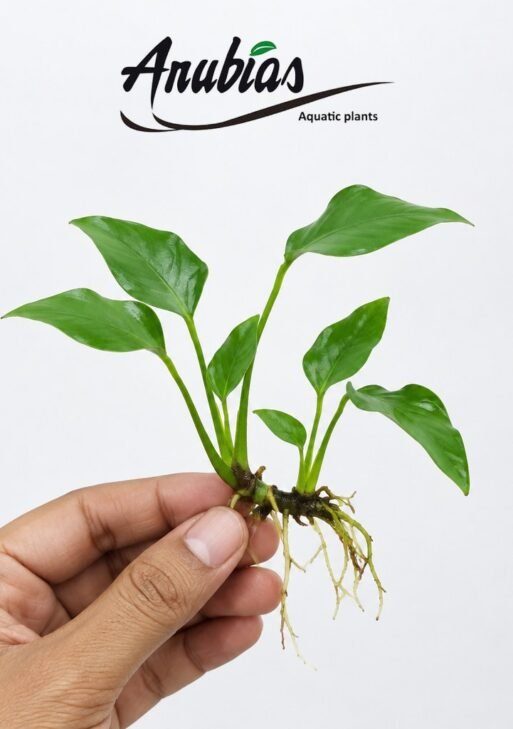
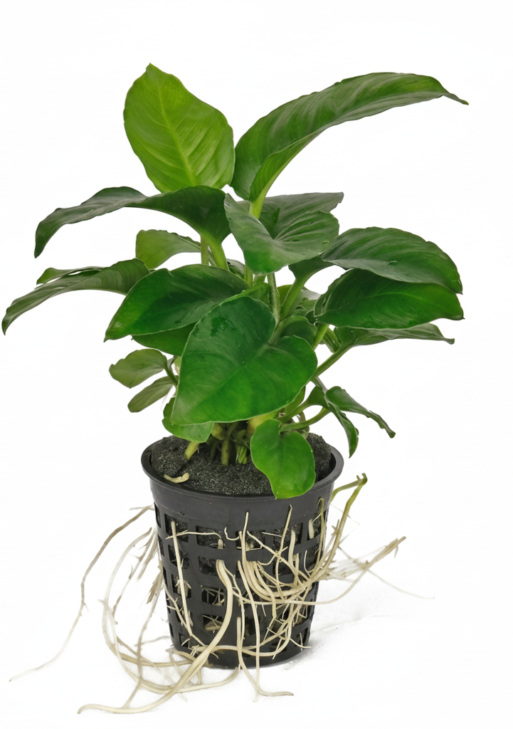
Anubias heterophylla is the big one: a large, slow-growing African aroid with long, lance-shaped leaves that can reach 30 cm or more underwater, making it one of the few background plants that needs neither CO2 nor bright light. It has the same iron constitution as its smaller cousins and does well in hard Indian tap water and warm tanks. If you keep goldfish, cichlids or a large community aquarium and want a tall, permanent green backdrop that fish cannot shred, anubias heterophylla is the plant to choose.
Anubias heterophylla at a glance
| Scientific name | Anubias heterophylla (syn. Anubias congensis, Anubias affinis in older trade names) |
|---|---|
| Family | Araceae |
| Origin | West and Central Africa (Cameroon, Gabon, Congo, Angola) |
| Difficulty | Easy |
| Light | Low to medium |
| CO2 | Not required; optional |
| Temperature | 22–28 °C (tolerates short spells to 30 °C) |
| pH | 6.0–7.8 |
| Growth rate | Slow |
| Height/size | 25–40 cm submerged; leaves 10–25 cm long |
| Placement | Background, epiphyte on large wood or rock; paludarium |
| Propagation | Rhizome division |
How to plant anubias heterophylla
The plant grows from a thick creeping rhizome that must remain above the substrate.
- Rinse the plant and trim damaged roots. The roots are strong and will regrow quickly for an anubias.
- Select a large piece of driftwood or a heavy rock at the back of the tank. A big plant needs a stable anchor; a loose stone will tip when the leaves catch the flow.
- Tie the rhizome with cotton thread or fishing line, or glue it with cyanoacrylate gel. Spread the roots across the surface so they can grip.
- Alternatively, wedge the rhizome between rocks in the substrate with the roots buried and the rhizome exposed. In a deep substrate, this is the easiest way to hold such a large plant.
- Give it moderate flow so the long leaves stay clean.
Once rooted, after six to ten weeks, the plant is very hard to dislodge.
Anubias heterophylla care: light, CO2, fertiliser and water
Light. Low to medium light keeps the foliage dark green and algae-free. The big leaves cast shade, so position it where it will not block light from smaller plants. Strong light is wasted on this slow grower and encourages green spot algae.
CO2. Not needed. With CO2 the leaves grow larger and faster, but the plant performs well without it, which is its main attraction as a background plant.
Fertiliser. Because of its size, anubias heterophylla uses more nutrients than small anubias. Dose a complete liquid fertiliser weekly. Potassium prevents holes in the old leaves and iron keeps new leaves from emerging pale. A root tab near the roots helps if it is planted in substrate.
Water. Hard tap water is fine. It prefers 22–28 °C; during Indian summers at 30–32 °C growth slows and the occasional leaf may be lost, so shade the tank and keep the surface agitated. Power cuts in the monsoon are not a problem for this low-demand plant. Weekly 25–30% water changes and good filtration keep the long leaves clean.
Growth, trimming and propagation
A new leaf appears every four to six weeks. Each leaf is long-lived, often more than a year. Remove a leaf only when it is damaged or covered in algae, cutting the petiole at the base.
Propagate by cutting the rhizome into sections with at least three leaves each. The rhizome is thick, so use a sharp blade or razor. Mount each section separately. A mature rhizome can be divided every year or so.
Grown emersed in a paludarium, anubias heterophylla becomes noticeably larger, with leaves over 30 cm and a faster growth rate. It is well suited to large ripariums and planted pond margins in shaded, frost-free locations.
Where to use it in an aquascape
This is a background plant for medium and large tanks. Use one or two plants along the back glass of a 3 ft (around 120 litres) to 6 ft (around 500 litres) tank to create a dense green wall that never needs replanting. In a nano tank it will quickly dominate, so stick to tanks of 2 ft (around 60 litres) and above.
Pair it with mid-sized Java fern, Anubias nana in the foreground and cryptocorynes in the substrate for a low-tech layout that stays tidy for years. Fast-growing stem plants can be added in the first months to soak up nutrients while the anubias establishes.
It is the ideal plant for tanks with goldfish, Oscars, African cichlids, large plecos and silver dollars that eat or uproot softer plants. Angelfish and discus use the broad leaves as spawning sites.
Common problems and fixes
- Rhizome rot. Leaves loosen from a soft rhizome. Cause: rhizome buried in substrate. Fix: cut away rot and remount above the substrate.
- Green spot algae on old leaves. Cause: too much light, low phosphate. Fix: reduce lighting hours, dose a complete fertiliser, add nerite snails.
- Black beard algae. Cause: inconsistent CO2 or stagnant corners. Fix: improve flow, spot-treat with liquid carbon or hydrogen peroxide.
- Holes and ragged edges on old leaves. Potassium deficiency. Dose potassium.
- New leaves emerging pale or twisted. Iron or calcium shortage. Dose micronutrients; add a remineraliser if you use RO water.
- Melting of emersed-grown leaves. Plants adapting from emersed growth may shed older leaves. New submerged leaves are slightly narrower; this is normal.
What you receive
One healthy anubias heterophylla plant of the size you select (Small or Standard), similar to the photo. Plants are checked before packing, packed moist and shipped across India from Surat. ₹99 shipping, free on orders of ₹999 or more.
Live-arrival guarantee: record one continuous unboxing video within 4 hours of delivery and we will refund or replace a plant that arrived damaged.
FAQ
Does anubias heterophylla need CO2?
No. Anubias heterophylla grows well without CO2. Injection speeds growth and enlarges the leaves but is optional.
How big does anubias heterophylla grow?
Submerged it reaches 25–40 cm tall with leaves 10–25 cm long. Grown emersed it gets even larger.
Is anubias heterophylla good for beginners?
Yes. It is one of the easiest background plants available: low light, no CO2, hard water and plant-eating fish are all tolerated.
Can anubias heterophylla be kept with goldfish and cichlids?
Yes. The leaves are thick and bitter, so goldfish, Oscars and African cichlids leave it alone. Anchor it firmly so diggers cannot dislodge it.
How fast does anubias heterophylla grow?
Slowly, about one new leaf every four to six weeks underwater. Emersed growth in a paludarium is faster.
Anubias heterophylla vs anubias barteri: what is the difference?
Heterophylla is much larger with long lance-shaped leaves and suits the background; barteri is a compact midground plant with oval leaves. Care is the same.
Not sure what fits your tank? Plan it with our free AI tank planner.










There are no reviews yet.