
Description
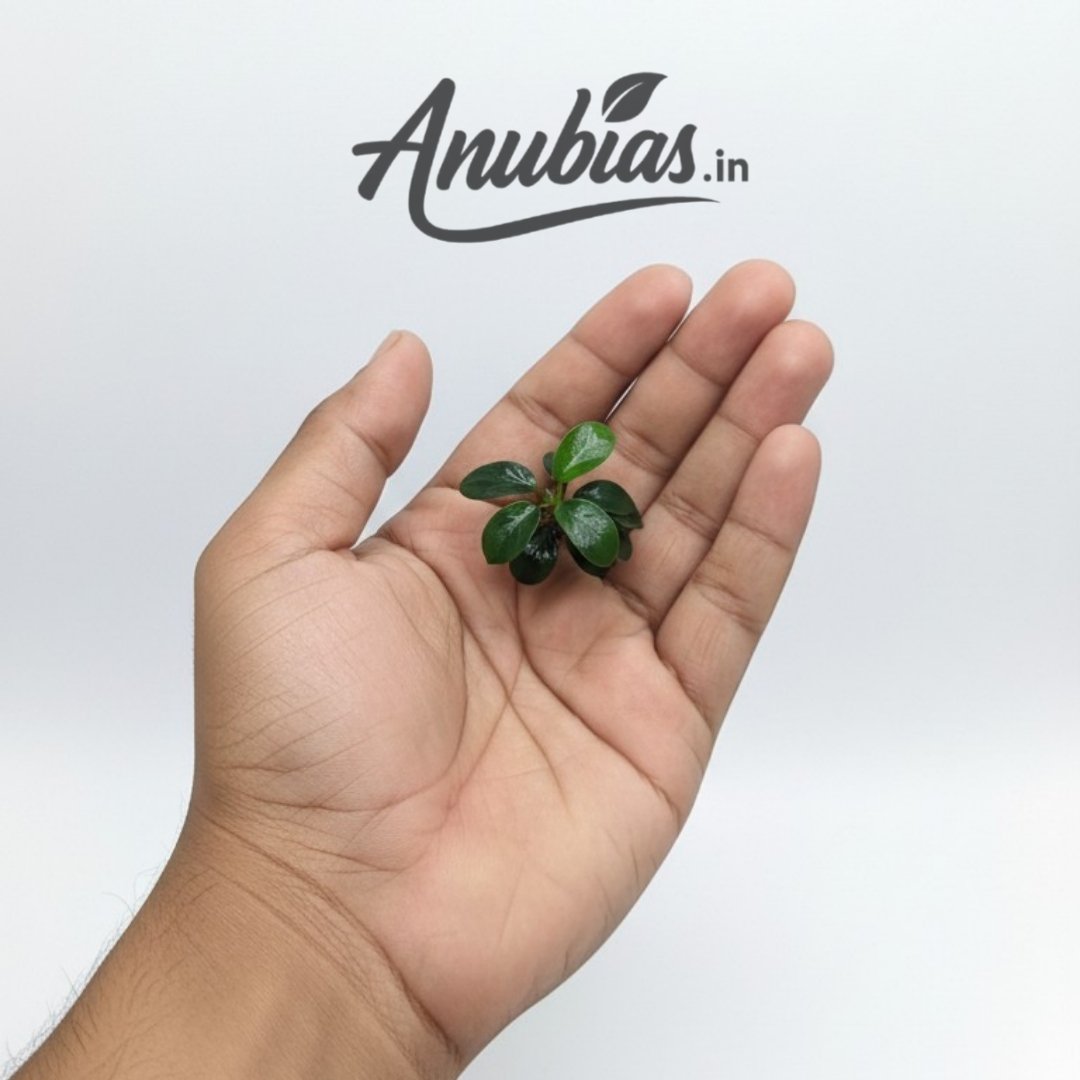
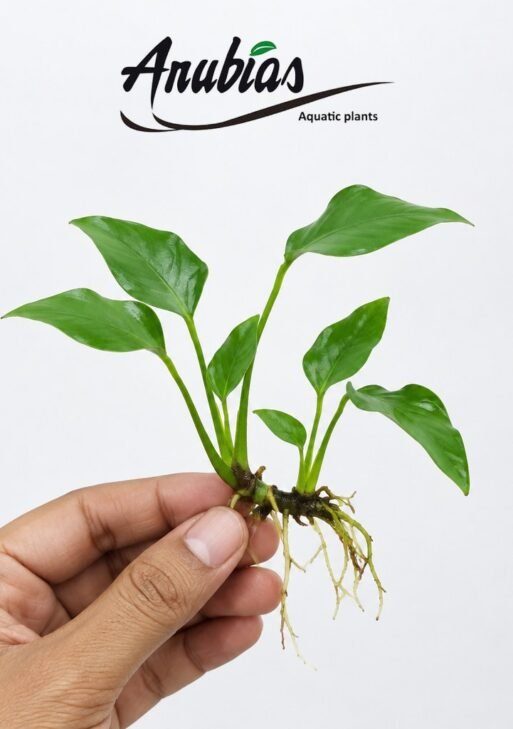
Anubias nana (Anubias barteri var. nana) is the classic compact anubias plant: a tough West African rhizome plant with rounded, dark green leaves about 4–6 cm long on a plant that stays roughly 5–10 cm tall. It grows attached to driftwood or rock rather than in the substrate, needs no CO2, is happy in low light and hard Indian tap water, and lives for years. Anubias nana suits beginners who want a plant that will not die on them, betta and shrimp keepers who want safe, leathery foliage, and aquascapers who need a dependable midground plant in a 1–4 ft tank.
Anubias nana at a glance
| Scientific name | Anubias barteri var. nana (common names: anubias nana, dwarf anubias) |
|---|---|
| Family | Araceae |
| Origin | Streams and river banks of Cameroon, Nigeria and Gabon, West Africa |
| Difficulty | Easy |
| Light | Low to moderate |
| CO2 | Not required |
| Temperature | 22–28 °C |
| pH | 6.0–8.0 |
| Growth rate | Slow; roughly one new leaf every one to three weeks |
| Height/size | 5–10 cm tall; leaves 4–6 cm long |
| Placement | Foreground to midground, epiphyte on wood or rock |
| Propagation | Rhizome division |
Which size should I buy?
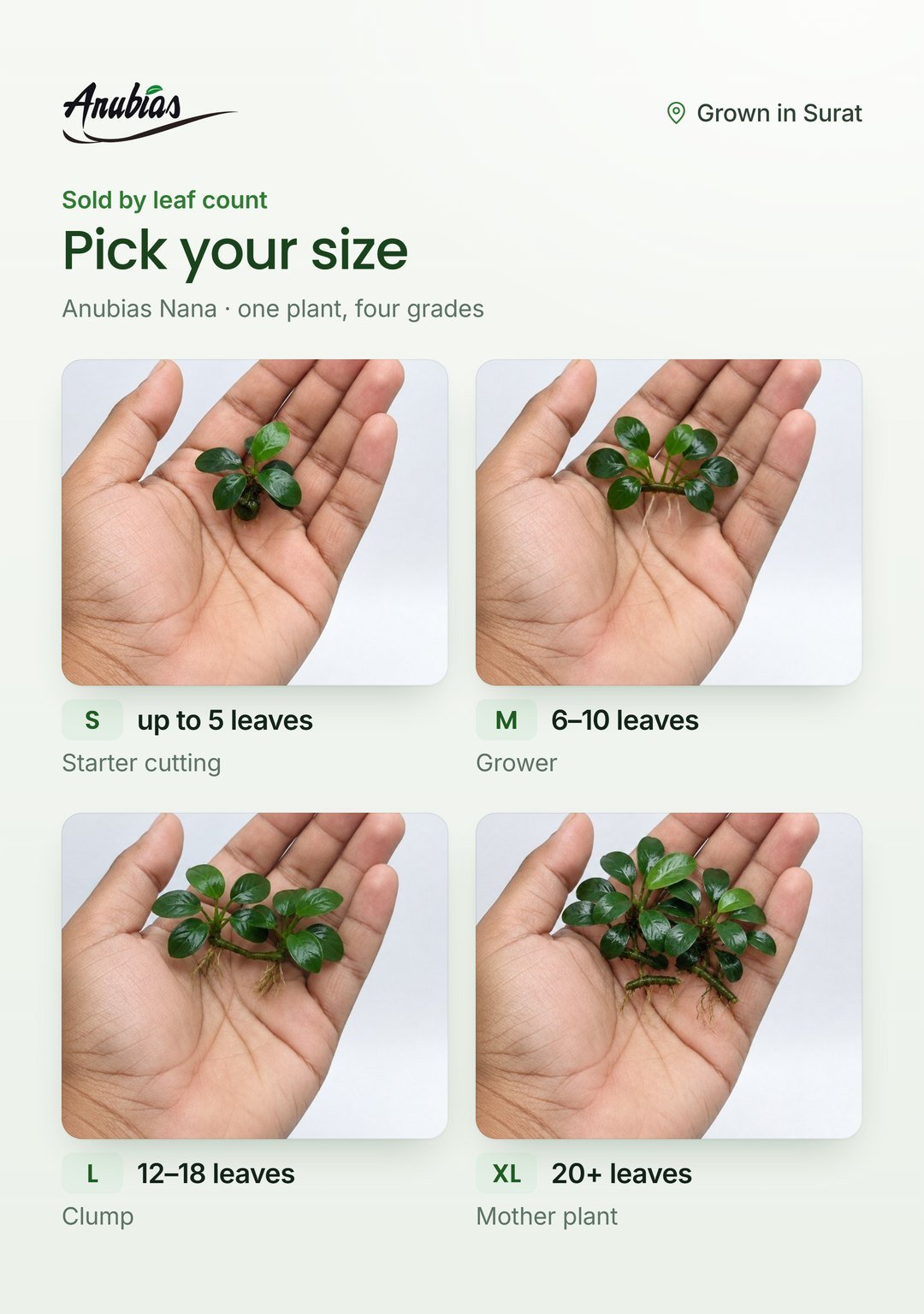
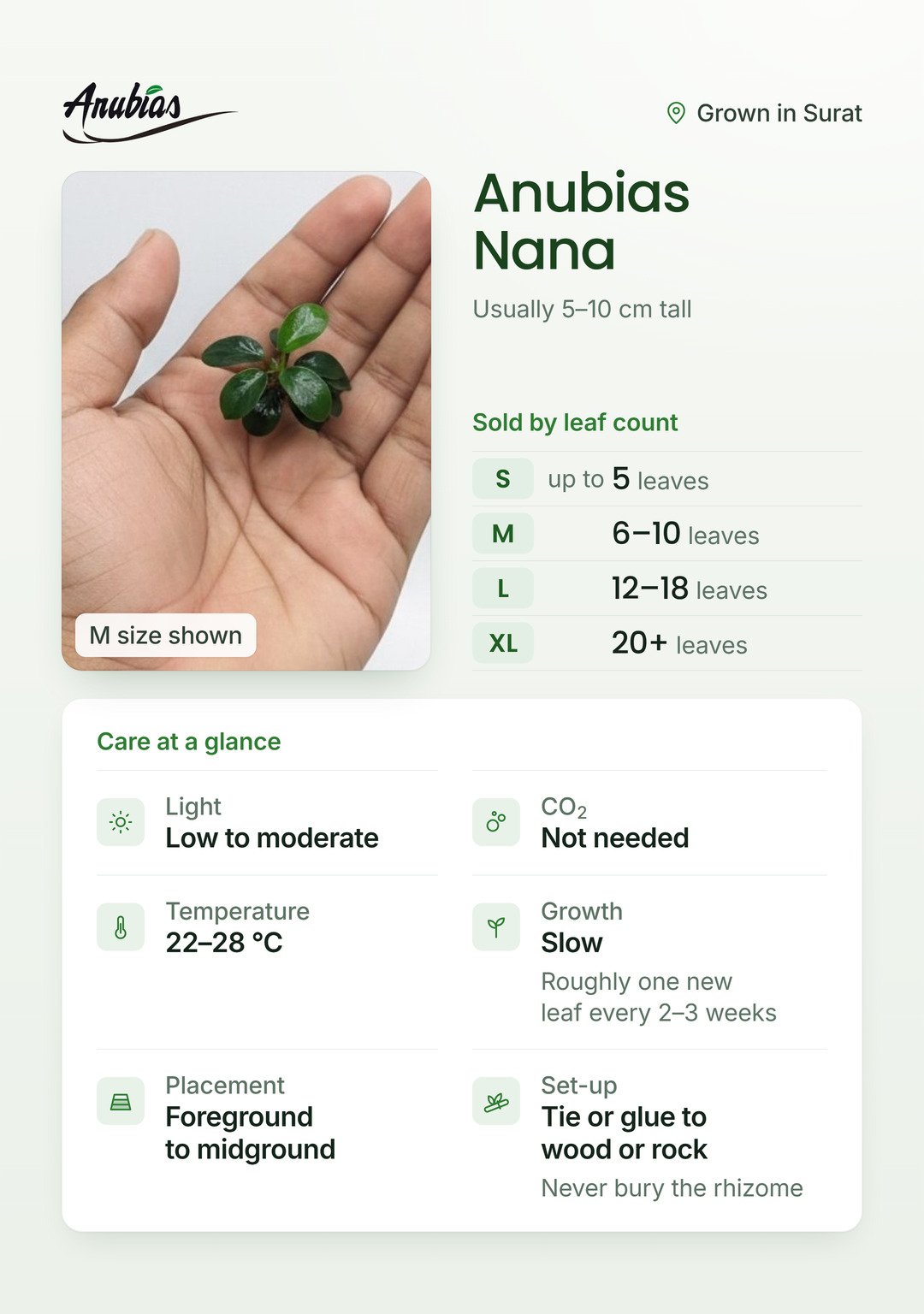
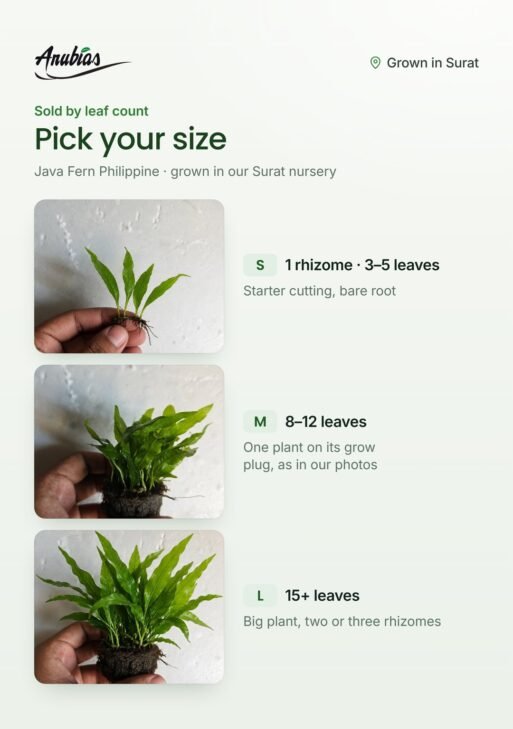
Anubias nana is sold in five grades. The plant grows sideways along its rhizome, so a larger grade means a wider, fuller plant, not a taller one.
- XS (grow-on): a rhizome tip with one or two leaves, for gluing many pieces onto an aquarium tree or rock wall, or growing your own plant on a budget.
- S (starter): a cutting with up to five leaves; the usual choice for a 1 ft nano or betta tank.
- M (grower): six to ten leaves; the all-rounder for 1.5–2 ft tanks of 30–60 litres.
- L (clump): twelve to eighteen leaves; a full midground bush from day one for 2–3 ft tanks of 60–120 litres.
- XL (mother): twenty or more leaves on a long rhizome; a focal plant for 3–4 ft tanks of 120–250 litres, or one to divide into several starters.
Rule of thumb: one M per foot of tank length looks natural within a few months; step up a grade if you want it finished on day one.
How to plant anubias nana
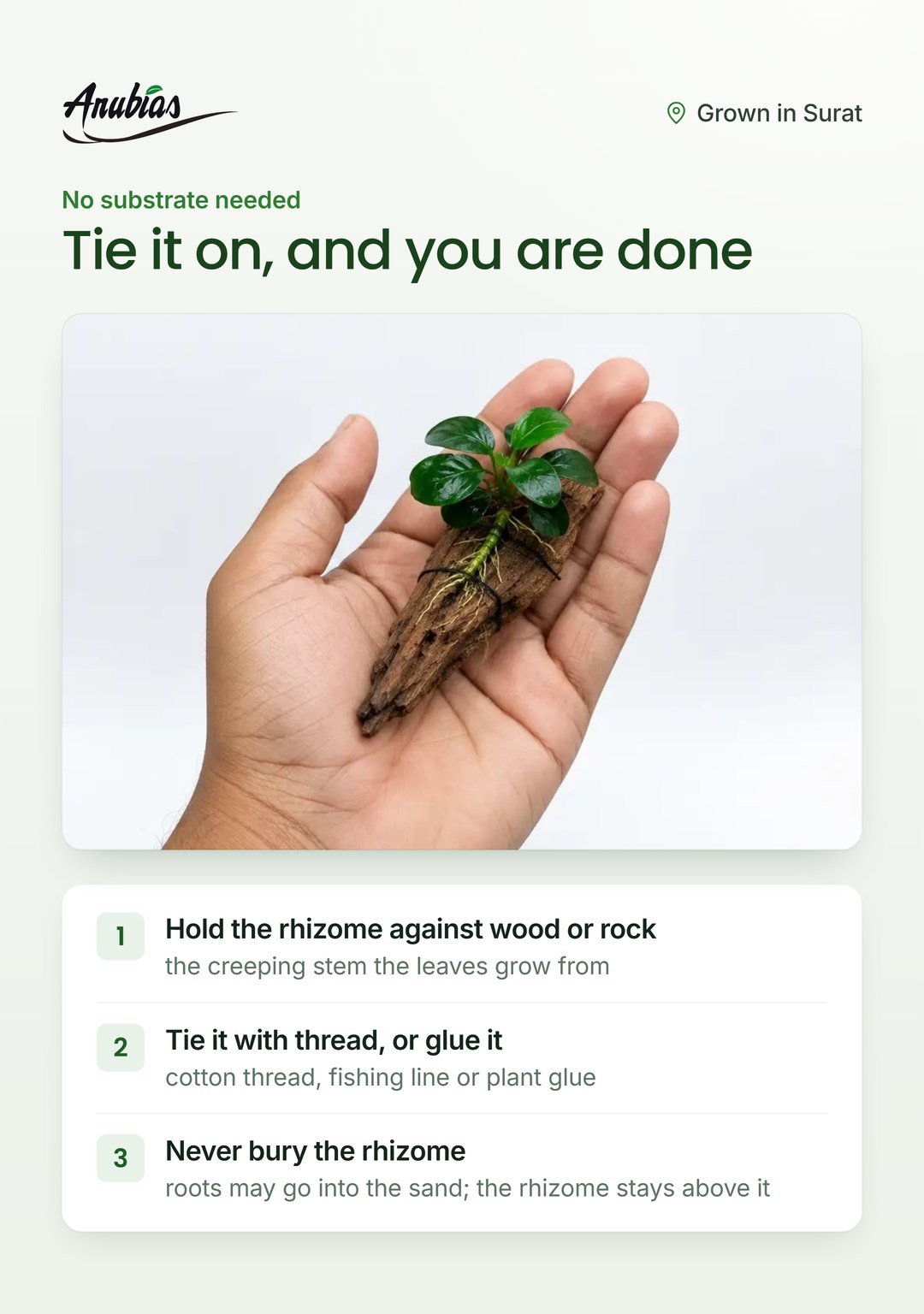
The one rule with every anubias is that the rhizome, the thick horizontal stem the leaves grow from, must stay above the substrate. Bury it and it rots.
- Rinse the plant gently and trim roots longer than 2–3 cm; new roots grow to grip the surface.
- Choose a textured surface: driftwood, lava rock, dragon stone or seiryu. Smooth pebbles give the roots nothing to hold.
- Tie the rhizome on with cotton thread (it rots away in a few weeks) or fix it with a small dot of cyanoacrylate gel on the rhizome and roots, never on the leaves.
- Or wedge the rhizome between stones, or set it on the substrate with only the roots pushed in.
- Place it where the light is gentle; under taller or floating plants the leaves stay cleaner.
Roots grip within three to six weeks.
Anubias nana care: light, CO2, fertiliser and water
Light. Low to moderate light is ideal. Strong light does not make it grow much faster; it mainly invites green spot algae on the long-lived leaves. Keep the photoperiod to 6–8 hours.
CO2. Not needed. With CO2 injection the leaves come in a little faster and larger, but this is a bonus, not a requirement.
Fertiliser. Anubias feeds through its leaves. A weekly dose of a complete liquid fertiliser with potassium and iron keeps new leaves dark green and prevents pinholes in older leaves. Root tabs are not needed.
Water. Hard Indian tap water is fine (pH 6–8). It is happiest at 22–28 °C; in peak summer at 30–32 °C growth slows but the plant survives if you shade the tank, add surface agitation and keep up weekly 25–30% water changes. A monsoon power cut of a day or two does not bother it.
Growth, trimming and propagation
Anubias nana adds roughly one new leaf every one to three weeks and creeps along the hardscape, branching as it goes. Trimming is rare: cut yellowed or algae-covered leaves at the base of the stalk.
To propagate, wait until the rhizome has grown long enough to carry eight or more leaves, then cut it with a clean blade so that each section keeps at least three leaves and a few roots. Attach the new piece to its own rock or wood.
Where to use it in an aquascape
In a 1 ft nano of 15–20 litres, one S plant on a small piece of wood becomes the main plant. In 1.5–2 ft tanks of 30–60 litres, an M plant tied low on driftwood gives a strong midground, with a low carpet from our carpeting plants in front. In 3–4 ft community tanks of 100–250 litres, use L or XL plants in groups of two or three on the hardscape, with Java fern behind them for height and stem plants along the back glass.
It is a natural choice for betta tanks, where the broad leaves give the fish a resting spot near the surface, and for shrimp tanks, where cherry and crystal shrimp graze the leaves without harming them. Goldfish and cichlids usually leave the tough leaves alone; tie it firmly so diggers cannot loosen it.
Anubias nana vs nana petite vs nana gold vs barteri
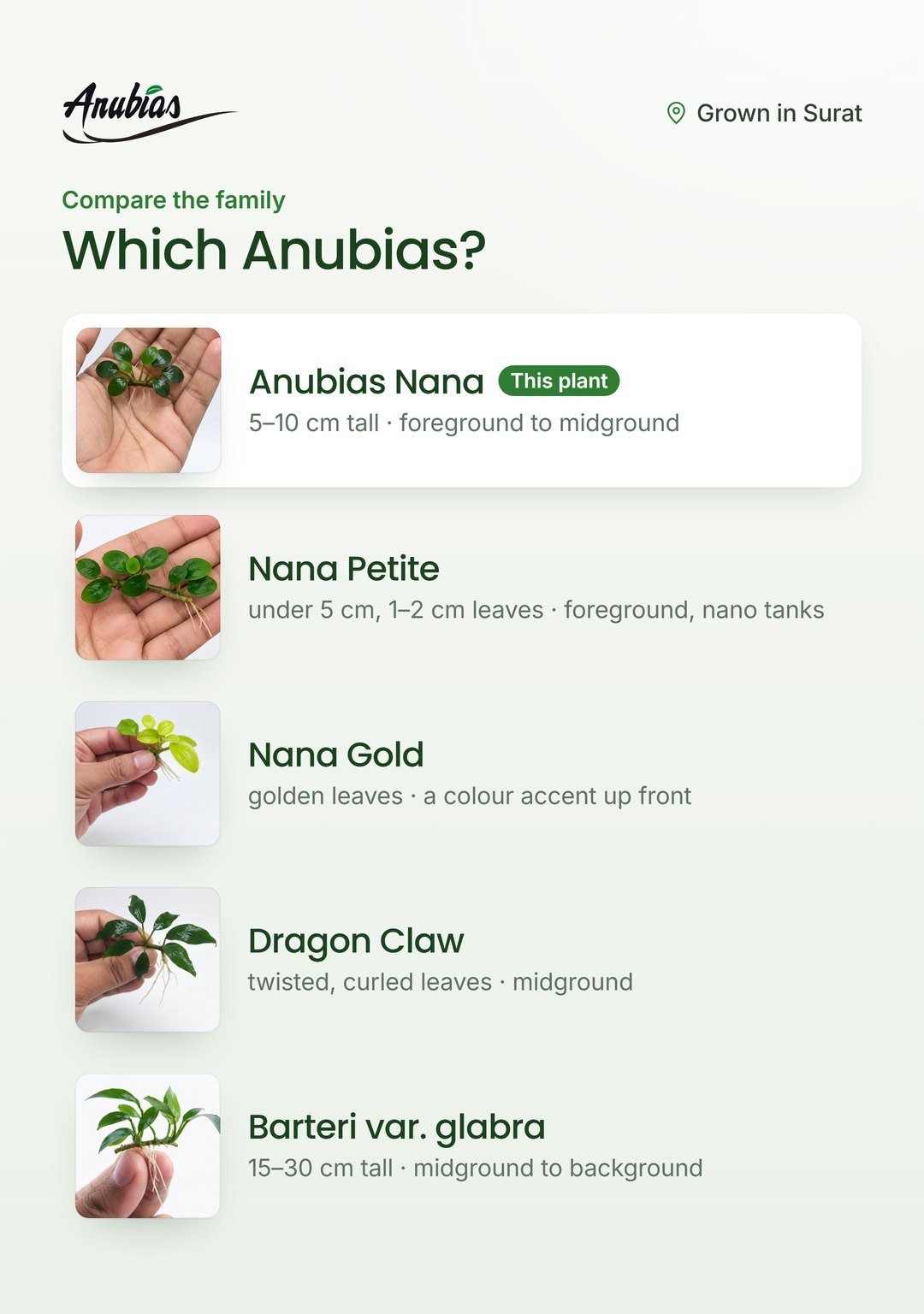
Shoppers asking about types of anubias usually want to know which fits their tank. These four cover most needs.
| Variety | Height | Leaf | Best for |
|---|---|---|---|
| Anubias nana | 5–10 cm | 4–6 cm, dark green, rounded | Midground in any tank from 1 ft up; the all-rounder |
| Anubias nana petite | Under 5 cm | 1–2 cm | Nano tanks, foreground detail, rock crevices |
| Anubias nana gold | 5–10 cm | 4–6 cm, golden green | Colour contrast next to green plants; grows slower |
| Anubias barteri var. glabra | 15–30 cm | 8–15 cm, long and narrow | Background in 2 ft and larger tanks |
If you only buy one anubias, buy nana. Choose petite when the tank is under 20 litres, gold when you want colour, and barteri when you need height at the back.
Common problems and fixes
- Rhizome rot. Rhizome turns soft, brown and smelly and leaves detach. Cause: buried rhizome. Fix: cut away the soft part with a clean blade and remount the healthy section above the substrate.
- Green spot algae on leaves. Cause: too much light for the growth rate. Fix: shorten the photoperiod, add shade, scrape the leaves, add nerite snails.
- Yellow leaves with pinholes. Cause: potassium deficiency. Fix: dose a complete liquid fertiliser weekly; remove the worst leaves.
- Melt after planting. A few leaves turn translucent in the first two weeks. Cause: the move from emersed to submerged growth. Fix: leave the rhizome in place; new submerged leaves follow.
What you receive
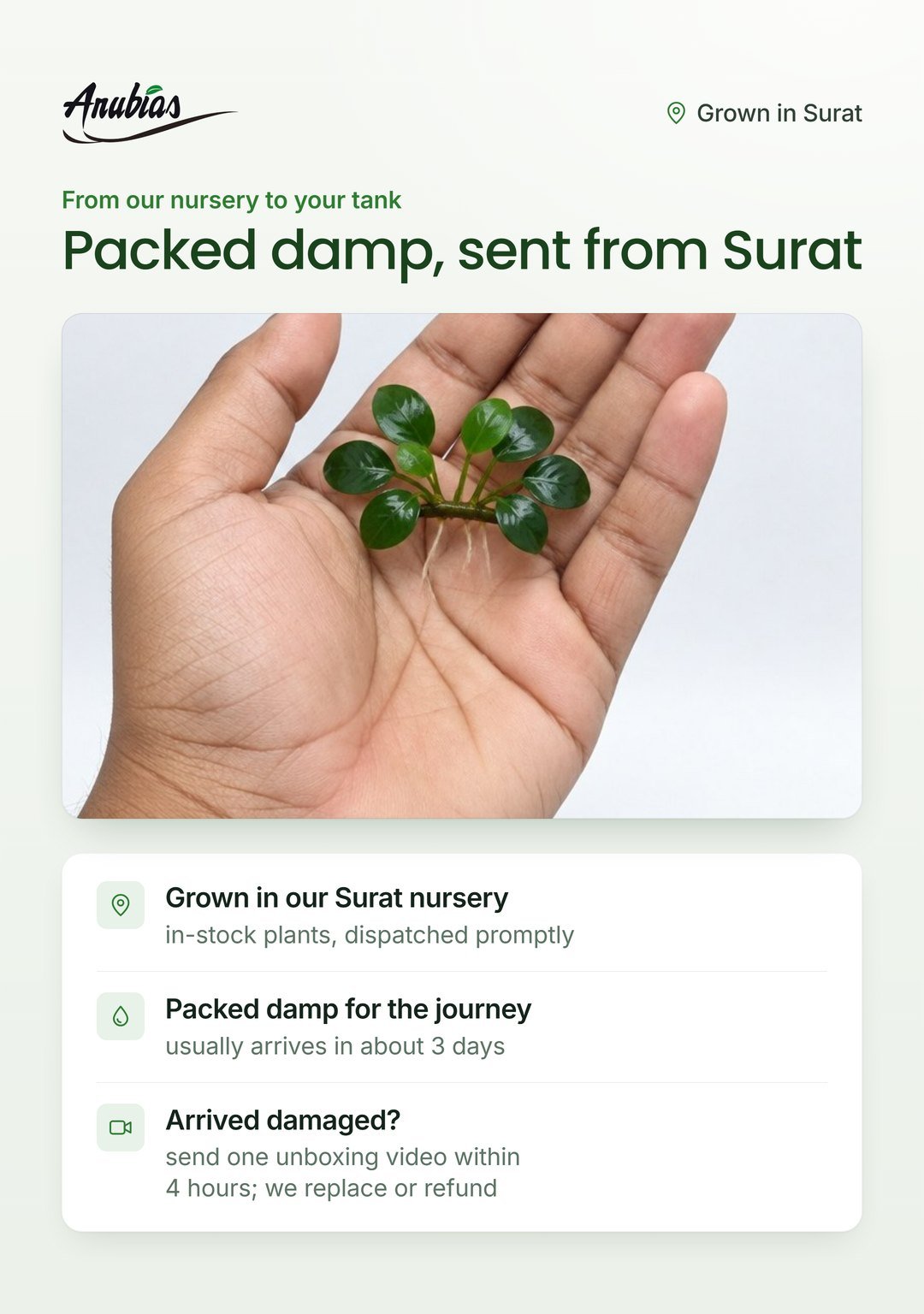
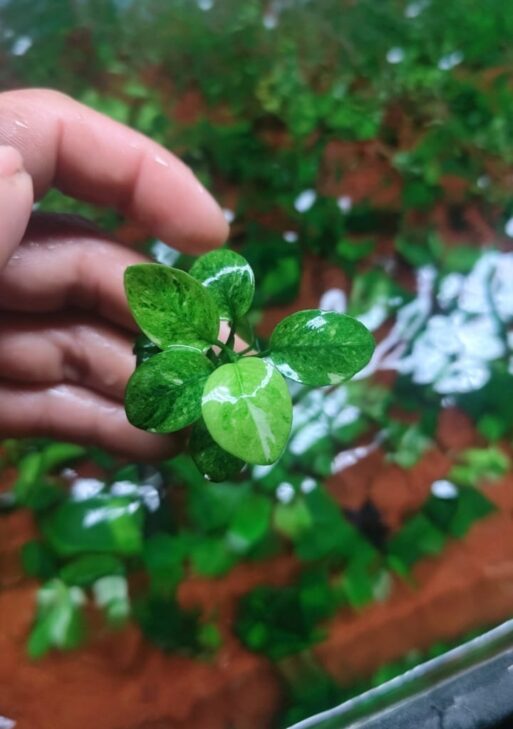
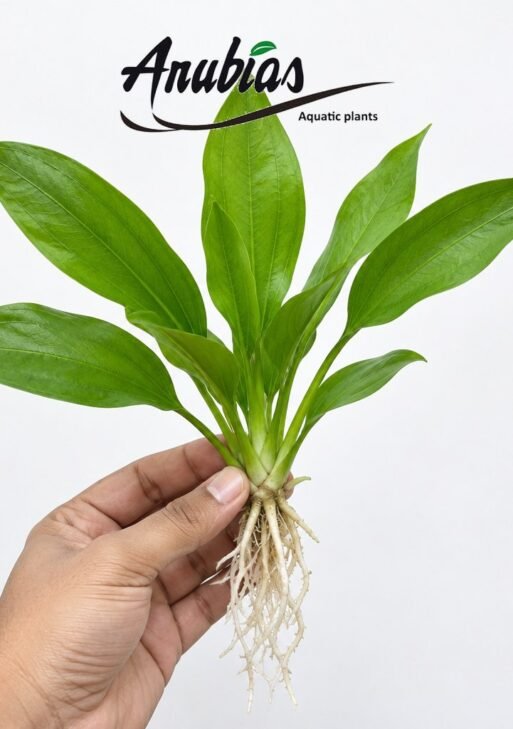
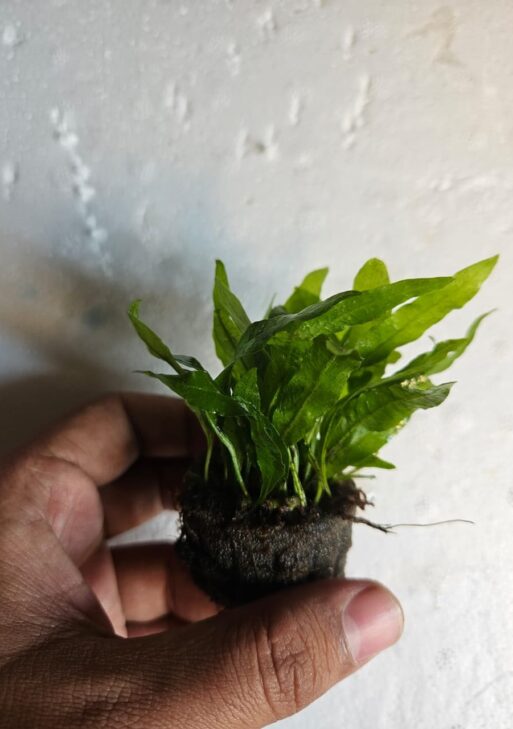
One healthy anubias nana plant of the size you select (XS, S, M, L or XL), similar to the photo. Each plant is checked before packing, packed moist and shipped across India from Surat. ₹99 shipping, free on orders of ₹999 or more.
Live-arrival guarantee: record one continuous unboxing video within 4 hours of delivery and we will refund or replace a plant that arrived damaged.
FAQ
Does anubias nana need CO2?
No. It grows well in a low-tech tank with no CO2 and low to moderate light. Injected CO2 only slightly increases leaf size and speed; brighter light mainly brings algae.
Is anubias nana good for beginners?
Yes. It tolerates low light, hard water, warm summers and missed fertiliser doses. The only rule is to keep the rhizome above the substrate.
How fast does anubias nana grow?
Slowly: about one new leaf every one to three weeks. A starter plant usually reaches the size of our M grade in three to six months.
Can anubias nana grow in sand or gravel?
Yes, as long as the rhizome sits on top with only the roots in the sand, or the plant is wedged between stones. Attaching it to wood or rock is the safest method.
Anubias nana vs anubias nana petite: what is the difference?
Size. Nana grows 5–10 cm tall with 4–6 cm leaves; petite stays under 5 cm with 1–2 cm leaves. Care is identical. Nana fills space faster; petite suits nano tanks and foreground detail.
Is anubias nana safe for bettas, shrimp and goldfish?
Yes. Bettas rest on the leaves, shrimp graze them and goldfish usually leave them alone. The leaves contain calcium oxalate, so keep trimmings away from cats and dogs.
Which size of anubias nana should I buy for a 2 ft tank?
One M plant gives a natural midground that fills out over a few months; an L plant looks finished on day one. For a 3 ft tank take two M or one L.
Not sure what fits your tank? Plan it with our free AI tank planner.
















There are no reviews yet.