
Light is the engine of a planted aquarium. Too little and plants stretch, fade and drop leaves; too much without enough CO2 and nutrients and you grow algae instead of plants. This guide explains how much light aquarium plants really need, how many hours to run it, how to pick an LED for a typical Indian tank, and which plants suit each light level.
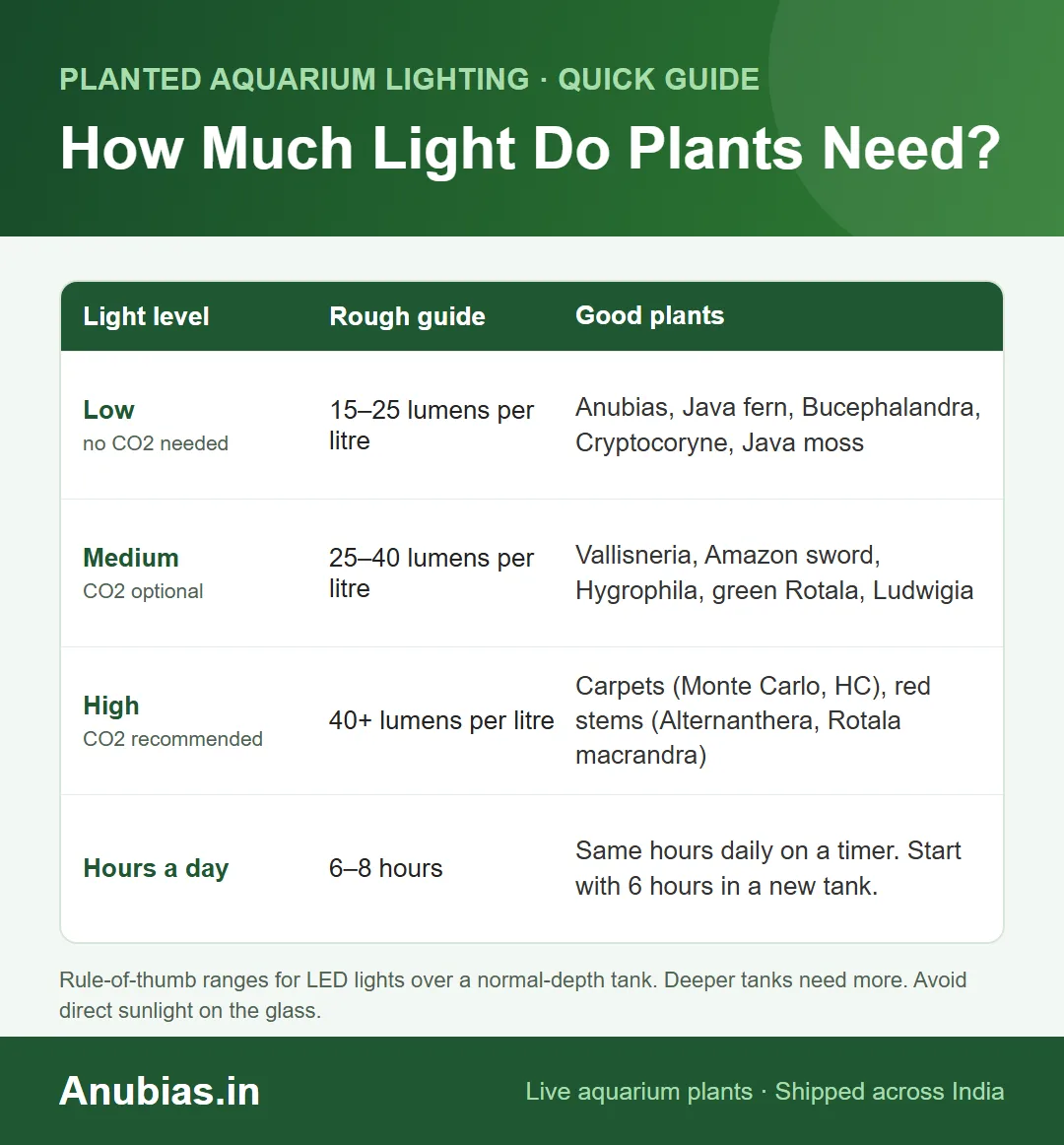
Quick answer: Most planted tanks do well with a white LED (about 6,500K) on a timer for 6–8 hours a day. As a rough guide, low-light plants like Anubias, Java fern and Cryptocoryne need about 15–25 lumens per litre, most stem plants 25–40, and carpets or red plants 40+ lumens per litre with CO2. Match brighter light with CO2 and fertiliser, keep direct sunlight off the glass, and start a new tank at 6 hours.
How much light do aquarium plants need?
Plants make food from light, so the right amount depends on what you grow. Old “watts per litre” rules came from tube lights and do not work for LEDs. Lumens (total visible light from the fixture) or PAR (light that actually reaches the plants) are better measures. Lumens are printed on most LED boxes, so they are the easiest number to use.
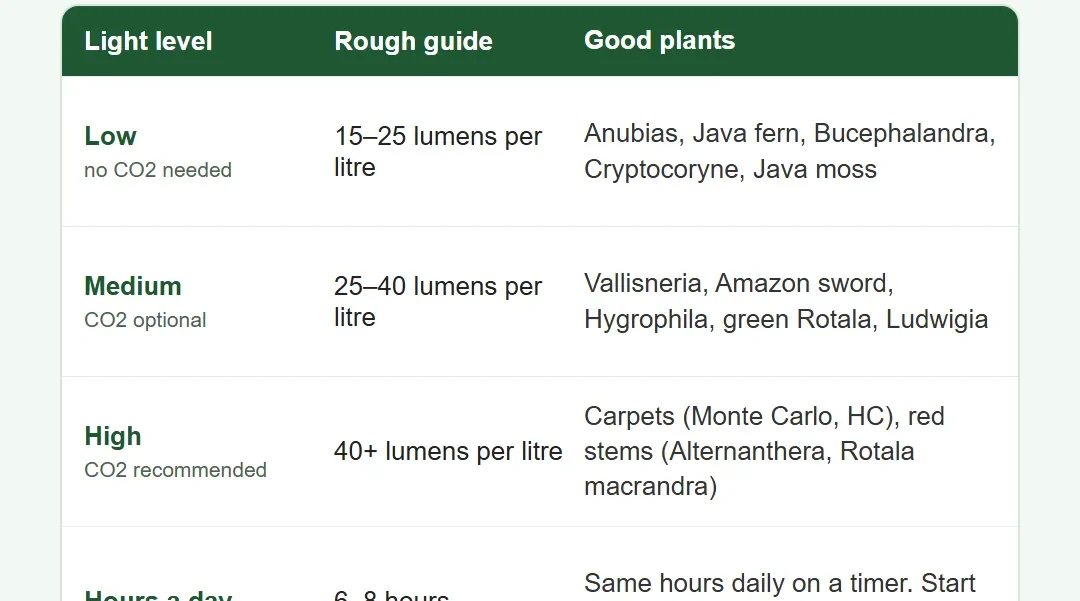
| Light level | Rough guide | CO2 | Plants that fit |
|---|---|---|---|
| Low | 15–25 lumens per litre (PAR about 15–30 at the substrate) | Not needed | Anubias Nana, Java fern, Bucephalandra, Cryptocoryne, Java moss |
| Medium | 25–40 lumens per litre (PAR about 30–50) | Optional, helps | Vallisneria nana, Amazon sword, Hygrophila, Rotala rotundifolia, most stem plants |
| High | 40+ lumens per litre (PAR 50+) | Recommended | Monte Carlo, HC Cuba, Alternanthera reineckii mini, Rotala macrandra |
These are rule-of-thumb ranges, not exact science. Light weakens quickly with depth, so a tall tank needs a stronger light than a shallow one of the same volume. Plants also adapt: an Anubias under bright light grows fine, it just collects algae on its slow leaves, while a carpet plant under weak light slowly thins out and dies back.
How many hours should the aquarium light be on?
Run the light 6–8 hours a day at the same time every day. A cheap plug-in timer is the single best lighting upgrade, because a steady schedule matters more than a long one. In a new tank, start at 6 hours for the first 4–6 weeks while plants settle and algae is most likely, then go up to 7 or 8 hours if plants look healthy.
- Do not run lights 10–12 hours to “help” plants. Extra hours mostly feed algae.
- Never leave the light on all night. Fish need darkness to rest, and plants do not grow faster without a dark period.
- Time the light for when you are home in the evening so you actually see the tank.
How to choose an LED light for a planted tank
- Colour temperature: a white around 6,500–7,000K looks natural and grows plants well. Lights with extra red make red plants look richer but are not essential.
- Lumens, not watts: check the lumen figure on the box and divide by your tank’s litres to see which light level you get.
- Length: pick a light close to the tank length (a 2 ft light for a 2 ft tank) so the corners are not dark.
- Dimmer or controller: very useful. You can start low and raise intensity slowly instead of shocking a new tank with full power.
- Plant LED vs basic LED: a basic “fish” LED is often enough for low-light plants. Carpets and red stem plants usually need a stronger planted-tank LED.
Light for common Indian tank sizes
Using the rough lumens-per-litre guide, here is about how much light common tanks need. Check the actual water volume of your tank, as many are smaller than the label once you add substrate.
- 1 ft tank (about 15–20 litres): 300–500 lumens for low light; a small clip-on LED usually does it.
- 2 ft tank (about 50–60 litres): 900–1,500 lumens for low light, 1,500–2,400 for medium, more for carpets.
- 3 ft tank (about 100–150 litres): 2,000–3,500 lumens for low light; most stem-plant tanks this size use two lights or one strong planted LED.
Planning a full setup? See our planted aquarium setup cost in India guide for light, filter and plant budgets, and the monthly running cost guide for what a light adds to your electricity bill.
Light, CO2 and fertiliser must stay in balance
Light decides how fast plants want to grow. CO2 and nutrients decide whether they can. If you add a brighter light but nothing else, plants hit a limit and algae uses the spare light. That is why high-light carpets usually need CO2 and regular fertiliser, while a low-light tank of Anubias and ferns runs happily with a light dose of liquid fertiliser and root tabs. If you see bubbles on leaves after a few hours of light, your balance is good; see why plants pearl.
Signs of too little or too much light
Too little light: stem plants grow tall and thin with wide gaps between leaves, lower leaves drop off, red plants turn green or brown, and carpets lift and thin out.
Too much light (for the CO2 and nutrients you have): green spot algae on glass and slow leaves like Anubias, hair or thread algae on plants, a green-water bloom, or pale, bleached new growth on stem plants.
If algae is the problem, reduce the hours first (go back to 6), then lower intensity, before changing anything else. See plants that help reduce algae.
Can sunlight replace an aquarium light?
Not reliably. Direct sun through a window changes every day and every season, heats the water in Indian summers, and is the most common cause of green water. Bright indirect room light can keep hardy plants alive, as explained in our guide to aquarium plants that grow without a light, but a basic LED on a timer gives far steadier growth.
Where to place plants under the light
Light is strongest straight under the fixture and weakest at the sides, corners and under driftwood. Use that: put carpets and red stem plants in the open centre, and tie Anubias, Java fern and Bucephalandra to wood or rocks in shaded spots where their slow leaves stay clean. Tall background plants like Vallisneria can shade the back corners, which suits Cryptocoryne underneath.
The easiest plants if you have a basic light
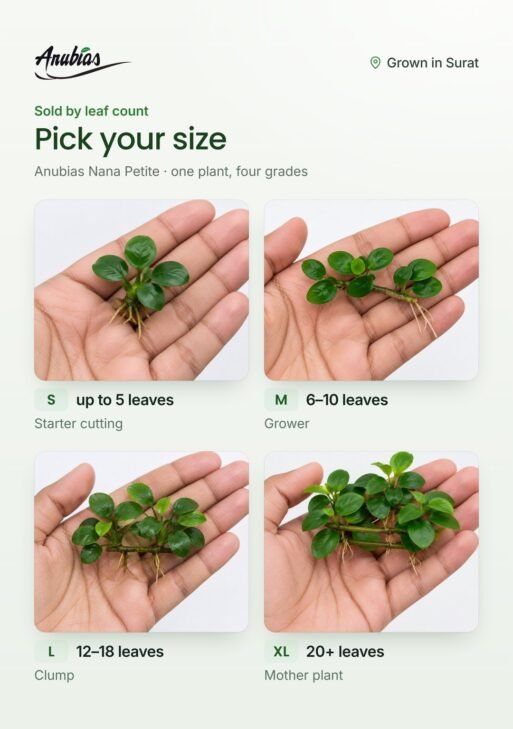
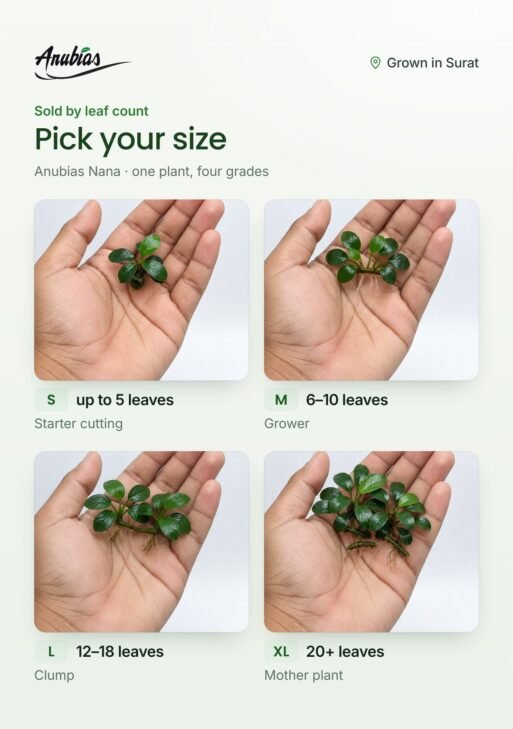
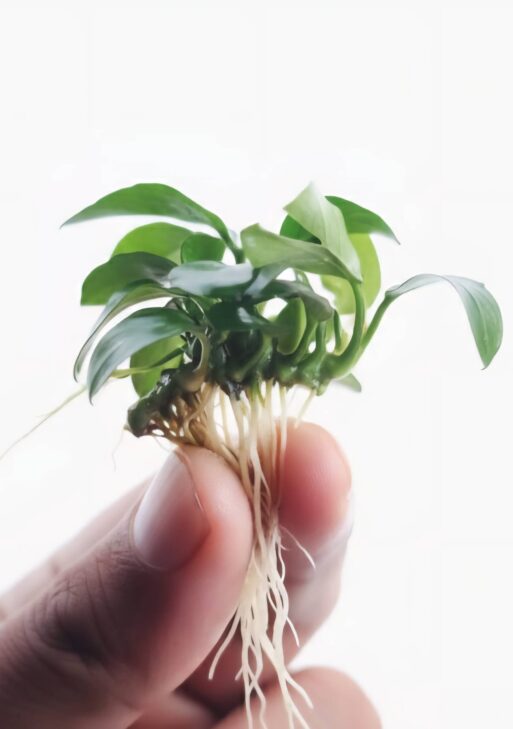
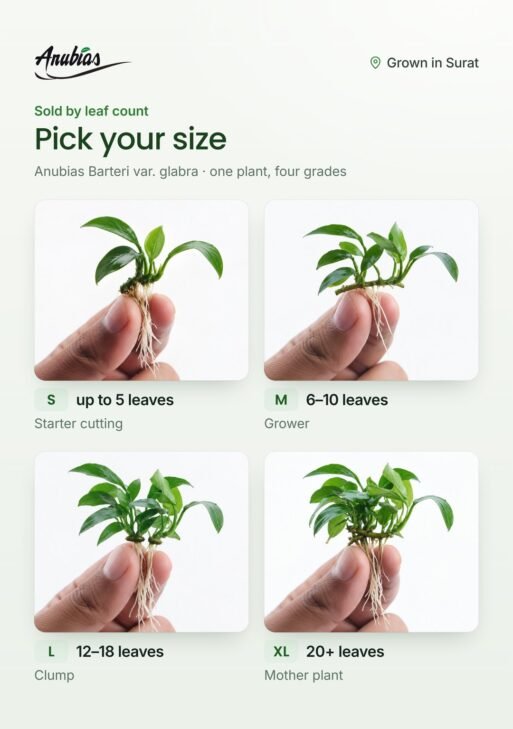
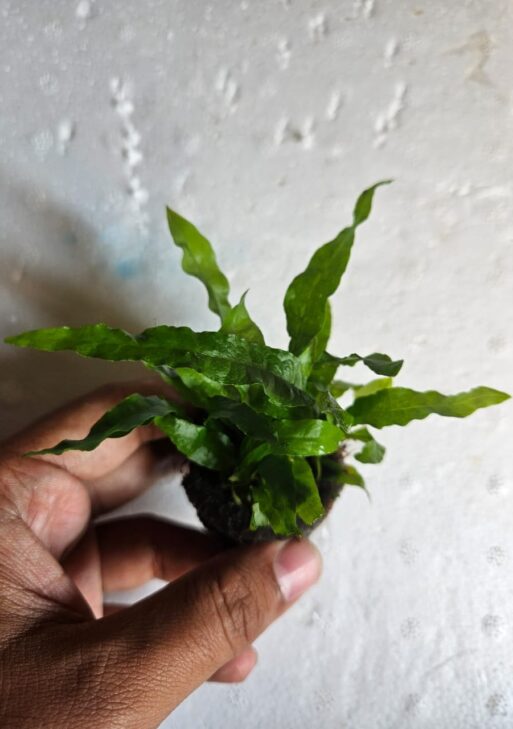
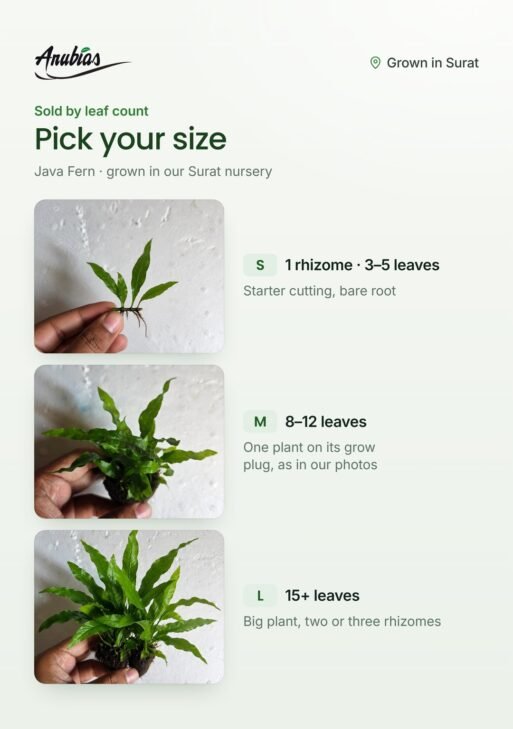
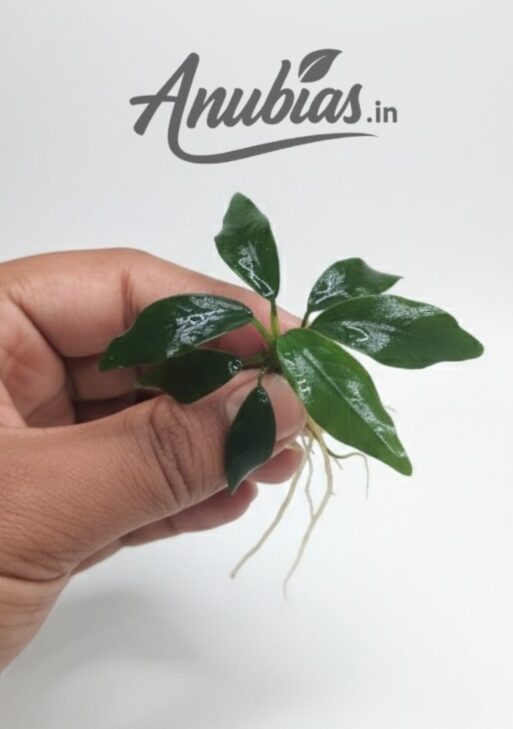
If your tank came with a simple LED, start with low-light plants and you will rarely fight algae: Anubias, Java ferns, Cryptocoryne, mosses and Bucephalandra. For a ready mix, the low-tech kit and our best beginner plants list are good places to start. For light needs of every plant we sell, see the aquarium plant care chart.
Frequently asked questions
How many hours a day should a planted aquarium light be on?
Six to eight hours a day on a timer. Start a new tank at 6 hours and only increase once plants are growing well and there is no algae.
Is a normal aquarium LED enough for live plants?
For low-light plants such as Anubias, Java fern, Cryptocoryne and mosses, usually yes. Carpet plants and red stem plants normally need a stronger planted-tank LED and CO2.
Can I leave the aquarium light on 24 hours?
No. Constant light stresses fish, does not make plants grow faster and almost always causes algae. Keep a regular dark period every night.
What colour light is best for aquarium plants?
A white LED around 6,500–7,000K works well for plant growth and looks natural. Extra red in the spectrum makes red plants look brighter but is optional.
Do Anubias need strong light?
No. Anubias grow in low light and do better in shade, because strong light lets algae settle on their slow-growing leaves.
How much light do carpet plants like Monte Carlo need?
As a rough guide, 40 or more lumens per litre at the substrate, with CO2 and regular fertiliser for a dense carpet. Under weaker light carpets grow slowly and thin out.