Description
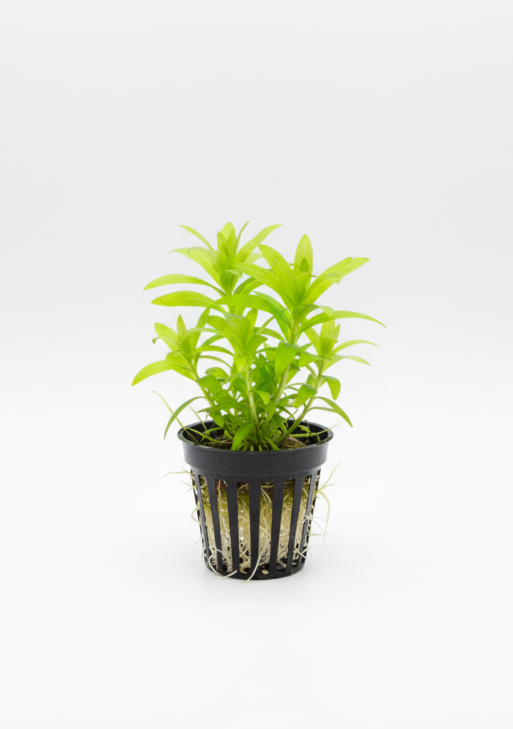
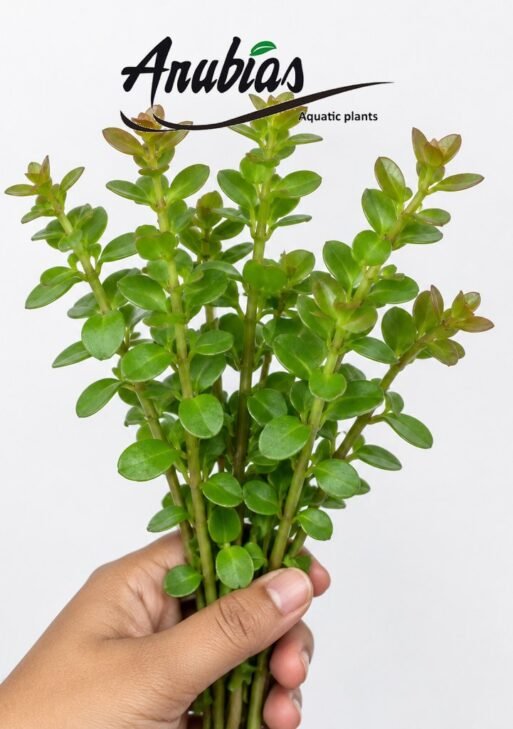
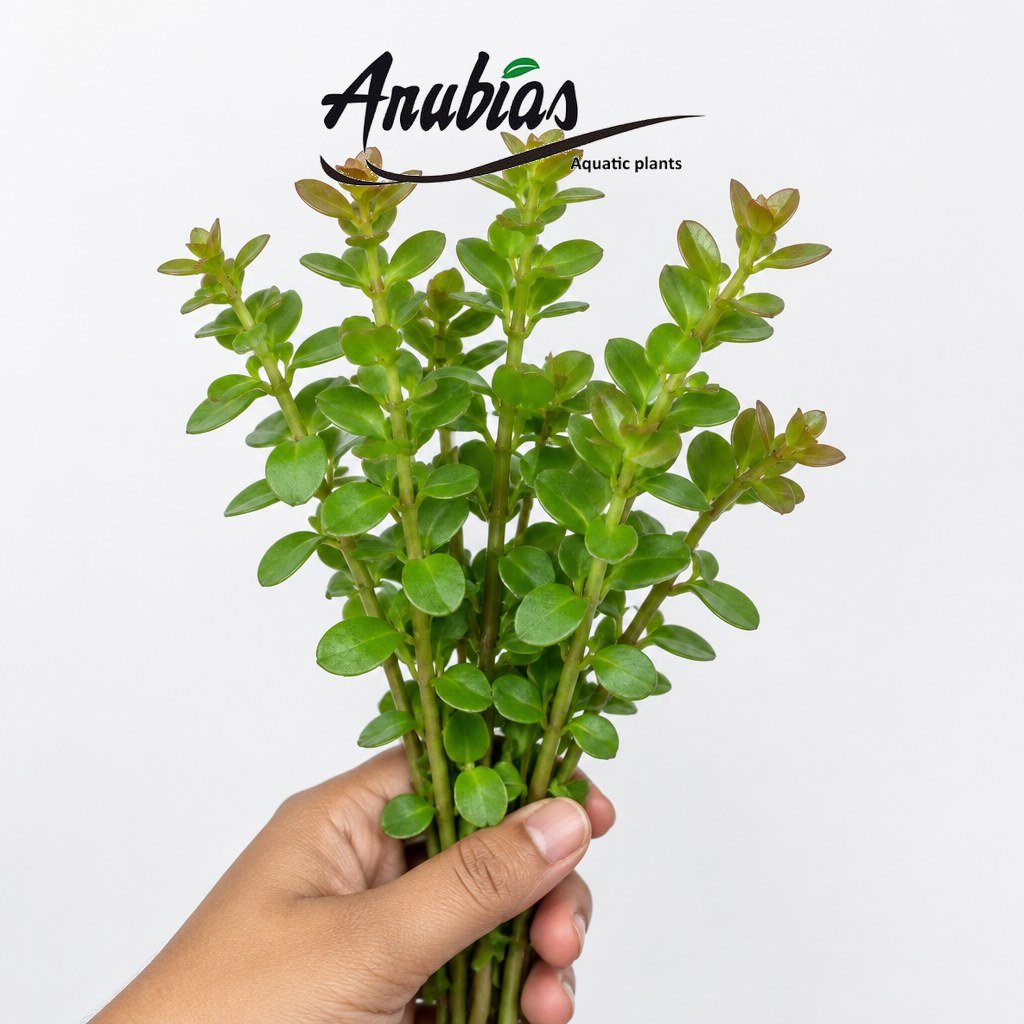
Bacopa caroliniana (lemon bacopa or giant bacopa) is a slow, sturdy stem plant with rounded, fleshy, almost succulent leaves arranged in pairs up a thick stem, and a faint lemon scent when a leaf is crushed. It comes from the marshes of the south-eastern United States and is one of the most forgiving stem plants: it grows without CO2, tolerates hard water, and stays tidy in upright groups. Bacopa caroliniana suits beginners who want a stem plant that will not take over, and aquascapers who need a neat, bright green column for the midground or background.
Bacopa caroliniana at a glance
| Scientific name | Bacopa caroliniana |
|---|---|
| Family | Plantaginaceae |
| Origin | South-eastern USA, in marshes and along slow streams |
| Difficulty | Easy |
| Light | Medium to high; tolerates moderate light with slower growth |
| CO2 | Optional; speeds growth |
| Temperature | 22–28 °C |
| pH | 6.0–8.0 |
| Growth rate | Slow to moderate |
| Height/size | 20–40 cm; leaves 1–2 cm long |
| Placement | Midground to background, planted in substrate |
| Propagation | Stem cuttings |
How to plant Bacopa caroliniana
Bacopa is a stem plant that roots from the nodes. The thick stems are easy to handle and hold their place well once planted.
- Remove any band from the bunch and rinse the stems.
- Strip the leaves from the bottom 3 cm of each stem.
- Plant the stems individually, 3–4 cm apart, pushing each 3–4 cm into a substrate at least 4 cm deep. Aquasoil is ideal; sand or gravel works with root tabs.
- Group five or more stems together for a proper column; single stems look sparse.
- Place the group in good light, in the midground of a large tank or the background of a small one.
Roots appear within a week and the stems stand firm after two. Bacopa can also be floated or grown emersed in a paludarium, where it flowers with small blue-violet blooms.
Bacopa caroliniana care: light, CO2, fertiliser and water
Light. Medium to high light for 7–8 hours a day gives compact stems with closely spaced leaves, and under very bright light the tips take on a coppery or pinkish tint. In moderate light it still grows, just taller and more open. Very low light leads to leggy stems and dropped lower leaves.
CO2. Optional. Bacopa caroliniana grows well in a low-tech tank, slowly and steadily. CO2 injection speeds it up and tightens the leaf spacing, but it is not needed for a healthy plant.
Fertiliser. A weekly dose of a complete liquid fertiliser with iron and trace elements keeps the leaves bright green. In inert substrate add a root tab near the group every couple of months. Stunted new growth usually means low potassium or iron.
Water. Unfussy. It grows in hard Indian tap water and across a wide pH range. It likes 22–28 °C and copes with summer peaks of 30 °C better than fine-leaved stems, though it slows down. During monsoon power cuts it is fine for a day or two. Weekly 25–30% water changes are enough.
Growth, trimming and propagation
Bacopa caroliniana is slower than most stem plants, adding a few centimetres a month in a low-tech tank and more with CO2. This is a real advantage: it stays where you put it and does not need weekly trimming.
When stems reach the surface, cut them 5–10 cm above the substrate. The stub branches from the nodes below the cut and the group thickens. Replant the cut tops beside the parent stems to make the column denser. Remove any bare, woody lower stems after a few trims and replace them with fresh tops.
Propagation is by cuttings: every top with two or more nodes roots within a week when pushed into the substrate. Side shoots can also be snapped off and planted.
Where to use it in an aquascape
Bacopa caroliniana is a midground-to-background plant for tanks of 1.5 ft (around 40 litres) and up. In a 2 ft tank (60–90 litres) a group of six to eight stems in the rear corner or behind the hardscape makes a bright, tidy column. In 3–4 ft tanks (120–250 litres) use it as a midground group in front of taller, finer stem plants, where its round leaves give a clear change of texture.
It pairs well with Anubias nana and Java fern on wood in front, Cryptocoryne at its base and a carpeting plant in the foreground. Its upright habit suits Dutch-style streets and simple low-tech community layouts alike.
It is safe with shrimp, snails and all community fish. Goldfish may nibble the fleshy leaves, and large cichlids can uproot a freshly planted group.
Common problems and fixes
- Lower leaves dropping. Cause: light not reaching the base of a dense group, or too little light overall. Fix: plant more sparsely, raise the light, replant the tops.
- Leggy stems with wide leaf spacing. Cause: low light. Fix: increase light intensity or move the group higher.
- Stunted, twisted new leaves. Cause: potassium or calcium shortage. Fix: dose potassium; check GH if using very soft water.
- Melting after arrival. Imported stems may lose some leaves while adjusting. Fix: leave the stems in place; new growth comes from the nodes.
- Green spot algae on old leaves. Cause: slow old leaves under high light. Fix: trim and replant the tops, shorten the photoperiod.
- Stems rotting at the base. Cause: leaves buried under substrate. Fix: strip the bottom leaves before planting.
Note: this is Bacopa caroliniana, an aquarium plant. It is not Bacopa monnieri, the herb known as Brahmi. It is sold as a live aquarium plant only and is not for eating.
What you receive
One healthy Bacopa caroliniana bunch of the size you select (Small or Standard), similar to the photo. Each bunch is checked before packing, packed moist and shipped across India from Surat. ₹99 shipping, free on orders of ₹999 or more.
Live-arrival guarantee: record one continuous unboxing video within 4 hours of delivery and we will refund or replace a plant that arrived damaged.
FAQ
Does Bacopa caroliniana need CO2?
No. It grows well in low-tech tanks without CO2. CO2 speeds growth and tightens the leaf spacing, but it is optional.
Is Bacopa caroliniana good for beginners?
Yes. It is one of the easiest stem plants: slow, sturdy, tolerant of hard water and forgiving of missed fertiliser doses.
How fast does Bacopa caroliniana grow?
Slowly to moderately, a few centimetres a month in a low-tech tank. It needs far less trimming than Rotala or Ludwigia.
Can Bacopa caroliniana grow in sand or gravel?
Yes. Push the stems 3–4 cm into a layer at least 4 cm deep and add a root tab every couple of months.
Is Bacopa caroliniana the same as Brahmi?
No. Brahmi is Bacopa monnieri, a different species. Bacopa caroliniana is sold here as an aquarium plant only, not for consumption.
Why does my bacopa smell of lemon?
The crushed leaves of Bacopa caroliniana release a mild lemon scent. It is harmless and is how the plant got the name lemon bacopa.
Not sure what fits your tank? Plan it with our free AI tank planner.