
Description
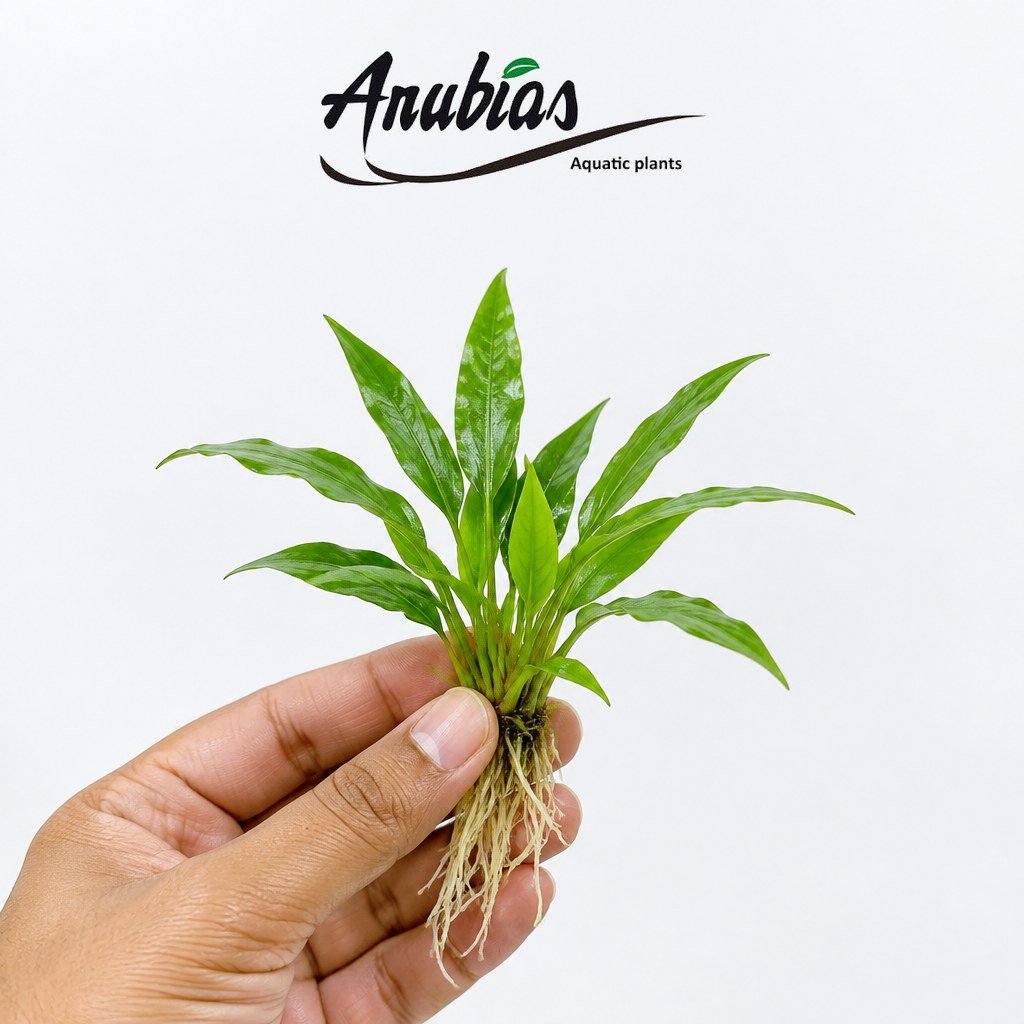
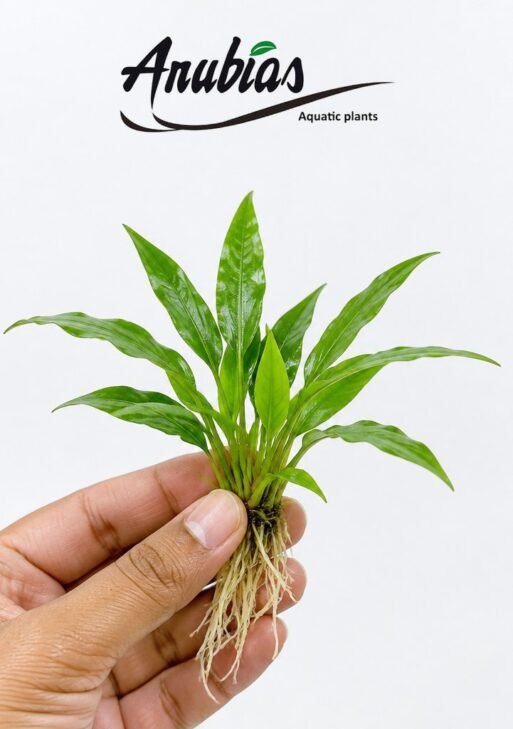
Cryptocoryne lucens is a compact, narrow-leaved crypt from Sri Lanka that sits neatly between the tiny Cryptocoryne parva and the mid-sized wendtii types. It grows a loose rosette of slender olive-green leaves around 10–15 cm tall, spreads steadily by runners and tolerates hard water, low light and no CO2. For a low-maintenance foreground-to-midground plant that looks natural rather than manicured, Cryptocoryne lucens is one of the easiest choices available to Indian aquarists.
Cryptocoryne lucens at a glance
| Scientific name | Cryptocoryne lucens (often sold as Cryptocoryne × willisii ‘Lucens’) |
|---|---|
| Family | Araceae |
| Origin | Sri Lanka |
| Difficulty | Easy |
| Light | Low to medium |
| CO2 | Optional |
| Temperature | 20–28 °C |
| pH | 6.0–8.0 |
| Growth rate | Slow to moderate |
| Height/size | 8–15 cm tall, leaves about 1 cm wide |
| Placement | Foreground in large tanks, midground in small tanks |
| Propagation | Runners |
How to plant Cryptocoryne lucens
- Rinse the portion and remove any leaves that are already soft or transparent. Trim the roots to 2–3 cm.
- Split the clump into single plants or small groups. Each needs its own crown and a few roots.
- Hold the plant with tweezers at the base and push it into the substrate until the roots are covered. Keep the crown (where the leaves emerge) level with the substrate surface, not under it.
- Space plants 4–5 cm apart. The gaps close within a few months as runners spread.
- Give it a root tab or nutrient-rich aquasoil. Crypts are root feeders and respond strongly to substrate nutrition.
- Do not move it again. Replanting resets the plant and often triggers melt.
Cryptocoryne lucens care: light, CO2, fertiliser and water
Light. This is a genuinely low-light plant. It grows under a basic LED or even a single tube on a 2 ft tank. Under medium light the rosettes stay tighter and leaves take on a slightly bronze tint; under strong light without CO2 it attracts algae, so keep the photoperiod to 6–8 hours.
CO2. Not needed. CO2 injection produces faster, denser growth but Cryptocoryne lucens is one of the crypts that looks perfectly healthy without it.
Fertiliser. Root tabs every three months in inert substrate, or aquasoil. A weekly dose of liquid all-in-one fertiliser covers trace elements. Potassium shortage shows as small holes in older leaves; iron shortage shows as pale new growth.
Water. Hard, alkaline tap water common in Indian cities suits it fine; it is native to streams with moderate hardness. It also does well in soft water. Stability matters more than any specific number: do regular 25% water changes rather than occasional large ones.
Indian conditions. It copes with summer temperatures up to about 30–32 °C if the tank has surface agitation. In a hot room, floating plants or a small fan over the water surface can bring the temperature down by two or three degrees. Short monsoon power cuts do not affect it.
Growth, trimming and propagation
Growth is slow for the first month while roots establish, then picks up. A settled plant pushes out a new leaf every one to two weeks and sends out runners under the substrate, with daughter plants popping up 3–6 cm from the parent.
No regular trimming is required. Pinch off yellowed or damaged outer leaves at the base to keep the rosette clean. If the group becomes too dense, lift daughter plants with tweezers and replant them elsewhere; the parent is not harmed as long as you do not pull up its main root mass.
To propagate deliberately, wait until a daughter plant has four or five leaves, then cut the runner between it and the parent and move it. Small plantlets moved too early often melt.
Where to use it in an aquascape
In a 2 ft (60–80 litre) tank, Cryptocoryne lucens works as a midground plant placed in front of driftwood or between stones. In a 3–4 ft (150–300 litre) tank it is low enough to serve as a textured foreground, especially in nature-style and jungle layouts where a perfectly flat carpet would look out of place.
It pairs well with Anubias nana and Java fern tied to wood, with Cryptocoryne parva in front of it, and with larger species from our Cryptocoryne range behind. For a fuller background add a few bunches of stem plants.
It is safe with shrimp and all community fish. Its roots hold the substrate well enough to survive moderate diggers such as Corydoras and kuhli loaches; keep it away from goldfish and large cichlids.
Common problems and fixes
- Melt in the first two weeks. Crypts shed their old leaves when moved to new water. Leave the roots in, trim away dissolved leaves and wait; fresh leaves grown in your water are far more stable.
- Melt in an established tank. Caused by a sudden change in temperature, hardness or nutrient levels, or by a large uprooting. Restore stable conditions. The rhizome survives even when every leaf is lost.
- Holes in older leaves. Potassium deficiency. Dose a potassium supplement or an all-in-one fertiliser with higher potassium.
- Pale new leaves. Iron or micronutrient shortage. Add a chelated iron supplement.
- Brown diatoms or green spot algae on leaves. Light is too strong for the slow growth rate. Shorten the photoperiod and add otocinclus, nerite snails or Amano shrimp.
- Leaves growing tall and thin. Light is too weak. Increase intensity slightly or move the plant closer to the light.
What you receive
You receive one healthy portion of Cryptocoryne lucens in the size you select (Small or Standard), similar to the one shown in the photo. Each plant is checked before packing, wrapped moist and shipped across India from Surat. Live-arrival guarantee: record one continuous unboxing video within 4 hours of delivery and we refund or replace any plant that arrives damaged.
FAQ
Does Cryptocoryne lucens need CO2?
No. It grows well without CO2 in low to medium light. CO2 makes it grow faster and denser but is not necessary for a healthy plant.
Is Cryptocoryne lucens good for beginners?
Yes. It is among the easiest crypts: it tolerates hard tap water, basic lighting and skipped fertiliser doses. The only thing to understand is the initial melt, which it recovers from.
Can Cryptocoryne lucens grow in gravel or sand?
Yes. Push a root tab into the gravel or sand under each plant and replace it every three months. In aquasoil no tabs are needed for the first year.
How fast does Cryptocoryne lucens grow?
Slow to moderate. After a month of settling it produces a new leaf every one to two weeks and spreads by runners, filling a 20 cm patch in roughly six months.
Cryptocoryne lucens vs Cryptocoryne parva: which should I choose?
Parva is smaller (3–8 cm) and much slower, suited to nano foregrounds. Lucens is taller (8–15 cm), faster and better for midground use in small tanks or foreground use in larger ones.
Why are the leaves of my Cryptocoryne lucens turning clear?
That is crypt melt. It happens after shipping, replanting or a sudden parameter change. Keep the roots in place, remove the clear leaves and keep conditions stable; new growth appears within a few weeks.
Not sure what fits your tank? Plan it with our free AI tank planner.












There are no reviews yet.