

Description
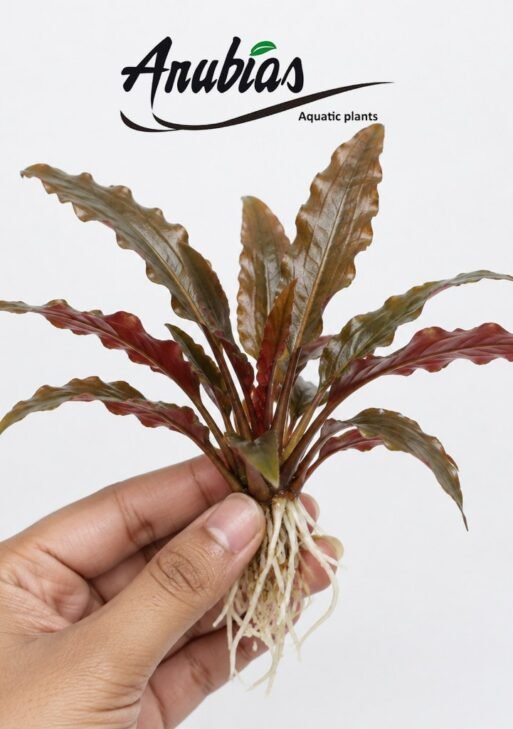
Cryptocoryne nurii is a collector’s crypt from the blackwater streams of Peninsular Malaysia, prized for leaves that are mottled, puckered and coloured in shades of bronze, olive and deep red rather than plain green. It stays compact at around 10–15 cm, grows slowly and rewards stable, slightly soft water with some of the most striking foliage in the genus. Cryptocoryne nurii suits aquarists who already keep crypts successfully and want a midground centrepiece with real character.
Cryptocoryne nurii at a glance
| Scientific name | Cryptocoryne nurii |
|---|---|
| Family | Araceae |
| Origin | Peninsular Malaysia (Johor, Pahang), blackwater forest streams |
| Difficulty | Moderate |
| Light | Low to medium |
| CO2 | Optional but recommended for best colour |
| Temperature | 22–28 °C |
| pH | 5.5–7.0 (tolerates up to 7.5 once settled) |
| Growth rate | Slow |
| Height/size | 8–15 cm tall, leaves 2–3 cm wide |
| Placement | Midground, nano centrepiece |
| Propagation | Runners |
How to plant Cryptocoryne nurii
- Handle the plant gently; the puckered leaves bruise more easily than those of common crypts. Remove any leaf that is already soft.
- Trim roots to 2–3 cm and plant singly, not in clumps, so each rosette has room to develop its full shape.
- Bury the roots fully in a nutrient-rich substrate and keep the crown exposed at the surface.
- Choose its spot carefully: a sheltered position with gentle flow, away from the filter outlet, in the midground where it can be seen.
- Plant it once and leave it. Cryptocoryne nurii resents disturbance more than most crypts.
Cryptocoryne nurii care: light, CO2, fertiliser and water
Light. Medium light brings out the red and bronze tones and the characteristic bullate (bubbled) leaf texture. Under low light it survives but leaves flatten and turn greener. Avoid very strong light without CO2; the slow growth cannot keep pace and algae settle on the leaves.
CO2. Optional. In nature the plant grows in stream water rich in dissolved CO2 and humic substances. Pressurised CO2 at modest levels produces fuller, better-coloured rosettes. Without CO2 it still grows, just more slowly.
Fertiliser. Rich substrate is the priority: aquasoil, or root tabs under each plant every three months. A weekly liquid fertiliser with iron supports the red colouring. Overdosing nitrogen pushes greener, larger leaves at the expense of colour.
Water. This is the one area where Cryptocoryne nurii is more particular than everyday crypts. It prefers soft, slightly acidic water (pH 5.5–7.0). In hard Indian tap water it can still be kept, but blend in some RO water if you can, add Indian almond (catappa) leaves or a small amount of peat in the filter, and avoid sudden swings. Once established in a stable tank it tolerates a pH of 7.5.
Indian conditions. Keep summer temperatures below about 30 °C; a fan over the surface helps. Blackwater species are sensitive to oxygen drops in warm water, so keep good surface movement, especially during monsoon power cuts.
Growth, trimming and propagation
Expect a new leaf every two to four weeks once settled; the first month often shows no visible growth. Mature plants gradually develop more pronounced leaf texture and colour.
Trimming is limited to removing old leaves at the base. Never cut the rosette back as a whole.
Runners appear slowly, usually after six months or more in good conditions. Leave daughter plants attached until they have at least four leaves, then separate the runner and move them. Many keepers prefer to let the group build into a natural clump rather than splitting it.
Where to use it in an aquascape
Cryptocoryne nurii is a focal plant, not a filler. Place one or three specimens in the midground of a 1.5–2 ft (40–80 litre) nano or nature-style tank where their colour contrasts with green neighbours, or use a small group as an accent in a 3 ft (150 litre) blackwater layout with driftwood, leaf litter and dim, warm lighting.
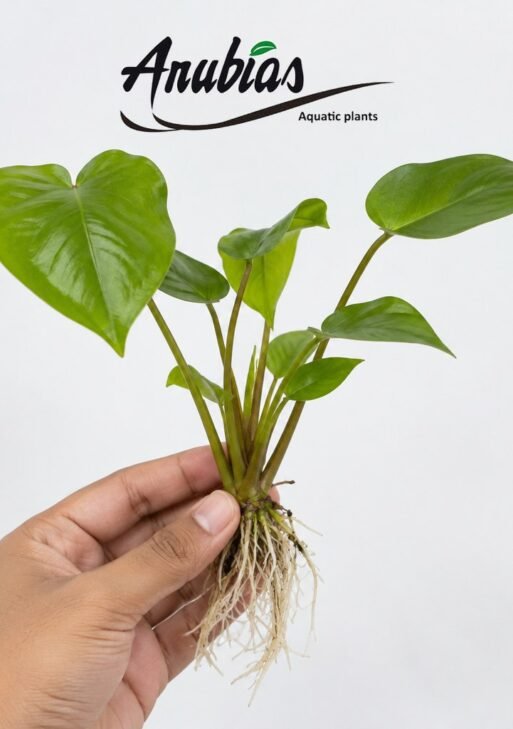
Companions should share its taste for stable, slightly soft water: Anubias nana and Java fern on wood, Cryptocoryne parva in front, and green crypts from our Cryptocoryne collection around it to make the colour stand out.
It is ideal for shrimp tanks (Caridina species especially appreciate the same soft water) and for small blackwater fish: chili rasboras, harlequin rasboras, boraras, pencilfish, bettas and small tetras. Avoid substrate diggers.
Common problems and fixes
- Complete melt after planting. Common in this species, especially when moving from emersed to submerged growth. Leave the roots in place; new submerged leaves emerge from the crown within three to six weeks.
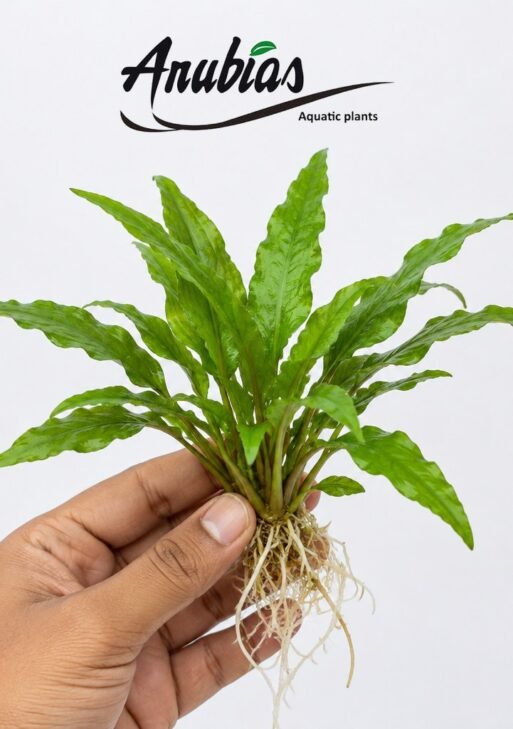
- Leaves plain green and flat. Light is too low, or nitrogen is high. Raise light to medium, keep nitrates moderate and ensure iron is available.
- Ongoing melt in hard water. The plant is struggling with hardness or pH drift. Blend RO water, add catappa leaves and keep parameters steady.
- Algae on the leaf surface. Reduce the photoperiod to 6–7 hours and add Amano shrimp or otocinclus. Avoid scrubbing textured leaves; they damage easily.
- Small holes or ragged edges. Potassium deficiency, or occasionally grazing by snails on a weakened leaf. Dose potassium and remove badly damaged leaves.
What you receive
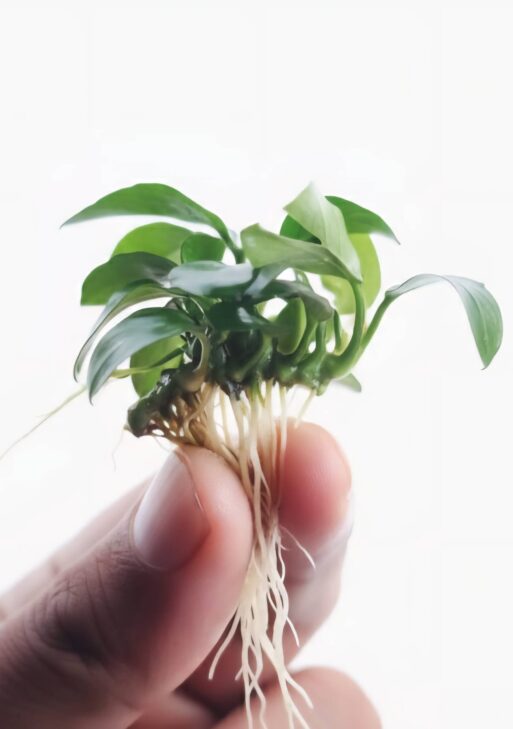
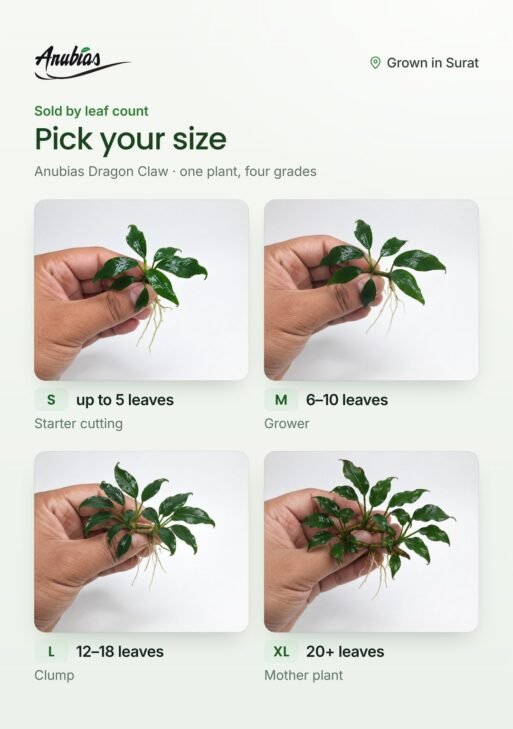
You receive one healthy Cryptocoryne nurii plant, similar to the one in the photo. It is checked before packing, wrapped moist and shipped across India from Surat. Live-arrival guarantee: record one continuous unboxing video within 4 hours of delivery and we refund or replace any plant that arrives damaged.
FAQ
Does Cryptocoryne nurii need CO2?
Not strictly. It grows without CO2 in stable, soft water, but CO2 injection gives faster growth and stronger red and bronze colour.
Is Cryptocoryne nurii good for beginners?
It is better as a second or third crypt. Beginners should start with Cryptocoryne lucens or wendtii, then try nurii once their tank is stable, because it prefers soft water and dislikes disturbance.
Can Cryptocoryne nurii grow in hard water?
It can be kept in moderately hard water once settled, but it does best at pH 5.5–7.0. Blending in RO water and adding catappa leaves helps in hard-water cities.
How fast does Cryptocoryne nurii grow?
Slowly. One new leaf every two to four weeks is typical, and runners appear only after several months.
Why does Cryptocoryne nurii have bumpy, mottled leaves?
The bullate texture and red-brown mottling are natural features of the species and become stronger under medium light with good iron supply. Flat green leaves usually mean low light.
Cryptocoryne nurii vs Cryptocoryne wendtii ‘Brown’: which is better for colour?
Wendtii ‘Brown’ is easier and faster, with uniform brown leaves. Nurii is slower and more demanding but offers mottled, textured foliage that wendtii cannot match.
Not sure what fits your tank? Plan it with our free AI tank planner.


There are no reviews yet.