
Most new-plant problems come from planting mistakes: buried rhizomes, crowns pushed too deep, or carpets that float away. The right method depends on the plant type.
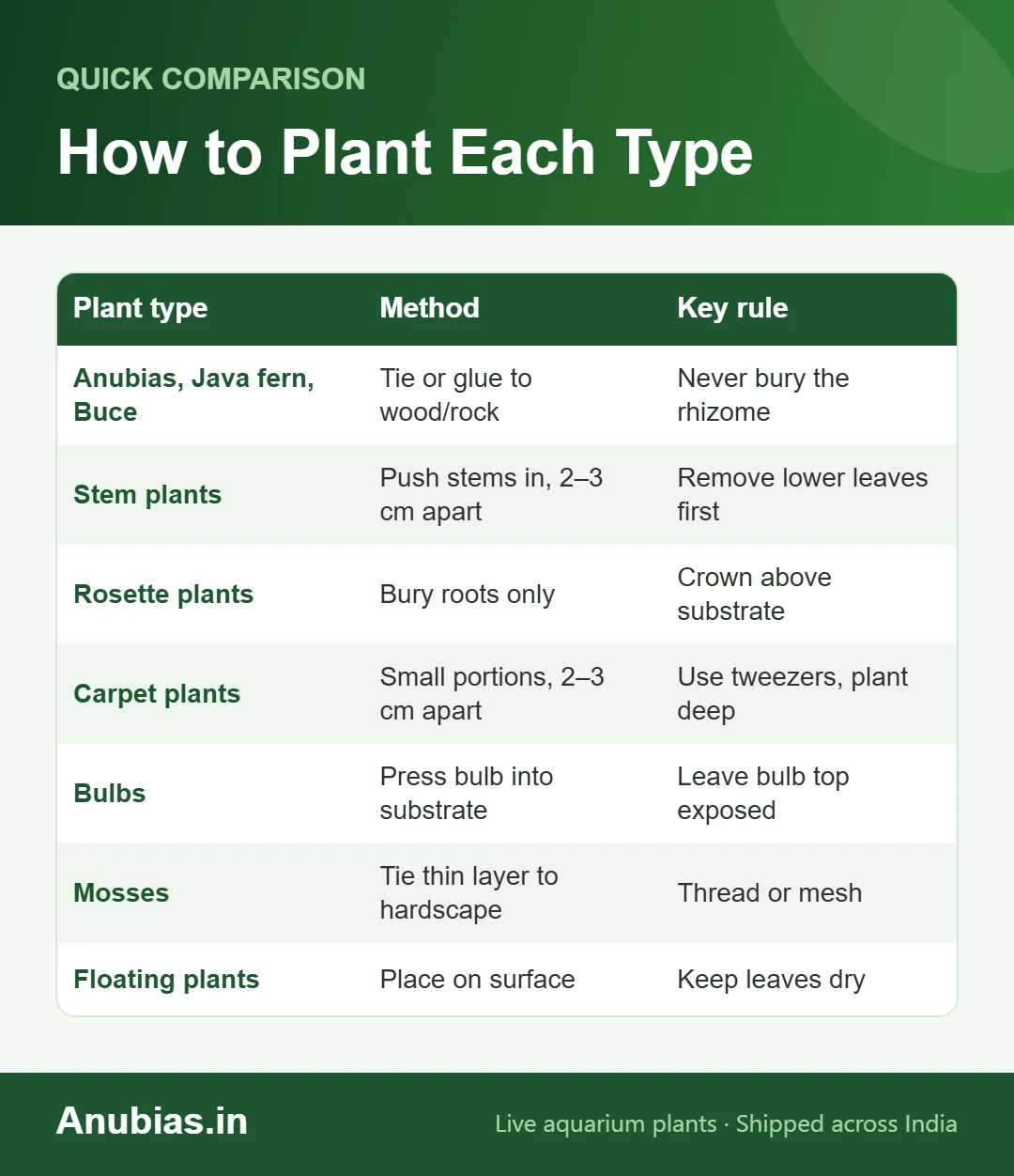
Quick answer: To plant aquarium plants, first remove pots, rock wool and any damaged leaves, and rinse the plants in dechlorinated water. Tie or glue Anubias, Java fern and Bucephalandra to wood or rock and never bury their rhizome. Push stem plants 2–3 cm apart into the substrate after removing the lowest leaves, bury only the roots of rosette plants such as Amazon swords, Crypts and Vallisneria with the crown above the substrate, plant carpets in small portions with tweezers, and leave the top of bulbs exposed.
Before you plant
- Unpack quickly and float bags or keep plants in dechlorinated water while you prepare.
- Remove pots and rock wool gently; it traps debris and can rot roots.
- Trim damaged leaves and very long roots.
- Check for pests: see how to remove snails from new plants.
Epiphytes: Anubias, Java fern, Bucephalandra
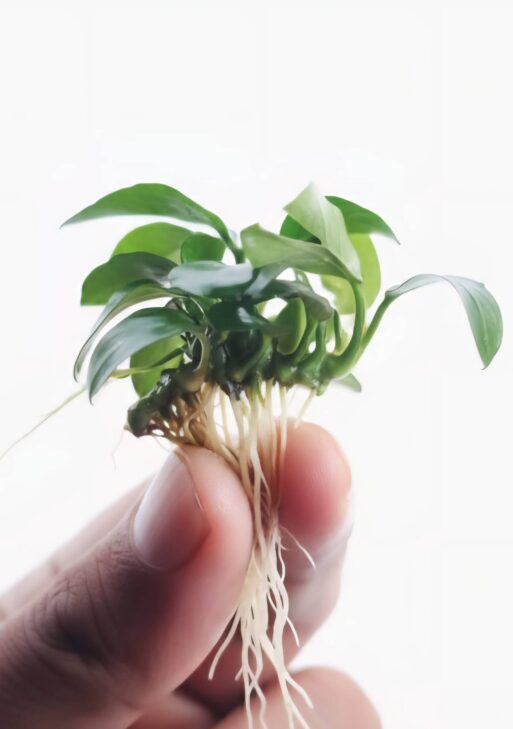
Tie with cotton thread or fishing line, or glue with aquarium-safe gel glue on the rhizome’s underside. The roots grip within weeks. How to attach Anubias to driftwood or rock.
Stem plants
Strip the lowest leaves, then push each stem 3–5 cm into the substrate with tweezers, 2–3 cm apart, so light reaches the lower leaves.
Rosette plants
Bury only the roots. Keep the crown, where leaves meet roots, just above the substrate. Add root tabs nearby for heavy root feeders like Amazon swords and Crypts.
Carpet plants
Split into small portions and plant them deep with tweezers, 2–3 cm apart. Small, deep portions are less likely to float up. Foreground plant guide.
Bulbs
Press the bulb gently into the substrate with the top exposed. Red tiger lotus guide.
Mosses
Spread a thin layer over wood or rock and tie it down with thread or sandwich it in mesh. How to attach moss.
Gravel vs sand
Rosette and carpet plants root best in fine gravel, sand or nutrient substrate. In coarse gravel, stems can float up; in plain sand, add root tabs because it holds few nutrients. Epiphytes and floating plants need no substrate at all: plants without substrate.
A planting order that saves rework
The sequence you plant in matters almost as much as the technique. Doing it out of order usually means uprooting something you have already placed.
- Hardscape first. Position all wood and rock before any plant goes in, since moving a stone later ploughs through the substrate.
- Attach epiphytes and mosses out of the tank. Tying Anubias or moss to a branch on the table is far easier than doing it with your arms in water.
- Fill to about a third. Damp substrate holds stems much better than dry substrate, and you can still reach everything comfortably.
- Carpet plants next. These are the fiddliest and need the clearest access, so do them before the tank fills up with taller plants.
- Rosette and midground plants. Set these once the foreground is fixed, so you can judge the spacing.
- Stem plants last. They are the quickest to place and the easiest to adjust.
- Fill slowly onto a plate or a bag. A direct pour will excavate everything you just planted.
The first two weeks after planting
New plantings are at their most fragile before roots take hold, and the usual instinct is to intervene too much.
Keep the photoperiod short, around six hours, for the first fortnight. Freshly planted tanks have little plant mass to use the light, and the spare energy goes straight into algae.
Change water often if you used fresh aqua soil, as it leaches ammonia in the first weeks. Around 30 per cent every day or two is normal practice.
Hold off fertiliser dosing for roughly the first week, then start at a low dose. Expect melting on Bucephalandra, Cryptocoryne and carpet plants as they convert from emersed to submerged growth, and trim the dead leaves out rather than leaving them to rot.
If you are planting in an Indian summer with the tank sitting at 30°C or more, expect slower rooting and more melt than the same setup in winter. Extra surface agitation helps more than extra light.
Plants in this guide
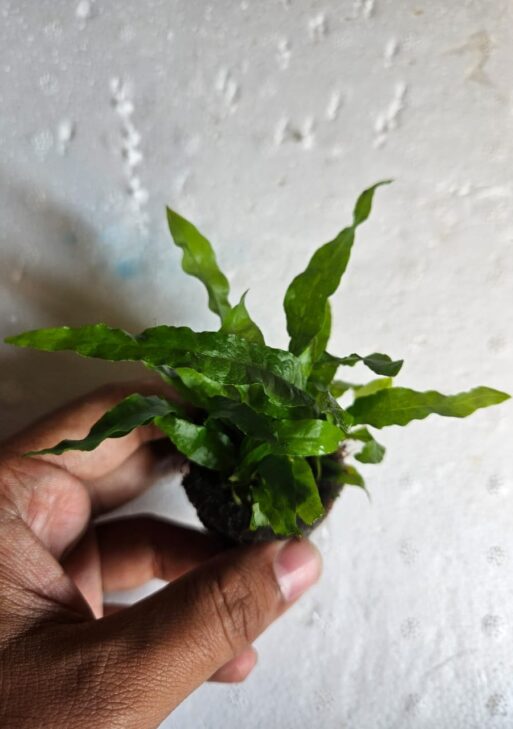
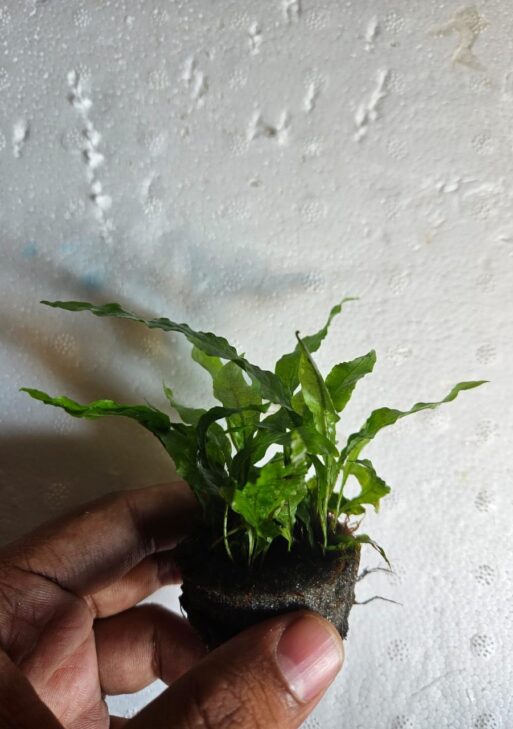

Want a ready-made set? See our aquarium plant starter kits for nano, betta, 2 ft and 3 ft tanks.
Frequently asked questions
Should I remove rock wool before planting?
Yes. Remove as much as you can without tearing the roots; it traps debris and can cause rot.
How deep should aquarium plants be planted?
Only the roots should be buried. Keep crowns, rhizomes and bulb tops above the substrate.
Why do my plants keep floating up?
They are planted too shallow or in coarse gravel. Plant deeper with tweezers, use smaller portions, or weigh stems with a plant weight until roots form.
Shop the plants in this guide: Red Tiger Lotus / Red Water Lily.
Shop live plants on Anubias.in.
हिंदी में पढ़ें: एक्वेरियम में पौधे कैसे लगाएं.
Should I fill the tank before or after planting?
Plant with the tank filled roughly a third of the way. Damp substrate grips stems and roots far better than dry substrate, and you avoid the plants drying out while you work. Once planting is done, fill the rest slowly by pouring onto a plate or a plastic bag so the flow does not dig everything up.
Can I plant in an aquarium that already has fish?
Yes, though you should work in sections rather than replanting everything at once. Lower the water level a little, plant one area at a time and siphon out the cloud of debris afterwards. Keep the filter running so the disturbed particles are cleared, and skip feeding that day to limit the load.
How long should I wait before trimming newly planted stems?
Give them three to four weeks so the roots can establish first. Trimming too early pulls stems out of the substrate and sets back growth that has barely started. Once you see clear new growth at the top and the stems resist a gentle tug, they are ready for their first cut.
Comparing species? The aquarium plant care chart lists light, CO2, growth rate and price for all 55 plants we stock.