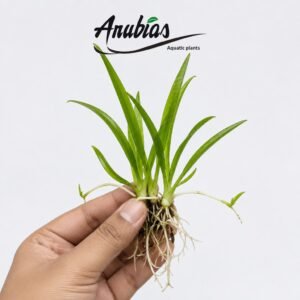


Dwarf Sagittaria (Sagittaria subulata) is a grass-like carpeting plant that gets far less attention than Dwarf Hairgrass or Monte Carlo, despite being easier to grow than both. If your previous carpet attempts melted away under low-tech conditions, this is usually the plant that finally works. This guide covers planting technique, realistic light and CO2 expectations, and how to keep it low instead of letting it grow tall and grassy.
How to grow a Dwarf Sagittaria carpet
Quick Overview
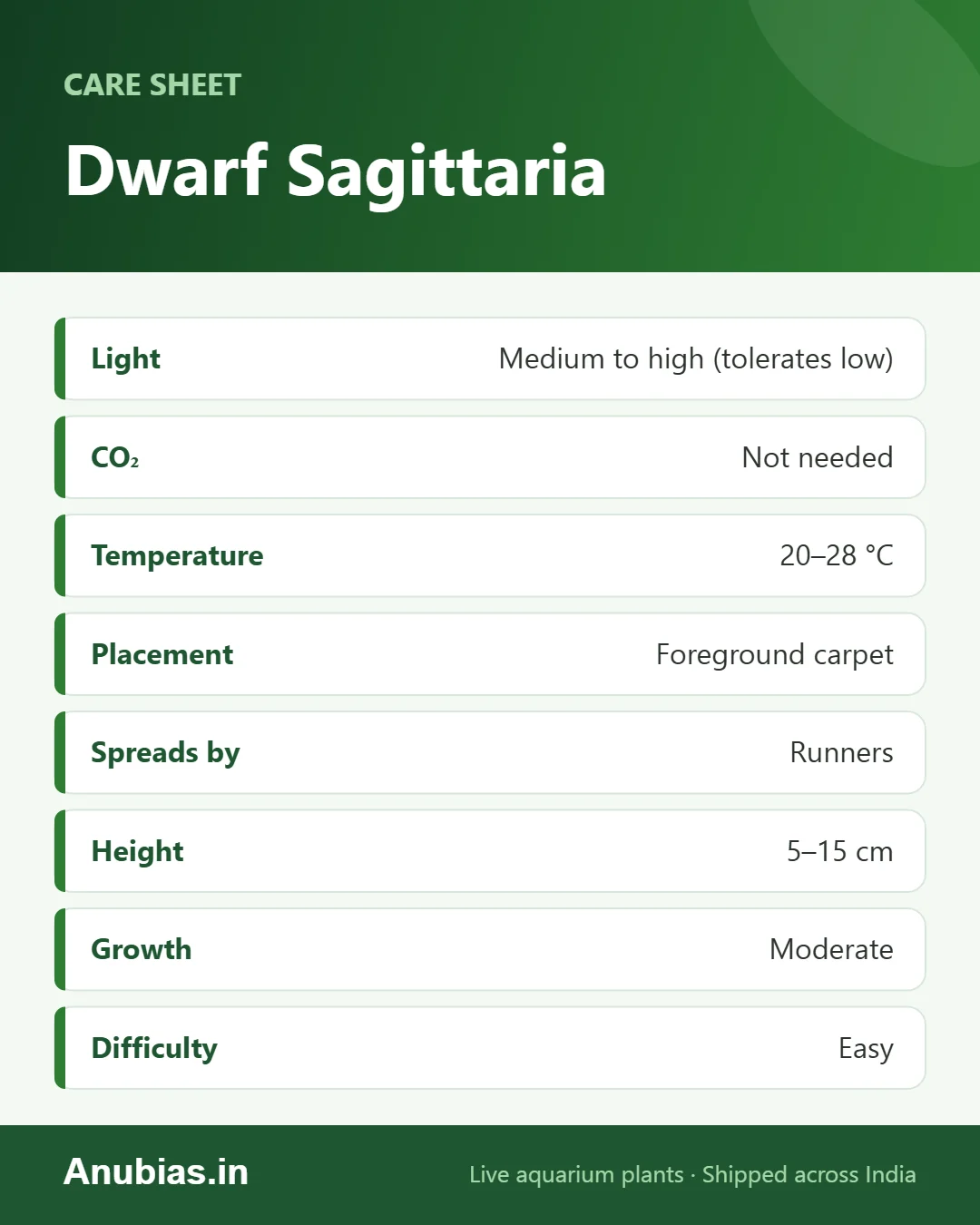
- Difficulty: Easy
- Placement: Foreground carpet
- Light: Medium to high for a low, dense carpet; tolerates lower light but grows taller
- CO2: Helps density, not required
- Water parameters: Very adaptable; pH 6.0–7.5
Planting Technique
Dwarf Sagittaria arrives as a clump of thin, grass-like blades joined at a short rhizome with fine roots. Separate it into small portions of two or three blades each, and use tweezers to bury the root and rhizome section a few millimetres into the substrate, leaving the blades free above the surface. Space portions roughly 3–5 cm apart — runners will fill the gaps as the plant establishes.
Light and Growth Habit
Under medium-to-high light, Sagittaria subulata stays relatively short and spreads sideways, forming a genuine low carpet. Under lower light it still grows and spreads, but individual blades stretch taller and thinner, giving more of a “seagrass meadow” look than a tight lawn. Neither outcome is unhealthy — it’s simply a trade-off you can use deliberately depending on the look you want.
CO2 and Carpet Density
CO2 injection is not required for this plant to survive or spread, which is what makes it a popular low-tech alternative to Dwarf Hairgrass. Adding CO2 mainly tightens the carpet and keeps blades shorter and denser rather than unlocking growth that wouldn’t otherwise happen — useful if you want a manicured look without committing to a pressurised CO2 system.
Comparing It to Dwarf Hairgrass
Both plants spread via runners and form foreground carpets, but Sagittaria subulata is the more forgiving of the two. Dwarf Hairgrass tends to thin out or die back under inconsistent light or nutrients, while Sagittaria is more tolerant of gaps in routine — a better starting point if you’re carpeting a tank for the first time, with Dwarf Hairgrass as a next step once you’ve got the fundamentals down.
Trimming and Maintenance
Trim any blades that grow noticeably taller than the rest of the carpet with fine scissors, cutting just above the substrate. Regular light trimming encourages the plant to spread sideways via runners rather than putting energy into height, which speeds up carpet formation.
Common Problems and Fixes
The most common issue is patchy, uneven growth, usually caused by shading from taller plants or uneven light distribution across the tank. Rotating or thinning nearby plants and making sure light reaches the substrate evenly will even out growth within a few weeks. Yellowing older blades are often a sign the substrate needs root tab feeding.
More carpet plant guides:
- Monte Carlo vs Dwarf Hairgrass
- Best Foreground Aquarium Plants (With and Without CO2)
- Easiest Carpet Plant Without CO2
- Staurogyne Repens Yellow Leaves or Not Spreading? Causes and Fixes
- Dwarf Hairgrass Turning Brown or Yellow? Causes and Fixes
- Monte Carlo Melting or Not Carpeting? Causes and Fixes (With and Without CO2)
- Hydrocotyle Tripartita Japan Care Guide
- Staurogyne Repens Care Guide
Frequently Asked Questions
Will Dwarf Sagittaria carpet without CO2?
Yes. Growth is slower and blades grow a little taller without CO2, but medium-to-high light and regular root feeding are enough to keep a low, dense carpet in a non-CO2 tank.
How is it different from Dwarf Hairgrass?
Sagittaria subulata is generally more forgiving and tolerant of lower light, with broader, grass-like blades, while Dwarf Hairgrass gives a finer, shorter lawn but is fussier about light and CO2.
How do I plant it so it doesn’t float away?
Separate the clump into small portions with a few blades and roots each, then use tweezers to bury the root/rhizome section a few millimetres into the substrate, spacing portions a few centimetres apart.
When will my pre-order ship?
This plant is imported to order; typical arrival is around 15 days from purchase, and we’ll email dispatch and tracking details.
Want an easier carpet for your next tank? Dwarf Sagittaria is available to pre-order here.
Grass-like plants compared: Vallisneria vs Dwarf Sagittaria.
Grown in Surat (pre-order plants imported to order) · live-arrival guarantee with a 4-hour unboxing video · ₹99 shipping, free from ₹999