
Description
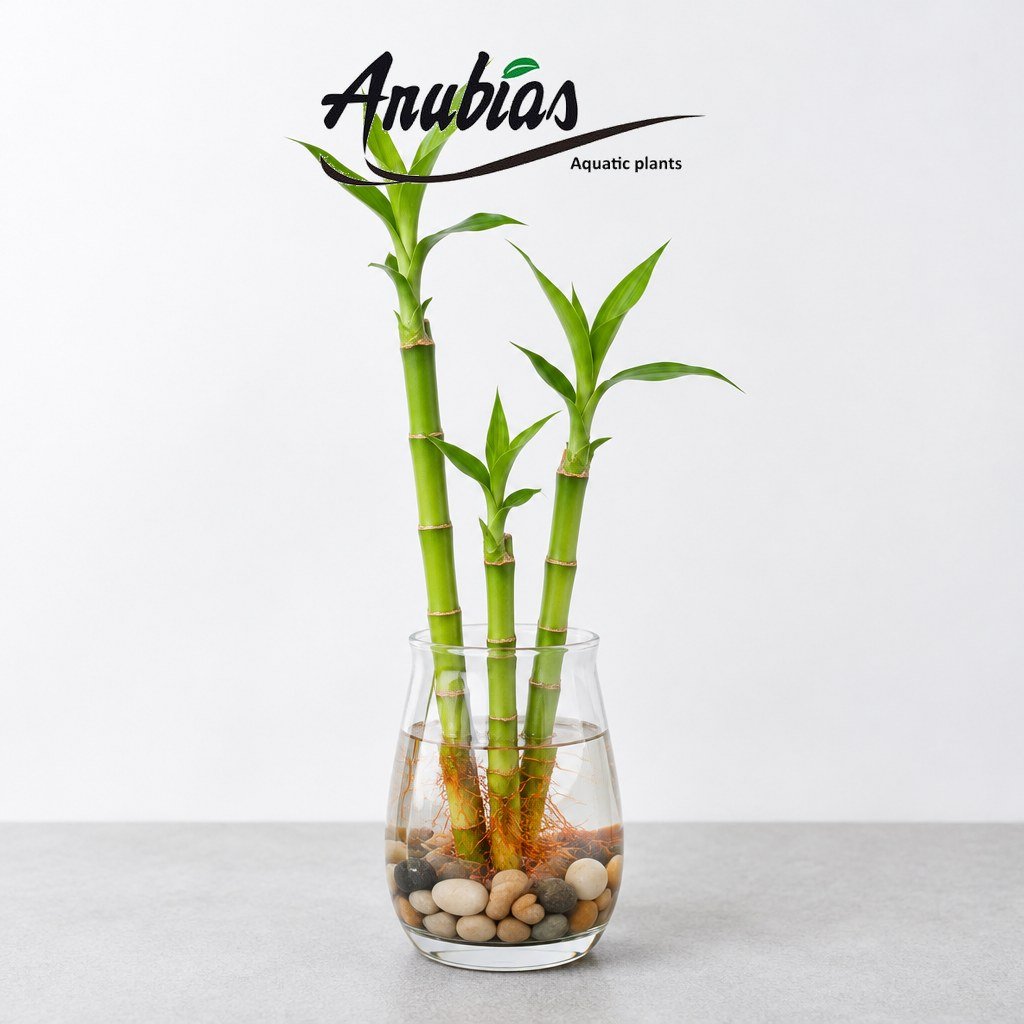
Lucky bamboo (Dracaena sanderiana) is the familiar jointed green stalk sold in vases across India, and despite the name it is not a bamboo at all but a dracaena that grows happily with its roots in plain water. That makes it a natural aquarium bamboo plant: stand it with the roots in the tank or a hang-on filter and the leaves above the surface, and it takes up nitrate while adding a clean, upright line. Lucky bamboo suits fish keepers who want a living filter plant that goldfish and cichlids cannot eat, anyone who wants a no-soil desk plant, and gift buyers.
Lucky bamboo at a glance
| Scientific name | Dracaena sanderiana (ribbon dracaena; not a true bamboo) |
|---|---|
| Family | Asparagaceae |
| Origin | Central Africa (Cameroon region), as an understorey plant; widely cultivated in Asia |
| Difficulty | Very easy |
| Light | Bright indirect room light; tolerates low light |
| CO2 | Not applicable; leaves grow in air |
| Temperature | 18–32 °C |
| pH | 6.0–7.5 |
| Growth rate | Slow to moderate |
| Height/size | Stalks 15–60 cm tall as sold; grows taller over years |
| Placement | Roots in tank, filter or vase; stalk and leaves above the water |
| Propagation | Stem cuttings and side shoots rooted in water |
How to set up lucky bamboo in an aquarium or vase
Lucky bamboo is not a submerged aquatic plant. The roots and the bottom few centimetres of stalk can live under water indefinitely, but the leaves must stay in the air; a stalk kept fully submerged for weeks yellows and rots.
- Rinse the stalk and check that the base is firm and the roots pale or orange-white. A few brown root tips after transport are normal.
- In the tank: push the base 3–5 cm into gravel at the back so the stalk stands upright with at least the top third clear of the water. Anchor it with pebbles until the roots grip.
- In a hang-on-back filter: stand the stalk in the filter box behind the media with the roots in the flow. This keeps the leaves well above the water and feeds the roots constantly.
- In a vase or jar: stand the stalk in 3–5 cm of water with pebbles for support, roots covered, leaves above. This is the classic desk or gift arrangement.
- Place the leaves in bright, indirect room light, near a window but out of direct afternoon sun.
Roots adjust within a couple of weeks and then thicken and spread, giving small fish and shrimp a place to hide.
Lucky bamboo care: light, nutrients and water
Light. The leaves need ordinary room light, not an aquarium lamp. Bright indirect light keeps the stalk green and the leaves full; a dim corner is tolerated but growth slows and the leaves pale. Direct sun through glass scorches the leaves and overheats vase water.
Nutrients. In an aquarium or filter the roots feed on the nitrate and ammonia your fish produce, so no fertiliser is needed; the plant is a slow, steady nitrate sink. In a vase with no fish it lives for months on plain water; a very dilute houseplant feed once a month helps if the leaves pale, but never add that to a tank with livestock.
Water. Lucky bamboo is sensitive to chlorine and fluoride, which show as brown leaf tips. In an aquarium your dechlorinated water takes care of this. In a vase, use filtered, RO or rested tap water and change it weekly so it does not go stale or breed mosquitoes. It tolerates Indian tap-water hardness and summer heat to 32 °C and is unaffected by monsoon power cuts, since the leaves breathe air.
Safety. Dracaena leaves and stalks are mildly toxic to cats and dogs if chewed, causing vomiting and drooling, so keep the plant out of reach of pets. The roots are harmless to fish, shrimp and snails.
Growth, trimming and propagation
Lucky bamboo grows slowly: a few centimetres a year from the top, with new leaves every few weeks. Remove leaves that yellow at the base. To control height, cut the stalk just above a node; the top can be rooted in water as a new plant, and the stump usually sprouts one or two side shoots below the cut.
To propagate, cut off a side shoot once it has a few leaves, strip the lowest leaf and stand it in water; roots appear within two to four weeks. The spiralled shapes seen in shops are made by turning young stalks toward the light over months.
Where to use it
Lucky bamboo earns its place in these situations:
- Goldfish, cichlid and turtle tanks of 3 ft (around 100–120 litres) and up, where submerged plants get eaten but a stalk above the water is untouched and keeps working on nitrate.
- Tall betta tanks and nano cubes of 1 ft (around 15–25 litres), with the stalk in a back corner and the leaves above the rim.
- Hang-on filters and sumps, as a tidy, upright alternative to trailing pothos; pair the two for the most nitrate uptake.
- Paludariums and open-top tanks, with Anubias nana and Java fern below the surface and floating plants around the base.
- Desks, reception counters and gifts. A stalk in a glass vase with pebbles is a classic housewarming and festival gift; see our other gifting plants.
It is safe with every fish, shrimp and snail, and especially useful where nothing else survives the inhabitants.
Common problems and fixes
- Yellow stalk from the bottom up. Rot, usually from stagnant water or a damaged base. Cut above the yellow section, let the cut dry for an hour and re-root the healthy top in fresh water.
- Brown leaf tips. Chlorine or fluoride in vase water, or very dry air. Switch to filtered or rested water and change it weekly.
- Yellow leaves, green stalk. Too much direct sun or old leaves finishing. Move it out of direct sun and remove the yellow leaves.
- Slimy or smelly roots. Stale water. Rinse, trim mushy parts and change water more often.
- Stalk leaning in the tank. Not anchored; add pebbles around the base.
What you receive
One healthy, rooted lucky bamboo stalk of the size you select, Small or Standard, similar to the photo. Small is a shorter stalk for a jar, small vase or nano tank; Standard is a taller stalk for a larger tank, hang-on filter or statement vase. Checked before packing, packed moist and shipped across India from Surat. ₹99 shipping, free on orders of ₹999 or more.
Live-arrival guarantee: record one continuous unboxing video within 4 hours of delivery and we will refund or replace a plant that arrived damaged.
FAQ
Can lucky bamboo grow in an aquarium?
Yes, with the roots and base in the water and the leaves above the surface. It should not be kept fully submerged for long; the leaves yellow and the stalk rots.
Is lucky bamboo safe for fish?
Yes. The roots are harmless to fish, shrimp and snails. Keep the leaves away from cats and dogs, which can be upset by chewing them.
Is lucky bamboo a real bamboo?
No. It is Dracaena sanderiana, a tropical plant that only looks like bamboo. Real bamboo cannot live with its roots in water.
Does lucky bamboo reduce nitrate in a fish tank?
Yes, slowly. The roots take up nitrate and ammonia. It is less hungry than pothos, so use several stalks or pair it with a pothos cutting in a heavily stocked tank.
Why is my lucky bamboo turning yellow?
From the bottom: stalk rot from stale water; cut above the damage and re-root. At the leaf tips: chlorine or fluoride; use filtered water. Whole leaves: too much direct sun.
Lucky bamboo vs money plant for an aquarium: which should I pick?
Lucky bamboo is upright, compact and slower growing, and looks neater in a vase or small tank. Money plant (pothos) trails, grows faster and removes more nitrate. For a heavily stocked tank choose pothos or both; for a desk or betta tank, lucky bamboo is tidier.
Should I grow lucky bamboo in water or soil?
Both work. In water (a vase, jar or with its roots in a fish tank) keep 3–5 cm of water over the roots, use clean water and change it every one to two weeks; this is the easiest way indoors and on a desk. In soil it grows a little faster and lives longer in a pot with well-draining mix kept just moist. Whichever you choose, give it bright indirect light, not harsh direct sun, and do not keep switching it between water and soil.
Not sure what fits your tank? Plan it with our free AI tank planner.


There are no reviews yet.