



Your cart is empty
Return to Shop
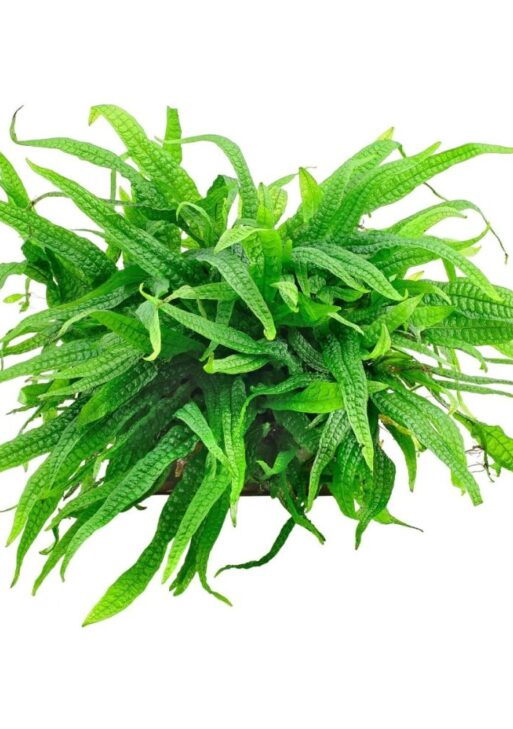
Dwarf Java Fern (Microsorum pteropus 'Green Gnome' or 'Mini')
Price range: ₹45 through ₹250
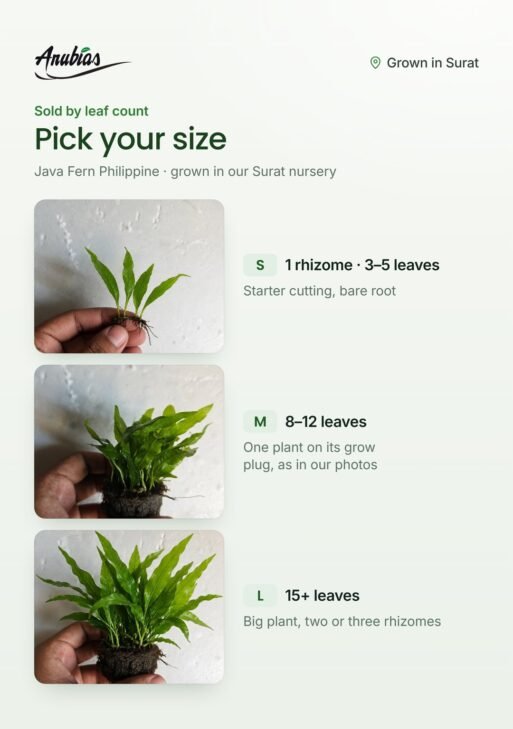
Java Fern Philippine
Price range: ₹45 through ₹250
Java Fern (Microsorum pteropus)
Price range: ₹45 through ₹250
Java Fern 'Green Gnome' (Microsorum pteropus)
Price range: ₹45 through ₹180
Java Fern 'Trident' (Microsorum pteropus)
Price range: ₹45 through ₹340
Bolbitis heteroclita 'Difformis'
Price range: ₹135 through ₹180
Java Fern 'Staghorn' (Microsorum pteropus)
Price range: ₹45 through ₹180
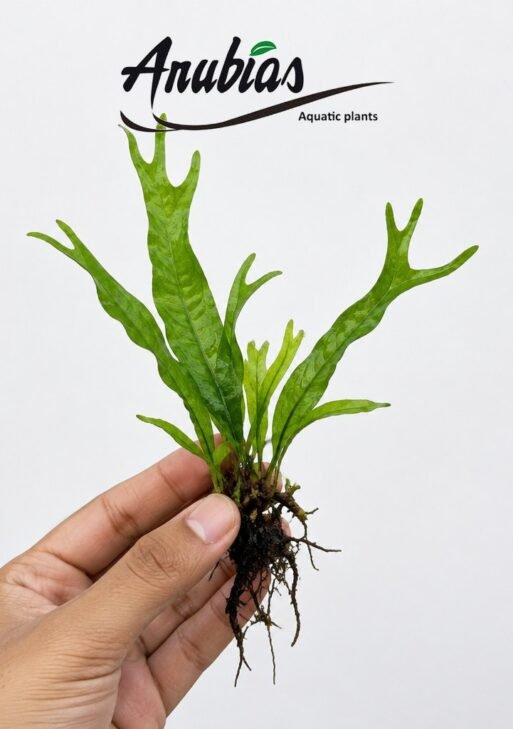
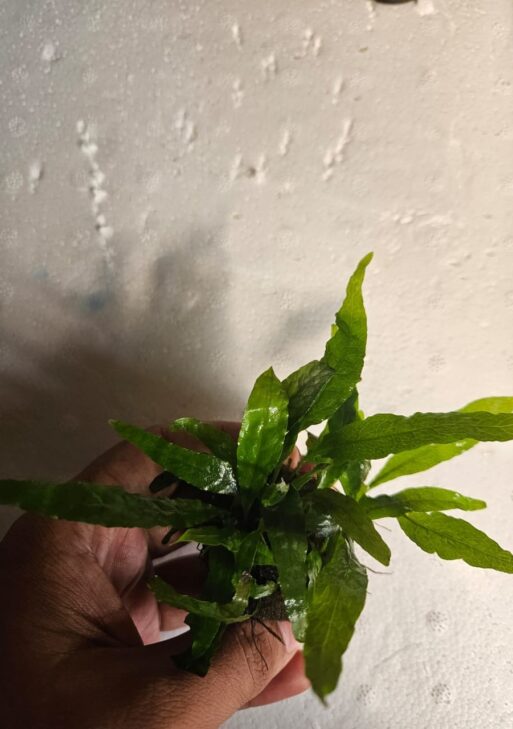
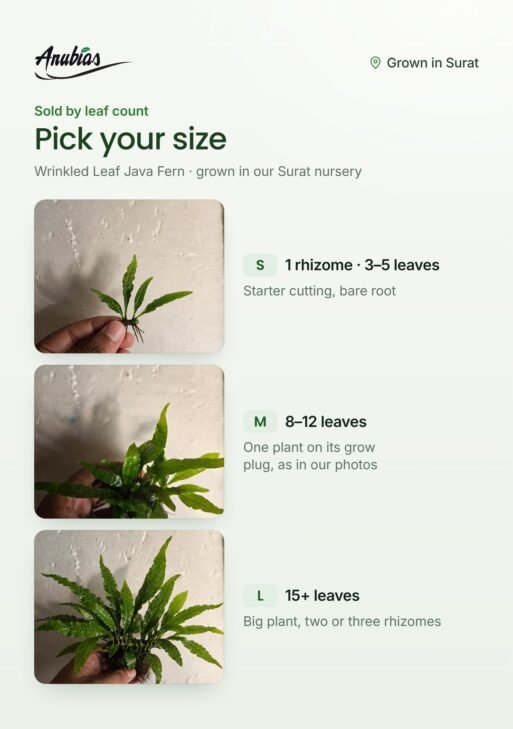
Wrinkled Leaf Java Fern (Microsorum pteropus)
Price range: ₹45 through ₹250
How to choose a Java fern for your tank
Java fern (Microsorum pteropus) is the aquarium fern: a rhizome plant from the streams of South and South-East Asia that grows attached to wood or rock, tolerates low light, hard water and no CO2, and is as close to indestructible as a live plant gets. Every plant on this page except Bolbitis is a form of Java fern, so the choice is about leaf shape and size rather than care. Pick the look, then tie it to a piece of hardscape and let it grow.
Java fern varieties at a glance
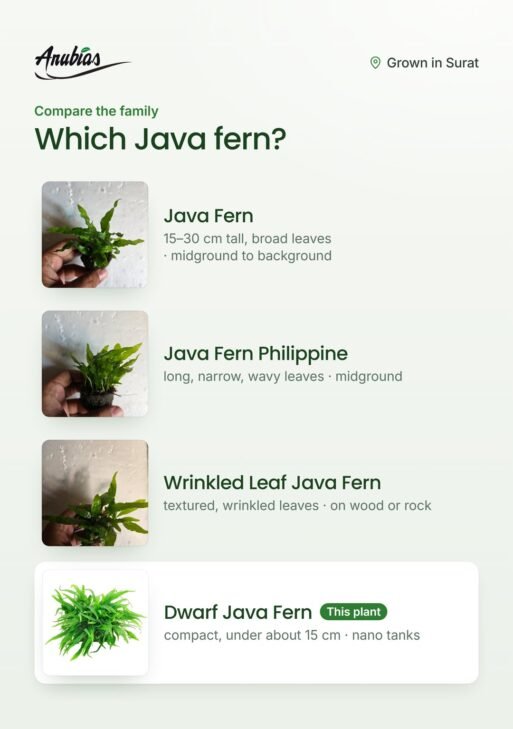
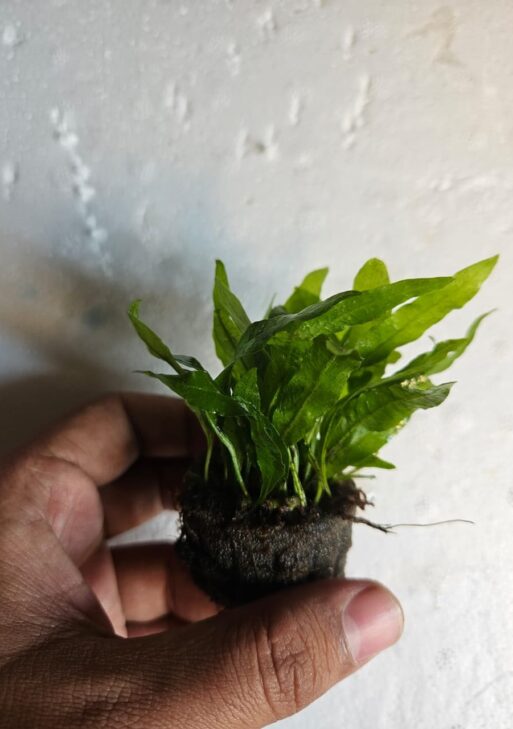
- Java Fern (Microsorum pteropus): the standard broad, strap-shaped leaves, 15–30 cm. Midground or background in any tank from 2 feet (60 litres) up.
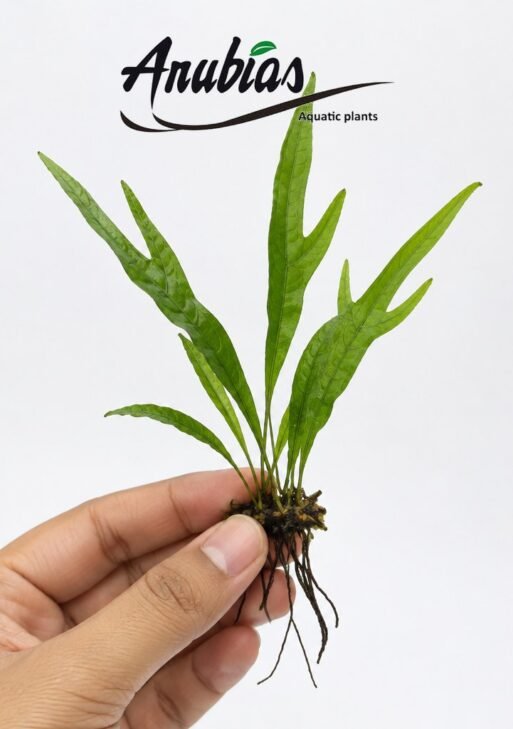
- Java Fern 'Trident': narrow leaves forked into three or more lobes. Finer texture, slightly smaller plant, the favourite for natural-style scapes.
- Java Fern 'Staghorn': leaves split repeatedly at the tips like antlers. The most unusual silhouette.
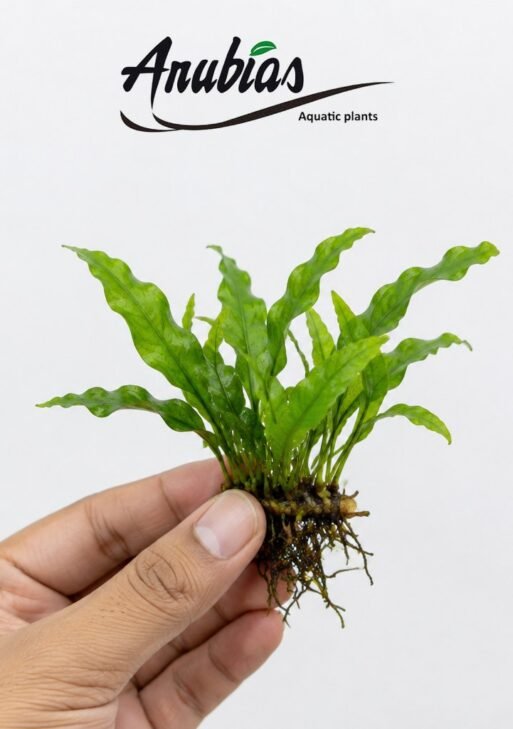
- Wrinkled Leaf Java Fern: broad leaves with a heavily crinkled surface that catches the light.
- Java Fern Philippine: wider, textured leaves and the best tolerance of hard and slightly brackish water of any form.
- Java Fern 'Green Gnome' and Dwarf Java Fern: compact forms that stay under about 10 cm, for nano tanks and the foreground of larger ones.
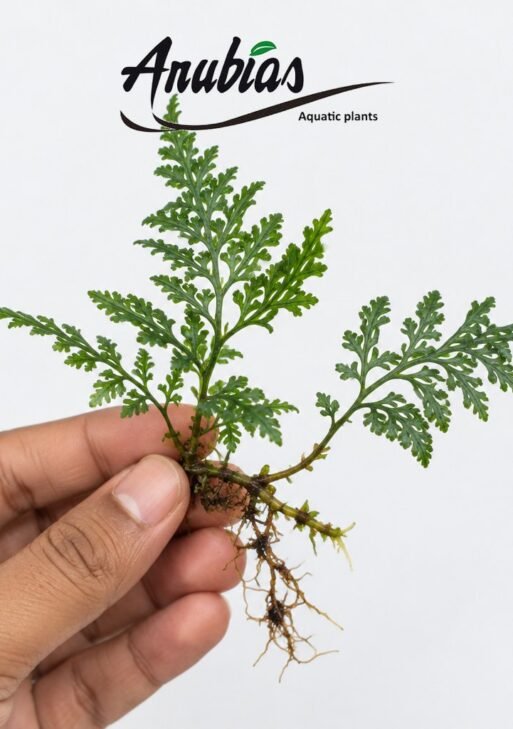
- Bolbitis heteroclita 'Difformis': a different genus. A small, slow, creeping fern with lacy leaves that grows submerged but thrives emersed in a paludarium or on wood above the waterline.
Aquarium ferns compared
| Plant | Light | CO2 | Growth | Placement | Difficulty |
|---|---|---|---|---|---|
| Java Fern (Microsorum pteropus) | Low | No | Slow | Mid/background on wood or rock | Easy |
| Java Fern 'Trident' | Low | No | Slow | Midground on wood or rock | Easy |
| Java Fern 'Staghorn' | Low | No | Slow | Mid/background on wood or rock | Easy |
| Wrinkled Leaf Java Fern | Low | No | Slow | Mid/background on wood or rock | Easy |
| Java Fern Philippine | Low | No | Slow | Background on wood or rock | Easy |
| Java Fern 'Green Gnome' | Low | No | Slow | Fore/midground, nano | Easy |
| Dwarf Java Fern ('Green Gnome' or 'Mini') | Low | No | Slow | Fore/midground, nano | Easy |
| Bolbitis heteroclita 'Difformis' | Low–medium | Optional | Slow | Wood, paludarium | Moderate |
How to plant and care for Java fern in Indian conditions
- Never bury the rhizome. The dark, creeping stem the leaves grow from must stay in open water. Tie it to driftwood or rock with cotton thread or fishing line, or glue it with a drop of cyanoacrylate gel on a dry spot. Roots will grip in a few weeks.
- Or wedge it. Push the rhizome into a crack in the wood or between two stones. It also grows well on a lava rock sitting on the substrate.
- Light: low to medium, 6–8 hours a day. Java fern in strong light grows algae on its slow leaves and turns translucent; the shaded side of a tank suits it best.
- Hard tap water: pH 7–8 and high GH municipal water is ideal. Java Fern Philippine even tolerates mildly brackish water.
- Summer heat: Java fern copes with 30–32 °C, though growth slows and old leaves may brown at the edges. A clip fan over the surface keeps it comfortable.
- Monsoon power cuts: with no CO2 and little light needed, a dark day or two does no harm. Keep the fish load sensible so oxygen holds.
- Feeding: Java fern takes nutrients through its leaves. A liquid fertiliser with potassium once a week prevents the small black holes that appear in starved leaves.
- Propagation: the plant grows plantlets on the tips and edges of old leaves. Leave them until they have a few roots, then pull them off and tie them down. You can also cut the rhizome into sections with three or four leaves each.
Best Java fern for beginners, low-tech, betta and nano tanks
- Beginners: standard Java Fern on a piece of driftwood. It survives the mistakes of a first tank and grows into a bush.
- Low-tech scapes: Java Fern 'Trident' for a fine, natural texture without CO2 or bright light.
- Betta tanks: Java Fern Philippine and Wrinkled Leaf Java Fern have the broad, firm leaves a betta rests on, and both handle a 28–30 °C heated tank.
- Nano tanks: Dwarf Java Fern and 'Green Gnome' stay in scale under 30 litres.
- Feature plant: Java Fern 'Staghorn' on a tall branch gives a 3-foot tank a focal point.
- Paludarium: Bolbitis heteroclita 'Difformis' on damp wood above the waterline.
Common mistakes with Java fern
- Burying the rhizome. It rots within weeks. Attach it to hardscape instead.
- Too much light. Translucent, algae-covered leaves mean the fern is sitting under a strong lamp. Move it into shade or add floating plants.
- Mistaking sori for disease. Rows of brown dots under old leaves are spores and are normal. Soft, spreading black patches are not.
- Removing plantlets too early. Wait until the baby plants on the leaf edges have roots.
- Expecting fast growth. One new leaf every two or three weeks is normal. Java fern is slow by design.
How we pack and ship
Every plant is checked before packing, packed moist and shipped across India from Surat. Shipping is ₹99 shipping, free on orders of ₹999 or more. Live-arrival guarantee: record one continuous unboxing video within 4 hours of delivery and, if a plant has arrived dead, we refund or replace it.
Frequently Asked Questions
Does Java fern need CO2 or high light?
No. Java fern is a low-light, no-CO2 plant. A basic LED on 6–8 hours a day is enough, and stronger light mainly grows algae on the slow leaves.Can Java fern be planted in substrate?
No. The rhizome must stay above the substrate or it rots. Tie or glue it to driftwood or rock, wedge it between stones, or rest it on a lava rock on the substrate. Only the thin roots may go into the gravel.Why are there black spots on my Java fern leaves?
Neat rows of raised brown or black dots on the underside of older leaves are sori, the fern's spore-bearing structures, and are normal. Black patches that spread and make the leaf soft are dying tissue, usually from a buried rhizome, a sudden water change or a lack of potassium, so trim those leaves off.How does Java fern reproduce?
Small plantlets grow on the tips and edges of mature leaves, each with its own roots. Once they have three or four leaves, pull them off and tie them to hardscape. A long rhizome can also be cut into sections with a few leaves each.Is Java fern good for a betta fish tank?
Yes. It tolerates the 26–30 °C of a heated betta tank, needs no CO2 and has broad leaves the betta rests on. Java Fern Philippine and Wrinkled Leaf Java Fern are the best forms for a 20–30 litre betta tank.Java fern Trident vs standard Java fern: which should I choose?
Standard Java fern has broad strap leaves and grows larger, so it suits the background of a 2-foot tank or bigger. 'Trident' has narrow forked leaves, stays smaller and gives a finer, more natural texture for scapes. Care is identical.Why is my new Java fern melting or turning brown?
A newly arrived plant may lose one or two older leaves while it adjusts to your water, especially if it was grown emersed. If the rhizome is firm and green, leave it attached and new leaves will follow within a few weeks. A soft rhizome means it was buried or waterlogged; cut away the rot and re-attach the firm part.Can Java fern grow in hard tap water?
Yes. Java fern is happy in the hard, alkaline water most Indian cities supply (pH 7–8), and Java Fern Philippine tolerates even slightly brackish water. No water treatment beyond dechlorination is needed.Not sure what fits your tank? Plan it with our free AI tank planner.







