

Background plants hide equipment, add height and make the rest of the aquascape look deeper. The best choice depends on your light and whether you run CO2.
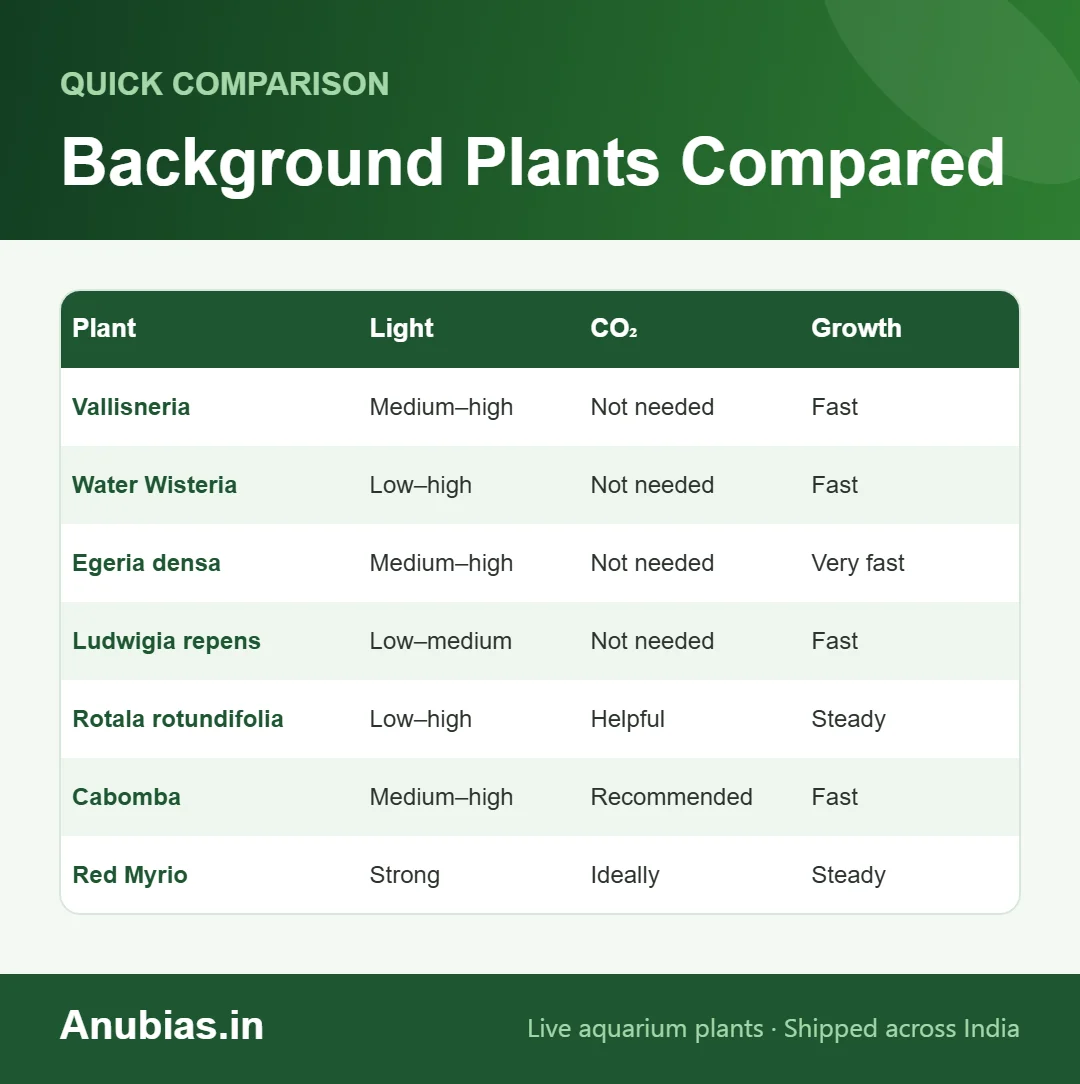
Quick answer: The best easy background aquarium plants are Vallisneria, Water wisteria, Egeria densa and Ludwigia repens, all of which grow without CO2. Rotala rotundifolia is also forgiving and colours up in stronger light. Cabomba and Red Myrio suit tanks with stronger light and CO2. Plant stem plants 2–3 cm apart in groups, trim and replant the tops, and leave space so the background does not shade the midground.
Easy background plants (no CO2)
Vallisneria
Tall ribbon leaves that spread by runners in moderate to high light. Keep the crown above the substrate. Vallisneria care guide.
Water Wisteria
Fast and adaptable from low to high light; replant cut tops for a dense wall. Water wisteria care guide.
Egeria densa
Very fast and good for goldfish and cooler tanks. Egeria densa care guide.
Ludwigia repens
Easy stem plant for the background that turns redder with stronger light and iron. Ludwigia repens care guide.
Rotala rotundifolia
Forgiving stem plant with pink-to-orange tips in strong light; plant in groups at the back. Rotala rotundifolia care guide.
Background plants for stronger light
Cabomba
Feathery and fast, but needs medium to high light and does best with CO2. Cabomba care guide.
Red Myrio
Soft red foliage that needs strong light, iron and ideally CO2. Red Myrio care guide.
Centrepiece option
In larger tanks, an Amazon sword (often 40–50 cm tall) works as a single tall focal plant rather than a dense background.
Planting tips
- Plant stems 2–3 cm apart so lower leaves still get light.
- Put the tallest plants in the back corners and keep the centre lower for depth.
- Trim regularly: how to trim aquarium plants.
Matching background plants to tank height
Height is the first thing to check, and it decides more than light does. In a standard 1-foot-tall tank, Vallisneria and Egeria densa will hit the surface within weeks and then lie flat along the water line, shading everything below. In a taller 18-inch tank the same plants finally look proportionate.
For short tanks, pick species you can top and replant, such as Rotala or Ludwigia, because you control the final height with scissors. For tall tanks, pick species that reach the top on their own, so you are not waiting six months for the back wall to fill.
Tank length matters too. A 2-feet tank usually needs only one or two background species, otherwise the back looks busy and confused. A 3-feet or 4-feet tank can carry three groups without losing the sense of depth.
Why the back of a tank stays patchy
Most bare backgrounds come down to a handful of avoidable errors rather than bad plants.
- Planting single stems. One stem reads as a stick. Groups of five to seven of the same species read as a bush.
- Trimming everything to the same height. A flat hedge kills depth. Stagger the trim so the corners stay taller than the middle.
- Letting floating plants take over. Frogbit and duckweed are useful, but a full surface mat starves tall stems of light exactly where they need it.
- Ignoring flow. Dead corners collect detritus and grow weak, thin stems. Angle the outlet so water moves along the back glass.
- Replanting the bottom half. When you top a stem plant, the healthy cut top is the piece worth replanting; the tired bald base is usually better discarded.
In Indian summers, background stems often slow down or drop lower leaves once the tank passes 30°C. That is heat stress rather than a lighting fault, so resist the urge to raise light levels, which only feeds algae. Add a clip fan, keep the lid open a crack, and let the plants recover when temperatures drop.
Plants in this guide
Grown in Surat · graded by leaf count and photographed before dispatch · live-arrival guarantee on every order · ₹99 shipping, free from ₹2,000

Frequently asked questions
What is the easiest background aquarium plant?
Vallisneria and Water wisteria are the easiest; both grow fast without CO2.
Can Anubias be a background plant?
Larger types like Anubias congensis can sit in the midground to background, but they grow slowly and will not quickly fill a background.
How many background plants do I need?
Plant fast growers in groups of several stems and let them fill in by replanting trimmed tops.
Shop the plants in this guide: Egeria Densa, Amazon Sword, Myriophyllum Tuberculatum, Anubias Congensis, Water Wisteria, Ludwigia Repens.
How far from the back glass should I plant background plants?
Leave about 3 to 5 cm between the glass and the first row of stems. That gap gives you space to get a hand and a siphon behind the plants during cleaning, and it stops detritus from packing into an unreachable strip. It also lets water move behind the group, which keeps the lower leaves healthier.
Do background plants need root tabs?
Rooted background plants such as Vallisneria and Amazon sword feed heavily through their roots and do noticeably better with root tabs. Stem plants like Rotala and Ludwigia take most of their nutrients from the water column, so liquid fertiliser matters more for them. If you have a mix, place tabs only under the rooted species and dose the rest weekly.
Why do my background stems go bald at the bottom?
Bald lower stems almost always mean light is not reaching them, either because the tops have grown dense or because floating plants are shading the tank. Thin the group out, top the tallest stems and replant the cuttings so the bush regrows evenly from the substrate. Poor flow along the back glass makes it worse, so check that water actually circulates there.
Comparing species? The aquarium plant care chart lists light, CO2, growth rate and price for all 55 plants we stock.