

Rotala wallichii is the plant aquascapers reach for when they want a genuine red-to-copper accent without relying on Alternanthera or a red Ludwigia. Its needle-thin leaves grow in tight whorls around a central stem, and under strong light with a steady CO2 supply they shift from green through pink and copper to deep red from the tips down. Under anything less, it survives as a thin, leggy green stem that never becomes the plant in the photo. This guide covers what it actually needs to colour up, and why it usually gets recommended to aquarists who already have CO2 and dosing sorted rather than as a first planted-tank purchase.
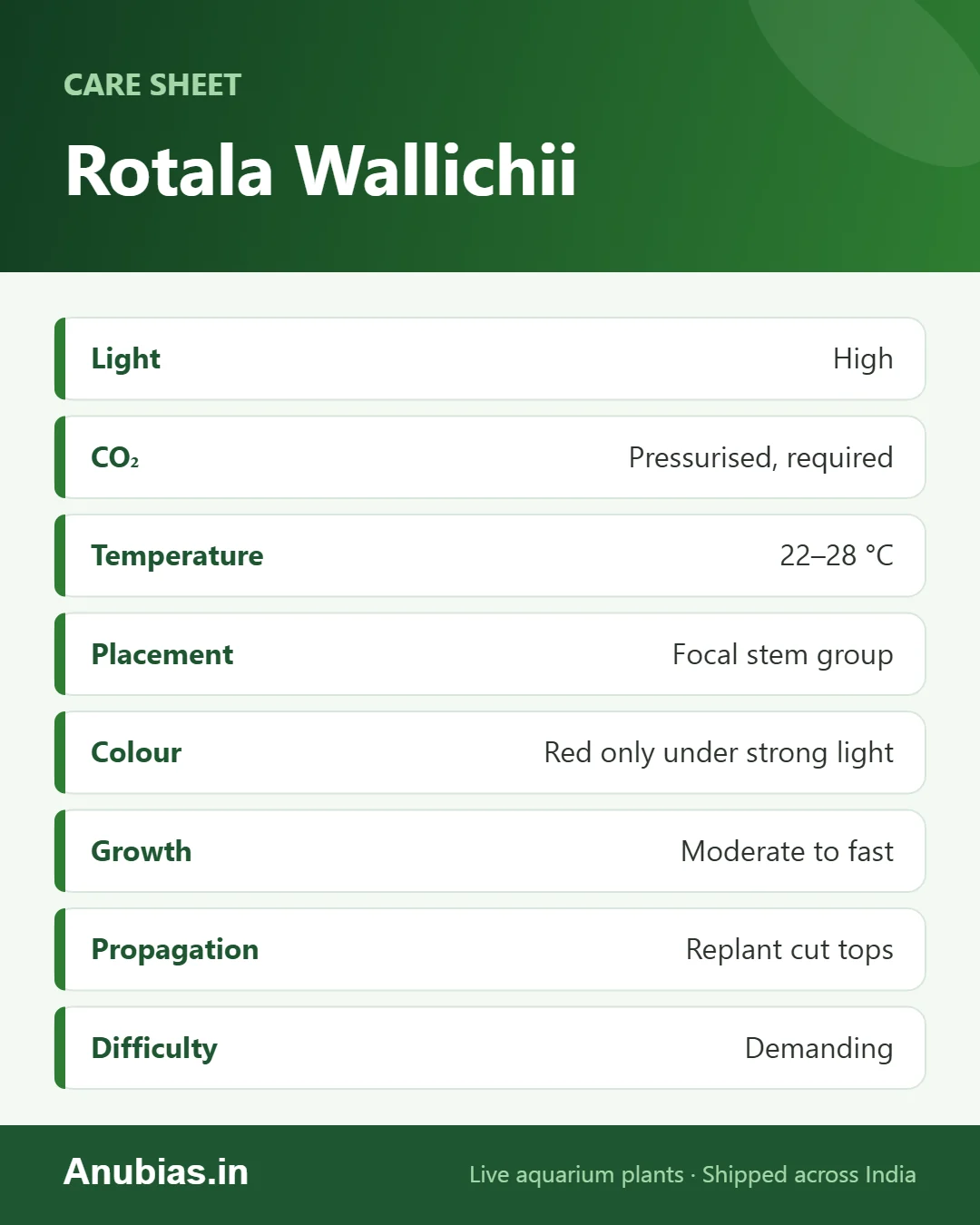
Quick answer: Rotala wallichii is a demanding plant: it effectively requires pressurised CO2 at 25–30 ppm, a strong full-spectrum LED run 8–10 hours a day, and soft, slightly acidic water — pH 5.5–7.0, with the best colour reported between 5.5 and 6.5. Propagate by cutting the top 10–15 cm of a stem just above a leaf node, stripping the lowest whorls and replanting.
What Is Rotala Wallichii?
Rotala wallichii is a stem plant native to parts of South and Southeast Asia, grown for its narrow, needle-like leaves arranged in dense whorls around a slender stem, which has earned it the common name Whorly Rotala among aquascapers. Commercial stock is usually grown emersed, meaning out of water in a nursery, or produced through tissue culture, and then converted to submersed growth once planted underwater. It is a popular focal stem for the foreground-to-midground of aquascapes specifically because of the colour range it can reach, from green through pink and copper to a deep, saturated red under strong light.
Ideal Water Parameters
This plant does best in water between 21 and 28°C, with growth and colour generally considered strongest around 24°C. It prefers soft, slightly acidic water, with a pH between 5.5 and 7.0 and the best results reported between 5.5 and 6.5. Because it is sensitive to unstable conditions, sudden swings in temperature or hardness tend to set it back more than they would a hardier plant like Vallisneria or Java Fern, so stability matters as much as hitting the exact numbers.
Lighting Requirements
High-output lighting is essential, both for growth and for colour. Under moderate or low light, Rotala wallichii survives but stays green and leggy, with wide gaps between the leaf whorls, rather than developing the pink and red tones it is grown for. A strong, full-spectrum LED positioned close to the water surface for around 8 to 10 hours a day is the baseline most aquascapers work with; the difference between a green, straggly stem and a deep red one is almost entirely down to light intensity and nutrients rather than a different variety of the plant.
CO2 and Nutrient Requirements
Pressurised CO2, typically in the range of 25 to 30ppm, is effectively required for long-term success with this plant rather than a nice-to-have as it is for hardier species. Without it, Rotala wallichii tends to survive rather than thrive, staying thin and pale even under strong light. As a stem plant, it takes up most of its nutrients from the water column through its leaves rather than through its roots, so consistent liquid fertilising, particularly of iron and other micronutrients, matters more here than substrate choice; our guide to NPK and micronutrient dosing covers how to set that up. For a CO2 tank dosed this consistently, DIY dry fertiliser salts usually cost far less than bottled liquid.
Substrate and Planting Method
Since it feeds mainly from the water column, almost any inert or nutrient-rich substrate works, though a nutrient-rich substrate gives new roots a head start. Plant stems in small, close bunches of five to seven stems for the dense, grouped look typical of aquascaped Rotala patches, inserting each stem two to three centimetres into the substrate. Handle the stems carefully; they are thin and crush easily between fingers, which damages the tissue the plant needs to root from.
Propagation and Trimming
Rotala wallichii propagates readily from stem cuttings taken from healthy side shoots. Cut the top 10 to 15cm of a stem just above a leaf node, strip away the bottom couple of leaf whorls that would otherwise sit below the substrate, and plant the cutting two to three centimetres deep; roots typically develop within 5 to 10 days under good light and stable water. Rather than repeatedly trimming the same stems down to the same height, use a top-and-replant approach, planting the healthy cutting back in and letting the base regrow, since regrowth from a stem cut at the same point over and over tends to come back thinner and less colourful each time. Trim every two to four weeks to keep growth dense and stop the lower leaves from dying off in the shade cast by the canopy above.
Common Problems
New stock, especially tissue-cultured or emersed-grown plants, commonly goes through a transition melt after planting, where the original emersed leaves deteriorate while new needle-like submersed growth takes over; this can take two to four weeks and is usually not fatal if water parameters stay stable in the meantime. Lower leaves melting or dropping on an established plant usually means insufficient light, CO2 or nutrients are reaching the base of the stem, often because a thick canopy above is shading it out, which regular trimming helps prevent. A plant that stays green instead of colouring up is almost always a light or micronutrient issue rather than a different, non-red variety.
More stem plant guides:
Frequently Asked Questions
Why is my Rotala wallichii green instead of red? Almost always light or nutrients. It needs high-output lighting plus consistent iron and micronutrient dosing, usually alongside CO2, to develop its pink, copper and red tones; without that it stays a thin green plant.
Can I grow Rotala wallichii without CO2? It can survive short-term without CO2, but rarely thrives; expect thin, leggy growth and little colour, since pressurised CO2 is effectively required for the plant most people picture when they buy it.
Why did my new Rotala wallichii melt after planting? Most tissue-cultured or emersed-grown stock goes through a transition melt as it converts to submersed growth, which can take two to four weeks; trim off the mush and keep parameters stable while it recovers.
Ready to add a red accent stem to your aquascape? Our Rotala Wallichii is best suited to tanks already running CO2 and a regular fertilising routine. If you have not set up CO2 yet, our guide on DIY CO2 for planted aquariums in India covers whether it is worth it before you commit to a demanding stem plant like this one. Not sure it’s the right choice for your tank? See our Rotala Wallichii vs Rotala Rotundifolia comparison.
Red plants staying green? See how to get red colour in Ludwigia and Red Myrio.
Grown in Surat (pre-order plants imported to order) · live-arrival guarantee with a 4-hour unboxing video · ₹99 shipping, free from ₹999