
Description
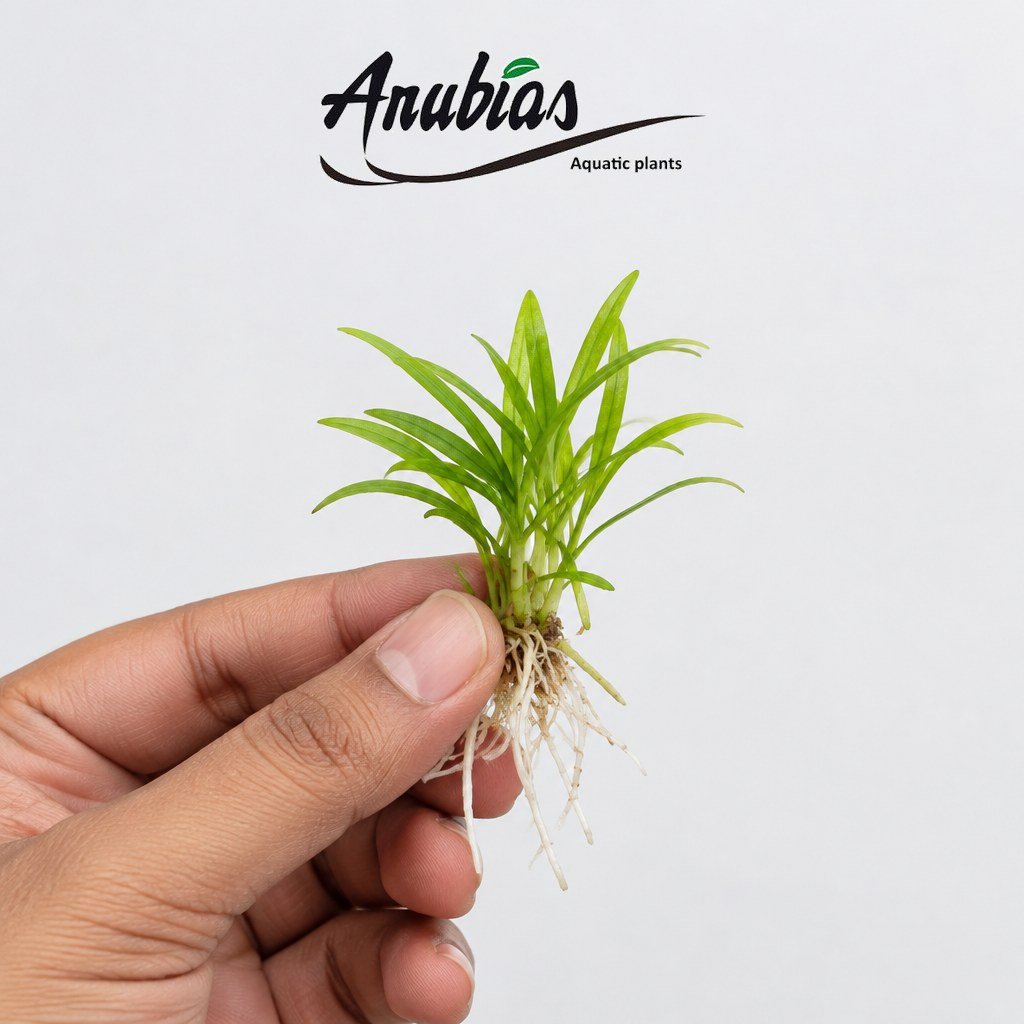
Cryptocoryne parva is the smallest cryptocoryne in the hobby, a slow-growing foreground plant from Sri Lanka that forms a tight, grassy lawn of narrow dark-green leaves without ever outgrowing its spot. If you want a carpet that does not demand high light, pressurised CO2 or weekly trimming, this is the crypt to choose. It suits patient aquarists, nano tanks, shrimp tanks and anyone who prefers a planted aquarium that stays tidy for months at a time.
Cryptocoryne parva at a glance
| Scientific name | Cryptocoryne parva |
|---|---|
| Family | Araceae |
| Origin | Sri Lanka (Kandy region, central highlands) |
| Difficulty | Easy to moderate (slow, but forgiving) |
| Light | Low to medium |
| CO2 | Optional; speeds growth noticeably |
| Temperature | 20–28 °C |
| pH | 6.0–7.8 |
| Growth rate | Very slow |
| Height/size | 3–8 cm tall, leaves 3–5 mm wide |
| Placement | Foreground, nano tanks, along hardscape edges |
| Propagation | Runners (short stolons producing daughter plants) |
How to plant Cryptocoryne parva
Like all crypts, Cryptocoryne parva is a rooted plant that feeds heavily through its roots, so the substrate matters more than the water column.
- Rinse the portion gently and remove any brown or transparent leaves. Trim roots to about 2 cm; shorter roots are easier to plant and regrow quickly.
- Separate the clump into individual plantlets or groups of two to three. Each piece needs a crown (the point where leaves meet roots) and at least a few roots.
- Using tweezers, push each plantlet into the substrate so the roots are fully buried but the crown sits just at the surface. Burying the crown causes rot.
- Space plantlets 2–3 cm apart. Dense spacing fills in faster, which matters for a plant this slow.
- Use a nutrient-rich aquasoil if possible. In plain sand or gravel, push a root tab under each group of plantlets.
- Leave it alone. Crypts dislike being moved.
Cryptocoryne parva care: light, CO2, fertiliser and water
Light. Cryptocoryne parva grows under low light but stays more compact and spreads faster under medium light (roughly 30–50 PAR at the substrate). A standard LED hood on a 30–60 cm tank is usually enough.
CO2. Not required. With pressurised CO2 the lawn fills in perhaps twice as fast, but it will still take months, not weeks.
Fertiliser. Roots first: an aquasoil or root tabs replaced every three to four months. Add a liquid all-in-one fertiliser once or twice a week for micronutrients, and watch for iron deficiency (pale new leaves) in long-established tanks.
Water. This species is tolerant of hard Indian tap water and does well in pH up to about 7.8. It does not need RO water. Keep changes modest and regular (20–30% weekly); large swings in water chemistry are the main trigger for crypt melt.
Indian conditions. Summer temperatures of 28–32 °C slow it down but rarely kill it, provided oxygen levels stay decent, so keep some surface movement. A few hours without filtration during a monsoon power cut is fine for this plant.
Growth, trimming and propagation
Expect a new leaf every one to three weeks per plant in good conditions. A sparse planting takes six to twelve months to form a closed carpet, which is why we recommend planting densely from the start.
Trimming is almost never needed. Pinch off brown or clear leaves at the base. Do not shear the carpet with scissors; crypt leaves do not regrow from a cut.
Propagation happens on its own through short runners. When daughter plants have three or four leaves and their own roots, either leave them to thicken the lawn or lift them with a bit of substrate and move them to a bare patch.
Where to use it in an aquascape
Cryptocoryne parva is a foreground specialist. Use it as the main carpet in a low-tech tank, as a transition between a stem-plant background and open sand, or tucked into the gaps between rocks and driftwood where larger plants would look clumsy.
It fits any tank from a 1 ft (around 20–25 litre) nano up to a 4 ft (300+ litre) display. Good companions are other slow, undemanding plants: Anubias nana and Java fern on hardscape, taller species from our Cryptocoryne collection in the midground, and a few stem plants behind.
It is excellent for shrimp tanks, as the dense leaves give shrimplets cover, and for small peaceful fish such as rasboras, tetras and Corydoras pygmaeus. Avoid goldfish and most cichlids, which uproot foreground plants.
Common problems and fixes
- Crypt melt after planting. Leaves turn transparent and dissolve within the first two weeks. This is normal for cryptocorynes adjusting to new water. Do not remove the plant; trim the melted leaves, keep the roots in place and new growth appears in two to four weeks.
- Melt in an established tank. Usually caused by a sudden change: a big water change with very different parameters, a temperature spike, or a new fertiliser regime. Return to stable conditions and the plant recovers.
- No visible growth for a month. Normal for this species. Check that the crown is not buried and that root tabs or aquasoil are present, then wait.
- Yellowing or pale new leaves. Iron or general micronutrient shortage. Dose a liquid fertiliser with chelated iron.
- Algae on leaves. Slow growers collect algae when light is too strong for the CO2 and nutrients available. Reduce the photoperiod to 6–7 hours, add shrimp or otocinclus and avoid direct sunlight on the tank.
What you receive
You receive one healthy portion of Cryptocoryne parva in the size you select (Small or Standard), similar to the one in the photo. Every plant is checked before packing, wrapped moist and shipped across India from Surat. We back every order with a live-arrival guarantee: record one continuous unboxing video within 4 hours of delivery and, if the plant has arrived damaged, we refund or replace it.
FAQ
Does Cryptocoryne parva need CO2?
No. It grows without CO2 under low to medium light. CO2 roughly doubles its growth rate, which is useful if you want a carpet sooner, but it is not required for health.
Is Cryptocoryne parva good for beginners?
Yes, as long as you are patient. It tolerates hard water, low light and no CO2. The only beginner mistake is giving up during the initial melt phase, which it almost always recovers from.
Can Cryptocoryne parva grow in sand?
Yes. Plant it in fine sand and place a root tab under each group of plantlets every three to four months. Growth is slower than in aquasoil but the plant does well.
How fast does Cryptocoryne parva grow?
Very slowly. A single plant produces a new leaf every one to three weeks, and a carpet takes six to twelve months to close. Dense planting is the only real shortcut.
Cryptocoryne parva vs dwarf hairgrass: which carpet is easier?
Parva is easier to keep but slower to fill in. Hairgrass needs more light and benefits strongly from CO2, and it needs regular trimming. Parva needs neither, but you wait longer for the result.
Why is my Cryptocoryne parva melting?
New plants melt as they adjust to your water; established plants melt after a sudden change in parameters. In both cases keep the roots in place, remove dead leaves and maintain stable conditions. New leaves follow within a few weeks.
Not sure what fits your tank? Plan it with our free AI tank planner.













There are no reviews yet.