
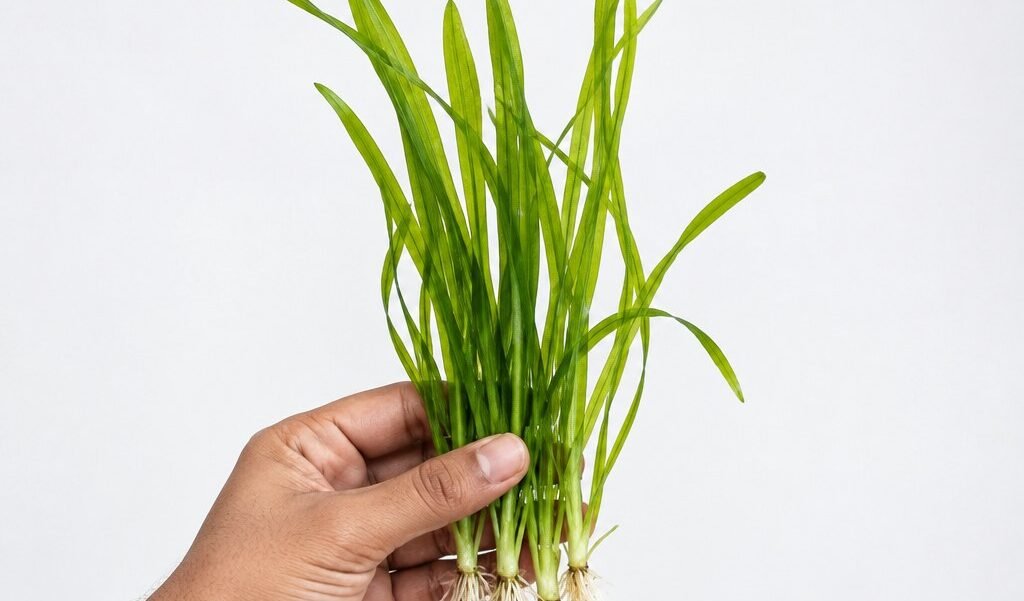
Quick answer: Vallisneria (tape grass, or ‘val’) is a hardy, grass-like background plant for aquariums. It roots in gravel or soil, spreads by runners, needs no CO2 and handles hard Indian tap water at 20–28°C. Pick Vallisneria nana or straight val for 2 ft tanks; giant val (V. americana var. gigantea) needs 3 ft or more. Vallisneria nana, which we sell as Jungle Val, costs ₹80 at anubias.in.
Want it done in one tap? Our 2 ft low-tech community kit already includes two portions of Vallisneria nana for the back row, with Anubias, Java fern, pennywort and frogbit for the other layers.
What is Vallisneria?
Vallisneria is a genus of rooted freshwater plants with long, ribbon-shaped leaves. Each Vallisneria plant grows from a central crown and sends runners through the substrate, and new plantlets come up a few centimetres away, so a handful of plants turns into a dense row. It goes at the back of the tank, where the leaves hide the heater and filter pipes and give fish and fry cover.
Indian fish shops have sold val for decades for practical reasons: it is cheap, it grows in the hard, alkaline water from most Indian taps and borewells, it needs no CO2 cylinder, and Vallisneria spiralis grows wild in ponds and slow rivers across the country.
Types of Vallisneria for aquariums
Shops sell several species and leaf forms under trade names that are not used consistently, so go by the species and the height it reaches.
| Type | Typical height in a tank | Leaf width | Minimum tank length |
|---|---|---|---|
| Straight or Italian val (V. spiralis) | 40–80 cm | About 5–10 mm | 2 ft (60 cm) |
| Vallisneria nana | 25–40 cm | Very narrow, under 1 cm | 1.5 ft (45 cm) |
| Giant val (V. americana var. gigantea) | 1 m and longer | 2 cm or more | 3 ft (90 cm) |
| Corkscrew val (twisted forms such as V. spiralis ‘Tortifolia’) | 30–50 cm | About 5 mm, tightly twisted | 2 ft (60 cm) |
Heights are typical for a home tank; in bright light every type grows longer, and extra length trails along the surface.
A note on names: we list Vallisneria nana under the trade name Jungle Val, but many other shops use Jungle Val for the giant V. americana var. gigantea. Check the species when you compare prices, because the two need very different tanks.
Which Vallisneria should you buy for your tank size?
Nano tanks (under 1.5 ft): most val is too tall. Vallisneria nana survives, but in a tank 25–30 cm deep it reaches the surface quickly and needs regular trimming. For a short grass look, read Vallisneria vs Dwarf Sagittaria first.
2 ft tanks (60–80 litres): Vallisneria nana or straight val along the back, or corkscrew val for a twisted look. Two portions of Vallisneria nana are enough for the back row, which is what our 2 ft low-tech community kit uses. The best plants for a 2 feet tank guide shows how it fits with the other layers.
3 ft and larger: any type works. Vallisneria nana gives a fine, even back row, and the 3 ft easy centrepiece kit uses three portions. Giant val belongs only here, ideally in a tall tank where leaves across the surface can shade shy fish. See the best plants for a 3 feet tank guide for a full layout.
Do not put giant val in a 2 ft tank. It reaches the surface within weeks and forms a mat that shades every plant below it.
Vallisneria price in India
Vallisneria nana (Jungle Val) is ₹80 per portion at anubias.in.
Because val spreads by runners, one or two portions are usually enough. New plantlets appear a few weeks after the plants settle, and in reasonable light the back of a 2 ft tank fills in over one to two months. That is why the starter kits above use two portions (₹160) and three portions (₹240) rather than a dense planting on day one.
Shipping is ₹99 anywhere in India and free on orders from ₹999. Payment is prepaid through Razorpay, and you can ask us anything on WhatsApp at +91 81416 96983 before you order.
Does Vallisneria need CO2, fertiliser or special soil?
CO2: no. Val grows steadily with 6–8 hours of moderate light a day, which a basic LED manages.
Soil and fertiliser: plain gravel or sand works, but val feeds heavily through its roots, so it grows noticeably better with root tabs near the crowns or a nutrient substrate underneath. Root tabs vs liquid fertiliser explains which suits your tank.
Water: val prefers moderately hard water, roughly pH 6.5–8.5, so untreated Indian tap and borewell water suits it (more in aquarium plants for hard water). It grows best at 20–28°C. In May and June, when a room without AC can push tank water past 30°C, growth slows; a small fan blowing across the surface cools the water a couple of degrees.
Liquid carbon: avoid it. Glutaraldehyde products such as Seachem Excel melt Vallisneria, often at the dose printed on the bottle. Read our liquid carbon safety guide before you add any.
Is this the Vallisneria from your biology textbook?
Yes. The Vallisneria used as the example of water pollination in Class 12 NCERT Biology is the same genus, and V. spiralis is the usual example. Male and female flowers grow on separate plants. The female flower rises to the surface on a long, coiled stalk, while male flowers break free underwater, float up and drift until they touch it, so water carries the pollen.
Aquarium val flowers the same way, sending a thin spiral stalk with a small, pale flower up to the surface. A tank colony usually grows from one plant through runners, so the plants are normally the same sex and seeds rarely form. Runners do the spreading, which is what makes val such an easy background plant.
Vallisneria vs other background plants
Val is a rooted grass that looks after itself: no CO2, and no cutting and replanting tops like stem plants.
- Short grass for the front: Vallisneria vs Dwarf Sagittaria explains when each fits.
- Goldfish tanks: goldfish dig and nibble, and val usually survives best because its leaves are tough; see our goldfish background plant comparison.
- Feathery texture: Cabomba (₹70) looks softer, but it is a stem plant that wants medium to high light, benefits from CO2 and prefers softer water, so in hard tap water val is easier.
- More options: the background plants guide compares other easy choices, and the submerged plants section of the shop lists what is available now.
How to plant Vallisneria on arrival
Start recording before you open the parcel. If a plant arrives dead, a claim needs one continuous unboxing video sent within 4 hours of delivery; photos alone are not accepted.
- Rinse the plants in water close to tank temperature, gently separate any joined crowns and remove broken or yellow leaves.
- Push each plant in so the roots are covered but the crown, where leaves meet roots, sits just above the substrate. A buried crown rots.
- Space the crowns about 10–15 cm apart along the back and sides; runners fill the gaps.
- Expect some melt in the first week or two, when older leaves turn see-through and soft. New leaves then come from the crown. Why new plants melt after delivery covers what to do meanwhile.
For runner control, trimming and melt that carries on in an established tank, follow our Vallisneria care guide.
Plants in this guide
Frequently asked questions
Does Vallisneria grow without soil?
It needs something to root in, but not necessarily aqua soil. Plain gravel or sand works, especially with a root tab near each crown. In a bare-bottom tank, plant it in a small pot of gravel.
Do goldfish eat Vallisneria?
Goldfish nibble most plants, but val’s tough leaves usually outlast softer plants. The bigger risk is digging, so ring new crowns with a few stones until the roots take hold.
Why are my Vallisneria leaves turning transparent?
That is melt. In the first two weeks it is normal while the plant adjusts to new water. In an established tank, check for liquid carbon, a buried crown or big swings in water conditions.
Is Vallisneria safe for shrimp and bettas?
Yes. Vallisneria is not toxic to fish or shrimp. Shrimp pick food off its leaves, and bettas often rest on leaves that reach the surface. Keep it away from plant-eating fish such as silver dollars, which strip the leaves.
Can Vallisneria float?
Uprooted plants float, and long leaves lying across the surface are normal once val outgrows the tank. It is not a floating plant, though: loose plants slowly weaken, so replant any that come up.