
Foreground plants sit at the front of the tank, so they need to stay short. Some form lawn-like carpets; others stay as neat, compact clumps. Your light and CO2 decide which will work.
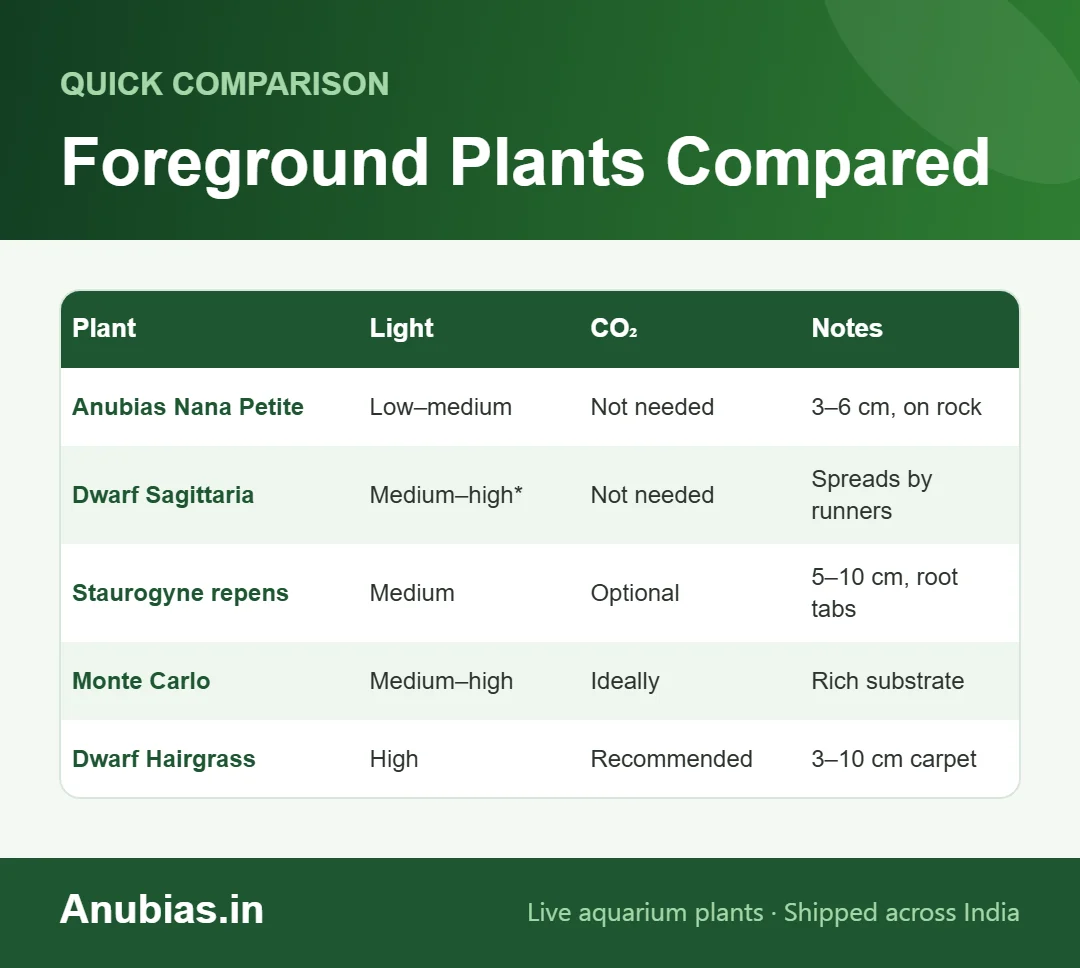
Quick answer: The best foreground aquarium plants without CO2 are Anubias Nana Petite (3–6 cm, attached to rock), Dwarf sagittaria (spreads by runners; stays lowest in medium to high light) and Staurogyne repens (5–10 cm, medium light, with or without CO2). For true carpets, Monte Carlo needs medium to high light and ideally CO2, and Dwarf hairgrass needs high light with CO2 recommended. Rooted carpets need a nutrient-rich substrate or root tabs.
Foreground plants without CO2
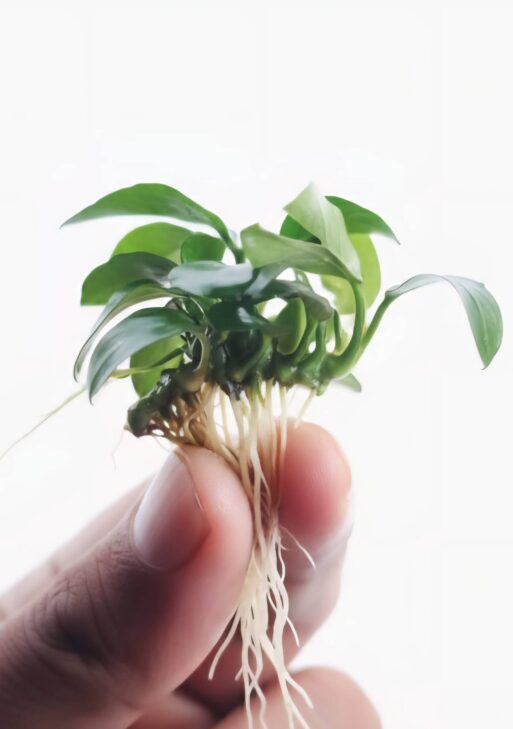
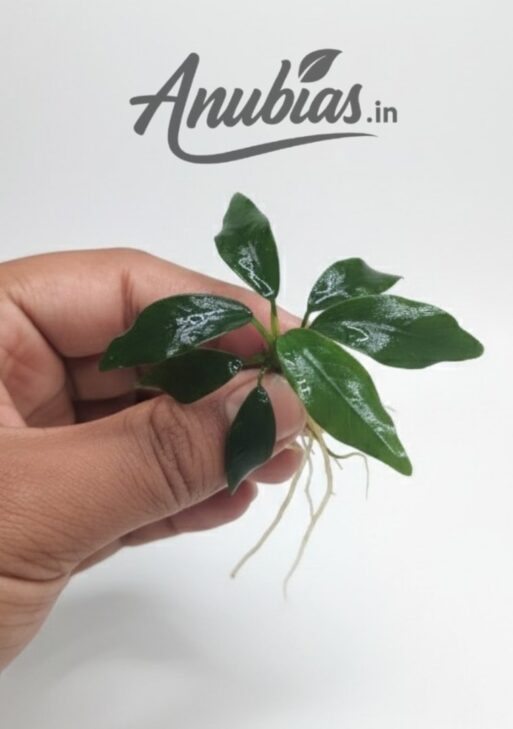
Anubias Nana Petite
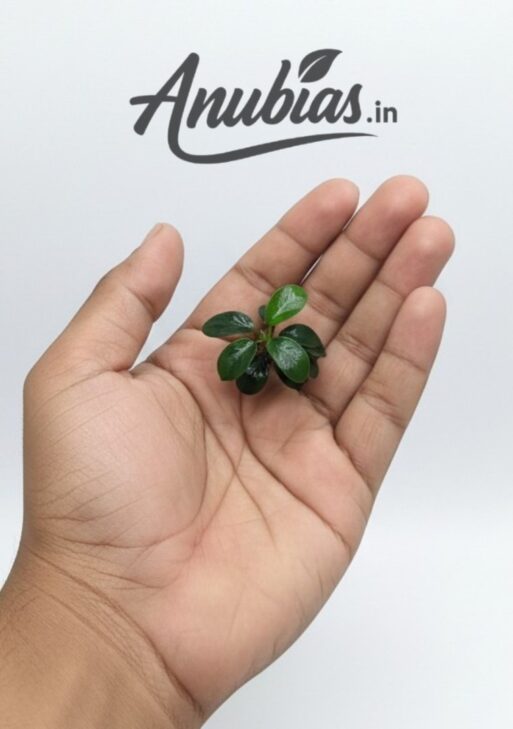
A miniature Anubias that stays about 3–6 cm tall. Glue or tie it into rock crevices; never bury the rhizome. Nana Petite care guide.
Dwarf Sagittaria
An easier carpet than hairgrass that spreads by runners. It stays short and dense in medium to high light; in lower light it still grows but the blades get taller. Dwarf sagittaria care guide.
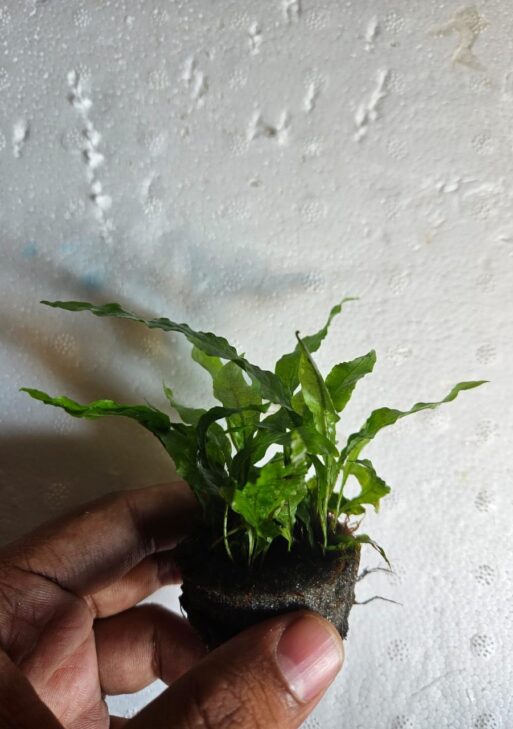
Staurogyne repens
A hardy low stem plant (5–10 cm) for medium light, with or without CO2; use root tabs. Staurogyne repens care guide.
Carpet plants that do best with CO2
Monte Carlo
Needs medium to high light, rich substrate and ideally CO2; without CO2 it carpets slowly and can melt. Monte Carlo care guide.
Dwarf Hairgrass
Needs high light, with CO2 recommended; plant small tufts 2–3 cm apart. Dwarf hairgrass care guide.
Planting tips
- Plant small portions 2–3 cm apart so they fill in evenly.
- Keep taller midground and background plants from shading the front.
- Trim carpets flat once they thicken: how to trim aquarium plants.
More carpet plant guides:
Matching the foreground to your tank size
Scale decides whether a foreground looks deliberate or messy, and the right plant for a two-foot tank is often wrong for a one-foot nano.
Nano tanks up to one foot: use small-leaved epiphytes and low clumping plants, and accept that a true lawn is difficult in a small footprint. One or two focal plants at the front read better than a dense mat in a tiny tank.
Two-foot tanks: the most forgiving size. There is room for a proper carpet and enough depth that the foreground reads as a separate zone rather than the whole floor.
Three feet and above: carpeting becomes expensive and slow, so plan on buying enough portions to space them across the front, or use spreading runner plants that fill in on their own over several months.
Shallow tanks of any length: light reaches the substrate easily, which helps carpets enormously. The trade-off in Indian conditions is faster heating, so run a surface fan through the summer.
What a foreground costs you in time
Foreground plants are the highest-maintenance part of most layouts, because they sit where every problem is visible.
Budget for a trim every two to four weeks once a carpet is established. Trimming is not optional: an untrimmed carpet thickens, light stops reaching the base, and the bottom layer rots and lifts off the substrate in sheets. In Indian summers this happens faster, so trim slightly more often through May and June.
Expect a substrate vacuum job around the foreground every couple of weeks too, since debris settles there and is hard to remove once the carpet closes over it.
If that sounds like more work than you want, build the foreground from Anubias Nana Petite or a few small clumps on stones instead. It gives a finished front without the trimming schedule, and it is far more forgiving if you travel or miss a week.
Plants in this guide

Frequently asked questions
What is the easiest foreground plant?
Anubias Nana Petite and Dwarf sagittaria are the easiest; neither needs CO2.
Can I grow a carpet without CO2?
Dwarf sagittaria is the most reliable no-CO2 carpet option. See the easiest carpet plant without CO2.
Why is my carpet plant floating up?
Small portions uproot easily. Plant them deeper with tweezers and in small pieces so roots can anchor.
Shop the plants in this guide: Dwarf Sagittaria, Dwarf Hairgrass, Staurogyne Repens, Anubias Nana, Anubias Nana Petite.
How long before a new foreground looks filled in?
Around six to twelve weeks for a spreading carpet with good light and CO2, and considerably longer without CO2. Splitting your plants into many small portions when planting is the single biggest factor in speeding this up. Clumping foregrounds like Anubias Nana Petite look finished immediately but never spread.
Can I use foreground plants in a betta tank?
Yes, and bettas suit them well because they are not diggers and prefer calm water. Keep the flow low so a fresh planting is not lifted, and choose low-light options if you are not running CO2. Avoid sharp-edged decor at the front where a betta’s fins can catch.
Do foreground plants need a special substrate?
Carpeting species do much better in fine, nutrient-holding substrate, which lets the roots grip and feed while they spread. Coarse gravel makes planting fiddly and slows establishment considerably. Epiphyte-style foregrounds attached to stones need no substrate at all, which is a useful workaround in an existing gravel tank.
Comparing species? The aquarium plant care chart lists light, CO2, growth rate and price for all 55 plants we stock.
Want a carpet without CO2? Try the dry start method, step by step for Indian conditions.