
Hygrophila pinnatifida is one of the more unusual stem plants in the hobby, and one with a genuine India connection – it is native to the freshwater streams of the Western Ghats and parts of Maharashtra. Unlike almost every other Hygrophila species, it does not behave like a typical stem plant at all: it grows sideways along hardscape, clings on with its own roots, and develops a deep reddish-brown colour under the right light. This guide covers what makes it different and how to grow it well.
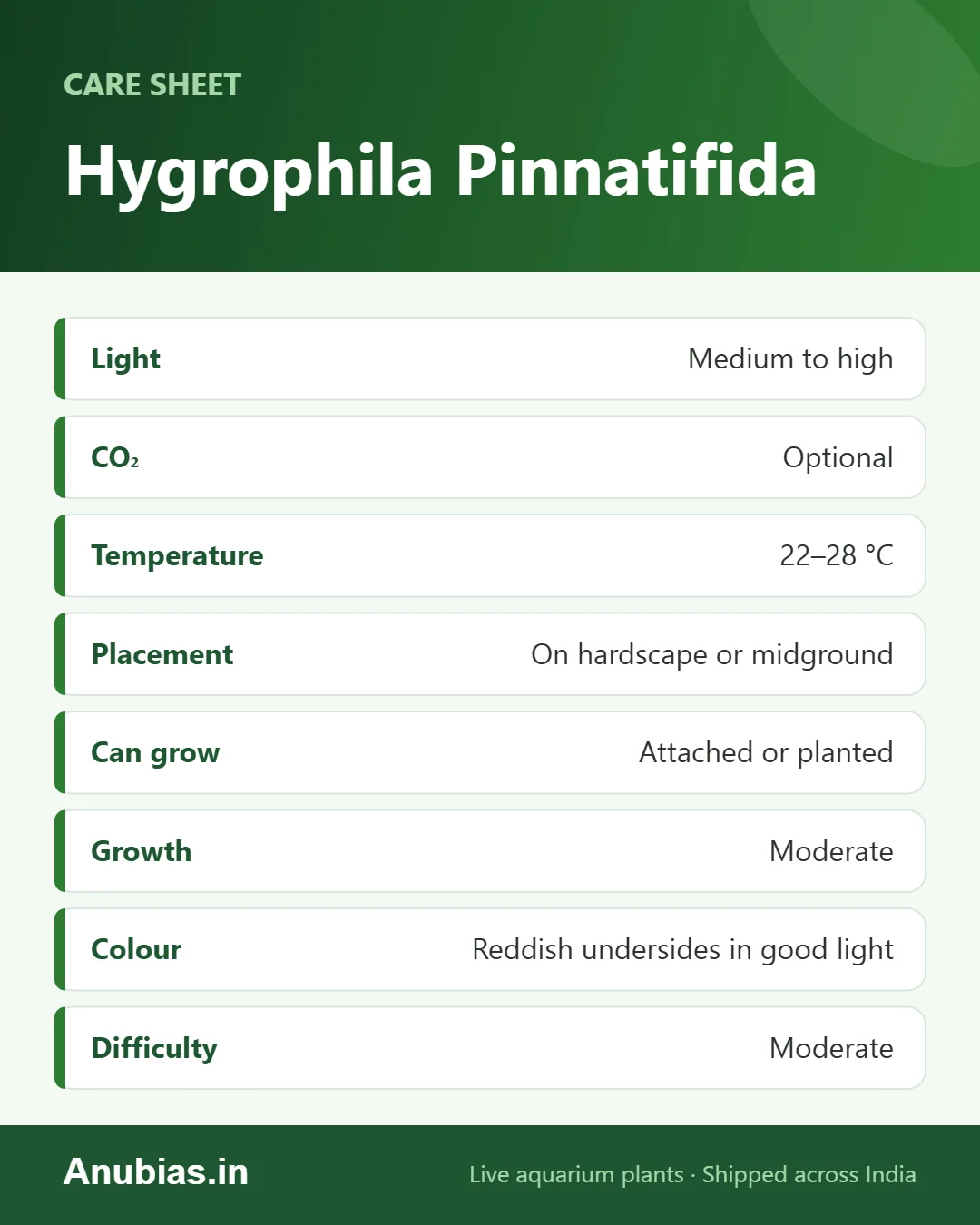
Quick Overview
- Difficulty: Moderate
- Placement: Midground, attached to hardscape or planted in substrate
- Light: Medium to high (roughly 50–120 PAR at substrate level)
- CO2: Grows without it, but pressurised CO2 makes a dramatic difference to colour and density
- Growth habit: Lateral, creeping runners rather than upright stems
- Leaf shape: Deeply lobed, fern-like, olive-green to red-brown depending on light
What Makes This Plant Different
Most Hygrophila species (like Water Wisteria) grow as upright stems that you plant vertically in substrate and trim from the top. Hygrophila pinnatifida does the opposite: it produces lateral runners that creep along and root onto hardscape, much like Anubias, Bucephalandra or Java Fern. This makes it genuinely versatile – you can grow it rooted in substrate as a low creeping groundcover, or tie it onto driftwood and rock as an epiphyte, and it will settle into either role over a few weeks.
Light and Colour
Light intensity is the single biggest factor in how this plant looks. Under low to moderate light it survives but tends to grow leggy, with stretched gaps between leaves and a mostly plain green colour. Under medium-to-high light it forms a much denser, lower mat and develops its signature reddish-brown leaf tone, especially on the newer growth closest to the light source. If your Hygrophila pinnatifida is staying green and stretched, more light – not more fertiliser – is almost always the fix.
CO2 and Water Parameters
It will grow without injected CO2, but this is a plant where the difference between low-tech and CO2-injected growth is unusually visible: with pressurised CO2 in the 20–30 ppm range, growth is noticeably denser, the lateral spread is faster, and colouration deepens further. It is not a beginner-mandatory requirement, but if you already run CO2 for other plants, this is one of the species that rewards it the most. It is tolerant of a fairly normal community tank range – pH 6.0–7.5, temperature 22–28°C – and does not need particularly soft or hard water to thrive.
Attaching to Hardscape vs Planting in Substrate
To attach it as an epiphyte, tie small portions of the plant onto driftwood or wedge it between rocks using cotton thread, fishing line, or aquarium-safe glue, the same method used for Anubias and Bucephalandra. Within a few weeks it will send out fine roots that grip the surface on their own, after which the thread can be removed. Because it attaches itself readily, it does not strictly need a nutrient-rich substrate underneath – this makes it a flexible choice for hardscape-heavy layouts where substrate fertility is not the focus. If you would rather grow it as a substrate groundcover, simply plant small clusters directly into the substrate; it will spread laterally over time rather than growing tall, making a low, textured red-brown carpet-like effect in the midground.
Trimming and Propagation
As it spreads, trim runners back to control width and encourage bushier side growth rather than letting a few runners travel unchecked across the hardscape. Cut sections that include a node (the small bump where leaves and roots emerge) will root readily if pressed against hardscape or substrate, making propagation straightforward – simply trim off a healthy runner section and reattach or replant it elsewhere in the tank.
Placement in an Aquascape
Its low, creeping habit and warm red-brown tone make it a natural midground accent against green epiphytes like Java Fern or Anubias, or draped over stones and driftwood for colour contrast in a Nature-style layout. It is also a strong choice for Iwagumi-adjacent layouts that want a touch of colour without breaking the minimalist stone-and-hairgrass palette, since it stays low and does not compete visually with a carpet plant. For care approaches to the epiphyte species it is commonly paired with, our Bucephalandra care guide and Java Fern care guide cover the same attach-and-wait method in more detail.
Common Problems
- Staying green instead of turning red-brown: Almost always insufficient light. Increase intensity or reduce distance from the light source before changing anything else.
- Leggy growth with big gaps between leaves: Also a light issue, sometimes combined with the plant reaching toward a light source it is too far from.
- Slow to attach to hardscape: Normal for the first two to three weeks; keep it secured with thread until you see visible new root growth gripping the surface.
- Melting after purchase: Like many nursery-grown plants, it can shed some older leaves adjusting from emersed to submersed growth. New growth adapted to your tank will follow within a few weeks.
Update: Hygrophila Pinnatifida is now available to pre-order on Anubias.in.
More stem plant guides:
Frequently Asked Questions
Is Hygrophila pinnatifida a good beginner plant?
It is beginner-friendly in terms of care difficulty and does not demand CO2 or exceptional water parameters, but achieving its best red-brown colour does take moderate-to-high light, so it is a slightly better fit for a keeper who already has a decent light fixture rather than a very low-light setup.
Does Hygrophila pinnatifida need to be planted in substrate?
No. It naturally attaches to hardscape with its own roots, similar to Anubias or Java Fern, and can be grown entirely tied to driftwood or rock without ever touching the substrate. Planting it in substrate is also fine and simply changes its growth habit to a low, spreading groundcover.
Why is my Hygrophila pinnatifida staying green instead of red?
Colour intensity in this species is driven almost entirely by light. Green, stretched growth under low light will typically shift toward its characteristic reddish-brown tone within a few weeks of moving it closer to a stronger light source.
Mixing up your Hygrophila? Compare Water wisteria vs Hygrophila pinnatifida.
Grown in Surat (pre-order plants imported to order) · live-arrival guarantee with a 4-hour unboxing video · ₹99 shipping, free from ₹999