
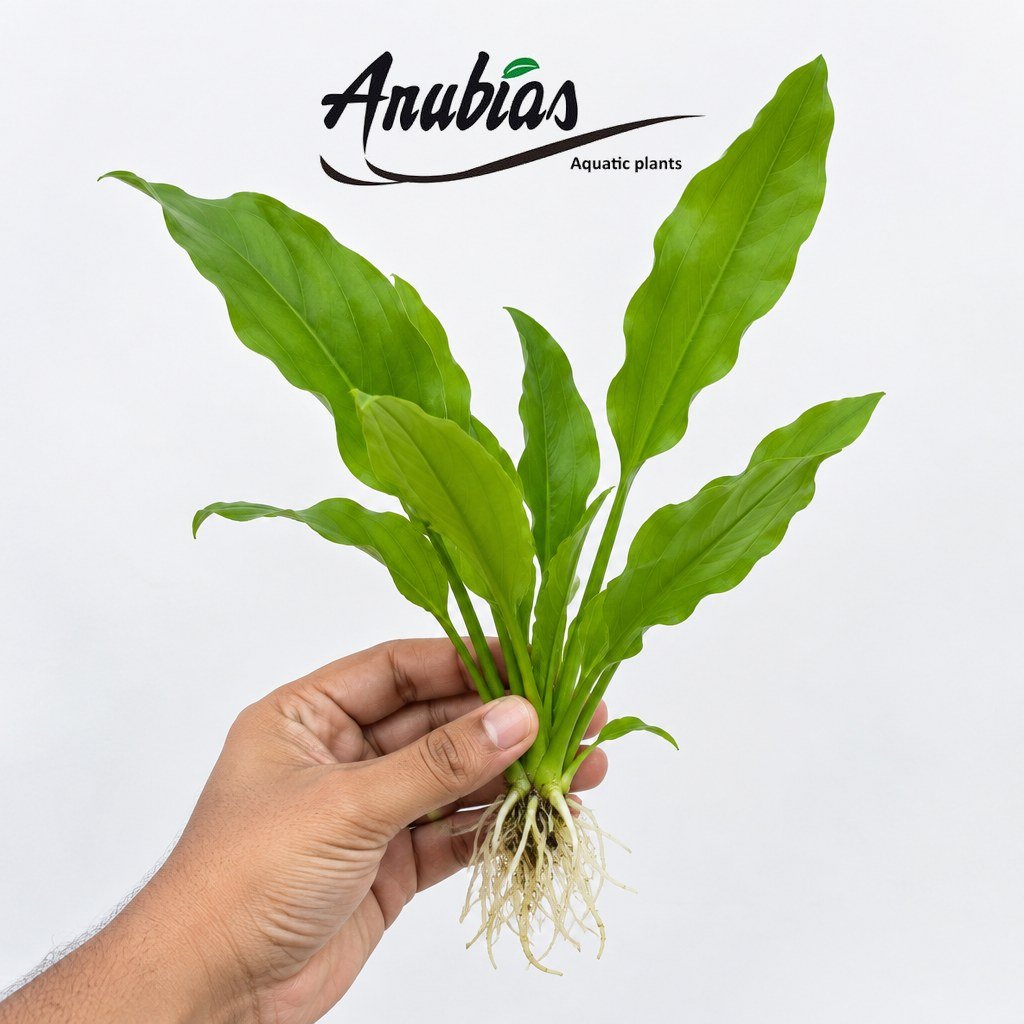
Description
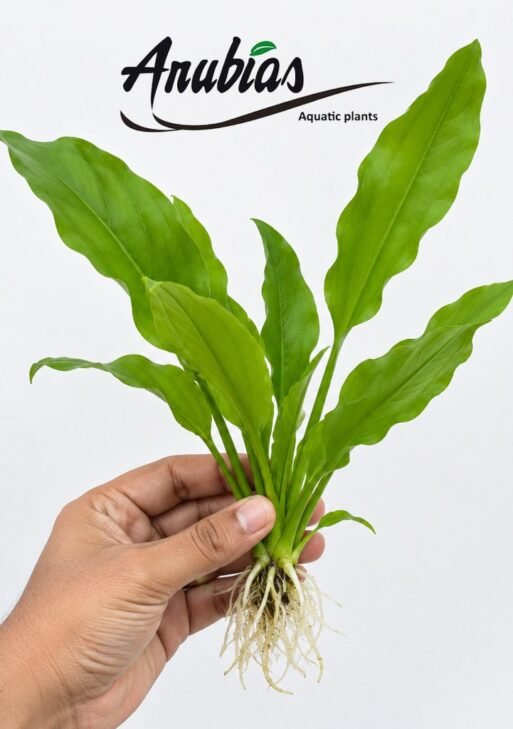
Echinodorus major, the Ruffled Amazon Sword, is a large South American sword plant with long, pale-green leaves whose edges ripple like a crimped ribbon. It grows 30–50 cm tall and nearly as wide, making it a natural centrepiece or background plant for medium and large aquariums. Like the common amazon sword it is a hardy root feeder that tolerates hard water and modest light, but the wavy leaf margins give it a far more distinctive look. Echinodorus major suits anyone with a 3 ft or larger tank who wants one dramatic plant that does the work of a whole background.
Echinodorus major at a glance
| Scientific name | Echinodorus major (syn. Echinodorus martii) |
|---|---|
| Family | Alismataceae |
| Origin | Brazil |
| Difficulty | Easy |
| Light | Medium |
| CO2 | Optional |
| Temperature | 22–28 °C |
| pH | 6.0–7.8 |
| Growth rate | Moderate |
| Height/size | 30–50 cm tall, 25–40 cm spread |
| Placement | Background or solitary centrepiece |
| Propagation | Adventitious plantlets on flower stalks; division of the rhizome |
How to plant Echinodorus major
- Rinse the plant and remove any damaged or yellow outer leaves. Trim the roots to 4–5 cm; they regrow quickly and shorter roots are easier to plant.
- Choose a spot with at least 25 cm of clear space around it. A sword this size needs room to spread.
- Dig a hole, spread the roots out and cover them, keeping the crown (where leaves meet roots) above the substrate.
- Press two or three root tabs into the substrate around the root zone. Swords are heavy root feeders and will not thrive in bare gravel without them.
- Use a substrate depth of at least 5–6 cm so the large root system has somewhere to go.
Echinodorus major care: light, CO2, fertiliser and water
Light. Medium light produces well-formed ruffled leaves. Under low light the plant survives but leaves grow longer, narrower and flatter, losing the ruffle. Strong light is tolerated if nutrients keep up; otherwise green spot algae appears on the broad leaves.
CO2. Not needed. CO2 produces larger, faster leaves but this amazon sword variety is a dependable low-tech plant.
Fertiliser. This is the key. Root tabs every two months, or a rich aquasoil, plus a weekly liquid fertiliser. Swords show deficiencies quickly: yellowing between the veins on new leaves means iron, pinholes in old leaves mean potassium, and pale, stunted new leaves mean general nitrogen shortage.
Water. Tolerant of hard Indian tap water and a pH up to about 7.8. It prefers slightly soft water but adapts well. Regular 25–30% water changes keep nutrients balanced.
Indian conditions. Comfortable at 28 °C; above 30 °C growth slows and older leaves may yellow faster, so use a fan in peak summer. A monsoon power cut of a few hours is not a concern for a rooted sword.
Growth, trimming and propagation
A settled plant produces a new leaf every week or so and reaches full size within three to four months. Submerged leaves that replace emersed-grown ones are longer and more ruffled.
Trim old outer leaves at the base as they yellow, and remove any leaf that reaches the surface and blocks light from plants below. A mature sword benefits from losing two or three of its oldest leaves each month, which keeps the plant compact and encourages fresh growth.
Propagation happens on flower stalks: the plant sends up a long runner-like stalk bearing small plantlets. Once each plantlet has several leaves and roots about 3 cm long, cut it free and plant it. Large plants can also be divided by cutting the rhizome with a clean blade, keeping leaves and roots on each piece.
Where to use it in an aquascape
Echinodorus major is a plant for 3 ft (150 litre) tanks and above. In a 3 ft tank use one as a solitary centrepiece slightly off-centre; in a 4 ft (300 litre) or larger tank, two or three along the back form a ruffled green wall. It suits Dutch-style, jungle and South American biotope layouts.
Plant lower species in front: medium crypts from our Cryptocoryne collection, Anubias nana and Java fern on driftwood, and a carpet in the foreground. Fine-leaved stem plants beside it add texture contrast.
The large, sturdy leaves suit angelfish, discus, gouramis, rainbowfish and larger tetras, and give fry and shrimp cover. Angelfish and many tetras spawn on broad sword leaves. Avoid goldfish and plant-eating cichlids.
Common problems and fixes
- Old leaves yellowing and dying after planting. Normal. Emersed-grown leaves are replaced by submerged ones over the first month. Remove them as they fade.
- Yellow new leaves with green veins. Iron deficiency. Add chelated iron and root tabs.
- Pinholes and ragged old leaves. Potassium shortage. Dose potassium.
- Leaves flat and narrow, no ruffle. Light too low. Increase intensity or move the plant closer to the light.
- Green spot algae on leaves. Light high, phosphate low. Reduce the photoperiod, dose phosphate, add nerite snails.
- Plant outgrowing the tank. Remove the largest leaves monthly and reduce root tabs slightly. Ultimately this sword needs a 3 ft tank.
What you receive
You receive one healthy Echinodorus major plant in the size you select (Small or Standard), similar to the one in the photo. It is checked before packing, wrapped moist and shipped across India from Surat. Live-arrival guarantee: record one continuous unboxing video within 4 hours of delivery and we refund or replace any plant that arrives damaged.
FAQ
Does Echinodorus major need CO2?
No. It grows well without CO2 in medium light with root tabs. CO2 produces larger leaves but is optional.
Is the Ruffled Amazon Sword good for beginners?
Yes, provided the tank is at least 3 ft. It is as easy as the common amazon sword; the only requirements are medium light and regular root feeding.
Can Echinodorus major grow in gravel?
Yes, with root tabs. Push two or three tabs around the root zone every two months. Without them, growth in bare gravel is poor.
How big does Echinodorus major get?
About 30–50 cm tall and 25–40 cm across. It needs a tank at least 45 cm high and 90 cm long.
How fast does Echinodorus major grow?
Moderate. A settled plant produces a new leaf roughly every week and reaches full size in three to four months.
Echinodorus major vs common amazon sword: what is the difference?
Both are large, easy South American swords. Echinodorus major has narrower, pale-green leaves with strongly rippled edges; the common amazon sword (Echinodorus bleheri) has broader, flat, darker leaves. Care is the same.
Not sure what fits your tank? Plan it with our free AI tank planner.















There are no reviews yet.