
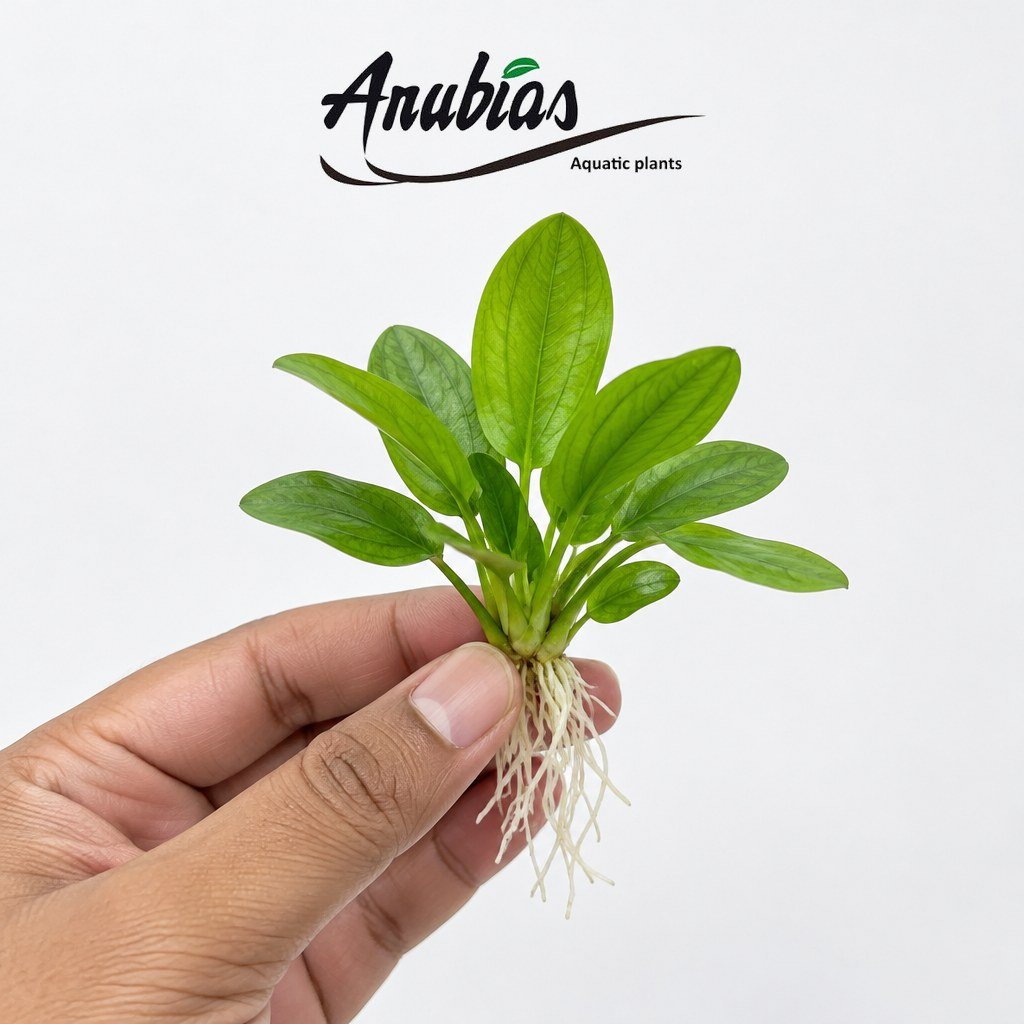
Description
Echinodorus parviflorus ‘Tropica’ is a dwarf amazon sword that stays only 5–10 cm tall, with dark-green, hammered-looking leaves on short stalks that form a dense, low rosette. It is a compact selection of the Bolivian and Peruvian species Echinodorus parviflorus, and it keeps the hardiness of the sword family in a size that fits the foreground of a 2 ft tank or even a nano. For aquarists who like the sword look but have no room for a large one, Echinodorus parviflorus ‘Tropica’ is the answer.
Echinodorus parviflorus ‘Tropica’ at a glance
| Scientific name | Echinodorus parviflorus ‘Tropica’ (cultivar of Echinodorus parviflorus) |
|---|---|
| Family | Alismataceae |
| Origin | Cultivar; species native to Bolivia and Peru |
| Difficulty | Easy |
| Light | Low to medium |
| CO2 | Optional |
| Temperature | 22–28 °C |
| pH | 6.0–7.8 |
| Growth rate | Slow |
| Height/size | 5–10 cm tall, 8–15 cm spread |
| Placement | Foreground or front midground |
| Propagation | Plantlets on short flower stalks; division |
How to plant Echinodorus parviflorus ‘Tropica’
- Rinse the plant and remove any damaged outer leaves. Trim roots to about 2–3 cm.
- Plant it in the foreground or just behind the carpet line, allowing 8–10 cm around it for the rosette to spread.
- Bury the roots with tweezers and keep the crown above the substrate.
- Push one root tab under the plant in sand or gravel; aquasoil needs nothing extra for the first months.
- Leave it in place. Swords reroot well after moving, but every move costs several weeks of growth.
Echinodorus parviflorus ‘Tropica’ care: light, CO2, fertiliser and water
Light. Low to medium light keeps the plant compact and the leaves dark and textured. Under very low light the leaf stalks lengthen slightly, but the plant still looks tidy. It does not need strong light, and under it the slow-growing leaves pick up algae.
CO2. Optional. The plant grows fine without it; CO2 makes the rosette fuller and slightly faster.
Fertiliser. A root tab every three months, or aquasoil, plus a weekly liquid fertiliser. Being small and slow, it needs less than a large sword, but it still shows iron deficiency as pale new leaves and potassium shortage as pinholes.
Water. Tolerant of hard Indian tap water up to pH 7.8. Regular moderate water changes are enough.
Indian conditions. Comfortable at 28 °C; keep surface movement in summer and use a fan if the tank passes 30 °C. Monsoon power cuts of a few hours do not affect it.
Growth, trimming and propagation
Expect a new leaf every two to three weeks. The rosette fills out over four to six months and then holds its size, which is the main attraction: it does not need to be cut back.
Remove old outer leaves at the base when they yellow or collect algae. No other trimming is needed.
Propagation is slow. Mature plants occasionally send up a short flower stalk with one or two plantlets; cut these free once rooted and plant them. Large rosettes can be divided at the crown with a clean blade.
Where to use it in an aquascape
At 5–10 cm this dwarf sword works in the foreground of any tank from a 1.5 ft (40 litre) nano to a 4 ft (300 litre) display. Use single plants as low accents between stones, or a row of three to five along the front of a 2 ft (60–80 litre) tank as a textured alternative to a carpet. In larger tanks it fills the gap between a fine carpet and the midground.
Pair it with carpeting plants in front, crypts from our Cryptocoryne collection behind, and Anubias nana and Java fern on the hardscape. Its dark, hammered leaves contrast well with bright-green stem plants.
Excellent for shrimp tanks, since the low rosette shelters shrimplets, and for small fish such as tetras, rasboras and Corydoras. Avoid diggers.
Common problems and fixes
- Old leaves dying after planting. Emersed leaves are replaced by submerged ones in the first weeks. Remove them as they fade.
- Pale new leaves. Iron deficiency. Dose chelated iron and replace the root tab.
- Pinholes in older leaves. Potassium shortage. Dose potassium.
- Algae on leaves. Light too strong for a slow grower. Shorten the photoperiod and add shrimp, otocinclus or nerites.
- Leaf stalks stretching. Light too low. Increase intensity slightly.
- No growth for weeks. Normal for a slow sword settling in. Check the crown is exposed and wait.
What you receive
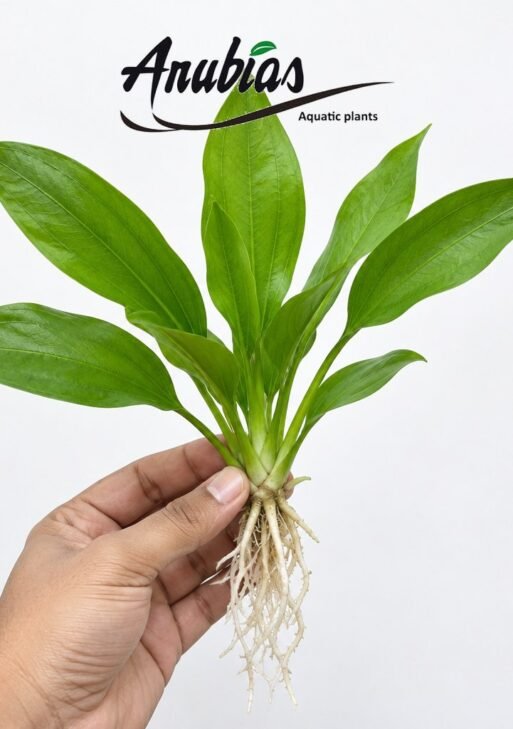
You receive one healthy Echinodorus parviflorus ‘Tropica’ plant in the size you select (Small or Standard), similar to the one in the photo. It is checked before packing, wrapped moist and shipped across India from Surat. Live-arrival guarantee: record one continuous unboxing video within 4 hours of delivery and we refund or replace any plant that arrives damaged.
FAQ
Does Echinodorus parviflorus ‘Tropica’ need CO2?
No. It grows well without CO2 in low to medium light. CO2 gives a fuller rosette but is optional.
Is Echinodorus parviflorus ‘Tropica’ good for beginners?
Yes. It is a hardy, slow dwarf sword that tolerates hard water and low light and never needs cutting back.
How big does Echinodorus parviflorus ‘Tropica’ get?
Only 5–10 cm tall and 8–15 cm across, which makes it one of the few swords suitable for nano tanks and foregrounds.
Can Echinodorus parviflorus ‘Tropica’ grow in sand?
Yes. Place a root tab under it every three months.
How fast does Echinodorus parviflorus ‘Tropica’ grow?
Slowly. A new leaf every two to three weeks; the rosette reaches full size in four to six months.
Echinodorus parviflorus ‘Tropica’ vs Echinodorus tenellus: which is better for a foreground?
Tenellus is grassy and spreads by runners into a carpet; ‘Tropica’ is a compact rosette that stays where you plant it. Use tenellus for a lawn and ‘Tropica’ for individual low accents.
Not sure what fits your tank? Plan it with our free AI tank planner.











There are no reviews yet.