
Description
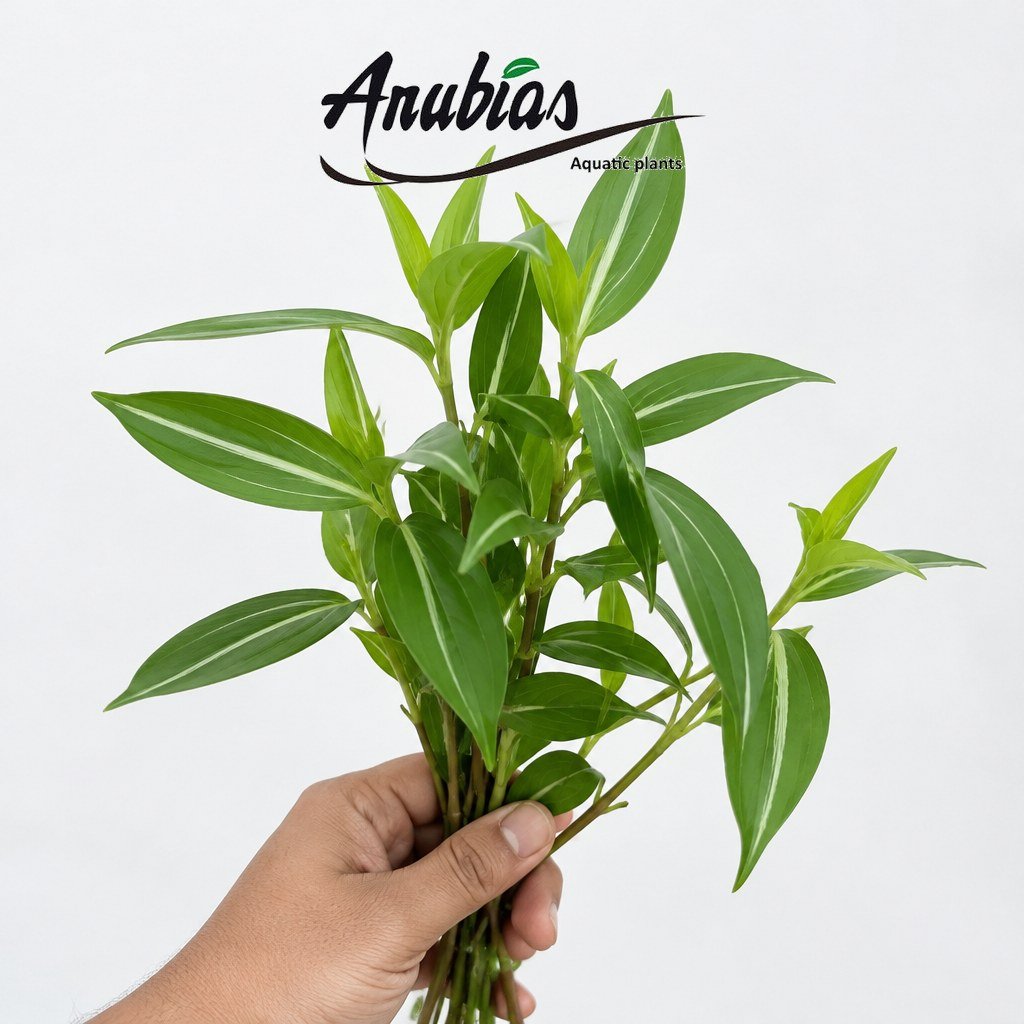
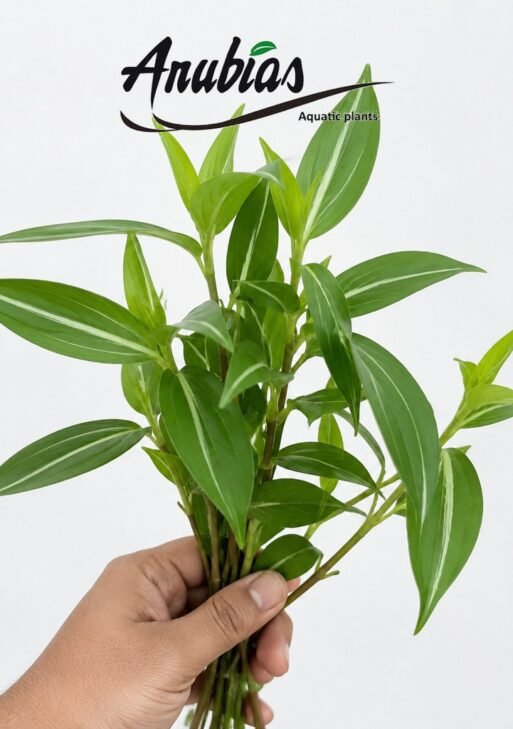
Floscopa cf. scandens is a stem plant from the spiderwort family, grown in aquariums for its stiff, narrow, lance-shaped leaves arranged in two neat ranks along an upright stem – a look closer to a miniature bamboo than to a typical aquarium stem. It occurs across tropical Asia, including India, where it grows on wet margins and in shallow water. It is a plant for the aquarist with good light and CO2 who wants an unusual, architectural midground or background stem.
Floscopa cf. scandens at a glance
| Scientific name | Floscopa cf. scandens |
|---|---|
| Family | Commelinaceae |
| Origin | Tropical Asia (India to South-east Asia) and northern Australia |
| Difficulty | Medium to difficult |
| Light | High |
| CO2 | Required for compact submerged growth |
| Temperature | 22–30 °C |
| pH | 6.0–7.2 |
| Growth rate | Slow to moderate |
| Height/size | 15–40 cm; stems 3–5 cm wide |
| Placement | Midground or background |
| Propagation | Stem cuttings; side shoots |
How to plant Floscopa cf. scandens
- Prepare the stems. Remove leaves from the bottom 3–4 cm of each stem so no leaf is buried.
- Plant singly. Push each stem 3–4 cm into the substrate with tweezers, 3–4 cm apart. Floscopa stems are stiff and do not like to be bunched.
- Nutrient substrate. Aquarium soil is best; in gravel add root tabs. The plant roots strongly from the nodes.
- Bright position. Plant it where the light is strongest, away from the shade of taller plants.
- Expect a transition. Stems sold emersed drop their old leaves under water and regrow narrower submerged ones in three to five weeks. Do not pull them out when the first leaves fall.
Floscopa cf. scandens care: light, CO2, fertiliser and water
Light. This is a high-light plant. Below about 0.8 W per litre of LED the stems stretch, the leaf ranks spread apart and the lower leaves drop. Place it under the brightest part of the fixture.
CO2. Essential for the compact, bamboo-like form. Without CO2 the plant survives but grows thin and leggy. Aim for 25–30 ppm with a drop checker reading lime green.
Fertiliser. Dose a complete liquid fertiliser with nitrogen, phosphorus, potassium and micronutrients weekly or daily in small amounts. Floscopa shows nitrogen shortage quickly as yellowing lower leaves, and iron shortage as pale new tips.
Water. Soft to moderately hard water suits it; very hard borewell water (above 15 dGH) slows growth, so mix in RO or rainwater if your tap is very hard. Summer temperatures to 30 °C are acceptable – it is a tropical lowland plant. Monsoon power cuts stop the CO2, which the plant tolerates for a day or two; longer outages cause some leaf loss.
Growth, trimming and propagation
Growth is slow to moderate even under good conditions – roughly 1–2 cm a week – which means less trimming than fast stems and a group that holds its shape for weeks between sessions. When a stem reaches the surface, cut it in the middle and replant the top; the rooted base produces side shoots from the nodes below the cut.
Propagation is by cuttings: take a 10 cm top with at least three nodes, strip the lowest leaves and plant. Cuttings root in two to three weeks. Side shoots that form at the base can be separated once they have roots.
Where to use it in an aquascape
- 2 ft (60 cm, 60–80 L) high-tech tank: a group of five to seven stems as the midground accent, fronted by carpeting plants.
- 3 ft (90 cm, 150–200 L) tank: a background block behind Cryptocoryne, contrasting with softer stem plants such as Rotala.
- Asian biotope: fitting with Indian species – it grows wild in the same wetlands as many of our Cryptocoryne and Lagenandra.
Fish: small tetras, rasboras, danios, dwarf gouramis and shrimp. Avoid goldfish and large cichlids.
Common problems and fixes
- Leaves drop after planting. Emersed-to-submerged transition; wait three to five weeks for new growth before judging.
- Leggy stems with wide leaf spacing. Insufficient light or CO2. Increase both and replant the tops.
- Yellow lower leaves. Nitrogen shortage; raise nitrate to 10–20 ppm.
- Pale new growth. Iron deficiency; dose a chelated iron supplement.
- Stems rot at the base. Leaves were buried or the substrate is compacted; replant with clean nodes.
- Slow growth in very hard water. Mix in RO or rainwater to bring GH below 12.
What you receive
One healthy portion of Floscopa cf. scandens in the size you select – Small or Standard – similar to the plant in the photo. Checked before packing, packed moist and shipped across India from Surat. Live-arrival guarantee: record one continuous unboxing video within 4 hours of delivery and, if the plant arrived damaged, we refund or replace it.
FAQ
Does Floscopa scandens need CO2?
Yes, for the compact bamboo-like form. It survives without CO2 but grows thin and leggy.
Is Floscopa good for beginners?
Not really. It needs high light, CO2 and regular fertiliser. Beginners do better with Hygrophila or Bacopa from our stem plants range.
Can it grow in gravel?
Yes, with root tabs; it roots strongly from the stem nodes. Aquarium soil gives better results.
How fast does it grow?
Slowly for a stem plant – about 1–2 cm a week – so it needs trimming only every few weeks.
Why did the leaves fall off after planting?
Emersed-grown stems shed their old leaves and regrow narrower submerged ones within three to five weeks. This is normal.
Does it tolerate hard Indian tap water?
Moderately hard water is fine; very hard borewell water slows it, so mix in RO or rainwater.
Not sure what fits your tank? Plan it with our free AI tank planner.











There are no reviews yet.